
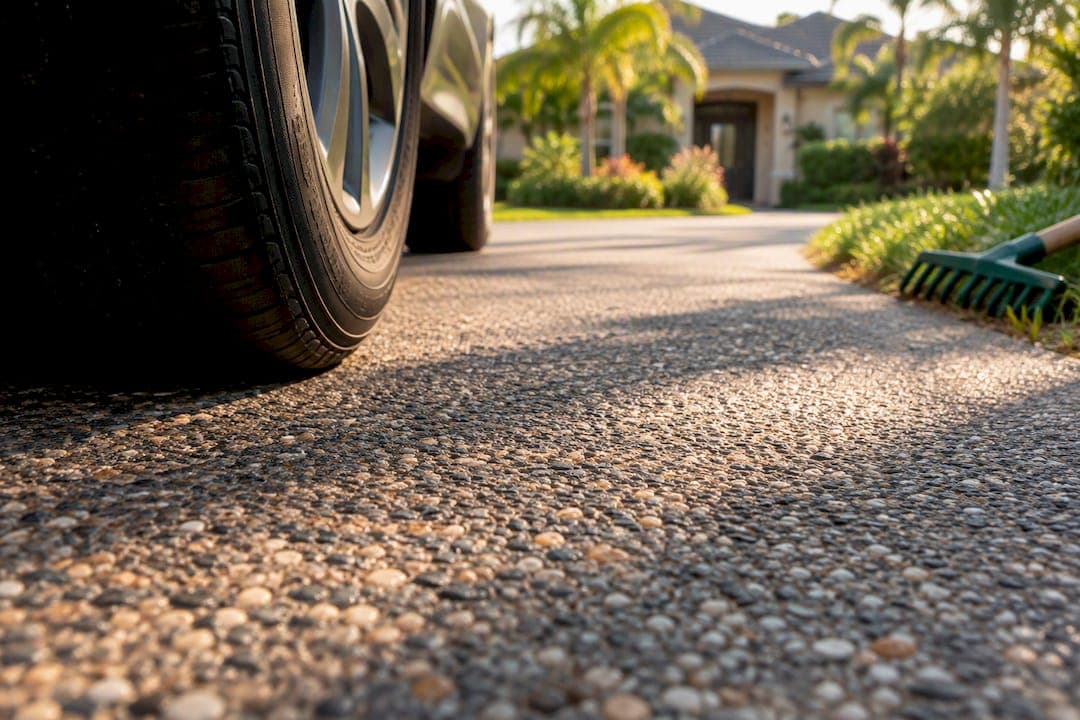
The quietest driveway surfaces are dense-graded asphalt for its smooth continuity, porous asphalt when properly maintained, rubber paving for its vibration damping, and resin-bound systems for their absorptive matrix. Pervious concrete can also help, but it depends heavily on install quality. The catch: every one of these materials loses its noise-reducing edge without correct installation and consistent upkeep.
TL;DR:
- Porous asphalt and rubber paving deliver notable noise reductions, but their acoustic benefits diminish without proper maintenance and monitoring for clogging or wear.
- Dense-graded asphalt remains the most affordable hard surface with moderate noise control, while porous surfaces cost more upfront and require diligent upkeep to maintain their quietness.
- Surface textures and porosity mainly influence noise levels, with finer aggregates and open-pore designs reducing tire and footstep sound more effectively.
- Long-term quietness depends heavily on regular cleaning, sealing, and repair, as polishing and cracking can reintroduce noise over time.
- Selecting the right driveway surface should consider traffic type, climate, and maintenance capacity to sustain noise reduction and durability.
Table of Contents
- 1. Common driveway surfaces and how they handle noise
- 2. Why some driveway surfaces sound quieter than others
- 3. Weighing durability, cost, and performance tradeoffs
- 4. Maintenance steps that keep a driveway quiet over time
- 5. How to pick the right quiet surface for your driveway
- 6. Where EcoTec Rubber Paving fits into the picture
- Realistic expectations for a quieter driveway
- How EcoTec can help you get there
- Sources
- FAQ
1. Common driveway surfaces and how they handle noise
Not every surface behaves the same way under tires or footsteps, and the differences come down to texture, porosity, and rigidity.
- Dense-graded asphalt (tarmac): A smooth, continuous surface with small aggregate tends to produce less tire noise than rougher finishes, and it remains one of the more affordable, durable choices for driveways.
- Porous or open-graded asphalt: The open pore structure absorbs sound rather than reflecting it, and FHWA guidance on porous pavement notes real noise and stormwater benefits, though performance depends on design and upkeep to avoid clogging.
- Rubber paving (including Rubberway® systems): Rubberized surfaces damp vibration at the tire-pavement contact point and typically stay permeable for drainage, which also supports ADA-compliant grading.
- Resin-bound or resin-bonded surfaces: The binder-aggregate matrix absorbs some sound, but how well it works depends on the resin type and how fine or coarse the aggregate is.
- Concrete and exposed-aggregate concrete: Standard concrete tends to be louder than asphalt unless it gets a special texture treatment, and while it holds up well structurally, it offers little inherent sound damping.
- Gravel, block pavers, and tar-and-chip: Loose stones, visible joints, and raised texture generally increase noise rather than reduce it, since tires compress and displace material with every pass.
Rubberized asphalt overlays used in Arizona's Quiet Pavement Pilot Program delivered measurable neighborhood noise reductions in some areas, though the program built in multi-year monitoring specifically because early results don't always hold. Smaller aggregate gradations tested in a European quiet pavement scan cut noise by a few decibels compared to standard mixes, with larger reductions possible from certain porous designs adapted for local climate and traffic conditions.
2. Why some driveway surfaces sound quieter than others
Most driveway noise comes from tire-pavement interaction: vibration at the contact patch and air getting compressed and released as tread grooves meet the surface. Smaller aggregate and shallower, "negative" surface textures cut down on the high-frequency whine that rougher, positive-textured surfaces produce. Porosity adds another layer of noise control because air-permeable mixes absorb sound waves instead of bouncing them back, though that only works while the pores stay open. Rubber and similar damping materials reduce vibration transmission more effectively than rigid concrete, which is part of why rubberized overlays show up in pilot noise programs. The catch across every material is that measured decibel benefits erode as surfaces polish smooth, pores clog with debris, or wear patterns change the texture that made them quiet in the first place.

3. Weighing durability, cost, and performance tradeoffs
Cost and lifespan vary enough between these materials that the noise decision rarely stands alone. Dense asphalt is usually the cheaper upfront option with a moderate lifespan; porous asphalt costs more to install and maintain because of its clog-prone void structure; rubber paving and resin-bound systems sit in a comparable install-cost range but differ in how they age; concrete lasts a long time structurally but doesn't flex much once cracks start. A closer look at lifecycle cost across paving materials breaks down how installation price and long-term upkeep interact.
- Clogging shuts down the acoustic benefit of any porous mix well before it fails structurally.
- Polishing from repeated traffic smooths out the texture that once absorbed sound.
- Cracking and joint movement in concrete or block pavers create new noise sources even on a surface that started quiet.
Climate matters too. Freeze-thaw cycles stress rigid concrete joints, while intense heat can soften and rut standard asphalt. FHWA's guidance on quiet pavement pilot programs specifically warns that pavement-type noise benefits often decline over time and shouldn't be treated as a permanent fix without a maintenance commitment attached.
Pro Tip: Ask any contractor for the expected acoustic performance timeline, not just the installed-day decibel number.
4. Maintenance steps that keep a driveway quiet over time
A quiet surface on installation day is not a quiet surface five years later without upkeep.
- Clean porous surfaces regularly by vacuuming or blowing out debris and avoiding repeated track-in of fine sediment that clogs voids.
- Reseal dense asphalt and resin-bound systems on a schedule that matches climate exposure, and plan for repaving once cracking becomes structural.
- Request installer specs up front, including aggregate gradation, compaction results, and void content for porous mixes, plus warranty terms tied to those specs.
- Watch for red flags like surface polishing, standing water suggesting clogged pores, or loose aggregate that signals binder failure.
5. How to pick the right quiet surface for your driveway
Start with the basics: driveway length, slope, the mix of vehicles using it, and typical approach speed all affect which surface makes sense. A short residential driveway with light passenger traffic has different needs than a long HOA access road.
- Match your goal to your budget: a low-cost quieting fix and a long-term low-maintenance solution are two different projects, even if they use similar materials.
- Check your site's drainage before committing to a porous surface, since standing water undermines both the material and its acoustic benefit.
- Ask contractors directly what noise benefit they expect, what maintenance plan comes with it, what the material specification actually calls for, and whether they can provide references.
Pro Tip: Get the maintenance plan in writing before signing, since a porous surface without a cleaning schedule rarely stays quiet past its first year.
For a side-by-side look at how these choices stack up, this guide to paving surface material options covers more of the lifecycle detail.
6. Where EcoTec Rubber Paving fits into the picture
A specialized rubber paving company installs rubber paving systems using recycled materials engineered for drainage, crack resistance, and ADA compliance, tailored to local climate conditions. That combination suits property owners who want vibration damping, reliable drainage, and a professionally installed surface rather than a do-it-yourself patch job. Whatever installer you choose, ask for mix specifications, a written maintenance plan, and references before signing.

Realistic expectations for a quieter driveway
Modest, real noise reductions are possible, but only with the right material, a careful install, and upkeep that doesn't lapse. Surface choice works best paired with landscaping, speed control, and other noise measures, not as a fix on its own.
— Roger
How EcoTec can help you get there
If you want the drainage and damping benefits of rubber paving without guessing at maintenance requirements, specialized companies can handle the installation and specification work directly, using product lines designed for local climate conditions.
- Request a site visit to get a quote specific to your driveway's size and layout.
- Ask for the maintenance plan and product specs before your project starts.
- Review the Rubberway® product lineup to see which system fits your surface.
Get in touch through EcoTec Rubber Paving to start the conversation.
Sources
- Porous asphalt pavement technical guidance - FHWA
- Quiet Pavement Systems in Europe - FHWA (international scan report)
FAQ
What is the least expensive hard surface for a driveway?
Dense-graded asphalt is typically one of the cheaper hard surface options for driveways, largely because it uses simpler mix designs and installation methods than porous or resin-bound alternatives. Gravel can cost less upfront but isn't a hard surface and tends to need more frequent replenishment.
What are some good alternatives to asphalt for driveways?
Concrete, rubber paving, resin-bound surfaces, and gravel or block pavers all serve as alternatives to standard asphalt, each with different tradeoffs in cost, durability, and noise. Rubber paving systems like Rubberway® add drainage and vibration damping that standard asphalt doesn't offer.
Is it cheaper to blacktop or concrete a driveway?
Blacktop, meaning dense-graded asphalt, is generally less expensive to install than concrete, though concrete tends to last longer with proper care. The right choice depends on your climate, budget, and how much upkeep you're willing to commit to over the driveway's lifespan.
What's the cheapest surface for a driveway overall?
Gravel is usually the cheapest driveway surface to install, though it requires periodic top-ups and doesn't offer the noise-reducing texture control of paved options. Among paved surfaces, dense-graded asphalt tends to be the more budget-friendly choice.
Does a quieter driveway surface stay quiet long term?
Not automatically. FHWA guidance warns that pavement noise benefits often decline over time as porous mixes clog or surfaces polish smooth, so sustained quiet depends on consistent maintenance rather than the material alone.