
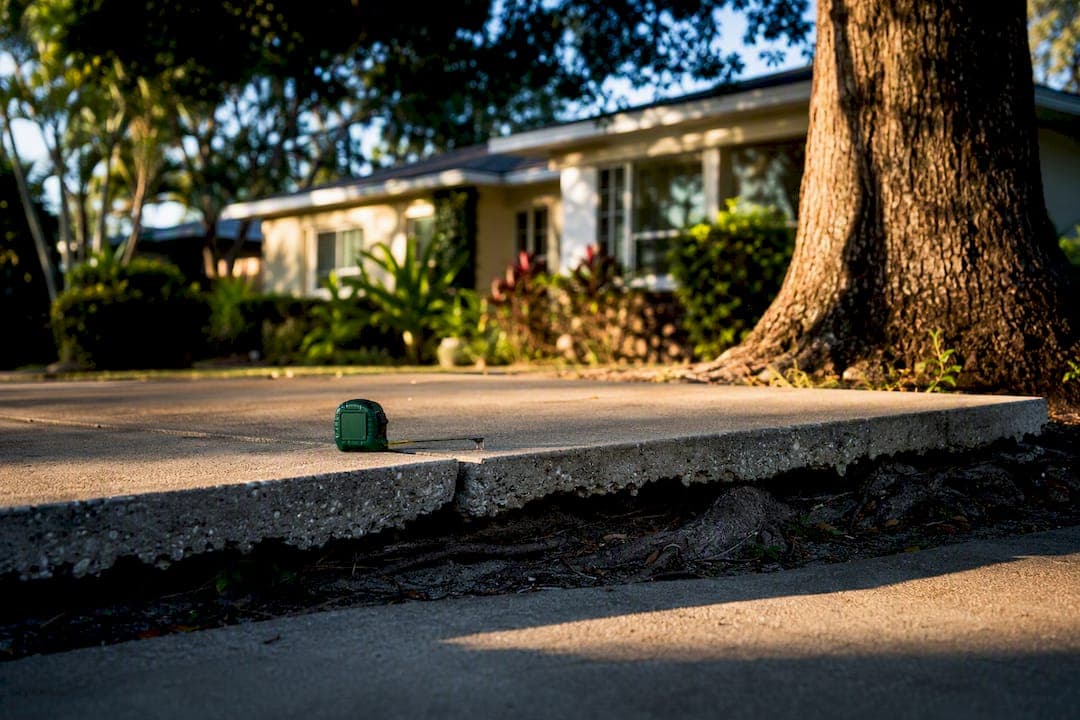
Small hairline cracks can be sealed and monitored, but heaving slabs or spreading gaps need targeted slab replacement with proper base repair, not a quick patch. Before touching any root thicker than a garden hose, call an ISA-certified arborist since cutting more than 25% of a tree's root system at once can destabilize it. Call 811 before you dig anything.
TL;DR:
- Repair options vary from sealing small cracks to full slab replacement, with the most invasive being regrading and removing roots when damage is extensive.
- Only cut up to 25% of a tree's root system at once, focusing on feeder roots under 2 inches thick, to avoid destabilizing the tree.
- Addressing base failure requires proper drainage, regrading, and sometimes rerouting or removing roots entirely, rather than patching surfaces repeatedly.
- Flexible surfaces like rubber overlays are better suited for root-prone driveways, especially after base repair, because they resist cracking from ground movement.
- Calling an arborist before root work and a paving contractor for base issues is critical, along with documenting cracks regularly and avoiding pouring over dead roots to prevent future sinking.
Table of Contents
- How Do You Know How Bad Your Driveway's Root Damage Is?
- What Are Your Realistic Options for Fixing Root Damage?
- How Much Root Can You Safely Cut Without Killing the Tree?
- How Do You Stop the Roots From Coming Back?
- What Should You Budget for Root-Related Driveway Repair?
- When Do You Need an Arborist, a Contractor, or Both?
- Where Flexible Rubber Paving Fits Into Root-Prone Driveways
- What Should You Actually Do This Week?
- Get a Straightforward Estimate for a Flexible Driveway Fix
- Where This Advice Comes From
- Sources
- FAQ
How Do You Know How Bad Your Driveway's Root Damage Is?
Tree roots don't damage a driveway overnight. They push slowly against the underside of the slab for years, and by the time you see a crack on the surface, the real story is happening a few inches below it.
Start with what you can see and measure. A hairline crack under an eighth of an inch wide with no vertical offset is cosmetic. Anything wider, or where one side of the crack sits higher than the other, means the slab has already shifted. Grab a tape measure and a level, or just a straight board, and record three things: the height difference between the two sides of any crack, the total length of the crack, and how much square footage looks affected. Write it down or snap a photo with a ruler in frame. That record matters later, whether you're getting repair quotes or filing an insurance claim (more on that below).
The harder question is whether you're looking at surface damage or a compromised base. Surface damage looks like isolated cracking with no movement, tight seams, and no puddling nearby. Base failure looks different: cracks that return in the same spot after you've patched them, water that pools and stays instead of draining, or a spot where you can wiggle a section of concrete with your foot. Recurring cracking is the biggest tell. If a patch job fails twice in the same location, the problem is underneath the slab, not on top of it, and the root is still growing.
Standing water after rain is another signal worth tracking closely, since poor drainage and subgrade erosion frequently ride along with root intrusion rather than showing up as a separate issue.
Before you call anyone, walk the driveway and check for these:
- Visible ridging or heaving where the surface rises more than half an inch
- Cracks wider than a quarter inch or with a visible step between the two sides
- Gaps at expansion joints that have widened noticeably since last year
- Standing water that doesn't drain within an hour after rain
- Roots visible at the driveway edge, in the grass, or breaking through nearby soil
- A hollow or springy feel when you walk or drive over a section
Pro Tip: Take photos of every crack once a season, not just when something looks wrong. A driveway that grows a quarter inch of gap over six months is a very different problem than one that's been stable for three years.
If a slab has sunk significantly, shifted so a wheel catches on the edge, or the same crack keeps reopening after repair, that's your cue to stop DIY-patching and call a paving contractor for an assessment.
What Are Your Realistic Options for Fixing Root Damage?
The repair you need depends entirely on whether the root is still small enough to manage or has already taken over the base. Here's how the options stack up, from least to most invasive.
-
Crack filling and edge shaving. For hairline cracks and minor lips, a flexible polyurethane crack filler and a bit of grinding on a raised edge solves the trip hazard and keeps water out. This works only when there's no ongoing heave. It's a maintenance move, not a fix, and it buys you a year or two at most if the root underneath is still growing.
-
Localized saw-cut repair. A contractor saw-cuts a clean rectangle around the damaged section, removes the broken concrete, addresses whatever is pushing on it, corrects and compacts the base, then repours to match the surrounding grade. The base work is the part people skip and shouldn't. Cosmetic fills that skip base repair fail again within a season or two because the compacted gravel underneath is still uneven.
-
Full slab replacement or regrading. When more than a third of a driveway section shows heave, or when the root has spread under multiple panels, patching piecemeal stops making sense. Full replacement lets a contractor regrade the whole subgrade, add proper drainage, and either reroute around the root or remove it entirely before pouring new material.
-
Flexible surfacing. Pavers, modular systems, asphalt overlays, and rubber surfacing all tolerate a certain amount of ground movement without cracking the way rigid concrete does. These are worth serious consideration specifically because roots don't stop growing just because you poured a new slab.
Here's the mistake that costs people the most money: pouring fresh concrete directly over a dead or dying root system. It looks fine for a year, sometimes two. Then the root mass finishes decomposing, the soil underneath settles into the space it left behind, and the new concrete cracks and sinks over roughly 5 to 10 years as that decay plays out. If you're removing a tree instead of just pruning around it, grind the stump and pull the major root mass before backfilling, then compact the soil properly. Skipping that step is the single most common reason a "brand new" driveway fails again within a few years.
How Much Root Can You Safely Cut Without Killing the Tree?
This is the part homeowners get wrong most often, usually because a heaving driveway makes people want to attack the problem with a shovel and a saw. That instinct can cost you a mature tree, and in some cases a lot more.
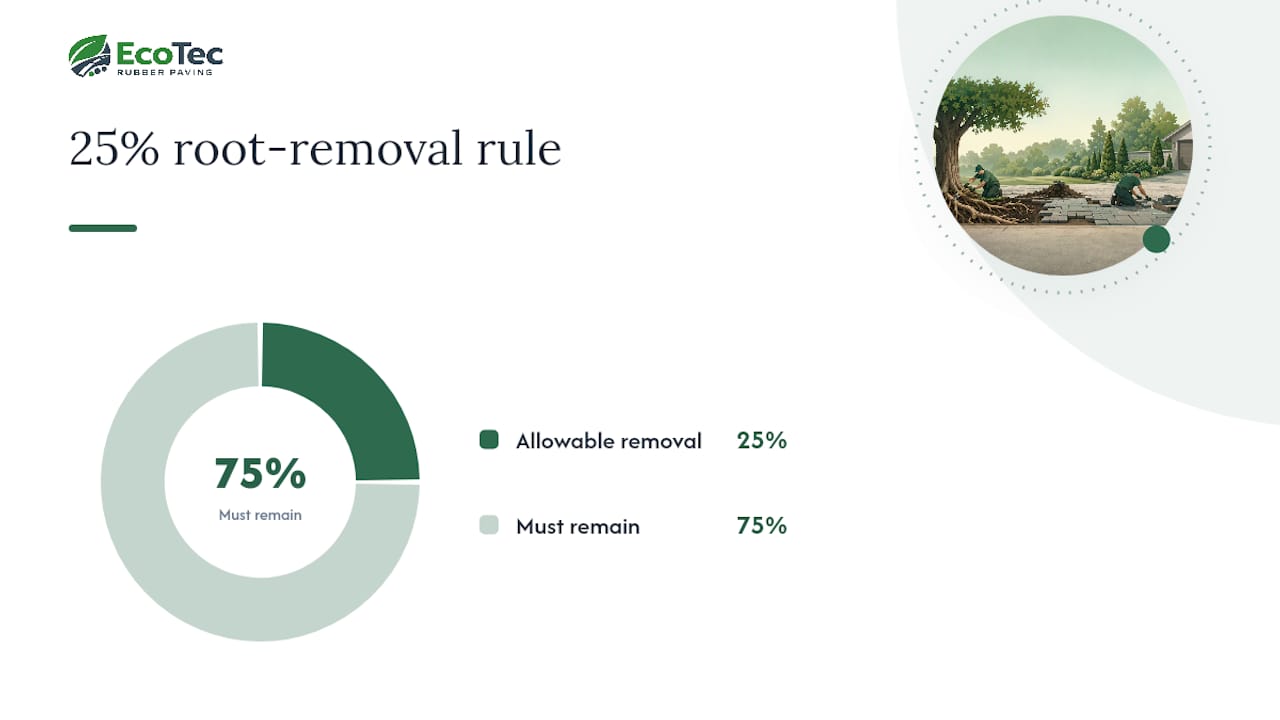
The 25% rule is the baseline every arborist works from: don't remove more than a quarter of a tree's total root system in one project. Roots do more than anchor a tree. They're the plumbing for water and nutrients, and cutting too many at once can starve the canopy, trigger dieback, or leave the tree unstable enough to fall in a storm. If the tree has a trunk wider than 6 inches in diameter or stands taller than 12 feet, get a professional evaluation before any major root is touched, not after.
Not every root is equal. Feeder roots are the thin, fibrous ones near the surface that handle water uptake, and cutting a few generally doesn't threaten the tree. Structural roots are the thick ones radiating from the trunk base that physically anchor it. As a rule of thumb, avoid cutting anything thicker than about 2 inches in diameter without an arborist's input, since these tend to be structural rather than feeder roots.
Your realistic options once a structural root is confirmed as the culprit:
- Root pruning by a certified arborist, done selectively and only within the 25% ceiling
- Root barriers installed vertically to redirect future growth away from the driveway
- Stump grinding if you're removing the tree entirely, followed by full root mass removal and backfill
- Chemical or desiccation treatments, which kill a stump slowly over months and carry less risk to nearby trees but require patience
Before any of it: call 811 to get utility lines marked, and check your municipality's tree protection ordinances, since many cities restrict root cutting or removal on trees above a certain size regardless of whose property they're rooted in.
How Do You Stop the Roots From Coming Back?
Fixing the driveway once solves this year's problem. Stopping the cycle means changing something about the root's path, the driveway's footprint, or the material itself.
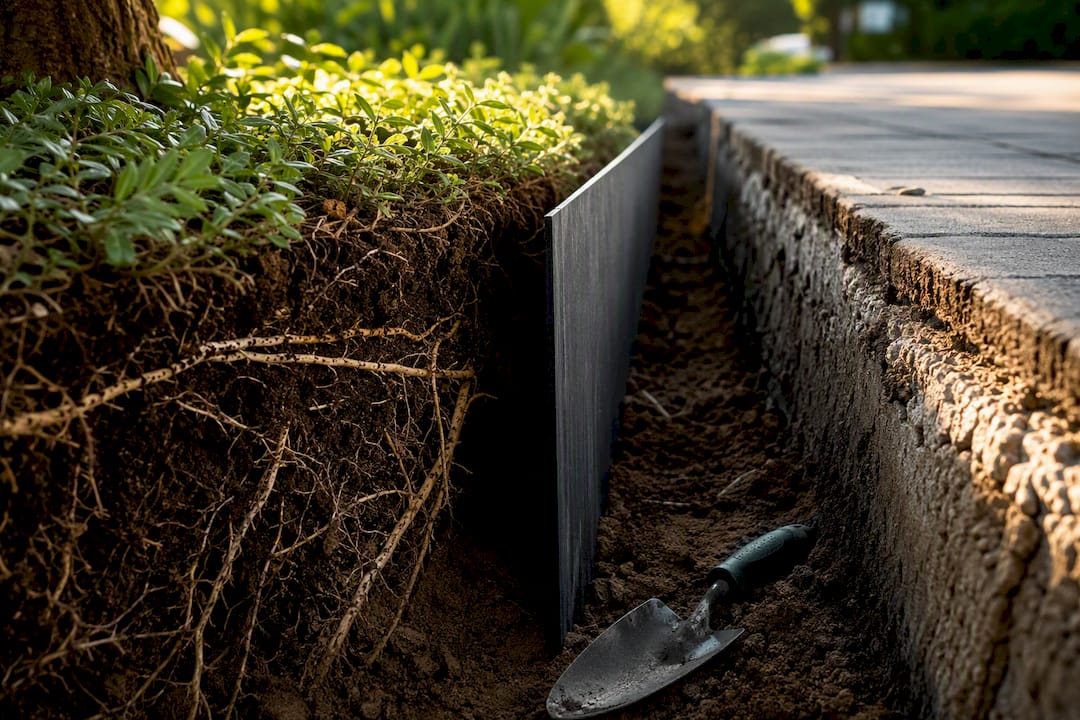
Vertical root barriers are the most direct tool. These are rigid or fabric panels installed edge-on into a trench, typically 18 to 24 inches deep, positioned between the tree and the driveway to redirect roots downward and sideways instead of up under the slab. They work well for a single problem tree near a defined edge, but they're not a permanent seal. Roots eventually find gaps at the bottom or ends of a barrier that wasn't installed deep or long enough, so this works best paired with base repair, not as a standalone fix.
Redesigning the driveway itself is underused as an option. If a root has already claimed one corner, rerouting the drive a few feet, narrowing it near the tree, or building in a buffer strip of gravel or planting bed between the tree and the pavement edge removes the conflict instead of managing it indefinitely.
Material choice matters more than most homeowners realize going in:
- Rigid concrete cracks predictably once a root pushes hard enough. It's cheap up front and brittle long term in root-prone soil.
- Asphalt flexes more than concrete but still fails under sustained heave and needs resurfacing on its own schedule.
- Pavers handle minor ground movement well since individual units shift instead of cracking, though they need periodic releveling.
- Flexible overlays, including rubber surfacing, tolerate a wider range of subgrade movement without the sharp cracking rigid materials show. Details on eco-friendly surfacing tradeoffs are worth reading before you commit to a material.
If you're planting new trees near a driveway, distance is the cheapest prevention there is. A general guideline is to keep large shade trees at least 15 to 20 feet from pavement edges, and to choose species known for deep, non-aggressive root habits over ones like silver maple or willow that are notorious for surface root spread.
What Should You Budget for Root-Related Driveway Repair?
Costs swing widely depending on how much base work is involved and how large the offending root has gotten, but you can plan around a few general bands.
- Crack sealing and minor patching: the cheapest option, appropriate only for cosmetic damage with no ongoing heave
- Localized saw-cut repair with base correction: a mid-range cost that covers a single damaged panel and the compaction work underneath it
- Full slab replacement or regrading: the highest cost among concrete-based fixes, but necessary once damage spans multiple panels
- Root barrier installation: typically a smaller add-on cost when paired with other work, more if installed as a standalone preventive project
Several factors move these numbers up or down: how deteriorated the base already is, whether an arborist assessment and permit are required before root work, whether you're preserving a mature tree versus removing it, and whether the job falls during a contractor's busy season.
The math that homeowners tend to miss: paying for a full fix that addresses the base and the root, once, is usually cheaper over a decade than paying for the same cosmetic patch three or four times. A patch that fails every two years because the root underneath was never dealt with adds up fast, and you still end up needing the full repair eventually anyway. Homeowner insurance policies typically treat root-related driveway damage as gradual wear rather than a sudden covered loss, so budget for this as an out-of-pocket home maintenance cost, not a claim.
When Do You Need an Arborist, a Contractor, or Both?
Some situations don't leave room for a wait-and-see approach.
- Call an arborist first if you see a large surface root, a leaning tree, dead branches in the canopy, or any sign the tree itself might be unstable. Root damage to a driveway is sometimes the first visible symptom of a tree in decline.
- Call a paving contractor first if the tree looks healthy and stable but the slab has sunk, shifted, or keeps recracking in the same spot after patching.
- Call both, ideally together, when a large surface root is both lifting pavement and looks structurally significant. A combined assessment lets the arborist confirm what can safely be cut while the contractor plans the base repair around that answer.
When you get an estimate, ask what's happening below the slab, not just what the surface repair will look like. A contractor should be able to tell you whether they found root intrusion, poor compaction, or drainage failure, and how the fix addresses each one specifically.
Where Flexible Rubber Paving Fits Into Root-Prone Driveways
Once a root has already compromised the base under a slab, rigid materials are fighting a losing battle. That's the gap Ecotecrubber's Rubberway® system is built for. The porous, recycled-rubber surface flexes with minor ground movement instead of cracking the way concrete does, drains water through the surface itself rather than pooling on top of it, and holds up under Florida's heat cycles better than rigid pavement tends to.
Rubberway overlays make the most sense for driveways where the root has been addressed, at least partially, and the base has been corrected. They're not a substitute for fixing an actively growing structural root problem. Once that root work is done, a flexible overlay is a reasonable way to stop the crack-and-repair cycle for good. A fully licensed and insured paving contractor working exclusively on rubber paving can coordinate tree assessment and paving work handled by people familiar with both sides of the problem.
What Should You Actually Do This Week?
If your cracks are hairline and stable, monitor and seal them. If you see heave, recurring cracks, or a large surface root, get an arborist and a paving contractor assessed together before spending money on either fix alone. Do call 811 first. Don't cut anything thicker than 2 inches without professional input. Do photograph and measure every crack before you touch it.
— Roger
Get a Straightforward Estimate for a Flexible Driveway Fix
Concrete patching and slab replacement solve the surface problem but leave the same rigid material fighting the same root pressure next year. Ecotecrubber's Rubberway® system takes a different approach entirely: a porous, flexible surface made from recycled rubber that drains through itself, resists the cracking that heat cycles and ground movement cause in concrete, and meets ADA compliance requirements without extra retrofitting.
If your driveway has already been through one or two failed patch jobs, or you're weighing a full replacement and want a surface that won't just crack again in five years, a Rubberway overlay is worth comparing against another concrete pour. The Rubberway® Pervious Pavement and related product lines cover driveways, walkways, and patios with the same drainage and flex advantages. Request a consultation through Ecotecrubber's site to get a licensed, insured assessment of what your specific driveway and root situation actually needs.
Where This Advice Comes From
The safety limits on root cutting and arborist evaluation triggers come from Michigan State University Extension. Insurance coverage expectations and the risks of pouring over dead roots come from MoneyGeek's homeowner insurance guidance. Repair tradeoffs and base-failure signs draw on Lee Company's driveway crack guidance.
Sources
- Reducing damage caused by tree roots (MSU Extension)
- Does homeowners insurance cover driveway damage? (MoneyGeek)
- What causes driveways to crack and how to fix it (Lee Company)
- How to kill tree roots, according to experts (The Spruce)
FAQ
Does homeowners insurance cover driveway damage caused by tree roots?
Generally, no. Insurers typically classify root-related driveway damage as gradual wear and maintenance rather than a sudden accidental loss, so plan for it as an out-of-pocket repair cost.
What should I do if tree roots are growing into my driveway?
Measure and photograph the damage first, then get an arborist to evaluate the tree before any root larger than 2 inches is cut, since removing more than 25% of a root system at once can destabilize it. Pair that assessment with a paving contractor if the base is already compromised.
Can you pour concrete over dead tree roots?
It's not recommended. As the dead root mass decays over roughly 5 to 10 years, the soil beneath the new concrete settles, causing the new pavement to crack and sink. Remove the root mass and compact the soil before repouring, or consider a flexible surface that tolerates minor settling better.