

For most Florida homeowners staying put for the long haul, interlocking pavers are the strongest all-around choice, and plain concrete wins if you're selling within a few years or watching your budget closely. Both beat asphalt and crushed shell on lifespan in most inland settings, though coastal lots change the math. Base preparation matters as much as the material you pick.
TL;DR:
- Interlocking pavers cost $10 to $25 per square foot and can last several decades if installed with proper base compaction and joint sealing.
- Concrete costs $6.50 to $19 per square foot, lasting 25 to 40 years with correct base preparation, joints, and reinforcement, but tends to crack over time.
- Asphalt is the cheapest upfront at $4 to $8 per square foot but degrades faster in Florida's heat and UV exposure, requiring regular sealcoating every 2 to 3 years.
- Crushed shell is an affordable coastal option costing $2 to $5 per square foot but demands ongoing replenishment and proper edging to prevent migration.
- Rubber paving like Rubberway® offers a permeable, crack-resistant, and environmentally friendly alternative that handles Florida's soil movement, salt, and storm runoff effectively.
Table of Contents
- Driveway Materials Florida Homeowners Should Compare First
- Why Interlocking Pavers Dominate Florida Recommendations
- Concrete Driveways: The Florida Value Standard
- Asphalt Driveways: Lowest Upfront Cost, Shortest Lifespan
- Crushed Shell Driveways: Florida's Coastal Budget Option
- Permeable Pavers and Porous Surfaces for Drainage Control
- What to Confirm Before You Sign a Contract
- A Rubber Paving Alternative Worth Pricing Alongside the Rest
- The Environmental Trade-Offs Behind Each Material
- How Your Soil Type Changes the Right Choice
- Keeping Your Florida Driveway in Shape Year-Round
- Quick-Reference Comparison for Florida Driveways
- What Actually Matters When You Cut Through the Marketing
- Get a Florida-Ready Driveway Built on Rubberway®
- Sources
Driveway Materials Florida Homeowners Should Compare First
Picking the right surface for a Florida driveway comes down to four forces working against you at once: relentless UV exposure, summer heat that softens asphalt, sudden downpours that pond on flat lots, and in coastal zones, salt air that corrodes and stains. The best driveway material for Florida depends on which of those threats hits your property hardest, plus how long you plan to own the house.
Here's a fast shortlist matched to common homeowner situations:
- Staying 10+ years, want the fewest headaches: Interlocking pavers, $10 to $25 per square foot installed. They flex with the ground instead of cracking against it.
- Selling within 3 years or tight budget: Plain concrete, $6.50 to $19 per square foot installed, per BuildPriced's Florida cost data. Lowest cost per square foot of the rigid options.
- Coastal lot near salt spray: Permeable pavers or polymer-surfaced materials, since standard asphalt and untreated metal fittings corrode faster near the coast.
- Flood-prone or low-lying yard: Permeable pavers, pervious concrete, or porous asphalt to cut runoff and standing water.
- Absolute lowest upfront cost, flat coastal lot: Crushed shell, $2 to $5 per square foot installed, if your HOA allows it.
- Want a driveway that dodges cracking without a paver budget: Ask installers about porous rubber surfacing as a fourth option worth pricing alongside the traditional three.
Whatever you land on, ask your installer about base compaction and joint spacing before signing anything. That's where most driveway failures actually start.
Why Interlocking Pavers Dominate Florida Recommendations
Pavers handle Florida's shifting, sandy soil better than any rigid surface because they're not rigid at all. A concrete slab has to crack somewhere when the ground underneath swells or settles. A paver driveway just has thousands of small joints that absorb that movement, so no single crack ever spreads across the whole surface.
They also run noticeably cooler. Pavers stay 8 to 12 degrees Fahrenheit cooler than asphalt in direct sun, which matters more than it sounds like when you're loading groceries barefoot in July. Properly installed pavers can last several decades, and because each unit is separate, a cracked or stained paver can be swapped out rather than patched.
Expect to pay $10 to $25 per square foot installed. That's real money for a two-car driveway, but the math changes when you count zero major resurfacing over three decades.
Before you sign a contract, insist on:
- A compacted aggregate base at proper depth, not just sand over dirt.
- Rigid edge restraints on every border, or pavers will migrate within a few seasons.
- Polymeric joint sand rather than plain sand, since it locks joints and resists ant tunneling.
Pro Tip: Ask your installer to show you the base compaction test results, not just tell you it was done. A plate compactor pass without verification is the single most common shortcut that leads to sunken pavers three years later.
Pavers aren't the answer for every budget. If you're stretching to afford a driveway at all, or you're running heavy commercial trucks over it daily without a reinforced base, plain concrete or a properly engineered asphalt section may make more sense.
Concrete Driveways: The Florida Value Standard
Plain broom-finished concrete remains the default choice for a reason: it's the cheapest rigid surface, it's fast to install, and it lasts 25 to 40 years when the base and joints are done correctly, according to BuildPriced's Florida heat guide. Stamped or decorative concrete costs more but gives you pattern and color options that plain concrete can't match.
Here's what determines whether your concrete lasts decades or cracks by year five:
- Base preparation. A 4 inch compacted limerock base under the slab is what Florida contractors consistently recommend for rigid surfaces. Skip it and you're pouring concrete over sand that will shift.
- Slab thickness. Four inches works for standard cars. If you're parking a truck, RV, or boat trailer regularly, bump that to 5 or 6 inches, or the slab will develop stress cracks under repeated heavy load.
- Control joints. Joints cut every 10 to 12 feet let the concrete crack in a straight, hidden line instead of a jagged one across your driveway's face.
- Reinforcement. Fiber mesh or rebar adds tensile strength that plain concrete lacks on its own.
Even with all of that done right, hairline cracking often shows up by year 5 to 8 without proper base and joint work, per the same BuildPriced data. That's not a defect. It's how concrete behaves in Florida's expansive soil, and sealing every 2 to 3 years slows moisture intrusion that widens those cracks over time.
Asphalt Driveways: Lowest Upfront Cost, Shortest Lifespan
Asphalt is the budget entry point at $4 to $8 per square foot installed, the cheapest material on this list by a wide margin. That upfront savings comes with a tradeoff Florida homeowners feel directly every summer.
Asphalt starts softening above roughly 130 degrees Fahrenheit surface temperature, which a dark driveway hits regularly during Florida afternoons. Combine that with constant UV exposure and you get oxidation, the process that turns asphalt gray, brittle, and prone to alligator cracking within a decade if it's neglected.
The fix isn't complicated, it just requires discipline:
- Sealcoat every 2 to 3 years to block UV penetration and moisture.
- Fill small cracks immediately, before water gets underneath and undermines the base.
- Avoid parking heavy trailers in the same spot repeatedly during peak heat, since soft asphalt deforms under sustained point load.
With that maintenance, asphalt typically delivers 12 to 18 years of service in Florida, sometimes stretching toward 20. Skip the sealcoating and you'll likely see visible degradation by year 6 to 8. Asphalt makes sense for homeowners who want the lowest possible install cost and are willing to maintain it on schedule, not for anyone hoping to install it once and forget it.
Crushed Shell Driveways: Florida's Coastal Budget Option
Crushed shell is the one material on this list that's distinctly Florida, and it shows up most often in coastal and rural communities where the aesthetic fits the landscape. It's also the cheapest option here, running about $2 to $5 per square foot installed in Northeast Florida markets, according to Coastal Driveway Pavers' cost breakdown.
The catch is ongoing upkeep. Shell migrates, especially on sloped driveways or during heavy rain, and most homeowners budget $150 to $400 annually just for replenishment. A properly built shell driveway needs geotextile fabric under a compacted shell rock base, topped with a finish layer of washed shell, plus solid edging to keep it from spreading into the lawn.
- Best fit: Flat coastal lots where drainage and a natural look matter more than a pristine, uniform surface.
- Watch for: Slopes, heavy daily vehicle traffic, and neighborhoods with strict HOA aesthetic rules.
Before you commit, check with your HOA or architectural review board. Plenty of Florida communities restrict or outright ban loose-surface driveways, and finding that out after installation is an expensive mistake.
Permeable Pavers and Porous Surfaces for Drainage Control
Florida's afternoon downpours don't care about your grading plan, and a driveway that can't absorb water sends it straight toward your garage or the street. Permeable pavers, pervious concrete, porous asphalt, and open-cell grid systems all solve this by letting water pass through the surface instead of running off it.
The benefit goes beyond avoiding a puddle at your front door. Permeable surfaces reduce the runoff volume your property sends into municipal stormwater systems, which increasingly matters as Florida communities tighten stormwater compliance rules tied to insurance costs and flood risk. On coastal properties specifically, permeable pavers and polymer-surfaced materials are often the preferred choice because they drain fast and resist the salt buildup that plagues solid, non-porous surfaces.
The tradeoff is maintenance: permeable joints and porous surfaces need periodic vacuuming or pressure washing to prevent sediment and organic debris from clogging the pore structure. Skip that and permeability drops off within a few years.
- Full-driveway permeable pavers work well for entire lots wanting comprehensive drainage.
- Porous asphalt or pervious concrete suits homeowners who want a more uniform look than jointed pavers.
- Grid systems with grass or gravel fill work best as decorative accents or overflow parking strips rather than primary drive lanes.
Pro Tip: Pair any permeable surface with proper grading toward a French drain or swale. Permeability handles water at the surface, but you still need somewhere for that water to go once it's through. Learn more about permeable paving types and costs before comparing bids.
What to Confirm Before You Sign a Contract
Every material on this list can fail early if the installation cuts corners underneath it. Before you approve any bid, walk through these steps with your contractor:
- Confirm the base material and depth. A compacted limerock base, roughly 4 inches deep, is the standard under rigid Florida driveways. Ask what base material they're using and get it in writing.
- Match slab thickness to your vehicles. Four inches handles standard passenger cars. If you regularly park a truck, RV, or boat trailer, ask for 5 to 6 inches, or expect cracking under repeated heavy load.
- Ask about joint spacing and edge restraints. Concrete needs control joints every 10 to 12 feet. Pavers need rigid edging on every border. Both prevent the most common early failures.
- Get the permit conversation in writing. Most Florida counties require a permit for new driveway construction or apron connections to a public road, and your contractor should handle that filing, not leave it to you.
- Check your HOA or ARB rules before choosing a material or color. Many communities restrict crushed shell, limit paver colors, or require specific edge treatments. Confirm this before you fall in love with a design.
Expect these cost bands installed: concrete $6.50 to $19 per square foot, pavers $10 to $25, asphalt $4 to $8, per BuildPriced's 2026 Florida cost data. A typical two-car driveway around 640 square feet runs roughly $5,000 to $15,000 depending on material and finish. Grading work, drainage upgrades, and permit fees can push that higher, so get itemized quotes rather than a single lump number.
A Rubber Paving Alternative Worth Pricing Alongside the Rest
Every material above forces a tradeoff: pavers cost more upfront, concrete cracks over time, asphalt needs constant maintenance, and shell requires ongoing replenishment. Porous rubber paving, like the Rubberway® system installed by Ecotecrubber, is built specifically to avoid several of these compromises at once using recycled tire material.
The porous structure drains water through the surface rather than across it, which helps on flood-prone or coastal lots where standing water and salt exposure are recurring problems. The surface also resists the cracking that plain concrete develops under Florida's soil movement and heat cycling, and it's manufactured to meet ADA compliance standards, which matters for homeowners adding accessible pathways alongside a driveway.
| Priority | Why rubber paving fits |
|---|---|
| Crack resistance | Flexible surface absorbs ground movement instead of splitting |
| Drainage | Porous design reduces ponding and runoff |
| Coastal durability | Resists the surface degradation salt air causes on some materials |
| Sustainability | Uses recycled rubber material rather than virgin aggregate |
| Accessibility | Installed to ADA-compliant surface standards |
If you're evaluating installers for any driveway project, ask specifically about local case studies and how they handle base preparation under a rubber system, the same base questions you'd ask a paver or concrete contractor. You can see Rubberway® product details and available colors if you want the technical specs before requesting a consult.
The Environmental Trade-Offs Behind Each Material
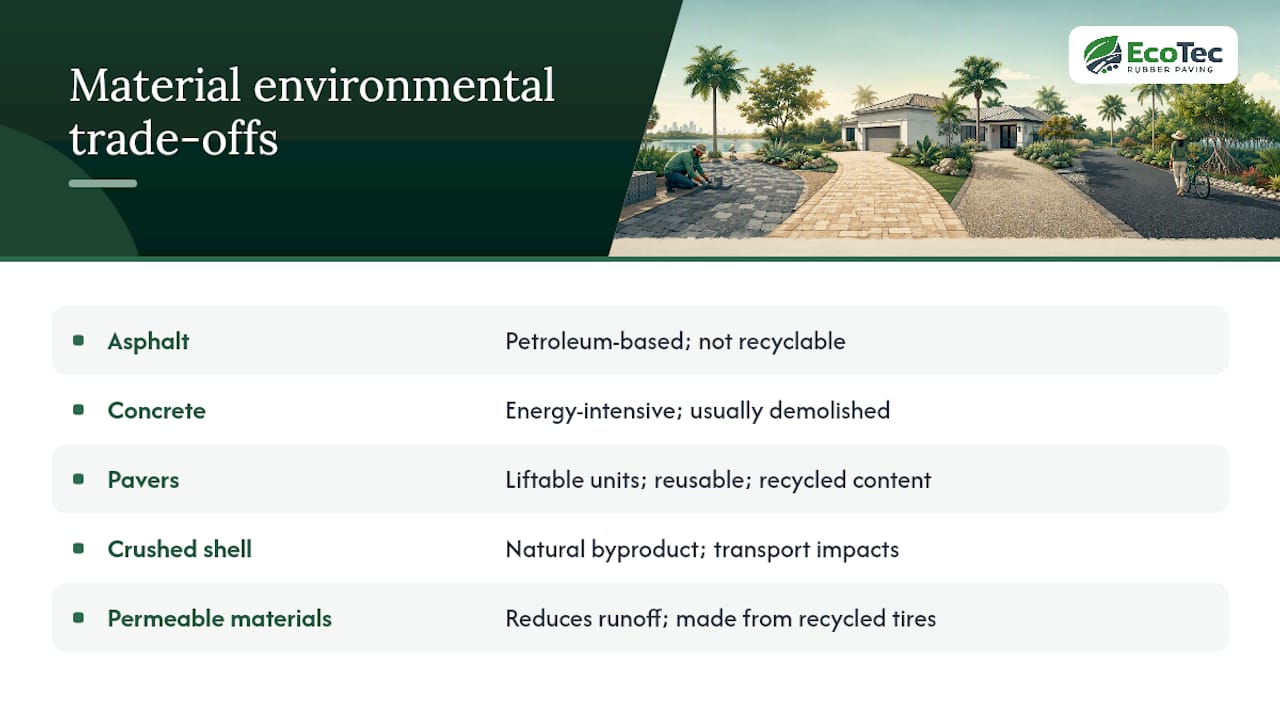
Every driveway material carries an environmental footprint that goes beyond how it looks in the yard. Asphalt is petroleum-based and essentially non-recyclable once installed, though reclaimed asphalt pavement can sometimes be reused in new mixes at the industrial level. Concrete production is energy-intensive, and a cracked slab typically ends up as demolition debris rather than getting a second life.
Pavers fare better on the reuse front since individual units can be lifted, cleaned, and reset if you ever need to access utilities underneath, and many manufacturers now offer recycled-content paver lines. Crushed shell is a natural byproduct material, but repeated harvesting and transport still carry a resource cost, and loose shell that washes into storm drains can affect local waterways.
Runoff is the bigger environmental story for most Florida properties. Non-porous surfaces like standard asphalt and sealed concrete send rainwater straight into storm systems, carrying oil residue, sediment, and lawn chemicals with it. That runoff contributes to the nutrient pollution behind algae blooms in Florida's rivers and coastal waters during heavy rain seasons.
Permeable materials, including porous rubber paving made from recycled tire content, address both problems at once: they reduce runoff volume and divert waste tires from landfills. If sustainability factors into your decision at all, weigh not just what a material is made from, but what happens to the water that hits it every time it rains.
How Your Soil Type Changes the Right Choice
Florida isn't one soil type, and that matters more than most driveway guides admit. Coastal and Central Florida lots often sit on sandy soil, which drains fast but compacts poorly without proper base work, leading to settling under rigid slabs if the base isn't compacted correctly. North and inland Florida properties are more likely to hit clay-heavy pockets that expand when wet and contract when dry, the exact movement that cracks concrete slabs lacking adequate joints.
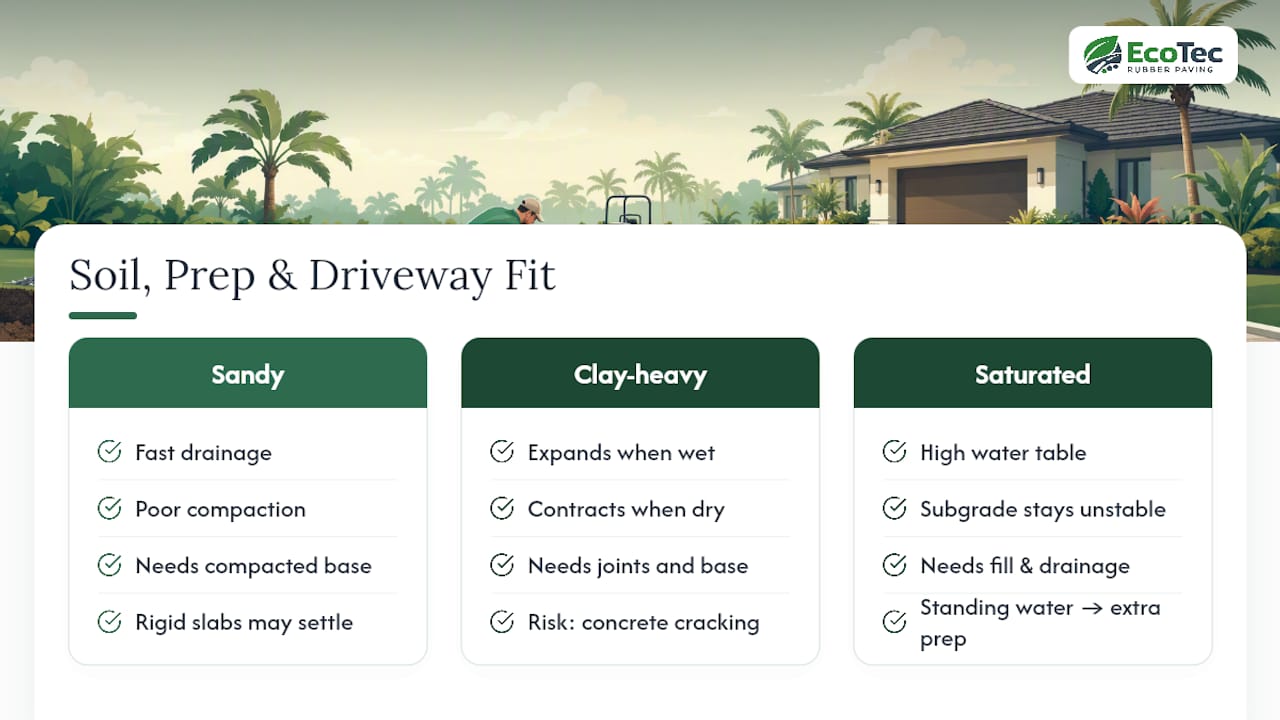
Low-lying properties near wetlands or with a high water table face a different problem entirely: saturated subgrade soil that never fully stabilizes, which undermines any rigid surface poured without significant fill and drainage work first. If your lot has ever held standing water after a storm, that's a signal to talk to your contractor about additional drainage prep before choosing a material, not after the driveway cracks.
A quick soil test or a conversation with your installer about local soil conditions on your specific street, not just your county, can save you from picking a material mismatched to what's underneath your yard. Pavers tolerate this soil variability better than any rigid option, which is part of why they show up so often in Florida-specific recommendations. But even pavers need a properly compacted base matched to your actual soil, not a generic spec sheet.
Keeping Your Florida Driveway in Shape Year-Round
Florida's maintenance calendar looks different from a driveway in Ohio or Colorado, and treating it the same way shortens its lifespan; that is why understanding why weather resistance matters: protect value and safety can inform better material choices. Summer is the highest-risk season: intense UV exposure accelerates asphalt oxidation and fades concrete sealers, so early summer is the right window to sealcoat asphalt or reapply a concrete sealer before the worst heat hits.
Hurricane season maintenance means checking paver joint sand and edge restraints before storms, since heavy, sustained rain is what washes out loose material and undermines unstable bases. After any major storm, walk your driveway and look for new cracks, shifted pavers, or shell migration, since catching small movement early is far cheaper than a full repair later.
Choosing lighter surface colors also pays off in daily comfort and material longevity. Lighter concrete, light-toned pavers, or a lighter rubber paving finish can run 8 to 12 degrees Fahrenheit cooler than dark surfaces in direct sun, which reduces the heat cycling that accelerates cracking and softening over time.
For coastal homeowners, rinse salt spray off your driveway periodically, particularly after storms with onshore wind, since salt residue corrodes metal edge restraints and control joint hardware faster than it damages the paving surface itself. Non-metallic edging and joint materials sidestep this problem for homeowners building near the coast. Pair routine rinsing with the drainage strategies outlined for Florida properties to keep water moving away from the surface instead of sitting on it.
Quick-Reference Comparison for Florida Driveways
Weighing five materials against seven variables in your head is a recipe for decision fatigue, so here's how they stack up side by side.
| Material | Cost ($/sq ft installed) | Lifespan | Maintenance | Heat/UV performance | Drainage | Coastal suitability | Recommended base/thickness |
|---|---|---|---|---|---|---|---|
| Interlocking pavers | $10–$25 | several decades | Re-sand joints periodically, occasional sealing | Runs 8–12°F cooler than asphalt | Moderate, improves with permeable joints | Strong, with proper edging | Compacted aggregate base, 4" typical |
| Plain concrete | $6.50–$19 | 25–40 years | Seal every 2–3 years, expect hairline cracks | Moderate, lighter colors help | Poor, sheds water off surface | Fair, needs sealed finish | 4" limerock base, 4" slab (5–6" for trucks) |
| Asphalt | $4–$8 | 12–18 years | Sealcoat every 2–3 years | Softens above ~130°F, oxidizes | Poor unless porous mix used | Weak, degrades faster near salt | Compacted base, 2–3" asphalt layer |
| Crushed shell | $2–$5 | Ongoing, replenished annually | Replenish $150–$400/year | Stays cool, no softening risk | Excellent | Excellent on flat lots | Geotextile fabric plus compacted shell rock |
| Permeable pavers/porous surfaces | $10 to $25 | 25–40+ years | Periodic vacuuming to prevent clogging | Good, varies by base material | Excellent | Excellent | Open-graded aggregate base for infiltration |
No single row wins across every column, which is exactly why the shortlist earlier in this guide matches materials to your actual priority instead of picking a single universal winner.
What Actually Matters When You Cut Through the Marketing
Most driveway content online treats material choice like a beauty contest: which surface looks best, which one's trendiest this year. That framing misses what actually determines whether a Florida driveway lasts 10 years or 40, and it's rarely the surface material itself. It's the four inches of compacted limerock nobody sees once the job is done.
Contractors know this. Homeowners rarely do, because a bad base doesn't announce itself. It shows up two or three years later as a hairline crack that becomes a real one, or a paver that starts rocking underfoot. By then it's a repair bill, not a conversation.
The conventional advice to just pick concrete because it's cheap or pavers because they're premium skips the harder question: what does your specific lot's drainage, soil, and sun exposure actually demand? A flood-prone lot with heavy clay soil has different needs than a sandy coastal lot with excellent natural drainage, even if both homeowners are shopping the same budget range.
That's also where permeable and porous options, including rubber paving systems like Rubberway®, deserve more attention than they typically get in mainstream driveway guides. They solve the drainage and cracking problems at the design level instead of asking homeowners to manage them through maintenance. Prioritize the base and drainage plan first, choose the surface material second, and skip any contractor who wants to skip straight to color swatches.
— Roger
Get a Florida-Ready Driveway Built on Rubberway®
If everything in this guide points toward wanting less cracking, better drainage, and a lower environmental footprint without babysitting a maintenance schedule, that's precisely the gap Ecotecrubber built its business around. Rubberway® installations use recycled rubber material to deliver a porous, ADA-compliant surface that handles Florida's heat cycling and sudden downpours better than the rigid, non-porous surfaces most homeowners default to.
The company works directly with Florida homeowners, HOA boards, and commercial property managers who want a driveway, walkway, or pool deck surface that won't crack under soil movement or pond after a storm. The company is licensed and insured, and every project focuses solely on rubber paving.
If a permeable, crack-resistant surface fits your property better than concrete, asphalt, or pavers, request a consult with EcoTec Rubber Paving to see what a Rubberway® installation would look like on your driveway.
Sources
- Florida Driveway Paving Cost (2026): $4–$25/sqft Installed | BuildPriced
- Best Driveway Material for Florida Heat | BuildPriced
- Shell and Crushed Shell Driveways in Northeast Florida: Real Cost and Yearly Upkeep - Coastal Driveway Pavers | Jacksonville's #1 Driveway Installer
- Driveway Materials for Coastal Florida Properties - Asphalt Paving South Florida