
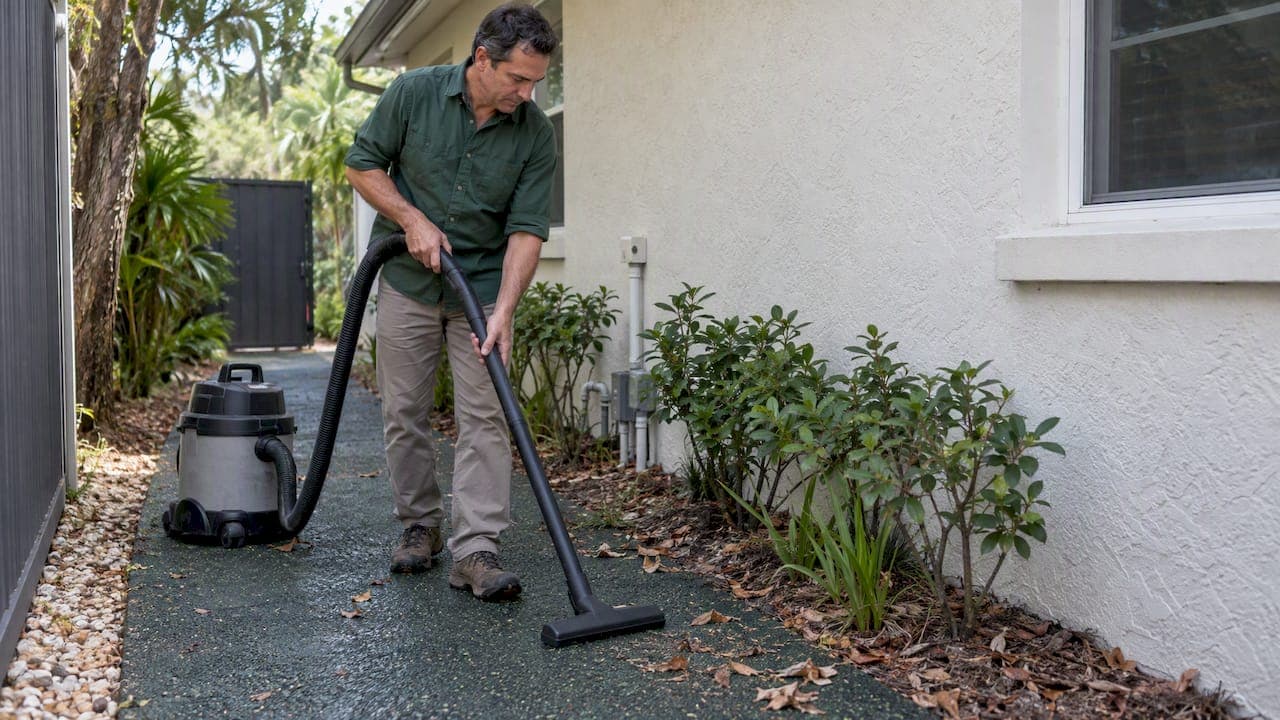
Keep Rubberway® porous rubber paving performing by sweeping often, scheduling vacuum sweeping at least twice a year, and calling in pressure washing with high-suction extraction, or a professional restorative service, once infiltration starts to decline. The goal behind every step is the same: protect the open pore structure that lets water pass through instead of pooling or running off. Skip the routine work and sediment builds up, slowing drainage and shortening the time before a full restoration is needed.
TL;DR:
- Time vacuum passes for the end of winter and autumn leaf fall; stabilize nearby soil, and keep sand, gravel, and sealants off the surface.
- Use water or a pressure washer under 1,500 psi with a wide fan nozzle held 12 to 18 inches away, and avoid direct jets.
- When drainage slows, pressure washing must be followed immediately by high suction extraction; washing alone can push sediment deeper instead of removing it.
- For neglected, heavily clogged areas, choose a true vacuum truck over regenerative air or mechanical sweepers; older sections with small joints may recover only partly.
- Inspect seasonally and request ASTM C1701 infiltration testing when ponding appears or annually; log results and adjust maintenance frequency for traffic and nearby sediment sources.
Table of Contents
- Quick preventive checklist: what to do regularly and why
- Step-by-step cleaning: homeowner methods and pro-level restorative sequence
- Restorative options explained: vacuum sweepers, pressure washing, and aggregate/joint work
- Inspection, testing, and maintenance records: how to verify performance over time
- Our perspective on upkeep and when to call in a professional
- How we help: cleaning coordination, testing, and repairs
- FAQ
- Sources
Quick preventive checklist: what to do regularly and why
Most of what keeps porous rubber paving draining well has nothing to do with heavy equipment. It comes down to keeping loose material off the surface before it works its way into the pores.
- Sweep weekly or after storms to clear leaves, grass clippings, and wind-blown debris before they break down into fine sediment.
- Keep upstream areas, like mulch beds, bare soil, or gravel margins, stabilized so dirt does not wash onto the paving.
- Schedule vacuum sweeping at least twice a year, ideally at the end of winter and again after autumn leaf-fall, which EPA permeable pavement guidance identifies as the main defense against clogging.
- Never spread sand or gravel for traction or weed control since loose granular material migrates straight into the pore structure.
- Skip sealants and coatings, which close the surface and defeat the purpose of a permeable system.
- Avoid piling snow directly on the surface for long stretches, since meltwater carrying de-icing residue concentrates in one spot.
For HOAs and municipal sites, written maintenance agreements and posted signage matter because shared spaces often see faster sediment buildup from foot traffic, landscaping crews, and inconsistent upkeep. A documented schedule also protects the surface's stormwater performance when ownership or management changes hands.
Pro Tip: Keep a simple binder or shared spreadsheet logging every sweep, rinse, and inspection date so a decline in drainage is easy to spot early.
Step-by-step cleaning: homeowner methods and pro-level restorative sequence
Routine cleaning and restorative cleaning use different tools and serve different purposes. Knowing which one a surface needs keeps you from over-cleaning or under-cleaning.
For everyday upkeep, a stiff broom, a leaf blower, and occasionally a garden hose on a low-pressure setting are enough. For deeper cleaning, pressure washers, regenerative-air or vacuum sweepers, and high-suction vacuum trucks come into play, each suited to a different stage of clogging.
Homeowner routine sequence:
- Remove loose debris by hand or with a leaf blower set to a low or medium airflow setting.
- Sweep the surface with a stiff-bristle broom, working in the direction of any slope to pull debris toward a collection point.
- Rinse lightly with a garden hose if grime remains, using a fan nozzle rather than a direct jet to avoid forcing fines deeper into the pores.
If a pressure washer is used for routine cleaning, keep it under 1,500 psi with a wide fan nozzle held at least 12 to 18 inches from the surface. Direct runoff toward a vegetated area or storm drain inlet filter rather than letting wash water carry sediment back into the pavement.
Pro restorative sequence (for surfaces showing slower drainage): a contractor pressure washes the surface to dislodge embedded fines, then immediately follows with high-suction vacuum extraction. The order matters: pressure washing alone just redistributes sediment across the surface or pushes it deeper, while extraction right after washing actually removes it. Restorative maintenance combining these methods has produced measurable gains. The USGS study on restorative maintenance found that restorative maintenance practices significantly increase infiltration rates on permeable interlocking concrete pavement sections, with smaller but still measurable gains on other permeable surface types.
If drainage does not improve after a restorative pass, that is the signal fines have packed into the base layer or rubber matrix itself rather than sitting on the surface. At that point, surface cleaning has reached its limit and joint or aggregate restoration, handled by a licensed installer, is the next step.

Restorative options explained: vacuum sweepers, pressure washing, and aggregate/joint work
Not every clogged surface needs the same fix. The right restorative approach depends on how old the installation is, how clogged it has become, and the site's layout.
Regenerative-air and mechanical sweepers work well for preventive passes on flat, open areas but struggle on tight curbs, steep slopes, or surfaces with heavy, compacted sediment. True vacuum trucks apply stronger suction and are the better choice once a surface has gone unmaintained for a season or more, since Minnesota's Stormwater Manual notes they outperform regenerative-air or mechanical sweepers on neglected, heavily clogged surfaces.
- Pressure wash plus vacuum combinations restore infiltration most reliably on newer installations and on surfaces with wider joint openings.
- Mature installations with small joints often see only partial recovery from surface-level restorative methods.
- Aggregate replacement or joint restoration becomes necessary when pressure washing and vacuuming no longer improve drainage.
Research on mature permeable interlocking concrete pavement backs this pattern: a combination of pressure washing and vacuum sweeping significantly improved infiltration on newer sections and those with larger joints, while older, heavily clogged sections showed limited recovery even after the same treatment.
Pro Tip: Budget for restorative maintenance on a schedule tied to traffic volume, not just age, since a high-traffic walkway clogs faster than a lightly used residential driveway.
Inspection, testing, and maintenance records: how to verify performance over time
A short, consistent inspection routine catches drainage problems before they turn into standing water.
- Walk the surface seasonally, checking for visible sediment buildup, ponding after rain, cracked or shifting joints, staining, and edge stability.
- Run or request ASTM C1701 infiltration testing when ponding appears or at a set annual interval, comparing results against the thresholds outlined in the Minnesota Stormwater Manual.
- Log every maintenance pass: date, method used, equipment, contractor name, infiltration test result if taken, and the next scheduled action.
- Adjust inspection frequency based on upstream sediment sources and traffic intensity, since a surface near bare soil, construction, or heavy vehicle use needs more frequent checks than a low-traffic patio.
Keeping these records also makes it easier to spot a trend rather than reacting to a single bad inspection, which matters most for HOAs and municipal sites answering to stormwater ordinances.
Our perspective on upkeep and when to call in a professional
We specialize exclusively in rubber paving installations, and the surfaces that hold their drainage longest are the ones on a real maintenance schedule, not the ones cleaned only after water starts pooling. Three signs tell us it's time for a site visit: ponding that persists well after heavy rain, an infiltration test result that falls below the acceptable range, and visible fines embedded in the surface that a routine sweep or rinse does not lift.
— Roger
How we help: cleaning coordination, testing, and repairs
We coordinate the full range of upkeep a porous rubber surface needs including vacuum sweeping, restorative pressure-wash and extraction passes, joint and aggregate remediation, and ADA-compliant repairs with the documentation municipalities and HOAs often require.
A site assessment from our team includes a visual inspection, an infiltration check, and a maintenance schedule built around your property's traffic and sediment exposure. From there, we can walk you through Rubberway® Pervious Pavement, Rubberrock 6000, and EVOLUTION if a section needs partial replacement rather than another cleaning pass.
- Vacuum sweeping coordination for routine and seasonal upkeep.
- Restorative pressure-wash and high-suction extraction service.
- Joint and aggregate remediation for surfaces beyond surface cleaning.
- ADA-compliant repair work with documentation for property managers and municipal buyers.
If your surface is holding water longer than it used to, request an inspection and we'll tell you exactly what it needs.
FAQ
How often should rubber paving be cleaned?
Sweep or blow off debris weekly, and schedule a professional vacuum sweeping pass at least twice a year, ideally at the end of winter and after autumn leaf-fall. This cadence matches the Minnesota Stormwater Manual's recommendation for permeable surfaces and keeps sediment from accumulating between passes.
What is the best cleaner for rubber paving?
Plain water with a low-pressure rinse or a pressure washer under 1,500 psi handles most routine grime without forcing debris deeper into the pores. Avoid sealants, degreasers, or anything that leaves a film, since the surface relies on open pores rather than a protective coating to perform well.
How do you remove algae or mold from a rubber pool deck?
Light algae or mold usually lifts with a stiff-bristle broom and a low-pressure rinse done promptly, before buildup sets into the surface. For deck areas that stay shaded and damp, pairing more frequent sweeping with a biannual vacuum sweeping pass helps prevent regrowth between cleanings.
How long does it take to restore a clogged rubber paving surface?
A restorative pressure-wash and vacuum extraction pass typically takes a few hours for a residential driveway or pool deck, though larger commercial or municipal surfaces take longer. Recovery varies by age and joint size: newer installations with wider joints tend to regain infiltration fully, while older, heavily clogged sections may only partially recover, according to research on mature permeable pavements.
What causes a rubber paving surface to lose its drainage?
Fine sediment, like dirt, pollen, and organic debris, gradually fills the open pore structure and slows water infiltration, a pattern EPA guidance on permeable pavements identifies as the primary maintenance concern for this type of surface. Keeping upstream areas stabilized and sticking to a sweeping and vacuum schedule are the most effective ways to prevent it.
Sources
- NPDES: Stormwater Best Management Practice — Permeable Pavements (EPA)
- Assessment of restorative maintenance practices on the infiltration capacity of permeable pavement (USGS)
- Operation and maintenance (O&M) of permeable pavement - supplemental information (Minnesota Stormwater Manual)