
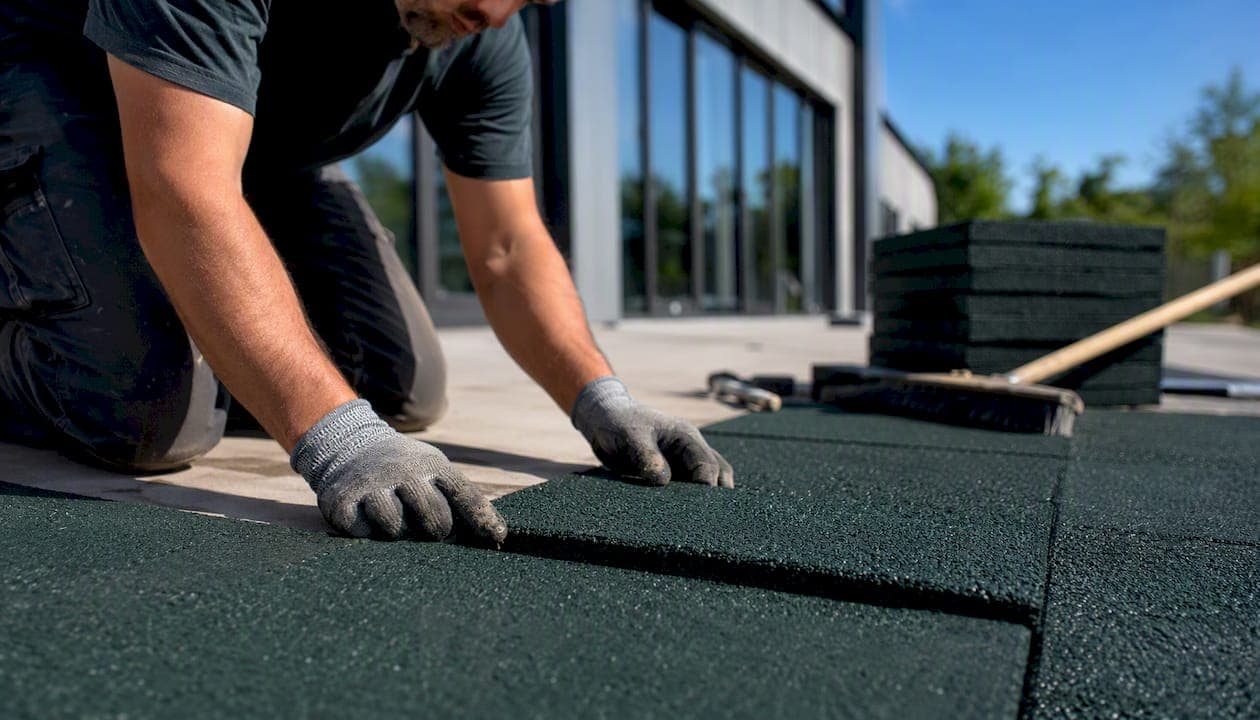
The highest-impact eco-friendly business exterior upgrades, ranked by energy savings and ROI, are: continuous insulation and recladding, high-performance windows and doors, rooftop solar or BIPV, green or reflective roofing, LED exterior lighting with smart controls, permeable paving (including Rubberway® rubber paving), stormwater bioretention landscaping, and EV charging infrastructure. Your single best first move is to schedule a building-envelope audit before committing budget to any single upgrade.
Here is the shortlist at a glance:
- Continuous insulation and recladding — biggest energy-load reduction per dollar
- High-performance windows and doors — utility savings of roughly 25–30% in documented retrofit scenarios
- Rooftop solar or BIPV — on-site generation that offsets utility costs long-term
- Green or reflective roofing — reduces cooling loads and extends roof lifespan
- LED exterior lighting with sensors — fast payback and low disruption
- Permeable paving (Rubberway® system) — manages stormwater, meets ADA, uses recycled materials
- Bioswales and rain gardens — reduce stormwater fees and site flooding
- EV charging infrastructure — tenant amenity and future-proofing
Certifications to benchmark against: LEED (Leadership in Energy and Environmental Design) and ENERGY STAR. Both programs provide measurable performance targets and open doors to incentive programs.
Pro Tip: Request a building-envelope audit before finalizing any scope. Auditors identify air-leakage paths and thermal bridges that determine which upgrades deliver the most measurable savings for your specific building.
Key Takeaways
Prioritizing building-envelope upgrades first, then on-site generation and permeable paving, then amenity improvements delivers the strongest combined ROI for commercial exterior sustainability projects.
| Point | Details |
|---|---|
| Envelope upgrades come first | Insulation, air sealing, and windows reduce the energy load that solar and HVAC must serve. |
| Window upgrades cut utility costs | Low-E window retrofits have delivered utility savings of roughly 25–30% in documented commercial scenarios. |
| Permeable paving manages stormwater | Porous surfaces like Rubberway® reduce runoff, lower stormwater fees, and meet ADA requirements. |
| Check incentives before finalizing scope | Federal ITC, 179D deductions, DSIRE state rebates, and utility programs can shift payback by years. |
| Ecotecrubber installs Rubberway® commercially | Licensed and insured installations across Florida with permitting coordination and ADA compliance support. |
Table of Contents
- Why commercial owners should prioritize exterior upgrades now
- Practical, high-impact upgrades: costs, lifespans, and ROI
- How to sequence upgrades and set realistic timelines
- Permits, incentives, and certifications to check before you start
- How to select contractors for sustainability-focused exterior work
- What Rubberway® porous rubber paving delivers on commercial sites
- An installer's perspective on sequencing exterior upgrades
- Ecotecrubber's Rubberway® installations for commercial properties
- Sources
Why commercial owners should prioritize exterior upgrades now
The business case for sustainable exterior renovations is no longer theoretical. Exterior upgrades reduce operating costs directly, and they affect how tenants, investors, and municipal authorities evaluate your property.
Key drivers:
- Stormwater cost avoidance: Permeable paving and bioretention landscaping reduce runoff volume, which lowers stormwater utility fees and potential regulatory fines in many municipalities.
- Maintenance savings: Durable, low-maintenance materials like recycled-rubber paving and fiber-cement cladding cut repair frequency over a 20–30 year lifespan.
- Tenant retention and rent premiums: Sustainability investments increasingly drive tenant retention when they reduce operating costs and improve occupant comfort, according to Carbon Tracker's analysis of investor and tenant demand for low-carbon buildings.
- Marketability: Green certifications (LEED, ENERGY STAR) signal building quality to prospective tenants and buyers, often supporting stronger lease terms.
Stat callout: Energy-efficient windows with low-E coatings and insulated frames have reduced utility expenses by roughly 25–30% in documented commercial retrofit scenarios, with facade improvements frequently delivering measurable rent-premium value.
Use EIA regional energy-cost data to establish your baseline before any upgrade, so you can calculate real payback against your actual utility rates rather than national averages.
Practical, high-impact upgrades: costs, lifespans, and ROI
Continuous insulation and recladding
Recladding with a continuous-insulation (CI) system eliminates thermal bridging through studs and framing, which standard batt insulation cannot address. Sto's recladding guidance frames this approach as a way to modernize envelopes, extend service life, and avoid the embodied carbon of full demolition. Typical installed cost runs $15–$40 per square foot depending on substrate condition and cladding material. Lifespan: 30–50 years with minimal maintenance. Payback driver: reduced heating and cooling loads, lower maintenance, and avoided future demolition costs.
High-performance windows and doors
Low-E coatings, insulated frames, and thermally broken assemblies reduce conductive and radiant heat transfer. In commercial retrofits, documented savings reach 25–30% on window-related utility costs. Installed cost range: $400–$1,200 per window unit for commercial-grade replacements. Lifespan: 20–30 years. Payback driver: reduced HVAC load and improved occupant comfort, which supports tenant retention.
Rooftop solar and BIPV
Rooftop photovoltaic arrays are the most familiar option. Building-integrated photovoltaics (BIPV) go further by replacing conventional cladding with solar-generating panels. Mitrex's eFacade PRO system is one example of a ventilated rainscreen BIPV approach that pairs facade aesthetics with on-envelope generation. Background technical data places modern BIPV output in the range of 7–18 watts per square foot, though actual yield depends on orientation, shading, and climate. Installed cost for rooftop solar: $3–$6 per watt installed (before incentives). BIPV costs more per watt but replaces cladding material, partially offsetting the premium. Payback driver: utility offset plus federal Investment Tax Credit (ITC).
Green and reflective roofing
Cool roofs (white membranes or reflective coatings) reduce surface temperatures and cut cooling loads in warm climates. Green roofs add insulation value, manage stormwater, and extend membrane life by shielding it from UV and thermal cycling. Installed cost for cool-roof coatings: $1–$3 per square foot. Full green roof systems: $10–$25 per square foot. Lifespan: 20–40 years depending on system type.
LED exterior lighting with controls
Replacing metal-halide or high-pressure sodium fixtures with LED and adding occupancy sensors or daylight controls is one of the fastest-payback upgrades available. Installed cost: $200–$600 per fixture for commercial-grade LED with controls. Payback: often 2–4 years before utility rebates, faster after.
Permeable paving
Permeable paving manages stormwater at the source, reducing runoff and the associated fees and flooding risk. Options include permeable concrete, interlocking permeable pavers, and porous rubber paving. The Rubberway® system from Ecotecrubber uses recycled tire material to create a porous, crack-resistant, ADA-compliant surface suited to commercial walkways, parking areas, and plazas. For sustainable commercial paving, rubber paving also reduces heat-island effect compared to conventional asphalt. Installed cost varies by project scope; contact Ecotecrubber for a site-specific estimate.

Bioswales and rain gardens
Bioswales are vegetated channels that slow, filter, and infiltrate stormwater runoff. Rain gardens are shallow depressions planted with native species that absorb water from impervious surfaces. Both reduce peak runoff volume and can qualify for stormwater utility credits in many jurisdictions. Installation cost: $10–$40 per linear foot for bioswales; $3–$15 per square foot for rain gardens. Maintenance: seasonal planting management and periodic sediment removal.
EV charging infrastructure
Installing EV chargers (Level 2, 240V) or running conduit for future installation is a low-disruption amenity upgrade that supports tenant recruitment and may qualify for federal and utility incentives. Installed cost: $2,000–$10,000 per Level 2 station depending on electrical panel capacity and trenching requirements.
Low-VOC cladding and recycled-content materials
Fiber-cement panels, recycled-aluminum composite, and low-VOC exterior coatings reduce off-gassing and embodied carbon. Lifecycle carbon considerations favor materials with high recycled content and long service lives over frequent-replacement options. Specify products with Environmental Product Declarations (EPDs) to document embodied carbon for LEED submissions.
Pro Tip: Schedule recladding and window replacement in the same mobilization. Separating them means two rounds of scaffolding, two sets of weather-protection costs, and a high risk that the new windows get installed before the air/water barrier is properly detailed around them.
| Upgrade | Estimated installed cost (range) | Typical payback driver | Typical lifespan |
|---|---|---|---|
| Continuous insulation and recladding | $15–$40/sq ft | Reduced HVAC load, avoided demolition | 30–50 years |
| High-performance windows | $400–$1,200/unit | Utility savings, tenant comfort | 20–30 years |
| Rooftop solar (PV) | $3–$6/watt (pre-incentive) | Utility offset, ITC | 25–30 years |
| Cool or green roof | $1–$25/sq ft | Cooling load, membrane life | 20–40 years |
| LED exterior lighting | $200–$600/fixture | Energy reduction 50% | 15–25 years |
| Permeable rubber paving | Site-specific | Stormwater, maintenance savings | 20+ years |
| Bioswales and rain gardens | $3–$40/sq ft or linear ft | Stormwater credits, flooding risk | Ongoing |
| EV charging (Level 2) | $2,000–$10,000/station | Tenant amenity, incentives | 10–15 years |

Cost ranges are estimates. Get site-specific quotes from licensed contractors.
How to sequence upgrades and set realistic timelines
Prioritize in this order: building-envelope measures first, then on-site generation and site solutions, then amenity and branding upgrades. The logic is simple: if you install solar before fixing the envelope, you are generating power to compensate for heat loss you could have eliminated more cheaply.
Sequencing rationale:
- Envelope measures (insulation, air sealing, windows) reduce the baseline energy load that solar and HVAC systems must serve. Smaller load means smaller — and cheaper — solar array.
- Permeable paving and stormwater landscaping can often be phased around tenant activity with minimal disruption.
- LED lighting and EV conduit are quick wins that generate early savings and tenant goodwill while larger projects are in design.
Sample phased timeline:
- Months 0–6 (quick wins): LED exterior lighting retrofit, EV conduit rough-in, low-VOC exterior repainting, bioswale design and permitting.
- Months 6–18 (mid-phase): Window and door replacement, permeable paving installation, rain garden construction, rooftop solar design and permitting.
- Months 12–36 (major work): Full recladding with CI system, BIPV integration, green roof installation.
Simple payback example (reusable formula):
Suppose LED exterior lighting costs $30,000 installed and saves $9,000 per year in electricity. Use EIA regional rate data to confirm your actual savings estimate.
Payback (years) = Installed cost ÷ Annual savings $30,000 ÷ $9,000 = 3.3 years
Apply the same formula to any upgrade. DOE weatherization guidance provides program-specific performance benchmarks you can reference when building your model.
Local rainfall trends from NOAA climate resources help owners size stormwater systems correctly and justify permeable paving investments to municipal reviewers.
Permits, incentives, and certifications to check before you start
Check these before finalizing project scope. Incentives can shift the payback calculation significantly, and some require pre-approval before work begins.
Federal programs:
- Investment Tax Credit (ITC): Covers a percentage of solar PV and BIPV installed costs. Check current rates at energy.gov.
- 179D Commercial Buildings Energy Efficiency Tax Deduction: Available for qualifying envelope, lighting, and HVAC improvements in commercial buildings.
- USDA REAP grants: For rural commercial properties adding renewable energy or efficiency upgrades.
State and utility programs:
- Search the Database of State Incentives for Renewables and Efficiency (DSIRE) at dsireusa.org for state-specific rebates and tax credits.
- Contact your local utility directly for rebate programs on LED lighting, HVAC, and window upgrades. Many utilities offer prescriptive rebates that do not require custom energy modeling.
Stormwater credits:
- Many municipalities offer stormwater utility fee credits for permeable paving and bioretention installations. Check with your local stormwater authority. Stormwater management guidance explains how permeable paving systems qualify.
Certifications:
- LEED (v4.1): Credits available for envelope performance, stormwater management, materials with recycled content, and EV infrastructure.
- ENERGY STAR Certified Buildings: Requires energy performance in the top 25% of similar buildings nationally.
Document checklist for rebate and tax credit applications:
| Document | Purpose |
|---|---|
| Project scope and specifications | Defines eligible measures |
| Equipment specs and certifications | Confirms product eligibility |
| Pre-upgrade energy use baseline | Required for savings calculation |
| Post-upgrade energy use data | Confirms actual performance |
| Contractor invoices and receipts | Proof of installed cost |
| Product EPDs or certifications | Required for LEED material credits |
How to select contractors for sustainability-focused exterior work
Hire contractors with documented envelope experience, active trade licenses, general liability and workers' compensation insurance, and references from commercial sustainability projects. A contractor who has done residential retrofits but never managed a commercial recladding project is a different risk profile than one with a portfolio of commercial envelope work.
Questions to ask every contractor:
- Can you provide references from commercial envelope or permeable paving projects of similar scale?
- What trade licenses do you hold in this state, and are they current?
- Who handles permitting, and do you have experience with LEED or ENERGY STAR documentation?
- What is your warranty on materials and workmanship, and who backs it if your company changes?
- How do you coordinate envelope, window, and paving scopes to avoid rework?
- Do you carry errors and omissions coverage for design-assist work?
Procurement approach options:
- Design-bid-build: Owner hires designer separately, then bids construction. Best for large, well-defined scopes where competitive pricing matters most.
- Design-build: Single firm handles design and construction. Faster, but requires careful scope definition upfront to avoid scope creep.
- Phased construction management (CM): Owner retains a CM to manage multiple trade contractors. Works well for complex, multi-phase envelope projects where sequencing is critical.
Coordinated envelope retrofits consistently show that air sealing, layered insulation, and cladding installed as a coordinated system outperform piecemeal repairs on both energy performance and durability.
Red flags to walk away from:
- No verifiable local license or insurance certificate
- Scope defined only verbally with no written specification
- No warranty on workmanship beyond one year
- Contractor who proposes separating window installation from air/water barrier work without a written coordination plan
What Rubberway® porous rubber paving delivers on commercial sites
Ecotecrubber's Rubberway® system is a porous rubber paving product made from recycled tire material, installed over an engineered aggregate base. On commercial sites, it addresses two problems that conventional asphalt and concrete cannot solve simultaneously: stormwater infiltration and surface durability in heat-intensive climates.
Rubberway® performance highlights (Ecotecrubber-sourced): The porous design allows water to pass through the surface and into the base, reducing standing water and runoff volume. The recycled rubber matrix resists cracking under thermal expansion, a common failure mode for asphalt in Florida's heat cycles. Surfaces are ADA-compliant when installed over a properly engineered base, and the system is available in a range of colors for branding or wayfinding applications.
Key performance attributes:
- Drainage: Porous design reduces surface runoff and standing water on walkways, plazas, and parking areas.
- Durability: Crack-resistant under heat and freeze-thaw cycling; outperforms asphalt overlays on long-term maintenance costs.
- ADA compliance: Meets ADA surface standards for firmness and stability when properly installed.
- Recycled content: Made from recycled tires, diverting waste from landfills and reducing embodied carbon versus virgin asphalt.
- Maintenance: Lower long-term maintenance frequency compared to asphalt, which requires periodic sealing and crack repair.
- Lifespan: 20+ years with proper base preparation and routine cleaning.
Pro Tip: During the design phase, document base specifications and test infiltration rates before installation. A properly engineered base is what separates a porous paving system that performs for 20 years from one that fails in five.
An installer's perspective on sequencing exterior upgrades
The single most expensive mistake on commercial exterior projects is treating each upgrade as a standalone scope. Start with the envelope. Every other upgrade performs better when the building's thermal and moisture boundaries are defined and sealed first.
Practical tips from project teams:
- Order sustainable materials early. Lead times for CI panels, low-VOC cladding systems, and BIPV modules often run 12–20 weeks. Missing a delivery window can push a project from one season into the next.
- Pull permits before mobilizing. Permit timelines for commercial exterior work vary widely by jurisdiction. In some Florida counties, stormwater and building permits for a combined envelope-and-paving project can take 8–12 weeks. Start the application the day the scope is finalized.
- Coordinate envelope and solar in one design phase. Roof penetrations for solar racking need to be detailed into the roofing system, not cut through it after the fact.
- Schedule paving last in the site sequence. Paving is vulnerable to damage from heavy equipment. Install it after all other site work is complete.
Practical red flag: Walk away from any contractor who proposes completing the window installation before the air/water barrier is fully detailed and inspected. That sequence guarantees moisture problems behind the new cladding within five years.
Ecotecrubber's Rubberway® installations for commercial properties
Commercial properties that need permeable paving without the maintenance burden of conventional concrete or asphalt have a direct option: Ecotecrubber installs the Rubberway® system across Florida for commercial walkways, parking areas, plazas, and municipal sites, handling permitting coordination and ADA compliance support as part of the project.
What the service includes:
- Recycled-rubber surfacing with porous drainage design
- ADA-compliant surface installation with engineered base preparation
- Color and finish customization for branding or wayfinding
- Permitting coordination and documentation support
- Warranty and maintenance guidance post-installation
Installation process: Site assessment → design and permitting → site prep and base work → Rubberway® surface installation → final inspection and documentation.
Ecotecrubber is licensed and insured, focused exclusively on rubber paving, which means every project gets a team that has solved the same drainage, durability, and compliance challenges dozens of times. Browse Rubberway® product options or visit Ecotecrubber to request a site assessment and get a project-specific quote.
Sources
Use these resources during the planning and design phase:
- Eia
- Exterior Commercial Renovation for Businesses: Energy Savings, Security & Curb Appeal - EB3 Construction