

Green building certification paving is the practice of selecting and installing paving materials that meet third-party sustainability standards, earning credits toward recognized frameworks like LEED, BREEAM, and WELL. These frameworks evaluate projects across categories including energy, water, materials, and site performance, with paving contributing directly to Sustainable Sites and Materials and Resources credits. The industry term you'll encounter most often is "sustainable paving," though certification-aligned paving is the more precise phrase when credits are the goal. LEED is the most widely recognized global green building framework as of 2026, making it the benchmark most project teams target first. Understanding how paving fits into this system is the first step toward building smarter and certifying successfully.
How do paving materials contribute to green building certification credits?
Sustainable paving materials earn certification credits through three primary mechanisms: stormwater management, heat island reduction, and recycled content. Each mechanism maps to a specific credit category, so choosing the right material is not a style decision. It is a technical one.
Stormwater management is the most direct contribution. Permeable pavers allow rainwater to infiltrate the ground rather than run off into municipal systems. This supports LEED's Sustainable Sites credits for stormwater control, which require projects to manage runoff volume and quality. One critical point: permeable pavement eligibility depends on a site-specific stormwater management plan that accounts for local climate and soil conditions. Installing permeable pavers without that plan does not automatically earn credits.
Heat island reduction addresses the urban heat effect, where dark paved surfaces absorb solar energy and raise local temperatures. High solar reflectance index (SRI) materials reflect more sunlight and reduce cooling loads on nearby buildings. LEED awards credits for paving that meets minimum SRI thresholds on non-roof hardscapes.

Recycled content and low-carbon materials contribute to Materials and Resources credits. Some bio-asphalt mixtures, for example, cut paving emissions by up to 76% compared to conventional asphalt. That figure comes from Barcelona's bio-based paving research using crushed olive pits, and it signals how far material science has advanced. Rubber paving made from recycled tires, like the Rubberway® system used by Ecotecrubber, fits this category by diverting waste from landfills while delivering durable, ADA-compliant surfaces.
| Paving material type | Primary credit category | Key sustainability attribute |
|---|---|---|
| Permeable concrete pavers | Sustainable Sites | Stormwater infiltration |
| High-SRI pavers | Sustainable Sites | Heat island reduction |
| Recycled rubber paving | Materials and Resources | Recycled content, waste diversion |
| Bio-asphalt | Materials and Resources | Low-carbon manufacturing |
| Biochar-infused pavement | Materials and Resources | Carbon sequestration potential |
Pro Tip: Map your paving material choices to specific credit categories before procurement. A material that earns credits in two categories, such as a permeable, high-SRI paver, delivers more certification value per dollar spent.
What are the main green building certification types that include paving standards?
Three certification systems dominate the market for projects that include paving sustainability criteria: LEED, BREEAM, and WELL. Each takes a different approach, and understanding those differences helps you target the right credits.
LEED (Leadership in Energy and Environmental Design), administered by the U.S. Green Building Council, is the most widely used system globally. It organizes credits into categories, and paving contributes most directly to Sustainable Sites (SS) and Materials and Resources (MR). LEED v4.1 and v5 both require Environmental Product Declarations (EPDs) for material credits, making documentation central to any paving strategy.
BREEAM (Building Research Establishment Environmental Assessment Method) is the dominant framework in the United Kingdom and Europe. It evaluates paving under Land Use and Ecology and Materials categories. BREEAM places stronger emphasis on biodiversity and ecological value than LEED does, so paving choices that support habitat connectivity or reduce impervious surface area score well.
WELL focuses on human health and wellbeing rather than environmental performance. Paving contributes to WELL credits through outdoor comfort, thermal comfort in exterior spaces, and accessible design. ADA-compliant, slip-resistant surfaces align directly with WELL's equity and access criteria.
- LEED: best fit for projects targeting environmental performance and global market recognition
- BREEAM: best fit for European projects with strong ecological and biodiversity goals
- WELL: best fit for projects prioritizing occupant health, comfort, and accessibility
Certification levels across all three systems follow a tiered structure. In LEED, projects earn Certified, Silver, Gold, or Platinum status based on total points. Paving credits alone rarely determine the final tier, but they can push a project from one level to the next. That margin matters when property value and market demand for certified projects continue to rise under sustainability mandates.
What criteria must paving materials meet for certification in 2026?
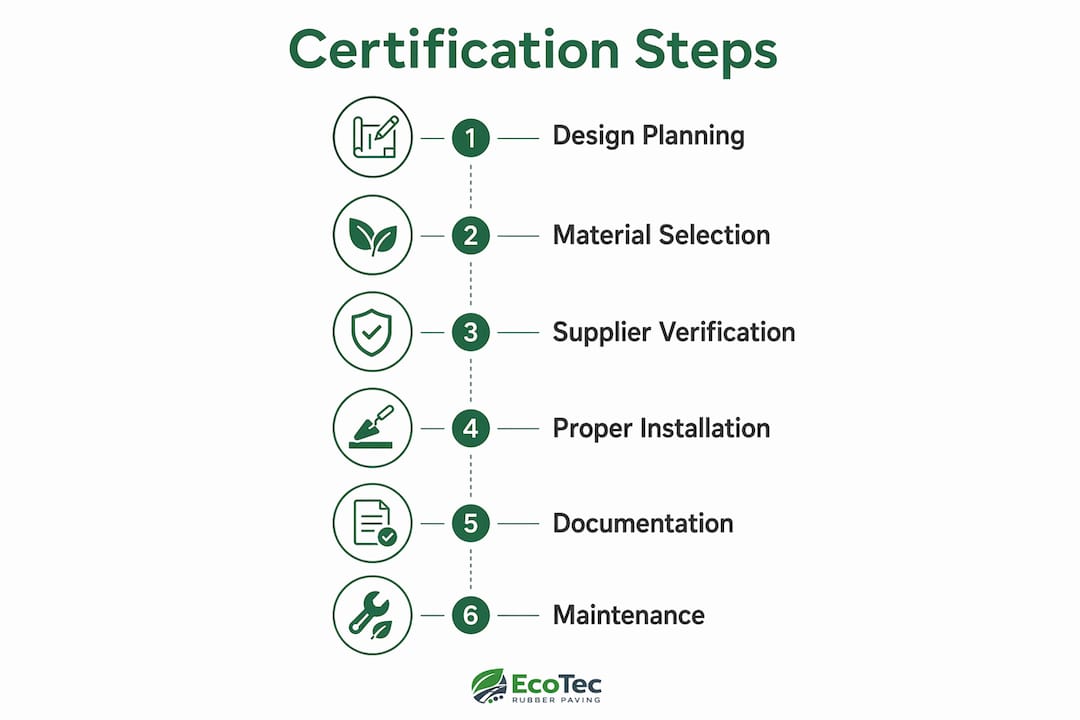
Meeting green building certification standards in 2026 requires more than choosing an eco-friendly product. It requires documentation, testing, and site-specific verification at every stage of the project.
-
Obtain Environmental Product Declarations (EPDs). EPDs are third-party verified documents that quantify a material's environmental impact across its full life cycle. EPDs are increasingly mandatory for LEED and similar systems. Request EPDs from manufacturers during procurement, not after installation.
-
Conduct site-specific performance testing. Permeability rates, solar reflectance index values, and durability metrics must be verified for your specific site conditions. Generic manufacturer data is not sufficient. Auditors require project-specific test results.
-
Prepare a stormwater management plan. This plan must account for local rainfall intensity, soil infiltration rates, and runoff targets. Without it, permeable paving credits are not available regardless of the material's technical performance.
-
Integrate paving decisions at project inception. Sustainable paving works best as a design element chosen early, not retrofitted after the site plan is finalized. Early integration allows the team to coordinate grading, drainage, and material selection for maximum credit impact.
-
Compile material ingredient reports. Beyond EPDs, some certification systems require Health Product Declarations (HPDs) or ingredient transparency reports. Collect these documents from suppliers during the procurement phase.
-
Audit-proof your documentation. Organize all test reports, EPDs, and supplier certifications into a single project file. Certification reviewers will request this file, and gaps cause delays or credit denials.
Pro Tip: Ask every paving supplier for their EPD before signing a purchase order. If a supplier cannot produce one, treat that as a red flag. Marketing language like "eco-friendly" or "green" without third-party documentation is a greenwashing signal, not a certification credential.
How can project teams implement sustainable paving to achieve certification?
Effective implementation of green paving materials starts with planning, not installation. The teams that earn the most credits treat paving as a system, not a surface.
Start with an integrative design process. Bring your paving supplier, civil engineer, and sustainability consultant into the design conversation before the site plan is drawn. This coordination prevents conflicts between grading requirements, drainage goals, and material performance specifications.
Select suppliers with verified products. A supplier's ability to provide EPDs, test data, and material ingredient reports is as important as the product itself. Certification compliance depends on documentation that only the manufacturer can provide. Verify this capability before committing to a product.
Follow installation best practices that protect performance. Permeable pavers installed over compacted subbase lose their infiltration capacity. Rubber paving systems require proper surface preparation to achieve rated drainage performance. Poor installation undermines the technical properties that earned the material its certification eligibility. Review the 2026 installation guide for current best practices.
Plan for maintenance from day one. Long-term maintenance and ADA compliance often outweigh initial eco ratings in determining whether a project sustains its certification benefits over time. Materials that require specialized equipment or frequent repair tend to degrade in performance and compliance. Prioritize systems compatible with standard municipal maintenance equipment.
Document everything during installation. Photograph subbase preparation, material delivery receipts, and installation stages. This documentation supports both warranty claims and certification audits. Teams that skip this step often face costly re-documentation requests during the review process.
Key Takeaways
Green building certification paving earns credits through verified material performance, site-specific documentation, and early design integration across LEED, BREEAM, and WELL frameworks.
| Point | Details |
|---|---|
| Certification requires documentation | EPDs, stormwater plans, and test reports are mandatory, not optional, for credit eligibility. |
| Paving credits span multiple categories | Materials earn credits in Sustainable Sites and Materials and Resources simultaneously. |
| Early design integration matters | Paving decisions made at project inception yield more credits than retroactive choices. |
| Greenwashing is a real risk | Marketing claims without third-party test data do not satisfy auditor requirements. |
| Maintenance sustains certification value | Low-maintenance, ADA-compliant systems protect long-term performance and compliance. |
What I've learned after years of watching paving projects miss certification
The most consistent mistake I see on green building projects is treating paving as a finish material rather than a performance system. Teams spend months coordinating mechanical systems and envelope performance, then select paving in the final weeks based on aesthetics or budget. That sequence costs credits and sometimes costs the certification tier entirely.
The second mistake is trusting marketing language. I have reviewed supplier submittals that used the word "sustainable" in every paragraph but could not produce a single EPD or permeability test result. Rigorous testing and product documentation are the only things that matter to a certification auditor. Everything else is noise.
What actually works is simple: treat paving like any other engineered system. Specify performance criteria first. Require documentation as a condition of procurement. Test on site. And choose materials that your maintenance team can actually manage without specialized equipment. The LEED-friendly paving guidance for architects reinforces this point clearly. Certification is also a business decision. Projects with verified green credentials command higher property values and satisfy corporate sustainability mandates. That business case is what drives market demand, and it is growing. The professionals who understand both the technical and business dimensions of certified paving are the ones delivering projects that actually reach Platinum.
— Roger
Ecotecrubber's rubber paving solutions for certified projects
Ecotecrubber's Rubberway® system is built specifically for the performance and documentation requirements that green building certification demands.
The Rubberway® system uses recycled rubber materials, delivering verified recycled content for Materials and Resources credits while providing excellent drainage, crack resistance, and ADA-compliant surfaces. Ecotecrubber is licensed and insured, and its installations are designed to meet the documentation standards that certification auditors require. For Florida municipalities, homeowners, and businesses pursuing sustainable site development, Ecotecrubber offers professional rubber paving installations that address standing water, heat-induced cracking, and long-term maintenance challenges in one system. Review the full range of eco-friendly paving products to find the right fit for your project's certification goals.
FAQ
What is green building certification paving?
Green building certification paving is the use of sustainable paving materials and designs that meet third-party standards, earning credits toward frameworks like LEED, BREEAM, or WELL. It covers material selection, site performance, and documentation requirements.
Does permeable paving automatically qualify for LEED credits?
No. Permeable paving earns LEED Sustainable Sites credits only when supported by a site-specific stormwater management plan that accounts for local climate and soil conditions.
What documents do paving materials need for certification?
Paving materials require Environmental Product Declarations (EPDs), project-specific performance test results, and in some cases Health Product Declarations or material ingredient reports for full certification compliance.
How does paving affect a project's overall certification rating?
Paving contributes credits in Sustainable Sites and Materials and Resources categories. These credits can move a project between certification tiers, such as from Silver to Gold, when other credit categories are close to a threshold.
What makes rubber paving a strong choice for certified projects?
Rubber paving made from recycled tires contributes recycled content credits, supports stormwater drainage, and provides ADA-compliant surfaces. Systems like Rubberway® also require minimal specialized maintenance, which protects long-term certification benefits.