
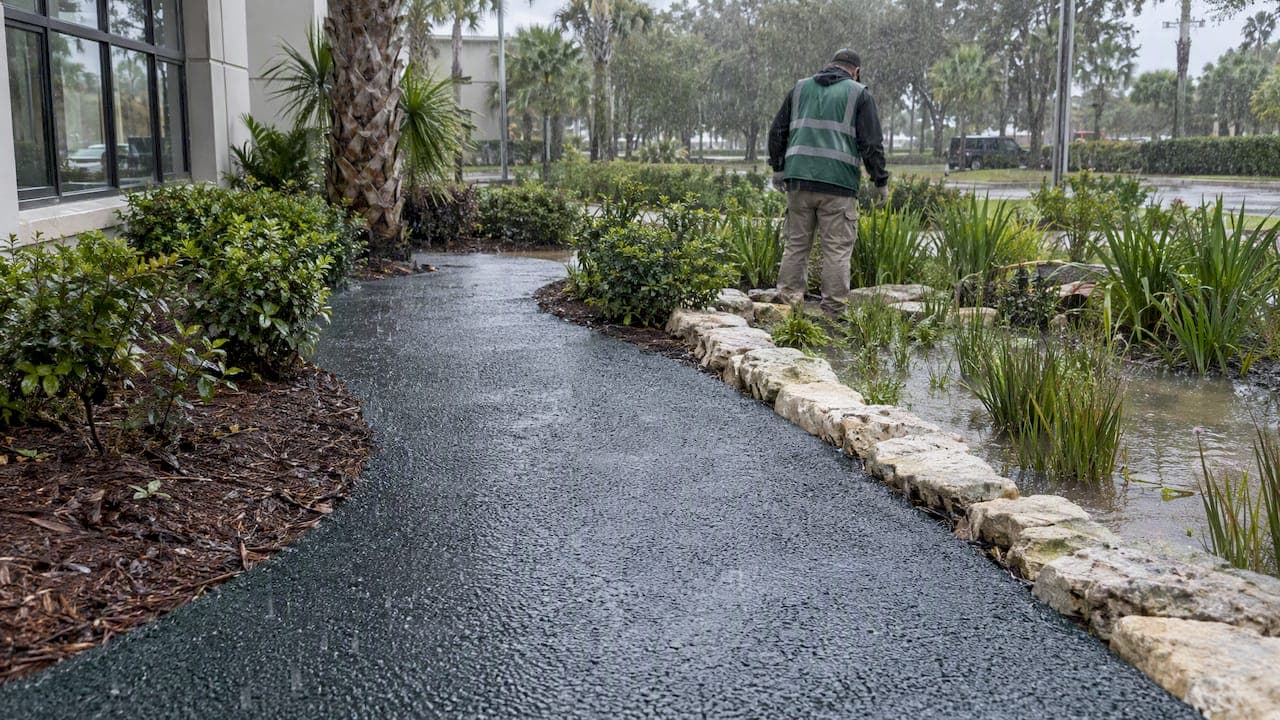
Porous rubber paving is a practical, permeable surfacing option for pedestrian and light-traffic public spaces when the base reservoir and maintenance plan are designed to manage infiltration and clogging. It combines recycled material content, resilience, and an ADA-friendly walking surface with real stormwater performance, but that performance depends entirely on getting the subsurface design and upkeep right.
TL;DR:
- Proper subsurface design, including a reservoir that drains within 24 to 72 hours, is essential for long-term stormwater infiltration performance.
- Adding crumb rubber to mixes slightly lowers strength but improves ductility and freeze-thaw resistance, with finer rubber retaining more strength.
- Installation quality heavily influences performance, requiring careful compaction, sequencing, and sediment control during construction.
- Maintenance involves regular inspections and vacuuming to prevent clogging, which is the leading cause of failure in permeable rubber surfaces.
- Cost depends on site-specific factors such as reservoir depth, pretreatment, underdrains, and installation requirements, with prices varying widely.
Table of Contents
- What Porous Rubber Paving Is and Where It Gets Used
- How Porous Rubber Surfaces Manage Stormwater
- Material Performance: Mixes, Strength, and Leaching Evidence
- Installation Essentials: Base Design and Construction Controls
- Maintenance, Inspection Schedule, and Remedial Triggers
- Pros, Cons, and Cost Drivers for Procurement
- How EcoTec Rubber Paving Builds Porous Rubber Projects
- When Porous Rubber Paving Makes Sense: a Practitioner's View
- Request a Site Assessment for Your Porous Rubber Project
- FAQ
- Sources
What Porous Rubber Paving Is and Where It Gets Used
Porous rubber paving is a permeable surfacing system made from recycled tire rubber bound into a void-filled mat that lets water pass through to an aggregate reservoir below. It sits in the same family as porous asphalt, pervious concrete, and permeable interlocking concrete pavers (PICP), but rubber offers more flexibility and a softer, slip-resistant walking surface than any of those alternatives.
Specifiers typically choose between a few variants:
- Pour-in-place rubber-only surfaces, bound with a urethane or polymer binder for a monolithic look.
- Rubber-and-aggregate blends that add stone for extra structural support.
- Binder chemistry variations (urethane versus other polymers) that affect flexibility, cure time, and UV stability.
Common applications include sidewalks, trails, tree wells, plazas, pool surrounds, and rooftop pedestrian areas, though rooftop use requires checking structural load limits before specifying a thick, saturated system.
How Porous Rubber Surfaces Manage Stormwater
A porous rubber surface works because its void structure lets rain pass directly through the mat rather than sheeting off into storm drains. Water then moves into a stone reservoir below, where it is stored temporarily and allowed to infiltrate into native soil or drain through an underdrain system.
Design guidance from the EPA's permeable pavement best practice calls for layered construction: a surface course, a choker course, a stone base reservoir, and, where soils drain poorly, a perforated underdrain tied into the storm system. The FHWA's permeable pavement guidance recommends designing the stored water in that reservoir to drain down within 24 to 72 hours, which keeps the system ready for the next storm and avoids standing water.
Getting this right involves a few sequential steps:
- Confirm native soil infiltration rate and water table depth before sizing the reservoir.
- Size the stone reservoir to capture the required storm volume with a 24 to 72 hour drawdown target.
- Add pretreatment, such as filter strips or sediment inlets, where upstream runoff carries heavy sediment loads.
- Build in an allowance for clogging over time so the design still performs at reduced capacity years later.
A properly designed stone reservoir with a 24 to 72 hour drawdown window is the single biggest factor in long-term infiltration performance, according to FHWA design guidance, which notes that subsurface design determines outcomes more than the surface material itself.
Material Performance: Mixes, Strength, and Leaching Evidence
Lab testing on rubber-modified pervious concrete gives specifiers a reasonably clear picture of the trade-offs. Adding crumb rubber to a pervious mix slightly lowers compressive strength and permeability, but it meaningfully increases ductility and freeze-thaw resistance, according to peer-reviewed testing of waste crumb rubber in pervious concrete. Fine crumb rubber retains more strength than coarse crumb rubber, which matters when a project needs both flexibility and load capacity.
Mix decisions that affect outcomes include:
- Crumb size: fine rubber trades less strength for ductility gains than coarse rubber.
- Rubber percentage: higher rubber content increases flexibility but reduces compressive strength further.
- Binder type: urethane and polymer binders affect both cure behavior and long-term permeability retention.
Dynamic column leaching tests (LEAF methods) give a more realistic picture of field leachate behavior from recycled rubber than older batch tests, supporting mitigation approaches like polyurethane coating or pre-washing to cut early leachate pulses.
Dynamic leaching and assessment of recycled polyurethane-coated tire rubber
Projects near sensitive waterways or wells should request site-specific leaching tests rather than relying on generic mix data.
Installation Essentials: Base Design and Construction Controls
Long-term performance depends more on what happens below the surface than what happens on top of it. FHWA's pervious concrete construction guidance stresses that pour timing, placement method, and avoiding over-troweling are critical to keeping void structure open, a lesson that applies directly to rubber-modified mixes too.
A standard build sequence looks like this:
- Prepare and compact the subgrade, checking infiltration rate and grading for positive drainage.
- Lay a geotextile fabric where soils are fine-grained, to prevent migration into the stone layers.
- Place the subbase reservoir stone, followed by a smaller choker course, compacting each lift without over-compacting the final layer.
- Install underdrains in poorly draining soils, and add an impermeable liner only where infiltration must be blocked entirely.
- Pour and finish the rubber surface course, protecting it and the open base from sediment until the project is complete.
Edge restraints matter wherever a porous surface transitions to vehicle traffic or a rigid curb, since unrestrained edges are a common early failure point.
Pro Tip: Keep sediment-laden runoff away from the open base during every phase of construction. A clean start adds years to the infiltration life of the finished surface.

For more on these sequencing and coordination issues, our rubberized paving guidance for owners and contractors walks through what to expect on site.
Maintenance, Inspection Schedule, and Remedial Triggers
Performance failures in permeable pavement are more often caused by deferred maintenance than by any material defect, per EPA's green infrastructure maintenance guidance. Budgeting for upkeep from day one avoids most of the common failure modes.
A workable inspection and maintenance routine includes:
- Visual inspection after major storms, checking for standing water or visible sediment buildup.
- A semiannual or annual infiltration check using a standard field test method.
- Routine vacuuming to remove fines, with deeper remediation triggered once infiltration rates drop noticeably.
- Pretreatment upkeep, since clean inlets and filter strips reduce how often the surface itself needs cleaning.
Clogging from fine sediment is the leading long-term risk to any permeable surface, and regenerative air sweeping alone often cannot remove deep fines. Specialized suction equipment, such as the DrainClear Pit & Trench Cleaner, is built for this kind of deeper drainage cleaning. Our guidance on reducing community maintenance covers how upfront design choices lower these ongoing costs.
Pros, Cons, and Cost Drivers for Procurement
Porous rubber paving brings real advantages for the right project, alongside limitations that procurement teams should plan around.
- Advantages: recycled tire content, slip resistance, flexibility under freeze-thaw cycling, and reduced need for separate drainage infrastructure.
- Limitations: lower load capacity for heavy vehicles, ongoing clogging risk, and a maintenance commitment that cannot be skipped.
- Cost drivers: reservoir and subbase depth, pretreatment devices, underdrain installation, specialized installers, and maintenance equipment over the life of the surface.
Projects with heavy truck traffic or minimal maintenance budgets should weigh these limitations carefully before committing to a porous rubber specification.
How EcoTec Rubber Paving Builds Porous Rubber Projects
We design installations around recycled rubber content, ADA compliance, and the documentation municipalities need for procurement sign-off. A typical proposal includes:
- A site evaluation covering soil infiltration, drainage goals, and existing grading.
- Base and subbase design sized for the site's stormwater capture requirements.
- A maintenance plan tailored to the site's traffic and sediment exposure.
- ADA compliance checks built into the surface specification from the start.
Designers can review our Rubberway® pervious pavement and product line specs and our ADA compliance guidance for architects when drafting a project scope.
When Porous Rubber Paving Makes Sense: a Practitioner's View
I recommend porous rubber paving for pedestrian plazas, sidewalks, and trails where stormwater goals matter and someone will actually maintain the surface. I steer clients away from it on sites carrying heavy truck traffic or with no budget for periodic vacuuming and inspection, since the surface only performs as well as the plan behind it.
— Roger
Request a Site Assessment for Your Porous Rubber Project
We start every project with a site assessment, so having your area measurements, expected traffic loads, stormwater objectives, and a few site photos ready speeds things up. From there, we put together a proposal covering the site survey, a base and surface specification, and a maintenance plan built around your site.
Reach out through Ecotecrubber to get a site assessment started, or browse our Rubberway® product lines if you're still comparing specs.
FAQ
What are the disadvantages of rubber pavers?
Rubber pavers carry lower load capacity than concrete or asphalt, which limits their use on heavy-vehicle routes, and they require a maintenance commitment to prevent clogging over time. Leaching from recycled rubber content is also a consideration on sensitive sites, which dynamic leaching research suggests can be mitigated with coating or washing treatments.
How much does porous pave cost?
Published pricing for porous rubber paving varies by site conditions and is not listed publicly for most installers, including our own projects, so cost is best confirmed through a site-specific proposal. Base depth, pretreatment devices, underdrains, and specialized installation labor are the main cost drivers to expect in any quote.
What are the downsides of porous asphalt?
Porous asphalt depends heavily on construction quality, since improper placement or compaction can close the void structure needed for infiltration, as FHWA's construction guidance notes for pervious mixes generally. It also faces the same clogging and maintenance demands as other permeable surfaces, and its rigid surface lacks the flexibility rubber-modified systems offer.
What are the disadvantages of rubberized asphalt?
Rubberized asphalt mixes can show reduced permeability compared to unmodified porous mixes depending on rubber content and binder type, per peer-reviewed testing on crumb rubber in pervious mixes. It also still requires the same subsurface reservoir design and maintenance routine as any permeable pavement to perform reliably over time.
Sources
- NPDES: Stormwater Best Management Practice — Permeable Pavements (EPA)
- Use of Permeable Pavements (FHWA)
- Mechanical properties, permeability, and freeze–thaw resistance of pervious concrete modified by waste crumb rubbers
- Dynamic leaching and assessment of recycled polyurethane-coated tire rubber (research article)