
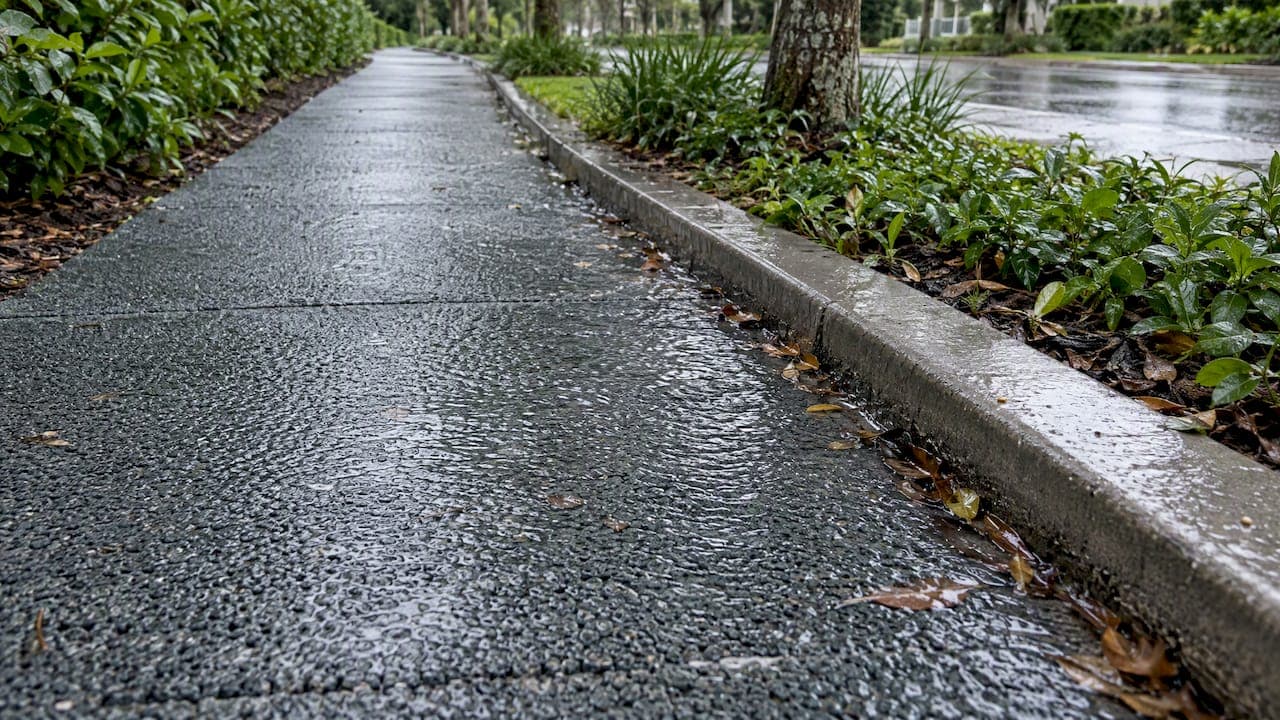
Porous sidewalk drainage works by letting rain pass through the surface pores or joints into a stone reservoir, where it either soaks into the native soil or leaves through an underdrain. Designers choose full infiltration, partial infiltration with an underdrain, or no infiltration with a liner, based on how well the soil drains and how deep the groundwater sits.
TL;DR:
- Full infiltration needs soil permeability near 0.5 inches per hour and about 4 feet between the reservoir bottom and seasonal groundwater or bedrock.
- Target reservoir drawdown within 48 to 72 hours, using an underdrain for slow soils and a liner when polluted runoff threatens groundwater.
- Record initial surface infiltration and inspect after storms; a roughly 25% decline or visible ponding calls for deep cleaning, while slow outlets may need flushing.
- Choose pavers when utility access and repairability matter, but reserve open cell grids for secondary routes because they do not provide a smooth accessible surface.
- Include observation wells and a safe overflow route from the start; wells show whether stored water drains on schedule after storms.
Table of Contents
- How does water move through a porous sidewalk?
- Which materials make a sidewalk permeable?
- What design conditions decide between infiltration and drainage?
- What drainage numbers should you expect?
- How do you inspect and maintain a porous sidewalk?
- When should you avoid porous sidewalks, or change the design?
- How does rubber paving compare with traditional porous materials?
- Why does recycled rubber matter for porous pavement?
- What does a porous rubber sidewalk installation involve?
- How do you maintain porous rubber over the long term?
- How does ADA compliance affect porous sidewalk drainage?
- What should you check before you commit to a porous sidewalk?
- Our Rubberway® pervious sidewalk systems
- FAQ
- Sources
How does water move through a porous sidewalk?
Picture the sidewalk as a layered sponge sitting on a gravel tank. Rain lands on the surface and passes through pores in the pavement itself or through open joints between paving units. From there it drops into a bedding layer and then into a reservoir of open-graded stone, where it is held while it slowly leaves the system. The FHWA guidance on permeable interlocking concrete pavement lays out three ways that stored water can exit: full infiltration, partial infiltration with underdrains, and no infiltration with a geomembrane liner.
A typical cross section, from the top down, includes these parts:
- Surface course: pervious concrete, porous asphalt, pavers with open joints, or a porous rubber layer. This is where water enters.
- Bedding or choker layer: a thin layer of small, clean stone that supports the surface and keeps fines from migrating into the reservoir.
- Stone reservoir: open-graded aggregate with a lot of void space. This is the storage that buys the system time during a storm.
- Geotextile: a fabric that separates the reservoir from the native soil so soil particles do not move up into the stone.
- Subgrade: the native soil, left uncompacted wherever infiltration is intended. Compacting it squeezes out the pores that carry water down.
- Underdrain (when used): a perforated pipe set in the reservoir that carries water away if the soil cannot absorb it fast enough.
The path water takes depends on which of those parts are included. In a full-infiltration design, there is no pipe: the soil is the only exit. In a partial-infiltration design, the pipe sits slightly above the bottom of the reservoir, so the lower portion of the stone still stores water that can seep into the ground while the upper portion drains by gravity. In a no-infiltration design, a liner keeps water out of the soil, and the pipe is the only way out.
Edges, curbs, and overflow
The parts around the pavement matter as much as the pavement. Edge restraints keep paving units and surface courses from spreading under foot traffic and maintenance equipment. Curb details control where water goes when the reservoir is full, and a sidewalk next to a building needs a deliberate overflow path so stored water never backs up against a foundation. Many designs include an overflow inlet or a graded spill point set at a safe elevation, so extreme storms release water in a controlled way rather than finding their own route.
Geotextiles deserve a note of their own. They protect the stone from soil intrusion, but a fabric placed carelessly can become the clogging layer itself. Installers keep the reservoir clean during construction and protect it from muddy runoff until the surface is in place, which is one of the maintenance themes municipal guides stress, as in Montgomery County's porous pavement maintenance pamphlet.
Proving that the system drains
Designers do not guess whether a reservoir empties on schedule. They install observation wells, which are perforated vertical pipes that let someone look down into the stone and see how much water remains after a storm. The FHWA guidance recommends observation wells and underdrains as tools for controlling drawdown and outflow. Pair a well with a record of storm dates and water levels, and you can tell whether the reservoir is emptying as designed or holding water longer than it should. Another FHWA-cited report on the design points out that underdrains are often best practice and that overflow paths and monitoring points belong in the design from the start.

If you want a shorter overview before going deeper, our explainer on what permeable paving is, its benefits, types, and cost covers the basics.
Which materials make a sidewalk permeable?
Four system types dominate permeable sidewalk work. They all share the same logic of surface, bedding, and stone reservoir, but each handles water and wear differently. The EPA's Soak Up the Rain guidance groups them as pervious asphalt, pervious concrete, pavers, and plastic grids, and notes that all of them reduce runoff and can filter pollutants.
Pervious concrete
Pervious concrete is made with little or no fine sand, which leaves an interconnected network of voids. Water passes straight through the slab into the base. Sidewalks and low-volume streets commonly use slabs of 5 to 8 inches, according to the FHWA permeable concrete tech brief, which also stresses that the material is weaker than conventional concrete and needs careful mix design, subbase support, and maintenance. Trial batches are standard practice for tuning the balance between strength and porosity for local materials.
Good fits and cautions:
- Pedestrian walkways, plazas, and low-traffic paths where its light-duty strength is enough.
- Sites where a continuous, jointed surface is preferred over individual units.
- Placement matters a great deal: a New Jersey DOT study of porous concrete for sidewalks found that performance depends on placement and maintenance, and that initial cost can run slightly higher than conventional concrete.
Permeable interlocking concrete pavers (PICP)
PICP uses solid concrete units with open joints filled with small stone. The units themselves do not absorb water; the joints do. Beneath them sits the same kind of open-graded base and reservoir. Because the surface is made of individual units, a utility cut or a settled area can be repaired by lifting and resetting pavers rather than breaking out a slab, and the units allow patterns and colors that pour-in-place surfaces cannot match.
Good fits and cautions:
- Walkways that may need future utility access.
- Projects where appearance and repairability matter.
- Joints need periodic attention, since sediment collecting in them is the main way the surface loses capacity.
Porous asphalt
Porous asphalt is an open-graded asphalt mix placed over a stone reservoir. The FHWA tech brief on porous asphalt describes benefits including stormwater treatment and recharge, and its design guidance covers slope limits, underdrains and overflows, frost-depth considerations, and regular inspection and cleaning.
Good fits and cautions:
- Shared-use paths and walkways that connect to asphalt parking areas.
- Sites where crews and equipment for asphalt are already on hand.
- Needs the same protection from sediment as other porous surfaces.
Open-cell grid pavers
Plastic or concrete grids filled with gravel or planted with grass give a lightweight, low-load option. They suit service paths, overflow walkways, and places where a green or gravel look is wanted. They do not offer the smooth, continuous surface that wheelchairs and strollers need, so they fit secondary routes better than primary accessible ones.
Porous rubber
Porous rubber surfaces bind recycled rubber into a flexible, water-passing layer. We cover how that compares with the materials above later in this article.
What design conditions decide between infiltration and drainage?
Whether a porous sidewalk soaks water into the ground or sends it down a pipe is decided by the site, not by preference. Designers work through a short sequence of checks, and each one can change the design. The University of Nevada Extension guidance on porous pavement puts it plainly: porous paving design must be site-specific, and underdrains, liners, or other features are used when soils or groundwater prevent full infiltration.
The usual sequence looks like this:
- Test the native soil. Field-verified infiltration rates beat lab estimates or soil-map guesses. Some manuals set a minimum soil permeability of about 0.5 inches per hour for a full-infiltration design. Slower soils call for an underdrain.
- Check groundwater and bedrock depth. Guidance commonly asks for about 4 feet (1.2 m) of vertical separation between the bottom of the reservoir and the seasonal high water table or bedrock. Less separation pushes the design toward a liner or a different surface.
- Screen the runoff. If the water arriving at the sidewalk could carry fuels, chemicals, or heavy pollutants, infiltration may endanger groundwater. A liner and an underdrain keep that water out of the soil.
- Check the slope. The FHWA porous asphalt brief recommends surface slopes under 5 percent for parking areas, and the Nevada guidance notes that systems need flat or gentle slopes. On steeper ground, designers step the reservoir in terraced cells with check dams so water does not rush downhill through the stone.
- Consider frost depth. Where the ground freezes, the reservoir has to be deep enough, or insulated enough, that frozen soil does not block drainage or heave the surface.
- Confirm the load. A pedestrian-only walkway has few demands. If trucks, snowplows, or delivery vehicles will cross it, the base and edge details change.
When an underdrain earns its place
An underdrain does not mean the system has given up on infiltration. In partial-infiltration designs, it acts as drawdown control, making sure the reservoir empties on schedule even when the soil is slow. The FHWA PICP guidance treats underdrains and observation wells together as the way to control drawdown and outflow. In no-infiltration designs, with a geomembrane liner under the stone, the pipe becomes the system's only exit, and it must connect to a safe outfall.
Our engineer-focused post on stormwater management paving solutions walks through how these decisions fit into wider site designs.
Slope and drainage around the sidewalk
Water does not respect the edge of the pavement. Rainwater management for sidewalks only works if the surrounding ground sends water toward the system or safely away from it. That is why grading around a porous walkway matters as much as the walkway itself. A good example from outside the sidewalk world is pool deck work, where Longhorn Pools recommends starting with a slope of 1/8 to 1/4 inch per foot so that surface water moves off the deck. The same discipline of small, deliberate slopes applies when you plan how stormwater will reach a porous surface and where overflow will go.
What drainage numbers should you expect?
Porous pavement is specified by numbers, and knowing them helps you spot a system that is underperforming.
Void content. Pervious concrete holds open space inside the slab. ACI Committee 522 reports that void contents commonly range from 15 to 35 percent, while the FHWA permeable concrete tech brief cites a typical range of about 15 to 25 percent. The two ranges overlap because they describe slightly different populations of mixes; a mix near the high end drains well but gives up strength.
Drainage rate. The surface itself can pass far more water than almost any storm delivers.
Storage. The stone reservoir sets how much water the system can hold. Available storage equals reservoir depth multiplied by the stone's porosity, and the open-graded stone commonly used in these designs holds a large share of its volume as void space. A deeper reservoir holds more water, which is why designers raise depth rather than surface area when space is tight.
Drawdown. Design practice targets emptying the stored water within 48 to 72 hours. That window prepares the system for the next storm and prevents standing water in the reservoir from lingering. Our engineering post on 48 to 72 hour drawdown specifications for porous rubber paving takes a closer look at drawdown targets.

Field verification. Observation wells show how long water remains in the reservoir, and standard surface infiltration tests, such as the ASTM methods, measure how fast water enters the surface. Initial test results become the baseline against which later results are compared.
ACI Committee 522 reports pervious concrete drainage rates generally fall between 2 and 18 gal./min/ft² (81 to 730 L/min/m²). That range means a new, clean surface is almost never the limiting factor. If water ponds on a young pavement, the cause is usually clogging, a compacted subgrade, or a blocked outlet, not the surface's raw capacity.
How do you inspect and maintain a porous sidewalk?
Porous pavement keeps working only if its pores stay open. The EPA and state stormwater manuals summarized in the Soak Up the Rain guidance recommend inspection, maintenance, and appropriate siting to manage clogging. The good news is that the routine is simple.
Inspection cadence. Inspect the surface regularly for ponding, sediment piles, vegetation growing in joints, and spots where runoff from adjacent landscaping washes soil onto the pavement. After heavy storms, check observation wells and outlets.
Cleaning hierarchy. Start with the lightest method that works and escalate only when needed:
- Routine sweeping to remove loose debris before it works into the pores.
- Deep cleaning with full vacuum extraction or pressure washing when sediment has packed into the surface. All Day Power Washing describes commercial sidewalk cleaning schedules and heavy-duty techniques that apply when a surface needs more than a sweep.
- Underdrain flushing when the pipe runs slowly. Flush the line, then inspect the outfall to confirm that water leaves freely.
Performance trigger. Measure the surface infiltration rate when the system is new and then again as it ages. A drop of roughly 25 percent from the initial rate, or visible ponding after rain, is the signal to move from routine care to deep cleaning.
Budgeting matters here. A sidewalk that is cleaned on schedule keeps its drainage; one that is ignored loses it. Our homeowner's guide to outdoor paving drainage covers planning for upkeep costs and simple inspection steps.
When should you avoid porous sidewalks, or change the design?
Porous sidewalks suit many sites, but some conditions call for a different approach or added protection. The common cases and their usual fixes:
- Shallow groundwater, karst, or bedrock. When there is too little vertical separation, infiltrating water can reach groundwater with little filtering, or fail to drain at all. Designers use an impermeable liner and an underdrain, or choose a non-infiltrating surface.
- Contaminated runoff. Where fuel, chemicals, or heavy pollutants can reach the surface, infiltration puts groundwater at risk. A liner with a controlled outlet keeps that water out of the soil.
- High sediment loads. Bare soil upslope, construction activity, or frequent winter sanding can clog the surface quickly. Options include diverting sediment-laden runoff around the pavement, adding pretreatment, or committing to a tighter cleaning schedule.
- Heavy loads or turning vehicles. Delivery trucks, snow removal equipment, or frequent vehicle turning can damage a light-duty surface. Designers specify systems and bases rated for higher traffic, or use a stabilized base course, and keep vehicle routes off pedestrian-only sections.
- Steep slopes. Water moves through the reservoir downhill and can emerge where it is not wanted. Terraced cells and check dams slow it down.
None of these conditions means the idea has failed. They mean the cross section has to change, which is the whole point of site-specific design.
How does rubber paving compare with traditional porous materials?
Our Rubberway® systems are porous rubber surfaces built from recycled tire material, installed as a finished, continuous walking surface. Where pervious concrete, porous asphalt, and pavers rely on rigid material with voids, rubber paving is flexible, which affects how it handles wear and movement.
On drainage, a porous rubber surface passes water through its structure into the base below, the same basic logic as any permeable pavement. That makes it a direct option for the same applications: sidewalks, pool decks, patios, and trails. Because it is a pour-in-place or installed layer rather than a set of units, there are no joints that fill with sediment, which is one of the main clogging points on paver systems.
On durability, we designed Rubberway® for crack resistance in Florida's heat and weather. Rigid pavements can crack from tree roots, soil movement, or thermal stress, and cracks both interrupt drainage paths and create trip hazards. A flexible surface moves with those forces instead of breaking. Our product overview lists the lines we install, including Rubberway® Pervious Pavement and the Rubberway Sidewalk System.
Why does recycled rubber matter for porous pavement?
The raw material in our surfaces is recycled tire rubber, which keeps used tires out of landfills and gives them a second, long-lived job. Putting that material into a pavement turns a disposal problem into infrastructure.
The sustainability story and the drainage story reinforce each other. A porous surface reduces runoff, and as the EPA notes, permeable pavements can filter pollutants and help meet low-impact development goals. Pairing that function with recycled content means a single installation can serve two environmental aims: managing stormwater where it falls and using material that would otherwise be waste.
There is a practical side too. Because water drains through the surface instead of pooling on it, standing water is less of a problem, and so are the mosquito breeding and slick patches that come with it. We cover broader installation considerations in our sustainable paving installation best practices guide.
What does a porous rubber sidewalk installation involve?
A porous rubber sidewalk begins with the ground, not the surface. Our crews prepare the area by removing existing material, setting the grade so water moves the way the design intends, and building a stable, free-draining base. Because a porous surface depends on the layers below it, base preparation is where drainage performance is won or lost.
The sequence generally runs like this:
- Site evaluation to review drainage conditions, existing slopes, and where water should go.
- Excavation and grading to the planned profile, with attention to edges and transitions.
- Base construction with materials that pass water and give firm support.
- Surface installation, where the rubber layer is placed and finished to a smooth, even walking surface.
- Curing, during which the surface sets before it takes foot traffic.
Curing times depend on temperature, humidity, and the specific system, so we give each project a schedule rather than one number for all conditions. Ask us for the cure window and the date the surface can open for use when we quote your site. Project timing and access details for homeowners, businesses, municipalities, and HOAs are available through our installation services page.
How do you maintain porous rubber over the long term?
Rubber surfaces have their own aging profile, and it differs from concrete's. The concerns that matter most are sunlight, heat, and the slow effects of weather over many years.
UV exposure. Sunlight can fade color and, over a long span, change the surface of any outdoor polymer. Choosing a quality binder and pigment system, and cleaning the surface so grime does not hold heat or hide early wear, helps keep the finish consistent.
Heat and weather. Florida's heat is part of why we engineered our systems for the climate. Flexible rubber avoids the thermal cracking that rigid surfaces can develop.
Keeping pores open. The same principle that applies to every porous pavement applies here: leaves, soil, and fine sediment are the enemy. Routine sweeping and occasional washing keep water moving through the surface. The regular inspection habit described earlier works for rubber just as well as for concrete.
Watching for wear. Check edges, transitions, and high-traffic spots for any loosening or abrasion, and report it early so repairs stay small. We can advise on spot repairs and cleaning methods suited to our products when you contact us.
How does ADA compliance affect porous sidewalk drainage?
An accessible route has to be firm, stable, and slip-resistant, and drainage design has to respect those requirements rather than work against them. That is a strong argument for a continuous porous surface over a loose or open-celled one: water drains through it, yet wheelchairs, walkers, and strollers roll across a smooth, even plane.
Our Rubberway® surfaces are ADA-compliant, and the drainage design supports that in practical ways:
- Standing water is removed from the route, which reduces slip hazards and ice formation where freezing occurs.
- Cross slopes stay gentle. Accessible routes limit how steeply a surface can tilt sideways, so drainage must come from the porous structure and a controlled base grade, not from steep crowning.
- Surface texture stays consistent, with no open joints or grids that catch cane tips or small wheels.
- Transitions are flush, so curbs, ramps, and adjoining pavements do not create lips that stop drainage or block passage.
Designing these together from the start is easier than fixing them later. When we evaluate a site, accessibility and drainage targets go into the same plan.
What should you check before you commit to a porous sidewalk?
Having read widely on this subject, my view is that most porous pavement failures are not material failures. They are information failures: nobody measured the soil, nobody wrote down a maintenance plan, or nobody told the owner that the surface needs care. The material gets blamed for what a missing spec caused.
A short checklist keeps a project honest:
- Site infiltration test results, with locations marked.
- A stated drawdown time for the reservoir.
- A written maintenance schedule with access for cleaning equipment.
- Warranty terms and the contractor's track record with similar surfaces.
Ask any contractor for initial surface infiltration measurements and a written plan that includes scheduled deep cleaning. Then budget for upkeep across the life of the sidewalk, because infiltration performance depends on it as much as on the original installation.
— Roger
Our Rubberway® pervious sidewalk systems
If you want a porous, durable, ADA-compliant sidewalk that handles drainage as part of the finished surface, we install it. Rubberway® Pervious Pavement and the Rubberway Sidewalk System are engineered porous rubber installations made with recycled materials, and we are licensed and insured. When you contact us, ask for a site evaluation, infiltration and drawdown targets, a written maintenance plan, references, and licensing and insurance confirmation. Browse our Rubberway product lines, then reach out through our installation services page to start your project inquiry.
FAQ
What are the different types of permeable pavement materials?
The main types are pervious concrete, porous asphalt, permeable interlocking concrete pavers, and plastic or concrete grid pavers. The EPA's permeable pavement overview groups them together. Porous rubber is another option for walkways.
Can porous pavement clog?
Yes, sediment can fill the pores and joints over time and slow drainage. Regular sweeping, vacuum cleaning, and deep cleaning when infiltration drops keep it working. Most manuals call for inspection and routine cleaning for this reason.
Is a permeable surface cheaper than concrete?
Not always. A New Jersey DOT study found that porous concrete's initial cost can be slightly higher than conventional concrete for sidewalks without subsurface drainage. Savings can come from reduced need for separate storm drains, as shown in a field guide case example.
What is the cheapest porous option available?
Prices vary by site, material, and base requirements, so no single option is always cheapest. Open-cell grids filled with gravel often cost less up front but suit only light-duty, secondary routes. For a quote on a rubber paving project, contact us for pricing on request.