
UV resistance is the property of paving materials that enables them to withstand damaging ultraviolet radiation from sunlight, protecting their color, strength, and lifespan in outdoor environments. The role of UV resistance in paving is not cosmetic. It determines whether a surface holds up for decades or begins failing within months. Property owners, contractors, and municipalities that ignore UV stability during material selection pay for it through premature cracking, fading, and costly repairs. Understanding how UV radiation attacks pavement, and how materials fight back, is the foundation of every smart paving decision.
How does UV radiation damage paving materials?
UV degradation in paving begins at the molecular level through a process called photo-oxidation. When ultraviolet radiation strikes a paving surface, it triggers chain scission and radical generation inside the material's polymer structure. This breaks apart the long molecular chains that give the material its strength and flexibility. The result is a surface that becomes brittle, discolored, and structurally weaker over time.
The visible signs of photo-oxidation are easy to recognize once you know what to look for. Surface chalking appears first, followed by fading and discoloration. Then micro-cracks form, spreading across the surface as the material loses its ability to flex under load or temperature change. These cracks are not just cosmetic. They allow water to penetrate, which accelerates freeze-thaw damage and undermines the base layer.
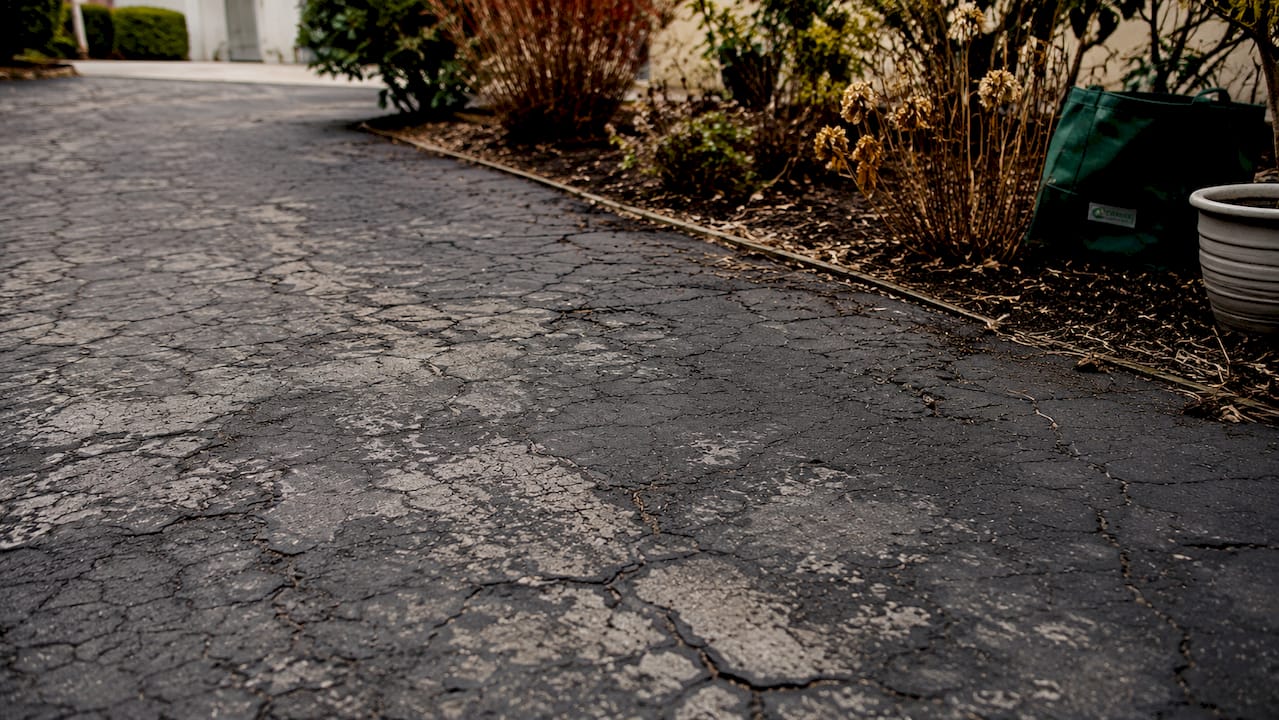
Asphalt binders, resins, and plastic-based pavers are all vulnerable to this process. Asphalt loses its binding oils through UV-driven oxidation, turning from a flexible black surface to a gray, brittle one. Resin-bound surfaces yellow and lose clarity. Polymer pavers made from materials like polypropylene fade and weaken at the surface.
Residual internal stresses in paving materials make UV-induced microcracking worse. Poor installation practices that leave materials under stress accelerate failure. This is why installation quality and UV resistance are inseparable topics.
Pro Tip: Inspect paving surfaces annually for surface chalking and gray discoloration. These are the earliest warning signs of UV degradation, and catching them early allows for protective treatment before structural damage sets in.
What paving materials offer the best UV stability?
Not all paving materials age the same way under sunlight. The difference between a surface that lasts five years and one that lasts twenty often comes down to the UV stability of the base material. Understanding these differences helps you compare paving surface materials before committing to a project.
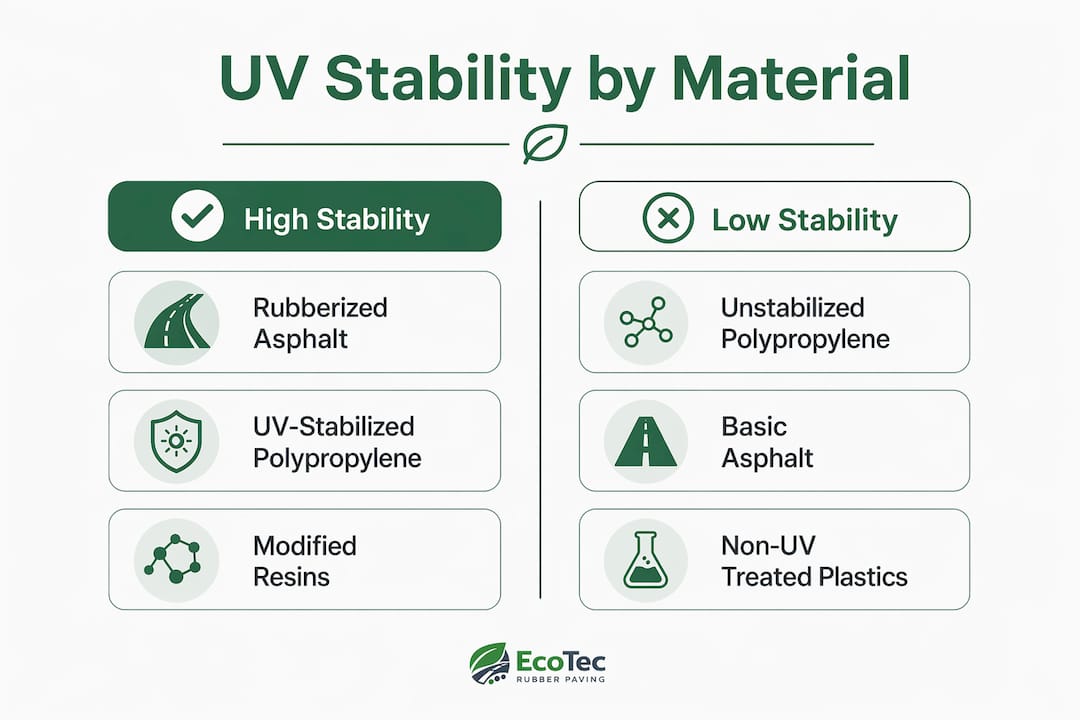
Unstabilized polypropylene degrades visibly within 3–6 months of outdoor exposure. UV-stabilized polypropylene extends that to 5–10 years. ASA (acrylonitrile styrene acrylate) is inherently UV-stable and can exceed 10 years without significant degradation. That gap in performance is enormous for any outdoor paving application.
| Material | UV Stability | Typical Lifespan Outdoors | Common Failure Signs |
|---|---|---|---|
| Unstabilized polypropylene | Low | 3–6 months | Fading, chalking, cracking |
| UV-stabilized polypropylene | Moderate | 5–10 years | Gradual color loss |
| ASA polymer | High | 10+ years | Minimal under normal exposure |
| HDPE | Moderate to high | 5–10 years (stabilized) | Surface yellowing |
| Standard asphalt binder | Low to moderate | Varies by climate | Graying, brittleness, raveling |
| Modified asphalt (e.g., Buton rock asphalt) | Moderate to high | Improved over standard | Slower oxidation, better flexibility |
The chemistry of asphalt modifiers matters as much as the base material. Compatibility between modifiers and petroleum asphalt directly influences UV aging resistance. Better compatibility reduces chemical oxidation rates and preserves mechanical properties during UV exposure. This is why modified asphalts, when properly formulated, outperform standard mixes in sun-intensive climates like Florida.
Selecting an inherently UV-stable polymer reduces the burden on added stabilizers and improves long-term performance. ASA, for example, requires far less additive support than polypropylene to achieve the same outdoor durability. That matters for lifecycle cost, not just initial material price.
Key signs that a material's UV stability is failing:
- Surface color shifts from original tone toward gray, yellow, or white
- Chalky residue that transfers to the touch
- Visible micro-cracks forming in a network pattern
- Loss of surface texture and increased brittleness
- Reduced flexibility under thermal expansion and contraction
How do additives and engineering improve UV protection?
Material selection sets the ceiling for UV performance, but additives determine how close a product gets to that ceiling. Two categories of additives define modern UV protection in paving materials: UV absorbers and hindered amine light stabilizers, known as HALS.
UV absorbers work by capturing ultraviolet radiation before it can trigger photo-oxidation. They convert the harmful UV energy into heat, which dissipates harmlessly. Common UV absorbers include benzophenones and benzotriazoles, both widely used in outdoor polymer applications. They act as a first line of defense, reducing the amount of damaging radiation that reaches the polymer chains.
HALS work differently. Rather than blocking UV radiation, they scavenge the free radicals that photo-oxidation generates. Free radicals are the reactive molecules that break down polymer chains and cause brittleness and discoloration. HALS interrupt this chain reaction, slowing degradation significantly.
Combining UV absorbers with HALS produces significantly more durable UV protection than using either alone. The synergistic effect means the two additives cover different stages of the degradation process, giving the material protection at multiple points. This combination is now standard in high-performance outdoor paving polymers.
Additive ratios and installation quality both affect how well these protections perform in the field. Overloading a mix with stabilizers does not linearly improve performance and can affect other material properties. Proper formulation requires balancing protection with structural integrity.
Pro Tip: When specifying paving materials for high-sun environments, ask suppliers for documented UV stabilizer packages and accelerated weathering test results. ASTM G154 and ISO 4892 are the standard test methods for UV resistance in plastics. A supplier that cannot provide these results is a red flag.
For high-traffic paving solutions, UV resistance and mechanical durability must work together. A material that resists UV but cracks under load fails just as quickly as one that holds up structurally but fades and chalks within a season.
What are the real-world impacts of UV resistance on pavement life?
UV resistance translates directly into dollars, aesthetics, and maintenance schedules. A surface that holds its color and flexibility under sun exposure requires less frequent sealing, patching, and replacement. One that degrades quickly creates a cycle of repair costs that compounds over time.
The "shadow effect" is one of the most striking examples of UV damage in resin-bound surfaces. Non-UV resistant resins create permanent discoloration outlines where objects like planters, furniture, or vehicles block sunlight. The shaded areas retain their original color while exposed areas fade, leaving a permanent ghost image on the surface. This effect destroys the appearance of commercial and residential paving and is entirely preventable with UV-stable materials.
One of the most persistent misconceptions in paving is that shade protects surfaces from UV damage. UV radiation penetrates cloud cover and reaches north-facing and shaded paving surfaces, causing yellowing and degradation over time. A surface under a pergola or tree canopy still receives diffuse UV radiation. Specifying UV-resistant materials for every outdoor surface, regardless of shade, is the only reliable approach.
Pavement UV resistance is not a luxury specification for sunny climates. It is a baseline requirement for any outdoor surface expected to perform for more than a few years. The cost difference between UV-stabilized and unstabilized materials is small compared to the cost of early replacement.
Practical steps for maintaining UV resistance over a surface's life include:
- Apply UV-protective sealers on asphalt surfaces every 2–3 years to replenish oxidized binders and slow further degradation.
- Choose materials with documented UV stabilizer packages rather than relying on color retention alone as a proxy for UV performance.
- Inspect surfaces after the first full summer season to catch early chalking or micro-cracking before it spreads.
- Follow manufacturer curing guidelines precisely. Thermo-oxidative aging during mixing and installation compromises long-term UV resistance, and poor curing accelerates this damage.
- For municipalities managing large surface areas, schedule UV performance audits as part of annual infrastructure assessments rather than waiting for visible failure.
Sustainable paving installation practices reinforce UV resistance by reducing the internal stresses that accelerate microcracking. Proper compaction, controlled curing temperatures, and quality material handling all extend the effective UV protection life of any paving system.
Key Takeaways
UV resistance is the single most important factor separating paving materials that hold up outdoors from those that fail prematurely, and no outdoor surface is exempt from its effects.
| Point | Details |
|---|---|
| UV damage starts at the molecular level | Photo-oxidation breaks polymer chains, causing brittleness, chalking, and cracking before visible failure appears. |
| Material choice sets the UV ceiling | ASA and stabilized HDPE outlast unstabilized polypropylene by years; choose base materials with inherent UV stability. |
| Additives work best in combination | Pairing UV absorbers with HALS delivers far stronger protection than either additive used alone. |
| Shade does not equal UV protection | UV radiation penetrates clouds and diffuse light, degrading shaded and north-facing surfaces just as surely as exposed ones. |
| Installation quality affects UV life | Poor curing and mixing practices accelerate UV degradation; follow documented installation standards on every project. |
What I've learned from watching UV failures in the field
I've seen contractors specify materials based on price per square foot and then spend twice that amount on repairs within three years. The pattern is consistent. A property looks fine at installation, holds up through the first winter, and then the Florida sun does its work. By year two, the surface is chalking. By year three, the cracks are visible. By year four, the client is calling for a full replacement.
The part that frustrates me most is how preventable it is. The cost difference between a UV-stabilized material and an unstabilized one is rarely significant at the project level. What is significant is the difference in outcome. A surface specified with proper UV absorbers and HALS, installed correctly with controlled curing, will still look and perform well a decade later. The unstabilized version will not.
The shade misconception is the one I correct most often. Property owners see a tree-lined walkway or a covered parking area and assume UV is not a concern. UV radiation reaches those surfaces through diffuse light and cloud penetration. I have seen shaded resin surfaces develop the shadow effect just as badly as fully exposed ones, because the installer assumed the canopy provided protection.
My recommendation is simple. Treat UV resistance as a non-negotiable specification, not an upgrade. Ask for test data. Verify additive packages. Confirm installation protocols. The materials that perform best long-term are not always the most expensive. They are the ones specified and installed with UV degradation in mind from the start.
— Roger
Ecotecrubber's UV-resistant paving solutions for Florida
Florida's sun intensity makes UV resistance a baseline requirement, not a bonus feature. Ecotecrubber's Rubberway® paving system is engineered for exactly this environment, using recycled rubber materials that resist UV-driven cracking and color degradation across residential, commercial, and municipal applications.
Ecotecrubber installs Rubberway® surfaces that maintain their integrity and appearance under sustained UV exposure, with professional installation practices that protect long-term performance from day one. The system also delivers ADA-compliant, permeable surfaces that address drainage and heat-related cracking alongside UV durability. Property owners and municipalities in the Tampa Bay and Sarasota areas can explore the full product range or contact Ecotecrubber directly to discuss UV resistance requirements for a specific project.
FAQ
What is UV resistance in paving materials?
UV resistance is the ability of a paving material to withstand ultraviolet radiation without losing color, flexibility, or structural integrity. Materials with high UV resistance maintain their appearance and mechanical properties far longer than unstabilized alternatives.
How quickly does UV damage affect paving surfaces?
Unstabilized polymers like polypropylene can show visible degradation within 3–6 months of outdoor exposure. UV-stabilized materials extend that timeline to 5–10 years or more, depending on the base material and additive package.
Does shade protect paving from UV damage?
No. UV radiation penetrates cloud cover and reaches shaded and north-facing surfaces through diffuse light. Every outdoor paving surface requires UV-resistant materials regardless of how much direct sunlight it receives.
What additives improve UV resistance in paving?
UV absorbers and hindered amine light stabilizers (HALS) are the two primary additive categories. Used together, they provide significantly stronger protection than either additive alone by blocking radiation and neutralizing the free radicals it generates.
How does installation quality affect UV resistance?
Poor curing and thermo-oxidative stress during mixing accelerate UV degradation over time. Proper installation practices, including controlled curing temperatures and quality material handling, preserve the UV protection built into the material from the start.