

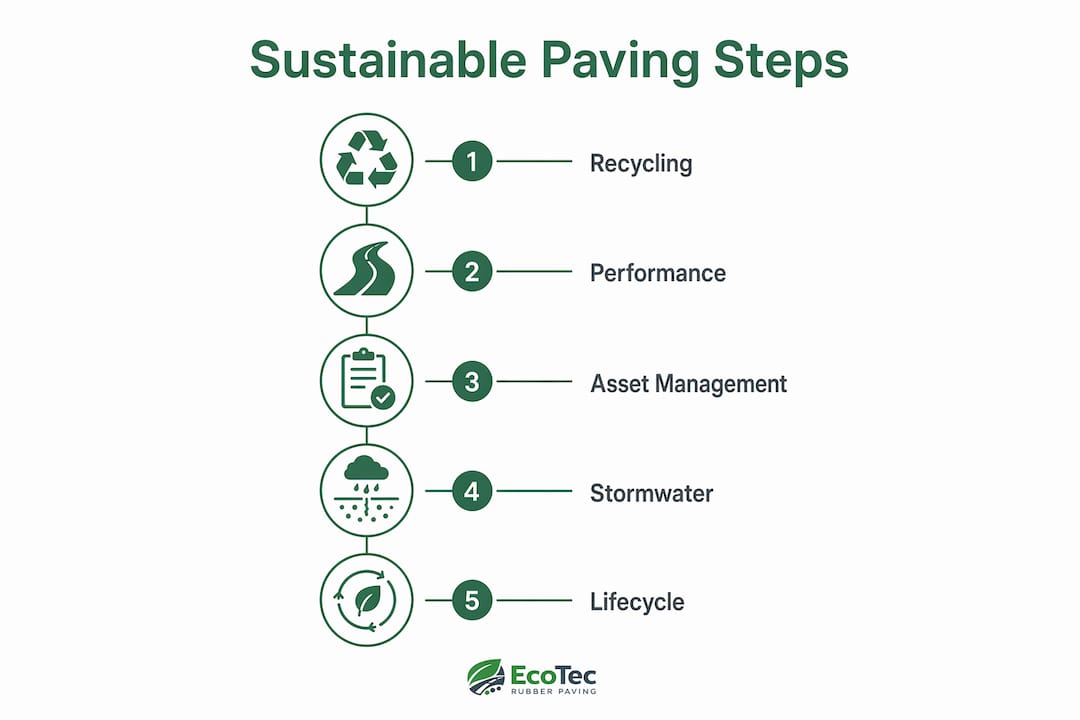
FHWA sustainable paving is defined as the design, construction, and management of pavements that maximize performance, minimize environmental impact, and use resources efficiently across the full infrastructure lifecycle. The Federal Highway Administration's Sustainable Pavements Program frames this through three lenses: engineering performance, environmental responsibility, and economic efficiency. For professionals and property owners alike, understanding what does FHWA sustainable paving mean shapes every decision from material selection to long-term maintenance planning. The standard is not a single technique. It is a coordinated system built on recycled materials, Balanced Mix Design (BMD), Transportation Asset Management Plans (TAMP), and integrated stormwater management.
What does FHWA sustainable paving mean for materials and technology?
Sustainable paving starts with what goes into the mix. The most widely used recycled input is reclaimed asphalt pavement (RAP). Over 96% of RAP was reused in US asphalt infrastructure projects during the 2024 season, totaling 101.4 million tons nationwide. That scale confirms RAP is not a niche option. It is the backbone of American sustainable paving practice.
Beyond RAP, fly ash and ground granulated blast furnace slag (GGBFS) play major roles. These industrial byproducts replace a portion of Portland cement or virgin aggregate in pavement mixes. Alternative materials like blast furnace slag reduce embodied energy and carbon by 20–30% and cut construction costs by 5–15%. That combination of environmental and financial benefit makes them a strong choice for public and private projects alike.
Warm-mix asphalt (WMA) is another key technology. WMA is produced at lower temperatures than conventional hot-mix asphalt, which cuts fuel consumption and reduces fumes during paving. Permeable pavements round out the technology toolkit by allowing water to pass through the surface layer directly into a designed sub-base. For a deeper look at how these materials compare, the green building material options guide from Ecotecrubber covers recycled content and slag impacts in practical detail.
Comparing sustainable paving materials
| Material | Primary benefit | Sustainability factor |
|---|---|---|
| Reclaimed asphalt pavement (RAP) | Reduces virgin aggregate demand | Highest recycled content volume |
| Fly ash | Replaces cement in base layers | Lowers embodied carbon |
| Blast furnace slag (GGBFS) | Improves strength and durability | Cuts energy use by 20–30% |
| Warm-mix asphalt (WMA) | Lower production temperature | Reduces fuel use and emissions |
| Permeable pavement | Manages stormwater on-site | Reduces runoff and pollution load |
Pro Tip: When specifying recycled content, ask your supplier for a certified RAP percentage by weight. Many state DOTs now require documentation, and having it ready speeds up project approvals.
How does Balanced Mix Design improve pavement performance?
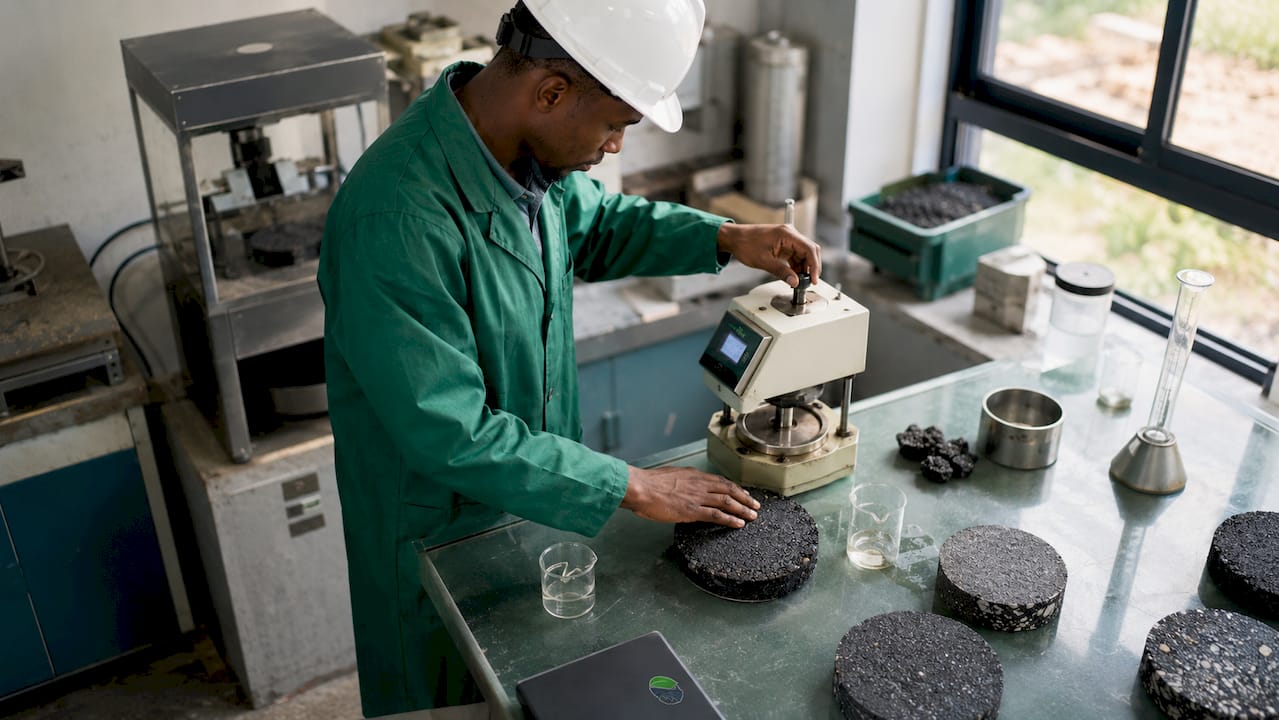
Balanced Mix Design is the shift from volumetric mix design to performance-based testing. Traditional volumetric design measures the proportions of aggregate, binder, and air voids. BMD goes further by testing how the finished mix actually behaves under load and temperature. BMD incorporates performance tests like Hamburg Wheel Tracking and Indirect Tensile Cracking (IDT-CT) to verify resistance to rutting and cracking under real-world conditions.
Hamburg Wheel Tracking simulates repeated heavy traffic loads on a wet pavement sample. IDT-CT measures how well a mix resists cracking at low temperatures or under fatigue. Together, these tests catch failures in the lab before they appear on the road. Oregon pilot projects validated BMD effectiveness in 2026, showing that performance-tested mixes outlast volumetrically designed ones in both rutting and cracking resistance.
The practical payoff is a longer pavement life and fewer reconstruction cycles. Fewer reconstructions mean less carbon, less disruption, and lower lifecycle costs. That is the direct link between BMD and the FHWA sustainable paving guidelines.
Adoption does face real barriers. Smaller contractors often lack lab equipment for BMD testing, which limits access to these methods for projects outside major state DOT contracts. The precision testing required is not cheap, and not every paving crew has a Hamburg Wheel Tracker on site.
Key performance tests used in BMD:
- Hamburg Wheel Tracking: Measures rutting depth under repeated wet loading
- IDT-CT (Indirect Tensile Cracking Test): Evaluates cracking resistance at low temperatures
- IDEAL-CT: A simpler cracking test gaining traction for field-level use
- Dynamic Modulus (E):* Assesses stiffness across a range of temperatures and frequencies
Pro Tip: If you are a smaller contractor evaluating BMD adoption, look into shared lab agreements through your state asphalt pavement association. Several states now offer subsidized testing access to reduce the equipment barrier.
What role do Transportation Asset Management Plans play in FHWA sustainable paving?
A Transportation Asset Management Plan is not optional for federally funded highway agencies. FHWA's TAMP mandate requires a systematic, engineering-based lifecycle approach to maintain pavements at the lowest practicable cost while achieving a "state of good repair." This requirement is defined under 23 U.S.C. 119 and MAP-21 regulations.
The core logic of TAMP is straightforward. Pavements that receive timely preservation treatments last significantly longer than those left to deteriorate until full reconstruction is needed. Reconstruction is carbon-intensive and expensive. TAMP prevents that cycle by scheduling interventions at the right point in a pavement's life.
Here is how a TAMP-based lifecycle approach works in practice:
- Inventory and condition assessment: Document every pavement segment, its current condition rating, and its remaining service life.
- Risk analysis: Identify segments most likely to fail early due to traffic volume, climate exposure, or deferred maintenance.
- Preservation scheduling: Plan treatments like crack sealing, micro-surfacing, or thin overlays before deterioration accelerates.
- Budget optimization: Allocate funds to the treatments with the best lifecycle cost return, not just the most visible failures.
- Performance tracking: Measure outcomes against targets and adjust the plan annually.
True sustainability extends beyond recycled content to include lifecycle maintenance planning via TAMP, preventing the early high-carbon reconstruction cycles that undermine green material gains. A road built with 40% RAP but reconstructed after 10 years has a worse carbon profile than a conventional road maintained for 25 years. TAMP closes that gap.
How does sustainable paving integrate stormwater management?
Stormwater management is not an add-on to sustainable paving. It is a design requirement from day one. Sustainable road construction requires combining pavement design, materials, water management through Sustainable Drainage Systems (SuDS), and maintenance planning from project inception. Adding drainage features after the design is finalized is the single most common failure point in otherwise well-intentioned projects.
Permeable pavements are the most direct tool for on-site stormwater control. Permeable pavements reduce stormwater runoff and filter pollutants, but their success depends entirely on correct sub-base drainage design. A permeable surface over a poorly designed sub-base builds up hydrostatic pressure and fails faster than a conventional pavement. The EPA guidance on porous asphalt is explicit on this point: soil infiltration rates must be tested and matched to sub-base depth before installation.
For engineers and project managers, the checklist for selecting sustainable paving with water management includes:
- Conduct a soil infiltration rate test before specifying permeable pavement
- Design sub-base depth to handle the 100-year storm event for the site
- Confirm SuDS compliance with local authority requirements before design sign-off
- Integrate outlet controls and overflow routing into the drainage plan
- Schedule annual inspection of the permeable layer to prevent clogging
For a detailed technical breakdown of how drainage integrates with paving design, the stormwater management paving solutions resource from Ecotecrubber covers sub-base design and SuDS compliance in depth.
Sustainable paving projects must coordinate design, drainage, approval, and maintenance planning from conception to meet 2026 legal adoption requirements and control flood risk. That coordination is not bureaucratic overhead. It is what separates projects that perform for decades from those that fail in the first wet season.
Key Takeaways
FHWA sustainable paving succeeds when recycled materials, performance-based mix design, lifecycle asset management, and integrated stormwater control are applied together from project inception.
| Point | Details |
|---|---|
| Recycled materials are standard | RAP, fly ash, and blast furnace slag reduce carbon and cost on every qualifying project. |
| BMD tests real performance | Hamburg Wheel Tracking and IDT-CT catch rutting and cracking failures before they reach the road. |
| TAMP prevents costly reconstruction | Lifecycle preservation planning under MAP-21 cuts long-term carbon and budget waste. |
| Drainage must be designed early | SuDS and permeable pavement sub-base design must be set at project inception, not added later. |
| Sustainability is a system | No single material or technique delivers FHWA-level sustainability without the full coordinated approach. |
Why the regulatory gap is the real obstacle
The technology for FHWA-compliant sustainable paving exists today. RAP is abundant, BMD testing protocols are published, and TAMP frameworks are federally mandated. The actual bottleneck is regulatory. Regulatory hurdles and a lack of standardized performance specifications slow sustainable paving adoption despite available technologies. Experts consistently call for performance-based standards over prescriptive ones to encourage real innovation.
From my experience watching projects move through state DOT approval processes, the prescriptive spec problem is real. An engineer can design a BMD mix that outperforms the standard volumetric spec on every test, and still face pushback because the state spec sheet does not list that mix design method. That is not a materials problem or a knowledge problem. It is a paperwork problem.
The other thing I see consistently underestimated is the TAMP connection. Professionals focus on the green material story, and that is understandable. RAP percentages and slag substitution rates are easy to communicate. But a project that skips proper lifecycle maintenance planning will burn through its carbon savings in the first reconstruction cycle. The most sustainable pavement is the one that does not need to be torn up and rebuilt.
My advice to smaller contractors facing BMD equipment barriers: do not let the lab requirement stop you from learning the method. Partner with a state university or a regional testing lab. The performance data you generate will differentiate your bids and build a track record that opens larger project opportunities. The 2026 sustainable paving installation guide is a practical starting point for understanding current FHWA-aligned standards.
— Roger
Ecotecrubber's rubber paving solutions for sustainable projects
Professionals and property owners who want a paving surface that meets sustainability goals without the complexity of full asphalt mix design have a direct option in rubber paving. Ecotecrubber installs the Rubberway® system across Florida, using recycled rubber content to deliver surfaces that resist cracking, drain effectively, and meet ADA compliance standards.
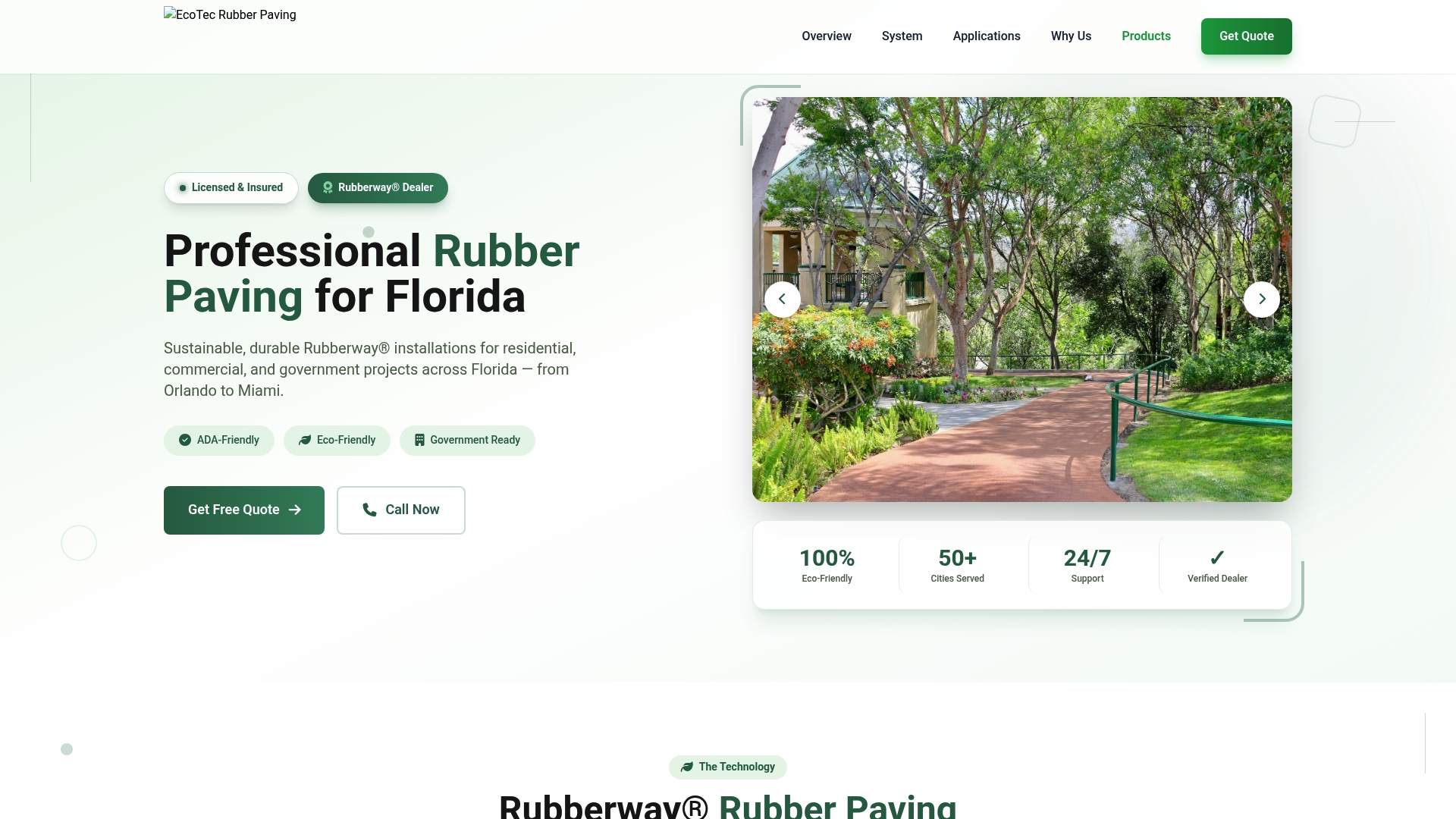
Rubberway® installations address two of the core FHWA sustainable paving principles: recycled material use and surface durability. The system is built from post-consumer recycled rubber, which reduces landfill waste and cuts the demand for virgin materials. Ecotecrubber is licensed and insured, and every project is coordinated by specialists focused exclusively on rubber paving. For municipalities, businesses, and homeowners ready to act on sustainable paving goals, explore Ecotecrubber's rubber paving solutions to see what a Rubberway® installation looks like for your site.
FAQ
What does FHWA sustainable paving mean in simple terms?
FHWA sustainable paving means designing and managing pavements to last longer, use recycled materials, and reduce environmental impact across the full lifecycle. The FHWA Sustainable Pavements Program coordinates materials, design methods, and asset management to achieve this goal.
What is Balanced Mix Design in sustainable paving?
Balanced Mix Design is a performance-based method that uses lab tests like Hamburg Wheel Tracking and IDT-CT to verify a pavement mix resists rutting and cracking under real conditions. It replaces traditional volumetric design, which only measures material proportions without testing actual performance.
How does TAMP support sustainable paving goals?
A Transportation Asset Management Plan schedules timely preservation treatments to extend pavement life and avoid high-carbon reconstruction cycles. FHWA mandates TAMP under 23 U.S.C. 119 and MAP-21 for federally funded highway agencies.
Why does permeable pavement sometimes fail?
Permeable pavement fails when the sub-base is not designed to match the site's soil infiltration rate. Hydrostatic pressure builds up beneath the surface and causes structural damage. EPA guidance requires soil testing and matched sub-base depth before installation.
Is recycled asphalt pavement widely used in the US?
RAP is the most recycled product in the United States. Over 96% of reclaimed asphalt pavement was reused in US infrastructure projects during the 2024 season, totaling 101.4 million tons.