

A city sustainable procurement policy is a set of purchasing rules requiring city buyers to factor environmental, social, and lifecycle costs into every buying decision, not just upfront price. ISO 20400:2017 frames this as strategic risk management: the goal is long-term value, not the cheapest bid. Municipal staff should start by embedding total cost of ownership (TCO) scoring and recycled-content documentation requirements directly into solicitations. Vendors and property owners, including HOAs, should prepare certifications and lifecycle cost evidence before the first RFP drops, and contact Ecotecrubber for project-level guidance on rubber paving specifications.
Pro Tip: Build your policy's definition around ISO 20400's three pillars: environmental responsibility, social equity, and economic value. Policies that reference this standard are easier to defend to finance and legal teams when TCO-based scoring is challenged.
Table of Contents
- What does a city sustainable procurement policy actually cover?
- Why cities adopt sustainable procurement policies
- What core clauses belong in an effective city policy?
- How do cities implement sustainable procurement step by step?
- What do vendors need to win bids under sustainable procurement rules?
- Sample contract language and scoring for rubber paving solicitations
- Common mistakes that derail sustainable procurement projects
- Key Takeaways
- Why enforcement beats drafting every time
- Ecotecrubber makes sustainable rubber paving procurement straightforward
- Useful sources and model policies
What does a city sustainable procurement policy actually cover?
City procurement policies typically organize sustainability requirements across three dimensions: environmental, social, and economic. Understanding all three is what separates a policy that shifts supplier behavior from one that just looks good on paper.
Environmental criteria are the most visible. Portland's policy requires agencies to integrate recycled-content preferences and reduced-toxicity material standards directly into solicitations. For paving, that means specifying post-consumer recycled content percentages, permeability thresholds for stormwater management, and low-VOC binders. Seattle's sustainable purchasing policy goes further, tying purchases to Zero Waste goals and prioritizing durable, reusable products over disposable ones.
Social criteria cover supplier diversity, fair labor practices, and local hiring. Louisville Metro's procurement manual explicitly encourages use of disadvantaged businesses and workforce development programs as scored dimensions, not optional extras.

Economic criteria center on TCO: the full cost of a product over its useful life, including maintenance, replacement, and disposal. A rubber paving surface that costs more upfront but lasts decades without cracking or requiring resurfacing often wins on TCO. Policies also reference third-party standards like Environmental Product Declarations (EPDs), Health Product Declarations (HPDs), and ISO 20400 to give buyers a defensible basis for preferring one material over another.
Why cities adopt sustainable procurement policies
The concrete benefits fall into three categories, and the financial case is stronger than most people expect.
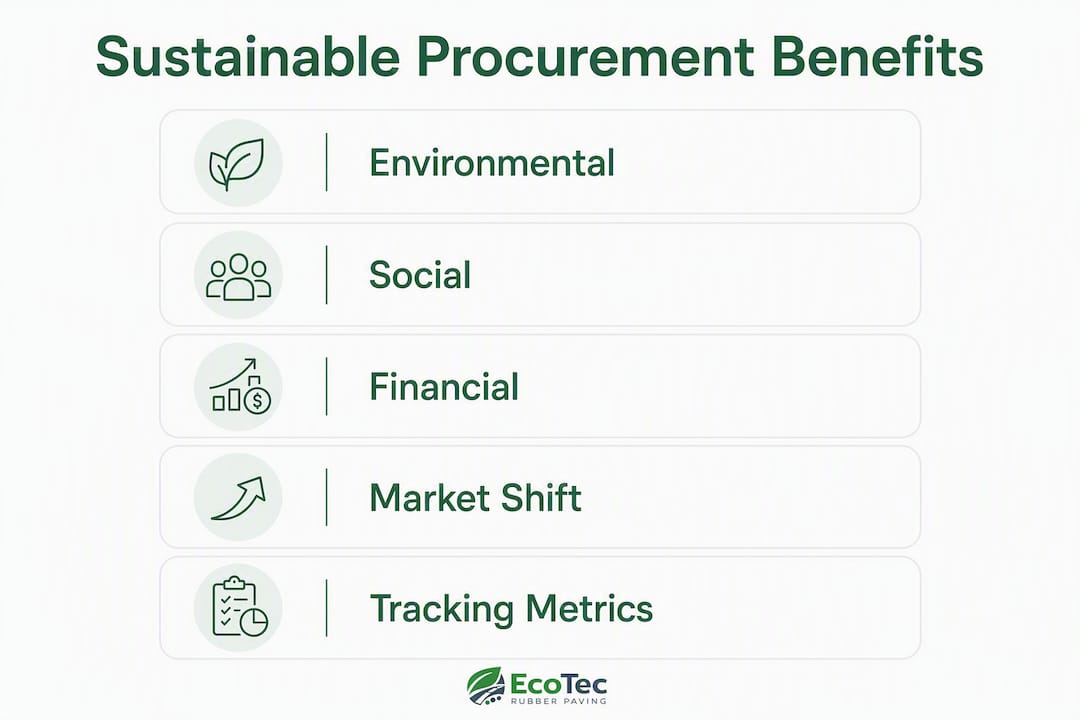
Environmental outcomes include reduced landfill waste from recycled-material purchases, lower embodied carbon in construction projects, and improved stormwater management when porous surfaces replace impermeable ones. Cities that track eco-paving maintenance savings consistently find that durable materials reduce the frequency of repair cycles.
On the social side, supplier diversity requirements channel contract dollars to minority- and women-owned businesses (WMBE), stimulate local economies, and improve worker health and safety standards across the supply chain.
The financial case is where TCO analysis pays off most visibly. Louisville Metro's manual cites LED bulbs lasting approximately 40 times longer than incandescent bulbs as a textbook TCO example: higher upfront cost, dramatically lower replacement and disposal costs over time. The same logic applies directly to recycled rubber paving versus conventional asphalt.
Pro Tip: Track three metrics from day one: dollar value of sustainable goods purchased, estimated GHG emissions avoided, and pounds of recycled materials procured. These numbers make the annual report to council straightforward and build the case for expanding the program.
Cities also use their buying power to shift markets. When a major municipality specifies recycled-content minimums, suppliers respond by developing compliant products, eventually lowering costs for everyone, including HOAs and private property owners.
What core clauses belong in an effective city policy?
A policy without enforceable clauses is just a mission statement. Here is what actually needs to be in the document:
- Policy scope and objectives statement referencing ISO 20400 and the city's specific sustainability goals (GHG reduction targets, Zero Waste commitments, equity plans).
- Mandatory minimum specifications for high-impact categories: recycled-content thresholds, allowable ecolabels, toxicity limits.
- Supplier qualification requirements: WMBE/DBE participation plans, supply-chain transparency declarations, EPDs and HPDs for construction materials.
- Evaluation methodology: a defined scoring model that weights technical performance, TCO, environmental criteria, and social value. A model weighting of 40% technical performance, 30% TCO, 20% social value, and 10% lifecycle risk creates predictable, defensible outcomes.
- Institutional supports: vendor outreach programs, staff training, procurement manuals, and contract clauses that require documentation delivery and allow audit rights.
Portland's Sustainable Procurement Program institutionalizes all of this through in-house technical assistance, category-specific specifications, and regular vendor trainings. That infrastructure is the difference between a policy that changes behavior and one that sits in a drawer.
| Scoring Dimension | Weight | What Bidders Must Provide |
|---|---|---|
| Technical performance | 40% | Material specs, ADA compliance, test results |
| Total cost of ownership | 30% | Lifecycle cost analysis, warranty terms |
| Social value | 20% | WMBE status, local hiring plan, safety record |
| Lifecycle risk | 10% | Supply-chain traceability, EPD/HPD |
How do cities implement sustainable procurement step by step?
Implementation follows a predictable sequence, and knowing where delays typically occur saves months.
- Draft and adopt the policy: council or board approval, followed by administrative instructions that assign responsibility to a specific procurement office.
- Develop category specifications: research the market, gather stakeholder input, set minimum thresholds and scoring language for priority categories.
- Run the solicitation: post the RFP or ITB, require mandatory documentation at submission, and evaluate against the scoring matrix. A realistic timeline from RFP posting to award runs 60–90 days for a standard paving project.
- Award and mobilize: issue the contract with sustainability deliverables built in, including documentation schedules and performance milestones.
- Monitor and report: track sustainable spend, verify recycled-content claims through audits, and report outcomes annually.
Most U.S. municipalities require formal competition above contract-value thresholds. Albuquerque's procurement manual and Houston's policy both set $50,000 as the threshold triggering formal RFP or ITB processes. Below that, simplified procedures apply, which matters for pilot projects. Budget for testing, site preparation, and warranty enforcement from the start; these costs are routinely underestimated.
Pro Tip: Run a pilot project in one category before rolling out the full policy. A single rubber paving installation in a municipal park generates real performance data, recycled-content documentation, and a TCO baseline you can use to justify broader adoption.
What do vendors need to win bids under sustainable procurement rules?
Sacramento's sustainable purchasing policy is direct: lacking transparent supply-chain data is one of the most common bid disqualifiers. Vendors who prepare early win more often.
The documents municipal buyers will score include:
- Recycled-content declarations with percentage by weight and source verification
- Material EPDs and HPDs from accredited third-party verifiers
- Lifecycle cost analysis showing TCO over a 10–20 year horizon
- WMBE/DBE certification and a local hiring plan
- Warranty documentation and a service plan
Bid strategy matters as much as documentation. Show the TCO advantage explicitly: a rubber paving surface that requires no crack-filling, no resurfacing, and minimal cleaning over 15 years has a lower lifecycle cost than cheaper alternatives that need replacement every 5–7 years. Quantify drainage benefits where stormwater management is a city priority. Provide supply-chain traceability for the crumb rubber feedstock.
Pro Tip: Prepare a one-page sustainability fact sheet with certified recycled-content percentages, a side-by-side lifecycle cost comparison, and your WMBE status. Attach it to every bid. Evaluators score what they can see.
Register as a vendor early and attend any pre-bid outreach sessions the city runs. Orlando's sustainable procurement policy allows additional evaluation points for sustainable offers, and bidders who show up to vendor trainings understand exactly how those points are awarded.
Sample contract language and scoring for rubber paving solicitations
Municipal staff can adapt the following language and matrix directly for rubber paving RFPs.
Minimum technical specifications:
- Recycled post-consumer rubber content: minimum 90% by weight
- Surface permeability: minimum 100 inches per hour (ASTM C1701)
- ADA compliance: slip resistance coefficient ≥ 0.6 (wet), per ADA Standards for Accessible Design
- Warranty: minimum 5 years covering delamination, cracking, and color fade
Sample evaluation matrix:
| Criterion | Weight | Scoring Basis |
|---|---|---|
| Technical performance | 40% | Spec compliance, test data, references |
| Total cost of ownership | 30% | 15-year cost model, maintenance schedule |
| Recycled content and EPD | 20% | Certified % recycled, third-party EPD |
| Social value | 10% | WMBE status, local hiring commitment |
Sample contract clause (material verification): "Contractor shall provide, within 14 days of material delivery, a third-party recycled-content certificate and EPD for all paving materials installed under this contract. Failure to provide documentation within the specified period constitutes a material breach subject to liquidated damages of $500 per day."
Pro Tip: Include audit rights in the contract: the right to inspect delivery records and request re-testing of installed surfaces. This deters inflated recycled-content claims and protects the city if a protest is filed.
Common mistakes that derail sustainable procurement projects
Vague specifications are the most expensive mistake. A spec that says "sustainable materials preferred" invites bids from vendors who define sustainability however they like, making evaluation subjective and legally vulnerable.
- Over-reliance on upfront price: skipping TCO analysis consistently favors cheaper, shorter-lived materials. The city pays more in maintenance within three years.
- Missing supply-chain documentation: requiring recycled content without requiring proof is unenforceable. Build documentation delivery into the contract, not just the bid.
- Inflated social-value claims: buyers who cannot verify WMBE status or local hiring commitments open themselves to protests. Require certifications, not self-attestations.
- Unrealistic timelines: recycled rubber paving materials have lead times. A project that needs to break ground in 60 days cannot wait for a 90-day RFP cycle.
Key Takeaways
A city sustainable procurement policy works when it combines ISO 20400-aligned definitions, TCO-weighted scoring, and enforceable documentation requirements in a single, auditable framework.
| Point | Details |
|---|---|
| Define policy around three pillars | Environmental, social, and economic criteria must all appear in the policy scope, referencing ISO 20400. |
| Embed TCO scoring in solicitations | Weight total cost of ownership at 30% or more; durable materials like rubber paving consistently outperform on 15-year cost models. |
| Require documentation, not promises | Recycled-content certificates, EPDs, and WMBE certifications must be contract deliverables with audit rights attached. |
| Run a pilot project first | A single municipal installation generates the performance data and TCO baseline needed to justify broader policy adoption. |
| Ecotecrubber supports compliance | Ecotecrubber provides Rubberway® installations with recycled-content documentation, EPDs, and ADA-compliant surfaces suited to municipal procurement requirements. |
Why enforcement beats drafting every time
Most sustainable procurement policies fail at the same point: the contract is signed, the documentation requirement is buried in an appendix, and nobody checks. The policy looks complete on paper. The supplier delivers conventional materials. The city pays for sustainability it never received.
The fix is not a better policy document. It is a procurement officer who knows what an EPD looks like, a contract clause with a real financial penalty, and an annual audit that compares claimed recycled-content percentages against delivery records. Portland built exactly this infrastructure through its Sustainable Procurement Program, and the difference between Portland's outcomes and cities that just adopted the policy language is measurable in supplier behavior.
For rubber paving specifically, the documentation chain is short and verifiable: crumb rubber feedstock certificates, a third-party EPD, and an installed-surface permeability test. Any vendor who cannot produce all three within 14 days of installation should not have won the bid. Build that standard into your solicitation and you will not need to chase compliance after the fact.
Ecotecrubber makes sustainable rubber paving procurement straightforward
Municipalities, HOAs, and commercial property owners in Florida that need a vendor ready for sustainable procurement evaluation will find Ecotecrubber already has the documentation stack assembled. Rubberway® installations use recycled tire materials with verified post-consumer content, ADA-compliant surfaces, and porous designs that meet stormwater management specifications. Ecotecrubber provides recycled-content certificates, EPDs, and lifecycle cost comparisons that slot directly into the scoring matrices described above, cutting weeks off the evaluation process.
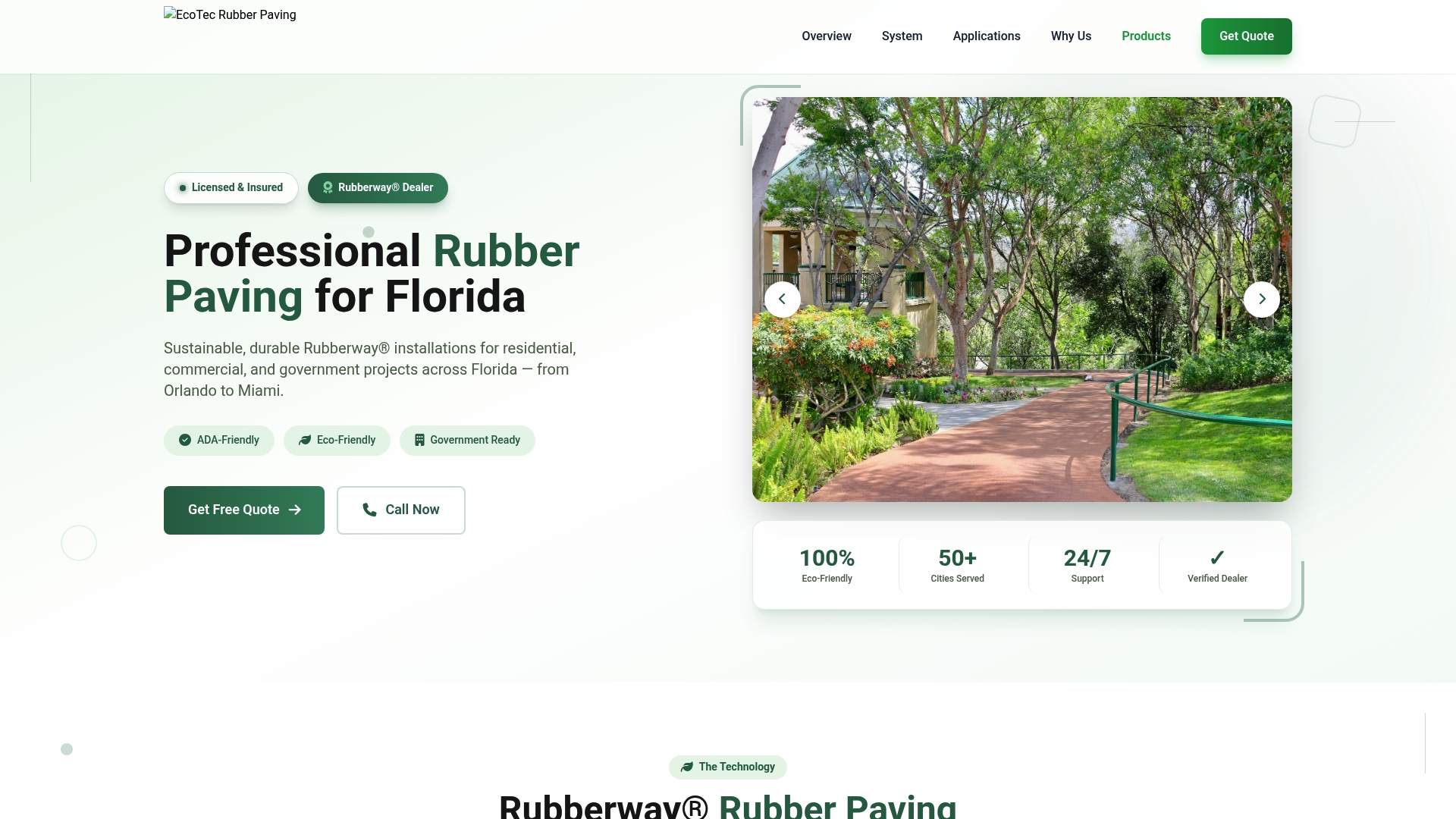
Whether you are drafting a pilot project spec, responding to an RFP, or planning a community paving project that needs to meet sustainability criteria, Ecotecrubber's team can provide sample specifications, documentation, and warranty-backed installation proposals. Visit Ecotecrubber's Rubberway® products page to review technical specifications, or request a consultation to get a project-specific proposal and pricing estimate.
Useful sources and model policies
These primary documents are worth bookmarking for policy drafters and vendors alike.
- ISO 20400:2017: the international standard defining sustainable procurement as strategic risk management; the authoritative basis for policy language and TCO scoring justification.
- City of Portland Sustainable Procurement Policy: detailed clause language for recycled-content and toxicity requirements; one of the most cited U.S. municipal models.
- Portland Sustainable Procurement Program overview: explains how Portland institutionalized the policy through training, vendor outreach, and technical assistance.
- City of Seattle Sustainable Purchasing Policy: strong model for post-consumer recycled-content thresholds and Zero Waste integration.
- Louisville Metro Procurement Policy Manual: covers social equity scoring, TCO examples, and outcome tracking metrics.
- City of Orlando Sustainable Procurement Policy: Florida-specific model with evaluation point incentives for sustainable offers.
- City of Sacramento Sustainable Purchasing Policy: clear guidance on vendor documentation requirements and pre-qualification.
- City of Albuquerque Procurement Manual: practical reference for competition thresholds, RFP/ITB methodology, and formal solicitation requirements.
- City of Houston Administrative Policy 5-7: covers recycled-product preference requirements under Texas Health and Safety Code and MWSBE participation goals.
This article provides general information about sustainable procurement policy frameworks and is not legal or procurement advice. Confirm current rules, thresholds, and requirements with your jurisdiction's procurement office or a qualified procurement professional before drafting or responding to solicitations.