
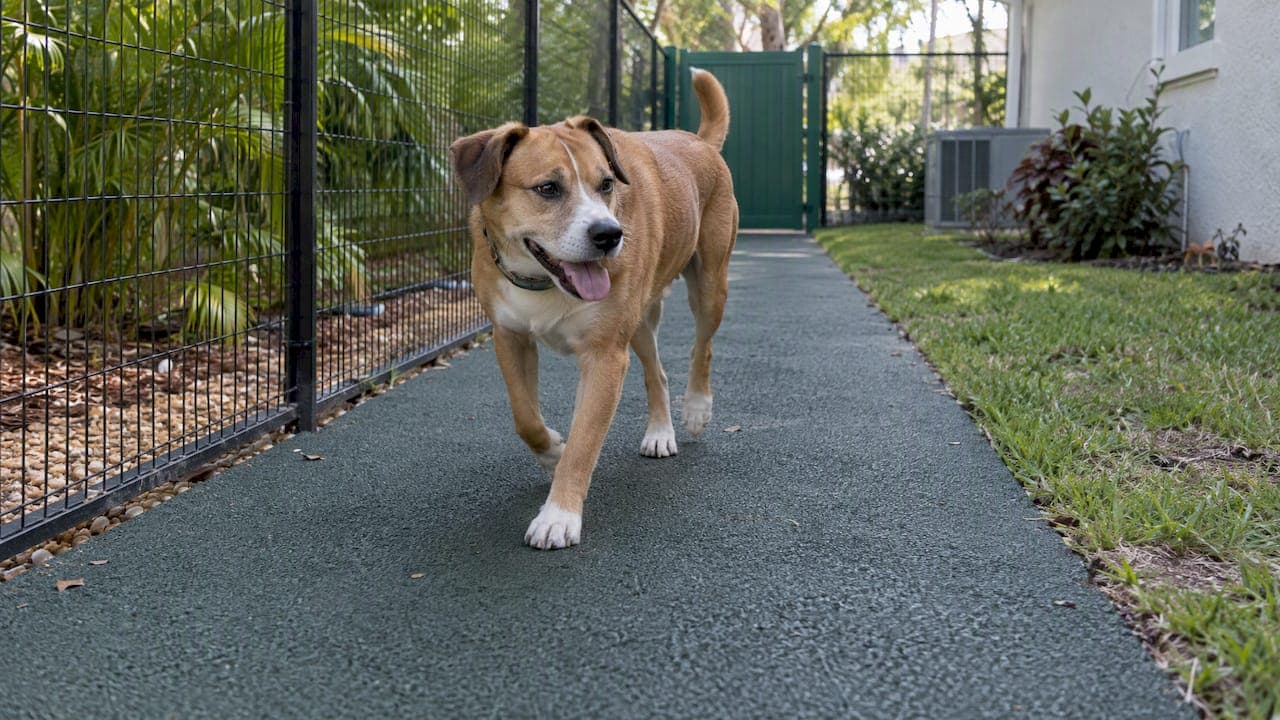
The best dog run walkway surface is one that drains fast, stays firm underfoot, can be rinsed clean and holds up to daily paws. No single material wins on every count. Turf, crushed stone, concrete and decomposed granite each trade something away, and the right pick depends on your climate, your slope and how much cleanup you want to do. This guide walks through the options, what public agencies say about them, and how to build the base so the surface lasts. It also covers what to look for in a pet-friendly patio.
TL;DR
- Drainage comes first: standing water breeds odor, mud and insects, and public guidance for pet areas puts drainage planning at the top of the list.
- Every common surface has a trade-off: natural turf wears, synthetic turf needs frequent cleaning, gravel can trap odors, concrete can run hot and rough.
- Edging, a gentle slope and a compacted base matter as much as the surface itself.
- Paths to a dog area in a shared or public space still need to meet accessibility rules, even though the animal containment area itself is excepted.
- In Florida, a porous, crack-resistant surface installed by a specialist is worth pricing out. We install the Rubberway® system for this.
Table of Contents
- What a dog run walkway has to do
- Surface options compared
- Heat and traction: what your dog actually feels
- Base, slope and edging: where most failures start
- Cleanup, odor and keeping the house clean
- Paths in shared or public spaces: the accessibility question
- Choosing a pet-friendly patio surface
- A worked example: a side-yard dog run in Florida
- Get a rubber paving quote for your dog run path
- FAQ
- Sources
What a dog run walkway has to do
A dog run path takes more abuse than a normal garden walkway. Dogs run the same line again and again, so wear concentrates in a narrow strip. Urine and waste soak in. Rain turns bare soil into mud that gets tracked to the door.
So judge any surface against five jobs:
- Drain quickly. Water that sits carries waste and germs with it.
- Stay cleanable. You should be able to pick up, rinse and deodorize without special tools.
- Give safe footing. Dogs need traction when they sprint and turn, and you need it when you carry a wet leash and a bag.
- Stay comfortable in heat. Sunny surfaces can get hot enough to bother paws.
- Last without constant repair. Cracks, ruts and migrating fill all cost money.
Public agencies that design dog parks have thought hard about exactly these problems, and their guidance is a good yardstick for a backyard too.
Surface options compared
Fairfax County's dog park design study lists the common choices. Natural turf is soft but wears quickly and needs high maintenance. Crusher fines or washed stone dust drain well and last but can erode if the ground is uneven. Synthetic turf needs less maintenance but needs frequent cleaning and costly replacement. Wood mulch holds waste, drains poorly, holds odors and is not recommended.
King County Public Health adds more detail. Wood chips and gravel drain easily, but gravel can trap odors and needs daily disinfection. Concrete or asphalt is easy to clean and deodorize but can be rough or hot, and it needs proper drainage and wastewater disposal.
Here is how those findings line up for a walkway:
| Surface | Drainage | Cleanup | Main watch-out |
|---|---|---|---|
| Natural turf | Good when soil is healthy | Hard to rinse | Wears into bare strips quickly |
| Crusher fines or stone dust | Good | Scoop and rake | Can erode on uneven ground |
| Gravel | Easy | Needs daily disinfection | Can trap odors |
| Wood mulch | Poor | Holds waste | Not recommended for dog areas |
| Synthetic turf | Depends on the base | Needs frequent cleaning | Costly replacement, can run hot |
| Concrete or asphalt | Needs designed drainage | Easy to clean and deodorize | Can be rough or hot, costly to repair |
| Decomposed granite | Quick-draining | Rake and replenish | Needs edging to stay put |
The table shows why people keep switching surfaces. Each fixes one problem and opens another. A porous, firm, rinsable surface that does not crack is the combination people are really after, and it is what we focus on (more on that below).
What cities require for dog runs
Official design rules show how seriously the surface is taken. Philadelphia Parks & Recreation specifies artificial turf or concrete pads for its dog runs, depending on the site and the maintenance plan. For regulated boarding and kennel settings, federal rules are looser on material but strict on condition: under 9 CFR § 3.4, outdoor housing floors may be compacted earth, absorbent bedding, sand, gravel or grass, and must be replaced if prevalent odors, diseases, insects, pests or vermin develop.
Some states go further for shelters. Connecticut's rules for dog pounds, for example, require impervious, cleanable and disinfectable run floors from January 1, 2029, or earlier for qualifying new construction or renovations. Those rules govern shelters, not your backyard, but the logic carries over: a surface you cannot clean becomes a problem.
Purdue Extension makes the same point about kennel flooring: it should be safe, comfortable and easy to clean, and some materials may harbor bacteria or be harder to sanitize.
Heat and traction: what your dog actually feels
Heat decides more surface choices than owners expect, especially in the South.
The Irvine Ranch Water District points to decomposed granite as a cost-effective, quick-draining option for pet play areas that stays significantly cooler than concrete or synthetic turf. That is a Southern California finding, but sun is sun. Meanwhile the University of Florida's extension advises that artificial turf can become hotter and is difficult to clean, so natural turf deserves a look for pet areas.
Two practical habits help on any surface:
- Test with your hand. Press your palm on the surface for several seconds in the afternoon. If you cannot hold it comfortably, your dog should not walk on it.
- Plan shade where the path runs. A tree, a pergola or a shade sail over the busiest stretch changes surface temperature more than most material swaps.
Traction is harder to measure. The Access Board notes that no consensus method exists to rate slip resistance, so it recommends specifying materials, textures or finishes that minimize slipperiness. In practice, that means choosing a textured finish over a smooth, polished one, and asking an installer to show you a finished sample wet.
Base, slope and edging: where most failures start
A good surface on a bad base fails. Three details do most of the work.
Slope and drainage
King County's guidance is to plan adequate drainage to prevent standing water, manage wastewater properly because runoff from pet facilities can harm waterways, and check local grading and land-use rules before building. Philadelphia's dog run guidelines go further and require a relatively flat surface with a slope under 5% to prevent erosion. A gentle slope away from buildings sends water off the path without washing material downhill.
Edging and containment
Loose surfaces migrate. Fairfax County recommends a concrete or timber curb at least 6 inches high and 8 inches wide around dog-park surfaces to limit material migration, with drainage weeps where appropriate. A backyard path can use a smaller border, but the principle holds: contain the surface and let water out through weeps.
A compacted, stable sub-base
Settling creates the low spots where water pools and the cracks that follow. Whatever you choose, a compacted aggregate base under the surface keeps the path flat through wet seasons. In Florida, where heavy summer rain and sandy soils test every base, this step is not optional.

Our own write-ups on walkway drainage in wet climates and on keeping sediment from clogging porous surfaces near the coast go deeper on these details.
Cleanup, odor and keeping the house clean
The surface touches the dog, but the mess ends up inside. Paws carry mud, moisture and odor through the door, and the first line of defense is a path that drains well and rinses clean. A hose-friendly surface, a rinse station by the door and a mat make the biggest difference. If pet traffic is already hurting your floors indoors, this guide to protecting your carpet from pets covers the indoor side of the problem.
Outdoors, build a routine around the surface you pick:
- Pick up solid waste daily, whatever the surface.
- Rinse hard or porous surfaces so that runoff flows to a planted or permeable area, not into a storm drain. King County warns that pet-facility wastewater can contain chemicals, worms and germs.
- Rake loose materials and top them up when they thin.
- Replace or deep-clean any material that begins to smell persistently. The federal rule above treats prevalent odors as a trigger for replacement.
Paths in shared or public spaces: the accessibility question
If you manage an HOA, a park or a business property, the path to the dog area is a regular walkway and must work for everyone. The Access Board states that accessible surfaces generally must be firm, stable and slip-resistant, while animal containment areas are explicitly excepted. So the run itself has leeway, but the route to it does not.
That has a design consequence. A loose surface like gravel may suit the run but fail on the approach. Access Board research also shows that stabilized engineered wood fiber systems can be designed to provide firm and stable surfaces for outdoor paths, which reminds us that accessibility is about how a surface is engineered, not only what it is called.
For planners weighing options, these pages help: park path surface options by ADA, drainage and rubber, slip-resistant community walkway types and park trail surfacing options.
Choosing a pet-friendly patio surface
A patio is where people and dogs share space, so it carries both sets of needs. Ask these questions:
- How hot does it get? A patio in full afternoon sun needs a surface you can test barefoot, or shade over it.
- Does water leave quickly? Patios next to pools or sprinklers see constant wetting. Porous or sloped surfaces keep puddles away.
- Can you clean it by hose? Accidents happen. You want a surface that rinses without staining or holding odor.
- Will it crack? Cracks collect water, dirt and odor, and they trip people.
- Is it comfortable to walk on? Hard, rough surfaces are hard on paws and on knees.
- Does it fit your look? Color range matters when the patio is part of the home.
If your patio and dog run connect, use one surface for both so there is no seam where material migrates or water pools. Our guides on walkway resurfacing options for homeowners and comparing paving surface materials lay out the trade-offs by material type.
A worked example: a side-yard dog run in Florida
Picture a 4-foot-wide path along the side of a house, running 40 feet from the back door to a fenced dog area. The yard is flat but sits low, and every summer storm leaves a puddle halfway down. Grass has worn to bare sand in a line where the dog runs the fence.
A sensible plan follows the principles above:
- Regrade lightly so the path slopes gently away from the house, staying well under the 5% figure that Philadelphia uses for dog runs.
- Excavate and compact an aggregate base so the path does not settle.
- Install edging along both sides to contain the surface.
- Choose a porous, textured surface so storm water passes through instead of pooling.
- Add shade or a light surface color over the sunniest stretch, and test it by hand in the afternoon.
- Put a hose bib and a rinse area near the gate.
Each step answers a failure the agencies describe: erosion, migration, standing water, heat and odor.
Our perspective
Most dog run complaints we hear start with water. The surface looks fine when it is dry, then a Florida storm arrives and the path turns into a puddle, a mud strip or a crack that keeps widening. That is why we work only with rubber paving and the Rubberway® system: it is designed around a porous structure that lets water pass through, resists cracking from heat and weather, and uses recycled tire material.
We would rather talk about drainage and base work before color, because a path that drains and does not crack is a path you do not have to think about. Then color and texture make it look like it belongs to your home or community. For HOAs and municipalities, we also provide the documentation boards ask for.
If you are choosing a surface for a dog run walkway or a pet-friendly patio, ask every installer the same questions: how does water leave, what is under the surface, and what happens in year ten? We are glad to answer them for your property.
Roger
Get a rubber paving quote for your dog run path
We are a licensed and insured Florida contractor that installs only rubber paving. Our Rubberway® product lines include Pervious Pavement, Rubberrock 6000, EVOLUTION and the Sidewalk System, and we install them on driveways, pool decks, patios, walkways, parks and community areas. We do not publish prices, because they depend on area, base conditions and the product chosen, so the way to get a number is to describe your project.
Tell us the length and width of the path, where water collects now and whether the space is private or shared. Request a professional rubber paving installation and we will tell you what the job involves.
FAQ
What is the best surface for a dog run walkway?
There is no single best one, but the strongest options drain fast, rinse clean and stay firm. Public guidance flags wood mulch as a poor choice because it holds waste and odor, and notes that turf, gravel and concrete each carry trade-offs. Choose by drainage, heat and cleanup first, then by look.
Is artificial turf a good idea for a dog area in Florida?
It can work, but the University of Florida extension notes that artificial turf can become hotter and is difficult to clean. Fairfax County adds that it needs frequent cleaning and costly replacement. In Florida's sun, check the surface temperature by hand and plan for shade.
Do dog run paths have to meet ADA rules?
The animal containment area itself is excepted from the Access Board's firm, stable and slip-resistant requirements. A route that people use to reach it in a public or shared space is still a walkway and should be built to accessible standards. Ask your architect or local building official about the rules for your site.
How do I keep a dog run from smelling?
Start with drainage, since standing water holds odor. Remove waste daily, rinse the surface so runoff reaches a permeable area, and replace any material that keeps smelling after cleaning. Gravel in particular needs daily disinfection, according to King County Public Health.
How steep can a dog run be?
Philadelphia Parks & Recreation requires a relatively flat surface with a slope under 5% to prevent erosion. A gentle slope is enough to shed water. Check your local grading rules before you build.
Sources
- Fairfax County: Dog Park Design
- King County Public Health: Design Considerations for Outdoor Areas for Pet Related Businesses
- Philadelphia Parks & Recreation: Dog Run Design Guidelines
- 9 CFR § 3.4, Outdoor housing facilities
- Connecticut Regs. § 22-336-34, Primary Enclosures
- Purdue Extension: Effects of Flooring on Animal Health and Well-Being
- Irvine Ranch Water District: Design a pet-safe yard in Southern California
- University of Florida IFAS: Petscaping
- U.S. Access Board: Chapter 3, Building Blocks
- U.S. Access Board: Stabilized engineered wood fiber for accessible trails
- U.S. Access Board: Chapter 3, Floor and Ground Surfaces