

Professionally installed poured-in-place (PIP) rubber and Rubberway® unitary systems are the strongest choice for most Florida playground applications. They combine consistent impact attenuation certified to ASTM F1292, full ADA accessibility, and the drainage performance Florida's rainy season demands. Recycled tire content means you're diverting material from landfills while getting a surface that outlasts loose-fill by years. Lifecycle costs run lower than loose-fill once you factor out annual replenishment and compliance re-checks.
Consider alternatives when:
- Budget is the hard constraint and the site has low fall heights (under 6 feet) with minimal ADA traffic
- Temporary or residential low-use installations where a full unitary pour isn't justified
- Peripheral, non-fall-zone areas where engineered wood fiber (EWF) or turf can fill space cost-effectively
Pro Tip: Ask any vendor for their ASTM F1292 third-party lab report before signing anything. A certified fall height on paper means nothing without the test data behind it.
Table of Contents
- How are playground safety surfaces actually evaluated?
- What can you expect from each surfacing option in Florida?
- Why does rubber paving perform best in Florida's climate?
- Maintenance and lifecycle cost: unitary rubber vs. loose-fill
- Where should you use unitary rubber vs. lower-cost materials?
- How do you vet a Florida playground surface installer?
- What does a typical rubber paving project timeline look like?
- Key Takeaways
- What the conventional wisdom on playground surfacing gets wrong
- Ecotecrubber brings Rubberway® expertise to Florida playgrounds
- Useful sources for verifying safety standards and specifications
How are playground safety surfaces actually evaluated?
Safety is measured by impact attenuation and critical fall height, both governed by ASTM F1292 and CPSC guidance. These are the primary pass/fail metrics. A surface either attenuates enough force to protect a child falling from the equipment's maximum height, or it doesn't. Falls to surfaces account for a large share of playground injuries, which is exactly why the CPSC and ASTM standards exist as the baseline, not a bonus.
Beyond impact attenuation, buyers should evaluate:
- ADA accessibility per ASTM F1951, which measures the force required to push a wheelchair across the surface
- Slip resistance under wet conditions (critical in Florida's afternoon rain pattern)
- Long-term shock performance after compaction, UV exposure, and heavy use
- Permeability and drainage to prevent standing water under equipment
Loose-fill materials compress at least 25% over time, which is why the industry recommends 8–12 inches of depth under equipment. Ask vendors for Head Injury Criterion (HIC) values and certified fall height documentation from a third-party lab, not just a product brochure.
What can you expect from each surfacing option in Florida?
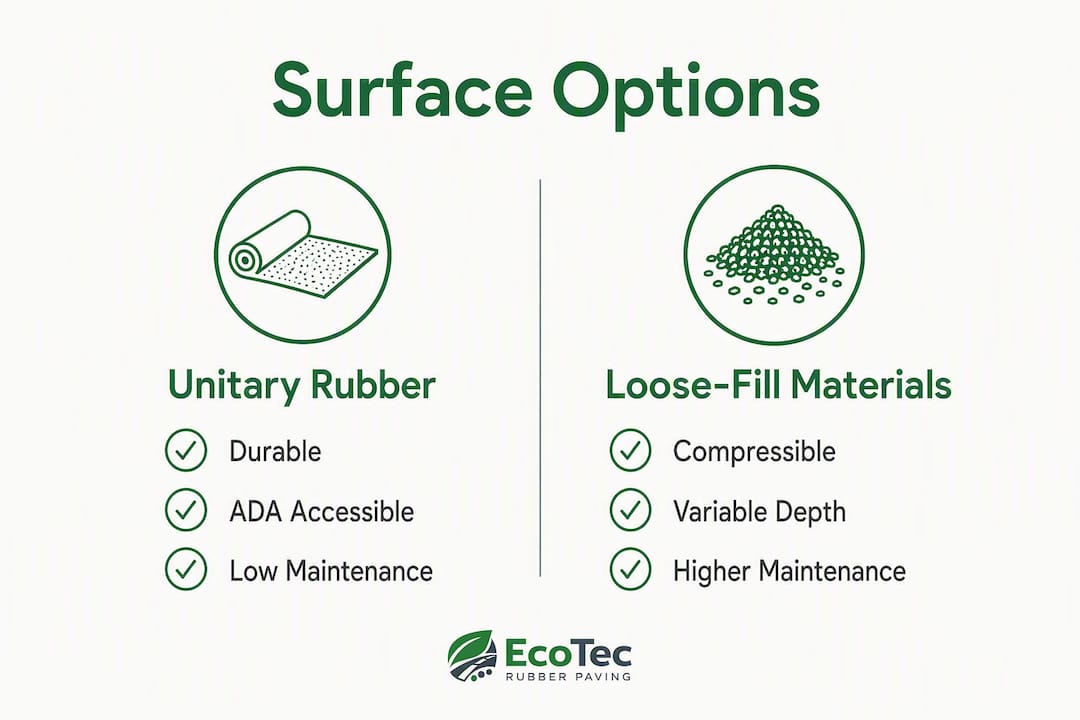
Unitary systems (PIP, rubber tiles, bonded rubber) win on long-term durability and ADA accessibility. Loose-fill options cost less upfront but require ongoing replenishment and monitoring to stay compliant.
| Material | Safety / Certified Fall Height | Durability / Lifespan | Maintenance Cost | ADA Accessible | Drainage | Heat / UV Resistance | Install Complexity | Colors / Aesthetics | Recycled Content |
|---|---|---|---|---|---|---|---|---|---|
| PIP Rubber | High / engineered to spec | 10–15+ years | Low | Yes | Porous options available | Good with UV-stable binders | Moderate / professional | Wide range | High (recycled tires) |
| Rubber Tiles | High / certified | 8–12 years | Low–Moderate | Yes | Moderate | Good | Moderate | Multiple | High |
| Synthetic Turf + pad | Meets ASTM with proper pad | 8–12 years | Low | Yes | Requires drainage design | Gets hot; needs cooling infill | High / professional | Limited | Moderate |
| Engineered Wood Fiber | High / up to 12 ft at 12 in. | 3–5 years | High (replenishment) | Yes, if maintained | Good | Poor (fades, degrades) | Low | Natural only | High (wood) |
| Rubber Mulch | Good / ~10 ft at 6 in. | 5–7 years | Moderate | Difficult | Moderate | Moderate | Low | Limited | High (recycled tires) |
| Sand / Pea Gravel | Low–Moderate | N/A | High (raking) | No | Good | Low | Low | None | None |
Florida-specific flags by category:
- PIP / Rubberway®: UV-stable binders and light-colored mixes reduce heat retention; porous design handles stormwater without pooling
- Synthetic turf: Surface temperatures spike in direct Florida sun; a cooling infill or shade structure is non-negotiable
- EWF: Degrades faster in high humidity; requires more frequent depth checks after heavy rain
- Rubber mulch: Can be displaced by wind and tracked indoors; Florida's afternoon storms accelerate this
Why does rubber paving perform best in Florida's climate?
Recycled rubber PIP systems like Rubberway® perform best across the axes that matter most in Florida: durability under UV exposure, drainage in high-rainfall conditions, and consistent impact attenuation regardless of temperature swings. The porous design moves stormwater through the surface and into a prepared base rather than letting it pool under equipment, which is a real problem for impermeable alternatives.
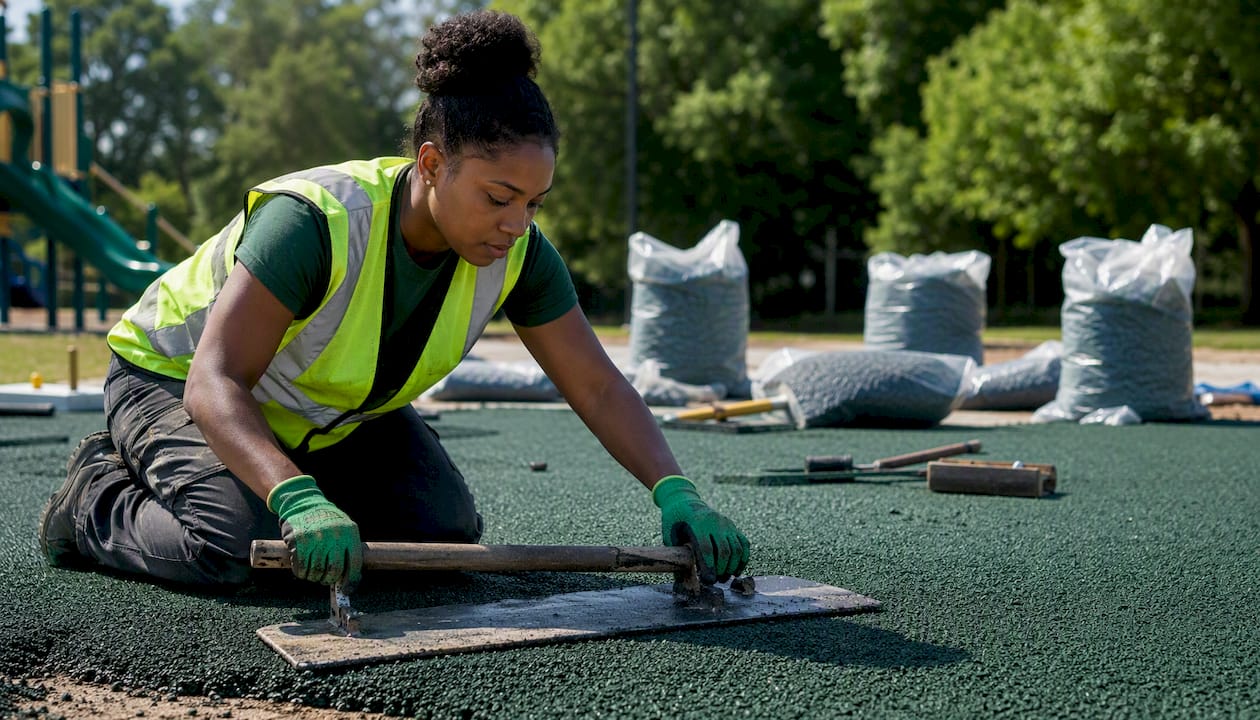
Sustainability credentials are concrete, not marketing language. High recycled-content rubber diverts used tires from landfills, and a surface that lasts 10–15 years consumes far less total material than loose-fill that needs topping off every season. Porous rubber systems significantly reduce standing-water issues in high-rainfall climates when paired with correct base preparation.
Key sustainability and performance advantages:
- Recycled tire content reduces landfill waste at scale
- Long service life lowers total material consumption over a 15-year horizon
- No allergen risk from organic decomposition (unlike EWF in humid conditions)
- Consistent impact attenuation doesn't degrade with Florida's wet/dry cycles
Pro Tip: Choose lighter color mixes or ask about reflective additive options for your Rubberway® installation. Darker surfaces in direct Florida sun can reach temperatures that discourage use. Ecotecrubber's product options include color choices specifically suited to heat management.
Maintenance and lifecycle cost: unitary rubber vs. loose-fill
Unitary rubber costs more upfront. Over a 10-year window, it typically costs less. That gap comes from eliminating annual replenishment, reducing ADA compliance re-checks, and avoiding the labor of raking, leveling, and depth-monitoring that loose-fill demands.
Major lifecycle cost drivers by surface type:
- PIP / tiles: Annual inspection, occasional spot patching, periodic cleaning. No replenishment. ADA compliance stays stable without intervention.
- EWF: Replenish depth 1–2 times per year, more often under swings and slide exits. Inspect after every significant storm. Industry guidelines recommend maintaining 12 inches of depth under equipment to ensure safety and compliance.
- Rubber mulch: Less frequent replenishment than EWF, but displacement from wind and rain requires regular redistribution. Tracking indoors adds cleanup cost.
Pro Tip: Schedule your annual inspection in May, before hurricane season starts, and budget a post-storm walkthrough after any named storm. Florida's rainy season (June through September) accelerates EWF depth loss and can shift rubber mulch significantly. A unitary surface survives that season with a rinse; loose-fill often needs a full depth correction.
Where should you use unitary rubber vs. lower-cost materials?
Prioritize unitary PIP or Rubberway® in high-traffic and high-fall-height zones: directly under swings, at slide exits, around climbing structures, and along all ADA transfer zones and access routes. These are the areas where a compliance failure or injury is most likely, and where the cost of loose-fill replenishment adds up fastest.
Practical hybrid layout patterns:
- Safety-critical zones (under equipment, fall zones): PIP or Rubberway® unitary surface
- ADA circulation routes and transfer areas: Unitary only — loose-fill cannot reliably maintain accessibility under heavy use
- Peripheral play yards and low-fall areas: EWF or synthetic turf where budget requires it
A reasonable rule of thumb: concentrate unitary surfaces across a significant portion of the total equipment footprint, depending on equipment type and fall heights. A swing bay needs full unitary coverage; a low-height sensory garden can use EWF in the non-fall zones.
Pro Tip: Transitions between unitary and loose-fill materials are where ADA compliance most often fails inspection. Use a flush, beveled edge or a recessed border to create a smooth join. Ask your installer to show you how they handle transitions on a recent Florida project.
How do you vet a Florida playground surface installer?
Hire a licensed, insured installer who can produce ASTM F1292 and ASTM F1951 test documentation, ADA compliance records, and references from Florida projects. That's the baseline. Everything else is secondary.
Questions to ask every bidder:
- Are you licensed and insured in Florida? Can you provide proof?
- Can you supply third-party ASTM F1292 lab reports for the specific system you're installing?
- What is your certified fall height for this installation, and how is it documented?
- How do you prepare the base and manage drainage for Florida soil conditions?
- What does your warranty cover, and for how long?
- Can you provide references and photos from recent Florida playground projects?
- Do you offer a post-install maintenance plan?
Red flags: no warranty offered, no third-party test data, vague answers about base preparation, and reluctance to share local project references. A vendor who can't show you a finished Florida project should not be your first call.
Verification checklist before signing:
- Confirm Florida contractor license number
- Review recent project photos and contact at least one reference
- Request a written warranty and maintenance plan before contract execution
- Verify the installer accounts for Florida's rainy season in the project schedule
What does a typical rubber paving project timeline look like?
A standard Florida playground rubber paving installation runs roughly 4–12 days from mobilization to handover, depending on site size and complexity. Base preparation is the step most buyers underestimate.
Typical phase breakdown:
- Site prep and demolition: 1–3 days
- Base installation and drainage: 1–5 days (crushed stone or gravel base is critical for drainage and long-term stability)
- PIP pour or tile installation and curing: 1–3 days
- Inspection and handover: 1 day
Cost drivers to budget for:
- Total surface area and equipment footprint
- Base prep complexity and existing subgrade conditions
- Drainage engineering requirements
- Color and pattern selections
- Local permitting fees
- Warranty and maintenance package scope
Florida seasonality matters. Hot weather accelerates curing but can affect binder performance if temperatures spike during the pour. Rainy season (June through September) adds scheduling risk. Plan installs for the dry season (October through May) when possible, and confirm your installer's weather contingency plan before signing.
Key Takeaways
Unitary rubber systems like PIP and Rubberway® deliver the best combination of safety, ADA compliance, and long-term value for Florida playground sites, especially when paired with a licensed, locally experienced installer.
| Point | Details |
|---|---|
| Unitary rubber wins long-term | PIP and Rubberway® systems lower lifetime maintenance costs despite higher upfront investment. |
| Standards to request | Require ASTM F1292 impact attenuation reports and ASTM F1951 ADA documentation from every bidder. |
| Hybrid layouts save money | Use unitary surfaces in 30–60% of equipment footprint (fall zones, ADA routes); EWF or turf elsewhere. |
| Vet your installer carefully | Confirm Florida licensure, third-party test data, local references, and a written warranty before signing. |
| Ecotecrubber's Rubberway® | Ecotecrubber installs Rubberway® systems in Florida with ADA compliance, drainage engineering, and warranty coverage built in. |
What the conventional wisdom on playground surfacing gets wrong
Most surfacing guides treat this as a pure safety question. It isn't. It's a total cost of ownership question with safety as the floor, not the ceiling. The buyers who end up frustrated are the ones who chose loose-fill to save money upfront and then spent the next five years paying for replenishment, compliance corrections, and ADA retrofits that a unitary surface would have handled automatically.
Florida adds a layer most national guides ignore entirely. Heat retention, afternoon thunderstorms, and high UV index aren't edge cases here. They're the operating conditions every single day from May through October. A surface that performs beautifully in Minnesota can become a liability in Sarasota if the installer didn't account for UV-stable binders, drainage channels, and color choices that manage surface temperature.
The other thing buyers consistently underestimate is the transition detail. A perfectly installed PIP field with a poorly executed edge where it meets a concrete path will fail an ADA inspection and create a trip hazard. That's not a materials problem. It's an installer problem. Which is why the installer question matters as much as the material question.
Ecotecrubber brings Rubberway® expertise to Florida playgrounds
Florida playground buyers don't need a generic rubber paving contractor. They need someone who understands what June through September does to a surface, how to engineer drainage for Florida's soil, and how to document ADA compliance for a municipal or HOA project. That's exactly what Ecotecrubber delivers with every Rubberway® installation.
Ecotecrubber is a licensed and insured Florida installer focused exclusively on rubber paving. Every project includes site survey and drainage assessment, ASTM F1292 and F1951 documentation, ADA-compliant transitions, color and pattern selection suited to Florida heat, and a written warranty with maintenance plan options. Whether you're specifying a municipal park, a school playground, or an HOA amenity space, the process starts with a site visit and a quote.
Request a quote or schedule a site visit to get ASTM documentation, local Florida references, and a written proposal for your project.
Useful sources for verifying safety standards and specifications
These sources let you verify claims independently and know exactly what to request from any bidder:
- CPSC Playground Safety Guidance: Background on fall injury statistics and the role of impact attenuation standards in reducing serious injuries.
- ASTM F1292 and F1951 Standards Overview: Explanation of what F1292 tests (impact attenuation / critical fall height) and what F1951 measures (wheelchair accessibility force). Use these to frame your vendor RFP.
- Unitary vs. loose-fill comparison: Detailed breakdown of maintenance, ADA, and lifecycle trade-offs across surface categories.
- PIP rubber performance data: Technical overview of PIP impact attenuation, color options, and base preparation requirements.
- Ecotecrubber ADA compliance resource: Technical detail on how Rubberway® installations meet ADA requirements for commercial and municipal projects.
- Lifecycle cost analysis: Financial framework for comparing upfront and long-term costs across surface types.