
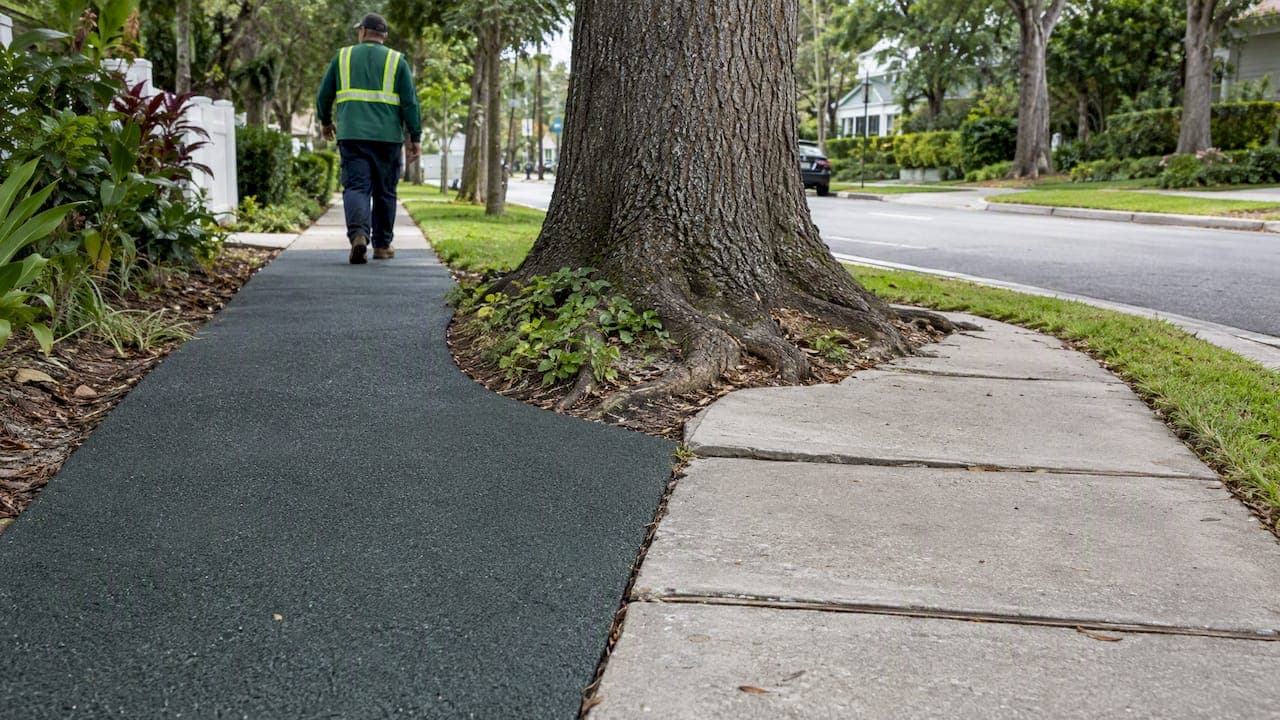
Flexible sidewalk material is a porous paving system built from recycled tire rubber, layered over an engineered subbase to let water drain through rather than run off. It suits pedestrian paths that need drainage, resistance to tree-root cracking, and a cushioned, non-slip surface. The trade-off is that it is not designed for heavy vehicle loads, and it needs a routine maintenance schedule to stay porous.
TL;DR:
- Rubber sidewalks are ineffective in areas with persistent heavy vehicle traffic or frequent snowplow activity, as repeated stress damages the surface.
- Routine maintenance, including sweeping and vacuuming, is essential to prevent clogging and maintain the system’s porous drainage capacity over time.
- Installation costs vary significantly based on soil conditions, site accessibility, and the depth of the storage layer needed for local rainfall, often increasing total expenses.
- The environmental benefits depend on site-specific testing, as retained tire particles can leach chemicals during storms, especially in sensitive watersheds.
- Long-term sustainability of rubber paving relies on proper site investigation, skilled installation, and lifecycle planning, not solely on initial material advantages.
Table of Contents
- How flexible rubber sidewalk systems are built
- How porous rubber handles stormwater drainage
- Flexibility, durability, and how rubber compares with concrete
- Site prep and installation steps that determine long-term performance
- Maintenance schedule, clogging risk, and planning for lifecycle
- Downsides, cost drivers, and when to choose something else
- What the research says about performance and lifecycle trade-offs
- A decision checklist for owners and specifiers
- How EcoTec Rubber Paving can help with your next project
- Sources
- FAQ
How flexible rubber sidewalk systems are built
Most systems use two or three layers. A colored wear layer, typically EPDM or virgin rubber granules, sits on top for finish and UV stability. Below it, a recycled crumb-rubber base mixed with a polyurethane or urethane binder provides structure and flexibility. A granular storage layer or subbase sits underneath to hold and slowly release water.
The wear layer is kept separate from the structural base because it takes the foot traffic and UV exposure while the base layer handles load distribution and drainage. Typical thickness ranges vary by application and traffic type.
- Wear layer: thin, colored, UV-stable rubber granules bound with polyurethane.
- Structural base: thicker crumb-rubber and binder mix that flexes under load.
- Storage/subbase: open-graded aggregate that holds water until it infiltrates the soil.
How porous rubber handles stormwater drainage
The open-void structure of the wear layer and the reservoir capacity of the storage layer let rainwater pass through the surface instead of pooling or sheeting off, the way it does on concrete. A filter fabric between the storage layer and native soil keeps fines from migrating upward and clogging the system from below.

Permeable pavements can retain over 96% of applied tire wear particle mass in lab experiments, a co-benefit for sites trying to limit pollutant runoff alongside stormwater control. That retention depends on keeping the surface clear: once surface voids fill with sediment, infiltration rates drop regardless of how well the storage layer was designed. For engineers specifying these systems, stormwater management guidance covers sizing the storage layer to local rainfall intensity.
Flexibility, durability, and how rubber compares with concrete
Rubber's elasticity is what sets it apart from rigid pavements. A root pushing up from below flexes the surface instead of cracking it, which cuts down on the trip hazards that plague concrete sidewalks near mature trees. That same give reduces the kind of brittle failure concrete shows under freeze-thaw cycling or heat expansion.
Representative testing on FlexiPave-type recycled-rubber systems found compressive strength around 115 psi and modulus of rupture near 170 psi, figures consistent with pedestrian-grade sidewalk loads rather than vehicular traffic. Pervious concrete, by contrast, offers higher structural strength and can tolerate occasional vehicle crossings, but it clogs more readily and cracks when subgrade support is uneven. The choice often comes down to whether the project needs rigidity and vehicle tolerance or flexibility and root accommodation.

Site prep and installation steps that determine long-term performance
Performance starts before the first layer goes down. A site investigation should check soil infiltration rates, the depth to groundwater, and likely sources of sediment runoff nearby, since all three affect how long the system stays permeable.
- Confirm soil infiltration rate and groundwater depth before sizing the storage layer.
- Compact the subgrade to spec and install filter fabric to block fines migration.
- Set storage layer depth based on recommended construction details, often around a suitably thick aggregate layer under a porous slab for comparable pervious systems.
- Install edge restraints and joint details to prevent lateral creep under traffic.
- Pour a test slab to verify mix design and finishing technique before full installation.
Pro Tip: Require a test slab and an on-site mix verification before full-scale pours. It catches finishing and binder-ratio problems while they are still cheap to fix.
Installer qualifications matter as much as material specification. The installation best-practice guide outlines QA steps including compaction equipment choice and certified applicator requirements.

Maintenance schedule, clogging risk, and planning for lifecycle
Keeping a flexible rubber sidewalk porous takes a routine, not a one-time cleaning. Sweeping on a weekly or biweekly basis clears surface debris before it compacts into the voids. Vacuum sweeping once or twice a year pulls out finer sediment that regular sweeping misses.
- Weekly or biweekly sweeping removes leaves, grit, and loose debris from the surface.
- Semiannual vacuum sweeping targets sediment lodged in the upper voids.
- Pressure washing, calibrated to the surface, clears moderate clogging that vacuuming cannot reach.
Vacuum sweeping removes surface sediment effectively but cannot reach deep-penetrated clogging, which is why a slowing infiltration rate signals it is time for a deeper intervention rather than another round of sweeping. Staying on schedule preserves both drainage function and the extended service life that makes the material's lifecycle advantages hold up over time.
Downsides, cost drivers, and when to choose something else
Cost depends heavily on site conditions rather than the rubber material itself. Poor native soils that need remediation, deeper storage layers for high-rainfall regions, and limited site access all push installation costs up before a single wear layer goes down.
Flexible rubber sidewalks are not built for heavy vehicle zones, loading docks, or routes plowed hard and often in winter, since repeated snowplow blade contact can raverl the wear layer over time. Sites with heavy sediment input, like unpaved parking lots draining onto the walkway, also shorten maintenance intervals significantly.
On the environmental side, tire wear particles and tire-additive chemicals are a legitimate area of ongoing research. Permeable systems can retain a large share of these particles, but retained material can leach during later storms, so site-specific testing is worth factoring into sensitive watersheds.
What the research says about performance and lifecycle trade-offs
Rubber-modified pavements can show higher initial global warming potential from binder content, but lower cumulative environmental impacts once reduced maintenance and longer service life are factored in. Michigan Tech life-cycle analysis
A life-cycle view, not a single install cost, is what determines whether rubber paving is the lower-impact choice. That nuance matters because a sustainability claim based only on recycled content ignores how maintenance frequency and replacement cycles shape the real footprint over 15 to 20 years.
Field reports on porous concrete sidewalks reinforce a similar point for pervious systems generally: outcomes hinge more on site selection, subgrade design, and installer skill than on the paving material alone.
A decision checklist for owners and specifiers
Rubber sidewalks earn their keep on tree-lined streets prone to root heave, stormwater-sensitive sites, and routes where pedestrian comfort matters, like parks or senior living paths. Before signing a contract, require a test slab, a written maintenance plan, proof of installer certification, and a clearly scoped warranty. Run a site investigation first and budget maintenance into the lifecycle cost, not as an afterthought.
— Roger
How EcoTec Rubber Paving can help with your next project
A contractor installs Rubberway® system products, including Rubberway® Pervious Pavement, Rubberway Rubberrock 6000, and Rubberway EVOLUTION, for sidewalks, trails, or walkways.
- Work is conducted with appropriate licensing and insurance.
- Surfaces designed for durability and ADA compliance.
- Experience coordinating projects for municipalities, HOAs, and homeowners.
If your project fits the profile above, a site assessment is the next step toward a working drainage plan. Request a quote through the Rubberway product lineup or start with the main site to discuss your specific location and traffic needs.
Sources
- Pervious pavements – installation, operations and strength part 4 : Flexipave® (recycled rubber tires) systems.
- Maintenance research on permeable pavements — University of New Hampshire
- The incorporation of crumb rubber derived from waste tires in asphalt pavements — Michigan Tech
- Mitigating tire wear particles and tire-additive chemicals in stormwater with permeable pavements — WSU lab (2024)
FAQ
What are the downsides of using rubber sidewalks?
Rubber sidewalks are not suited for heavy vehicle loads, aggressive snowplow routes, or high-sediment sites, since repeated stress or clogging can shorten service life. They also require a routine sweeping and vacuuming schedule to stay porous, which adds an ongoing maintenance cost beyond installation.
What are some alternatives to a concrete sidewalk?
Common alternatives include pervious concrete, asphalt, pavers, and flexible rubber paving systems like the Rubberway® system. Each trades off differently on strength, drainage, cost, and maintenance, so the right choice depends on expected traffic and site drainage needs.
How much would a 20 ft sidewalk cost?
Cost depends on site prep, subbase depth, soil conditions, and access, so there is no fixed per-project figure without a site assessment. Pricing is available through a direct quote based on your specific site.
Is rubber paving cheaper than concrete?
Cost comparisons vary by region, soil conditions, and project scope, so neither material is reliably cheaper in every case. Rubber paving's cost advantage, where it exists, tends to show up over the lifecycle through reduced cracking repairs and extended service life rather than in the initial install price.