
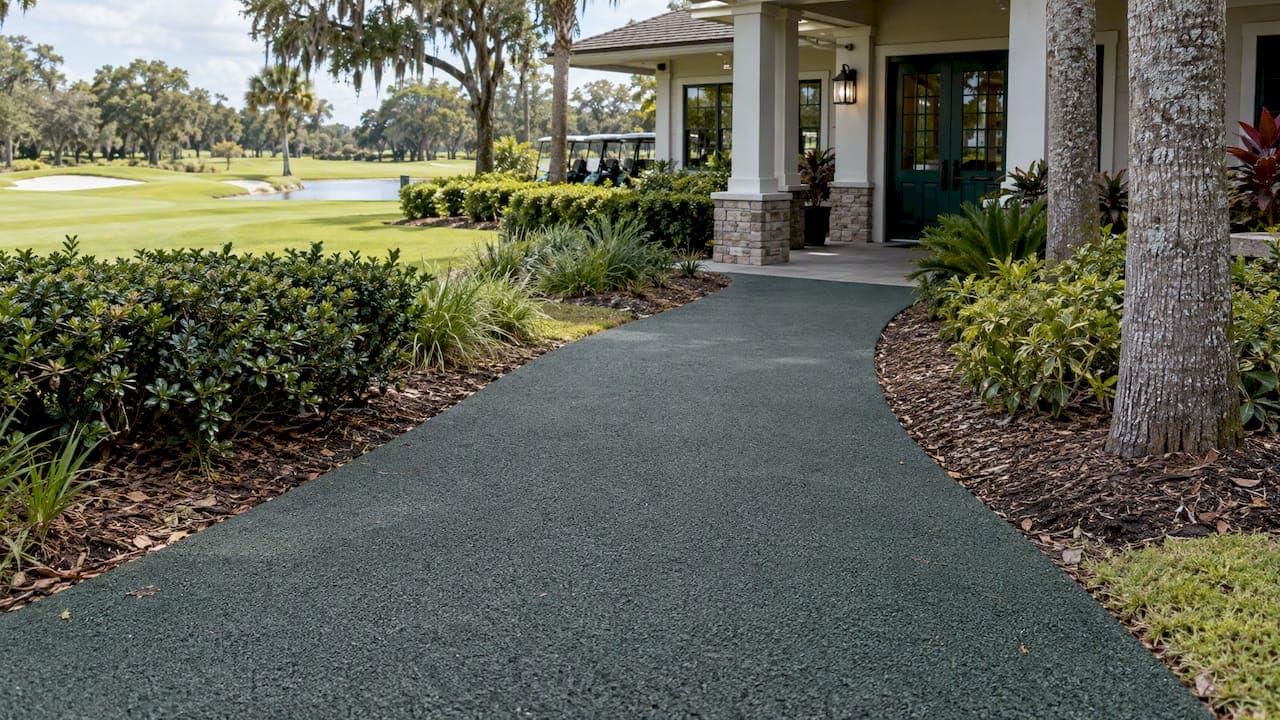
The best clubhouse walkway material is the one that stays firm, slip-resistant and accessible in your climate while costing your crew the fewest hours over the next 20 years. Concrete is the familiar default, but it holds heat and sheds water onto your turf. Stabilized aggregate drains well but needs upkeep. Poured-in-place recycled rubber paving drains through the surface, flexes instead of cracking, and can meet ADA requirements when it is installed correctly. Below we compare the options on the criteria that matter to a club, then show how to run the decision.
TL;DR
- Judge a walkway on ADA compliance, drainage, heat, crack resistance and long-term labor, not on the install quote alone.
- Any accessible route on a golf facility needs a running slope of 5% or less, a cross slope of 2.1% or less and a firm, stable, slip-resistant surface.
- Concrete lasts, but it is costly and holds heat. Loose aggregate is cheap to lay and expensive to keep.
- Porous rubber paving suits Florida's rain and sun, and it is a professional installation, not a DIY job.
- Bring your superintendent into the design before anyone draws a line.
Table of Contents
- What a clubhouse walkway has to do
- The ADA numbers your walkway must meet
- Comparing the common materials
- Heat and drainage: why Florida changes the answer
- Crack resistance and what it saves you
- The sustainability angle, with realistic numbers
- A practical way to decide
- Perspective: what we see on clubhouse projects
- Rubber paving for your clubhouse, installed by specialists
- Resurfacing an existing walkway versus building new
- Questions clubs ask
- Sources
What a clubhouse walkway has to do
A clubhouse walkway is not a cart path. Carts move along a cart path at speed, and golfers rarely walk it. The clubhouse walkway carries members in soft spikes, guests in dress shoes, caterers pushing carts, staff with mowers and maintenance equipment, and people using wheelchairs, walkers or strollers. It runs between the parking lot, pro shop, locker rooms, dining room, practice green and cart staging. It is also the first thing a visitor sees.
That gives you five jobs for the surface:
- Be accessible. The route must meet federal accessibility rules where it serves required accessible elements.
- Handle water. Standing water means slip risk, ice-free but algae-prone patches, and runoff into bunkers and turf.
- Handle weather. In Florida that means heat, heavy summer rain, UV and soil movement.
- Look right. Material, color and texture should fit the architecture and the course.
- Cost little to keep. Labor spent regrading, weeding, pressure washing and patching adds up every year.
The USGA's guidance on choosing cart path materials makes the same point: the material has a significant effect on performance, appearance and how golfers feel about it. Some materials cost less to buy and install but need more maintenance.
The ADA numbers your walkway must meet
Start with compliance, because it limits what you can build and what a retrofit will cost if you get it wrong.
The U.S. Access Board's guide to golf course requirements says accessible routes are continuous, unobstructed paths connecting all accessible elements and spaces of a facility. For a golf facility, the figures to design to are:
| Requirement | Limit |
|---|---|
| Running slope (direction of travel) | 1:20 (5%) or less |
| Cross slope | 1:48 (2.1%) or less |
| Minimum clear width | 36 inches |
| Width where connecting golf car features | 48 inches |
The Access Board's standard for accessible routes likewise defines walking surfaces as those with a running slope not steeper than 1:20.
The surface itself matters as much as the geometry. The Access Board's chapter on floor and ground surfaces says accessible surfaces must be stable, firm and slip resistant. Stable surfaces resist movement. Firm surfaces resist deformation by applied forces. Concrete and asphalt meet this reliably. Other materials, including rubber and stabilized aggregate, can too, provided they achieve the same stability and firmness once installed. That last condition is why installation quality, not the product name on the bag, decides compliance.
If your property is in Florida, also check the state's accessibility code with your architect, since state rules can add requirements to the federal ones. We are not your code official, and your design professional should confirm what applies to your project.
Comparing the common materials
Here is how the main options stack up for a clubhouse setting in a hot, wet climate.
| Material | Strengths | Weak points | Typical fit |
|---|---|---|---|
| Concrete | Rigid, long-lived, reliably ADA-compliant | Higher cost, heat and glare, cracking at joints, runoff | Formal entrances, heavy delivery routes |
| Asphalt | Fast to install, familiar | Soft in heat, oxidizes, impervious | Cart paths, service roads |
| Pavers | Attractive, repairable by unit | Joints settle and grow weeds, labor to relevel | Plazas and patios |
| Loose or crushed aggregate | Low upfront cost, natural look | Migrates, needs regrading, ADA only if stabilized | Secondary garden paths |
| Stabilized aggregate | Natural look, drains, can be accessible | Binder wear, edge restraint needed, upkeep | Informal trails near the clubhouse |
| Poured porous rubber paving | Drains through the surface, flexes, wide color range, ADA-capable | Professional installation required, needs good base prep | Clubhouse entries, walkways, pool decks, practice areas |
Concrete
The USGA notes that concrete is rigid and long-lasting, with a service life that can reach 50 years, but that it is costly and prone to heat retention. In Florida that matters twice. Heat reflecting off a pale slab is hard on adjacent turf and on people standing at the 18th green waiting for a table. And concrete is impervious, so every storm sends sheet flow across the surface and into whatever sits downhill. Joints and control cuts also crack as slabs shift, and a trip edge of a half inch is an ADA problem and a liability one.
Loose and stabilized aggregate
Crushed stone is cheap and looks natural. The trouble is labor. Maintenance costs often exceed the initial installation expense, and that hits aggregate hardest, because staff spend hours regrading, edging and weeding it. The MSU-archived article on cart path materials and labor costs argues for contained systems that hold their integrity over time.

There is a common myth that all gravel is non-compliant. It is not: the Access Board's guidance on ground surfaces shows that aggregate can be accessible when stabilized so it stays firm, stable and slip resistant. The catch is keeping it that way through rain, traffic and years of wear.
Pavers
Pavers look good at a clubhouse entrance and a damaged unit can be swapped. But sand-set joints invite weeds and ants, and settling creates lips that catch wheels and heels. They are a decent choice for a small plaza and a poor one for a long route that carries service traffic.
Poured porous rubber paving
Rubber paving made from recycled tire material is bound and troweled in place into a flexible, porous surface. Because water passes through, there is little standing water, and because it flexes, it does not crack the way a rigid slab does when soils move or roots push. It stays cooler underfoot than many people expect when it is properly specified, and it comes in a range of colors that can match clubhouse stonework or tie into course branding. Our own pages cover why rubber surfaces suit golf course environments and how rubber paving handles golf cart weight if you need details for service traffic.
Heat and drainage: why Florida changes the answer
The USGA's cart path guidance notes that impervious materials such as concrete reflect and retain heat, which can affect adjacent turf and golfer comfort, while permeable options handle wet conditions better. Florida amplifies both. Afternoon thunderstorms can drop a lot of rain in an hour, and a clubhouse sits on the most heavily hardscaped part of the property.
A porous surface helps in three ways:
- Less runoff. Rain moves down through the surface and the base instead of across it, which reduces what reaches bunkers and low turf. The USGA's piece on smarter solutions for golf course walkways describes erosion, weed control and routine upkeep as a constant drain on staff time, and notes that modern materials can help.
- Fewer slip hazards. Water that drains does not pool at the door of the pro shop.
- Less heat load on turf. Less reflective mass beside the grass means fewer stressed edges.
To see how this plays out on a real entrance, read our guide to a rubber surface for your golf clubhouse entrance.
Crack resistance and what it saves you
Cracks are where maintenance budgets leak. They start as a hairline, collect water, grow roots and weeds, and eventually become a trip hazard that needs grinding or replacement. A rigid slab cracks because it cannot move. A flexible, bonded rubber layer is built to move with the base. We go deeper on this in why golf facility paving needs crack resistance.
No surface is maintenance-free. Rubber paving still needs sweeping, occasional washing and attention to edges. The difference is the type of labor: routine cleaning versus regrading, weeding, patching and re-pouring.
The sustainability angle, with realistic numbers
Many clubs now report on environmental practice to members and owners, and the walkway is a visible place to show it. Recycled tire material keeps waste out of landfills. The U.S. EPA described a county that used more than 1,100 old tires to resurface walkways and outdoor floors, which gives a sense of how much material even a modest project can use.
On carbon, be careful with claims. A procurement guide from a New South Wales regional waste group reports that rubber-modified paving can extend pavement service life by 10 to 40% and cut carbon footprint by 5.6% to 27.3% against conventional materials. That is Australian road-paving data, not a measurement of any clubhouse walkway in Florida, so treat it as an indication of direction, not a guarantee. Our article on how recycled paving supports golf sustainability covers how to describe this honestly to your membership.
A practical way to decide
A walkway decision goes better as a short process than a debate over samples.
- Map the route. List every origin and destination: parking, entry, pro shop, locker rooms, dining, cart staging, practice facilities. Mark which segments are part of an accessible route.
- Measure slopes. Check running and cross slope against 5% and 2.1% before choosing a material. A material cannot fix a slope that is too steep.
- Classify traffic. Foot traffic only, or also beverage carts, maintenance equipment and delivery vehicles?
- Walk the drainage. Note where water stands after a storm and where it goes. Bring your superintendent along.
- Price the lifetime. Ask for installation cost, expected annual maintenance hours, and what repair looks like in year 10.
- Ask for documentation. Public clubs, municipal courses and HOA-run facilities often need specifications, product data and proof of license and insurance for their files.
- Specify the base. Most surface failures are base failures. Get compaction, depth and edge restraint in writing.
Involve the superintendent early
The golf course superintendent knows site-specific drainage, maintenance labor hours and how the path edge affects the turf next to it. Architects often miss all three, which is why the MSU-archived article recommends involving them during design, not after.
Design for the whole route
The Access Board's golf guidance points to routes that connect all key facilities. Connecting the pro shop, dining area and cart staging with a single continuous accessible path avoids the cost of retrofitting a non-compliant link later. It is also simply a better experience for every member, not only those who need it.
Perspective: what we see on clubhouse projects
We install only rubber paving, so we are not neutral, and we would rather say so than pretend otherwise. What we can offer is a focused view of how these surfaces behave in Florida.
The mistake we see most is treating the walkway as a cosmetic line item. A club picks a material from a sample board, then spends years patching it. The questions that save money come before the material: where does the water go, what is the base, who maintains it, and what will it look like after ten summers?

We are most comfortable recommending rubber where drainage, heat and accessibility meet in one place: entries, pool decks, patios, walkways between buildings and areas where a slab would crack. We are less eager to promise it for a pure vehicle lane. And we do not treat concrete as the enemy. For a heavy delivery apron it can be the right answer. We simply think a clubhouse walkway is a place where a porous, flexible, recycled surface earns its keep.
Whatever you choose, insist on a licensed, insured installer who can show documentation for the surface and base, and who will walk your slopes before quoting.
— Roger
Rubber paving for your clubhouse, installed by specialists
EcoTec Rubber Paving installs the Rubberway® system across Florida: Rubberway® Pervious Pavement, Rubberrock 6000, EVOLUTION and the Sidewalk System, in a range of colors, with drainage built into the surface. We are licensed and insured, we work on rubber paving alone, and we can supply government-ready documentation for municipal, HOA and club files. We do not publish prices, since slope, base condition and area change every quote. To discuss a clubhouse route, entry or pool deck, contact our team through the main site. If you are comparing materials for the cart paths as well, see our guide for superintendents on cart path resurfacing options.
Resurfacing an existing walkway versus building new
Many clubhouses already have a worn slab or paver walkway, so the real question is whether to replace or resurface. The base decides. If the existing base is sound, drains and holds slope, a new wearing surface can go on top. If it is settled, undermined or sloped past 5%, resurfacing hides the problem for a season. Resurfacing exists as its own trade in other regions too, for example this overview of patio and walkway resurfacing in Phoenix, which shows how much the answer depends on the condition of what is underneath. Have the base inspected before any quote is accepted.
Questions clubs ask
Is rubber paving ADA-compliant for a golf clubhouse?
It can be. The ADA requires accessible ground surfaces to be stable, firm and slip resistant, and recycled rubber is permitted when it shows equivalent stability and firmness once installed. The slope and width limits (5% running, 2.1% cross, 36 inches minimum) apply regardless of material, so the design matters as much as the surface.
Is concrete or rubber better for a clubhouse walkway in Florida?
Concrete is rigid and very long-lived, but it is costly, retains heat and sheds water. Porous rubber drains through the surface and flexes instead of cracking, which suits Florida's rain and heat. For heavy vehicle aprons, concrete may still be the sounder choice.
Can gravel paths be accessible?
Yes, if the aggregate is stabilized with binders, geotextiles or grid forms so it stays firm and stable. Loose gravel on its own usually fails. Stabilized systems also tend to need more upkeep than a bonded surface.
Who should be involved before we choose a material?
Your superintendent, your architect or engineer, and the installer. The superintendent knows drainage and labor hours, the designer confirms slopes and code, and the installer judges the base and the real constructability.
Sources
- U.S. Access Board, Chapter 10: Golf Courses
- U.S. Access Board, Chapter 3: Floor and Ground Surfaces
- U.S. Access Board, Chapter 4: Accessible Routes
- USGA, Choosing Cart Path Materials
- USGA, Smarter Solutions for Golf Course Walkways
- Cart paths bring materials and labor costs into play (MSU archive)
- U.S. EPA, These Tires Were Made for Walkin'
- SSROC, Procure Recycled: Paving the Way with Rubber
- Patio and walkway resurfacing in Phoenix, AZ