
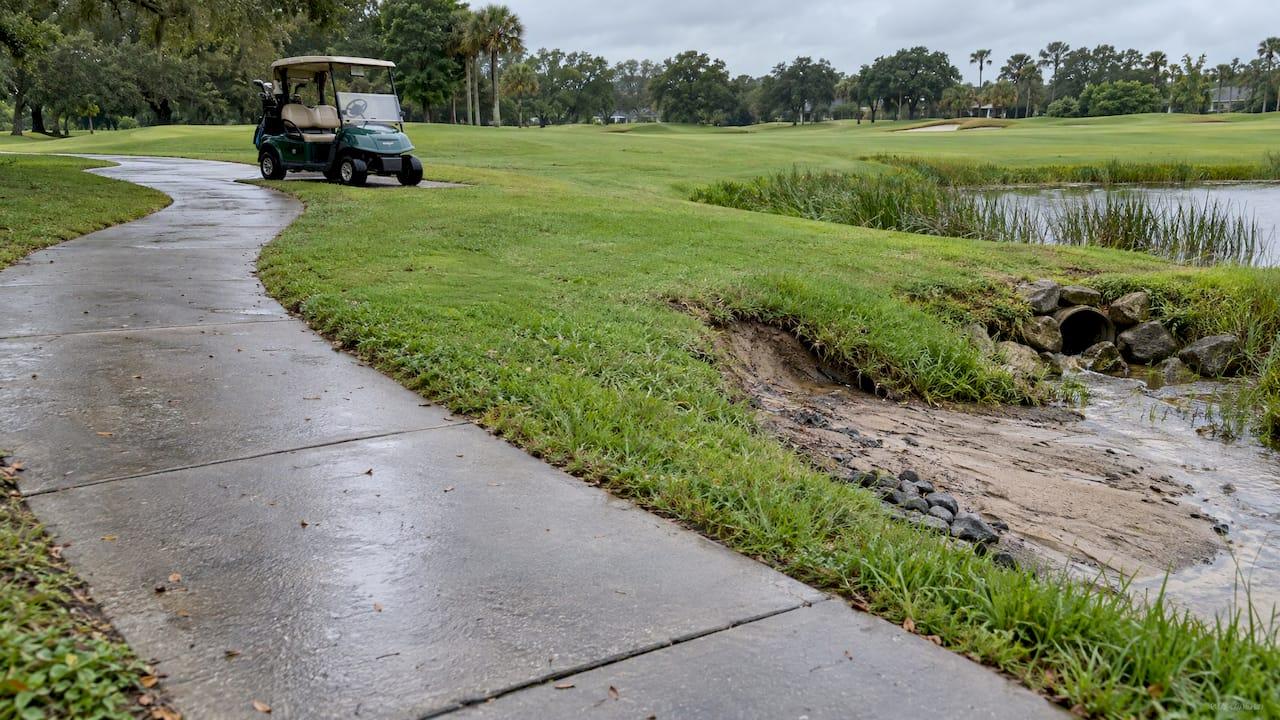
Golf cart path erosion is controlled by three things, in this order: moving water off and away from the path, shaping the grade and edges so water never concentrates, and choosing a surface that stays put when it is saturated. Surface choice matters, but a path with bad drainage will wash out whatever you put on it. This guide walks superintendents, owners and board members through each step, with the specific numbers and standards behind them.
TL;DR
- Erosion starts with concentrated water. Fix the grade, cross-slope and outlets before you touch the surface.
- Loose aggregate paths rut and migrate into turf when saturated, so heavy-runoff paths need a stronger, non-erodible material with drains at the end.
- Keep paths ADA-ready: accessible routes need at least 36 inches of width and a slope no steeper than 1:12, and golf car passages need at least 48 inches.
- Sediment leaving a course can bring Clean Water Act exposure, so treat runoff control as a compliance issue as well as a maintenance one.
- A porous rubber surface installed over a sound base is one way to combine drainage, stability and accessibility. We cover it below.
Table of Contents
- Why cart paths erode in the first place
- Start with grade, cross-slope and outlets
- A quick path-by-path diagnosis
- Choosing a surface that holds up in wet weather
- Where porous rubber paving fits
- Protect turf, ponds and streams from path runoff
- Keep paths ADA-ready while you fix erosion
- Inspection and repair routine
- Get a path plan for your course
- FAQ
- Sources
Why cart paths erode in the first place
Water is the cause, and traffic is the accelerant. The University of Delaware Cooperative Extension lists the main drivers of erosion as the loss of vegetation that binds soil, stormwater running off impermeable surfaces, and natural weathering, with slopes making all of it worse because gravity speeds the flow.
A golf course concentrates every one of those factors along a narrow strip. A cart path sheds rain quickly, funnels it to a low point, and then drops it onto turf or a bank. The same extension fact sheet notes that erosion creates dangerous conditions on pathways by undercutting and causing bank failure.
For loose-surface paths the problem is more direct. The USGA Green Section explains that gravel, decomposed granite and native sand are inherently less stable than asphalt or concrete. Their permeability can let them saturate and lose integrity in wet conditions, which leads to rutting and erosion. Washed-out aggregate then migrates into turf, impairs playability and can damage mowing equipment.
There is also a turf effect nobody likes to talk about. Jeff Brauer, writing in Golf Course Industry, warns that thin irrigation coverage combined with extra cart traffic will kill turf quickly. When the path edge is already stressed, erosion has an easy start.
Start with grade, cross-slope and outlets
Before comparing materials, walk the path in the rain. You are looking for four things: where water crosses the path, where it runs along it, where it leaves, and what it carries when it leaves.
The USDA NRCS conservation practice standard for trails and walkways gives a useful engineering frame. It says grades should reduce erosion potential from runoff, cross-slopes or crowns should let water leave without causing erosion, cuts and fills should have stable slopes of at least 2 horizontal to 1 vertical, and concentrated flows should be diverted with surface or subsurface drainage. That standard is written for trails and walkways in general, but the logic transfers directly to cart paths.
Keep water from running along the path
A path is a poor drainage channel. Brauer cautions that using paths as drainage ways makes wet pavement less safe and accelerates flow, causing erosion at exit points. His advice is to build paths with swales and drainage inlets on each side, and to use catch basins in the pavement with curbing to trap water.
He also points out that courses retrofitting paths often block existing drainage patterns by accident. The 1994 USGA article "Common Sense Cart Paths" says the same thing from the other direction: paths set above grade can dam surface drainage and leave water standing in adjacent turf, while paths set below grade may stay wet. Swales can be built into the path design.
Give water somewhere to go quickly
Golf course architect Steve Forrest, quoted in Golf Course News, aims for a 3 percent minimum grade on any surface slope and gets water into the ground through culverts and pipes as fast as possible. His rule of thumb is that more inlets mean more drainage and less erosion.
If you are working a rough site, the earthwork matters as much as the paving. A qualified crew doing grading and drainage earthwork can reshape swales, set outlets and correct low spots before any surface goes down.
Treat the end of the path as a design element
The USGA says paths that capture and redirect surface water should be built of stronger material that is not vulnerable to erosion, and that drains should be installed to avoid excessive runoff onto turf at the end of the path. Most visible erosion on a course happens right there, at the outlet, not in the middle of the run.
Maintain the drains
Subsurface drainage helps manage stormwater, but it needs inspection. The GCSAA Best Management Practices for Nebraska golf courses advise routinely checking drainage systems because roots and animal activity can clog drains easily. Add inlets and outlets to your post-storm checklist.
A quick path-by-path diagnosis
Use this table when you walk the course after heavy rain.
| What you see | Likely cause | First fix |
|---|---|---|
| Gullies in the path surface | Water running along the path, loose material | Add cross-slope or inlets, then stabilize or replace the surface |
| Aggregate fanning into turf | Washout at the low end | Install a drain or swale at the outlet, contain the edge |
| Standing water beside the path | Path above grade blocking sheet flow | Cut swales or add pipe crossings |
| Wet, soft path in low area | Path below grade, poor subsurface drainage | Add subsurface drain, consider a porous system |
| Dead turf along the edge | Water concentration plus traffic stress | Correct irrigation coverage and runoff routing |
Choosing a surface that holds up in wet weather
The USGA's guidance gives a clear baseline. Asphalt and concrete are durable and low-maintenance, while loose aggregates are less stable and need regrading and added material as routine. Edging or curbing used to contain aggregate can shift and add to ongoing maintenance.
There are well-documented ways to make loose or natural surfaces work, too. At Nissequogue Golf Club on Long Island, the USGA Green Section describes narrow waste bunkers filled with highly angular sand that binds together, backed by perforated drain pipe below the surface and small catch basins within the paths. The result was minimal washouts. In a regularly flooded tidal area, the same club used dark angular gravel with stone curbing on both sides to hold the footprint.

On the turf side, The Valley Club of Montecito used rubber mats with subsurface drainage to support bermudagrass as a path surface. The USGA reports that this eliminated erosion and dust problems. The build included a 6-inch base of 1- to 2-inch rock, geotextile fabric, sandy loam and sod set about half an inch below final grade.
The lesson across those examples is that a surface only works as part of a drainage system. Whatever you choose, ask five questions: How much runoff does this path carry? How steep is it? How wet is the soil beneath it? What does traffic look like on tournament days? What does it cost to keep it intact over ten years? Our guide on five questions for choosing cart path materials works through them in more detail, and our overview of cart path resurfacing options covers what to do with paths that are already failing.
Base preparation decides the outcome
Any hard or semi-rigid surface is only as stable as what is under it. Poorly compacted backfill settles, opens gaps and channels water. Contractors working on trenches and fill around drains should follow backfill and compaction specs so the base does not settle after the first wet season.
Where porous rubber paving fits
For golf facilities that want the path itself to take on water rather than shed it, porous rubber paving is built around that idea. The Rubberway® system uses recycled tire material in a porous design, and our installations are designed to give water a way down through the surface instead of running across it. That fits the principles above: keep stormwater close to where it falls, slow it down and let it infiltrate, which is how the GCSAA Nebraska BMPs describe effective runoff management.
A few practical points follow from that design:
- Drainage. Porous construction reduces the sheet flow that cuts gullies. It still needs a proper base, outlets and edge details. We design those with the surface, not after it.
- Cracks. Heat and weather cracking opens paths to water and root intrusion. Rubberway is designed for crack resistance in Florida's climate; see why crack resistance matters at golf facilities.
- Cart loads. We cover how the system is designed to handle traffic in how rubber paving handles golf cart weight.
- Course environment. Recycled content and porous construction suit sites near ponds and wetlands. We explain more in why rubber surfaces suit golf course environments and how recycled paving supports golf sustainability.
- Stormwater planning. Engineers weighing infiltration against detention can start with our piece on stormwater management paving solutions.
We install across Florida, where intense summer storms, flat terrain and high water tables make drainage the central design question.
Protect turf, ponds and streams from path runoff
Erosion control on a course is not only about keeping the path intact. Sediment leaves the site and ends up somewhere. The EPA, in a settlement involving a golf course developer, noted that sediment-laden runoff can raise turbidity, lower oxygen in receiving waters, destroy spawning beds and smother bottom-dwelling organisms. That case ended with a $430,000 civil penalty for Clean Water Act and stormwater permit violations, including failures to select, install, maintain and inspect controls.
That was a construction case, so check which permits apply to your own path work. If you are rebuilding or extending paths, ask your engineer or state stormwater authority whether a construction stormwater permit is needed.
The GCSAA Minnesota handbook offers a practical frame. It recommends a treatment train approach in which water moves from one treatment to the next, for example across a vegetated filter strip, through a swale and into a detention pond. It also says a 25-foot buffer of turf mowed at three inches and minimally fertilized works well for water quality, with the first 25 feet landward of a water body treated as a no-spray zone.
The Louisiana and Mississippi water BMPs add a design principle worth remembering: the most effective treatment is preventing contaminated runoff in the first place, and architects should minimize connected impervious areas. A porous path is one way to apply that on a strip that would otherwise be a continuous hard surface.
Keep paths ADA-ready while you fix erosion
Path rebuilds are a good time to check accessibility. The US Access Board's guide for golf courses says accessible routes must meet ADAAG provisions for width, slope and surface: a 36-inch minimum width and a maximum slope of 1:12 (8.33 percent). Where an accessible route is used instead of a golf car passage, the minimum width rises to 48 inches, or 60 inches where handrails are provided. A golf car passage must be at least 48 inches wide, and barriers that keep cars off fairways need openings at least 60 inches wide at intervals no greater than 75 yards.
Note how this interacts with drainage. Cross-slope for drainage has to be balanced against accessible-route limits, so settle both in the design stage rather than correcting one later. Rubberway surfaces are designed to be ADA-compliant, and we provide government-ready documentation for public and municipal projects.

Inspection and repair routine
A simple schedule prevents most of the expensive failures:
- After every major storm: check outlets, inlets and catch basins for clogging and look for new gullies or aggregate fans.
- Monthly in the wet season: inspect path edges, curbing and shoulders for undercutting.
- Seasonally: confirm irrigation heads are not soaking path edges, and that coverage favors the path side where cart traffic is heavy.
- Annually: review slope and cross-slope on problem paths, and flag any section that needs regrading or a surface change.
- Always: photograph and log problem sites so you can see which locations repeat.
For loose-aggregate paths, plan on regrading and adding material as routine work, as the USGA describes. If the same few locations keep needing it, that is the case for a permanent fix at those spots.
Our perspective
We only install rubber paving, and that focus shapes how we look at golf path erosion. Nearly every failed path we hear about has the same story: water got concentrated, it found the weakest point, and the surface paid for it. So we start every conversation with drainage and grade, and we treat the surface as part of that system.
This is where we think a porous rubber surface earns its place. Rubberway is designed to let water pass through instead of racing along the top, to resist cracking in Florida heat, and to meet ADA requirements. It is made with recycled tire material, which suits courses that want their sustainability story to be more than a brochure.
Our advice to superintendents and boards is to fix the worst outlets first, standardize the path edge details, and pick a surface you will not have to regrade every season. We are licensed and insured, and we deliver the documentation public owners expect.
Roger
Get a path plan for your course
If you manage a golf course, HOA community or municipal facility in Florida and have paths that wash out, rut or pond, we can look at the site and recommend a Rubberway system that fits it. Our line includes Rubberway Pervious Pavement, Rubberrock 6000, EVOLUTION and the Sidewalk System, and our professional rubber paving installation is handled by a licensed, insured team focused only on rubber paving.
Bring us your problem locations and your accessibility needs, and we will tell you which system fits the traffic, slope and water on each one.
FAQ
What is the fastest way to stop a cart path from washing out?
Find where water concentrates and give it an outlet. Add cross-slope, swales or catch basins, and put a drain at the end of the path so runoff does not spill onto turf. Resurfacing before fixing drainage usually repeats the failure.
Are gravel and decomposed granite paths a bad choice for erosion control?
They are more vulnerable to erosion when saturated, according to the USGA, and they need regular regrading. They can work on flat or gently sloping ground with curbing and good drainage, as the Nissequogue example shows. Steeper or wetter paths call for a stronger, non-erodible surface.
How wide should an accessible golf cart path be?
According to the US Access Board, accessible routes must be at least 36 inches wide with a slope no steeper than 1:12. A golf car passage must be at least 48 inches wide, and a route used in place of one is also widened to 48 inches, or 60 inches with handrails.
Does path erosion create legal risk for a golf course?
It can when sediment reaches waterways. The EPA has enforced the Clean Water Act against a golf course developer for stormwater control failures. For specific permits and requirements, ask your engineer or state stormwater agency.
Sources
- University of Delaware Cooperative Extension: Preventing Erosion
- USGA Green Section Record: Choosing Cart Path Materials
- Golf Course Industry: Cart Path Design
- USDA NRCS Conservation Practice Standard: Trails and Walkways
- USGA Green Section Record: Common Sense Cart Paths
- Golf Course News: The right strategies make for successful erosion control
- GCSAA Best Management Practices for Nebraska Golf Courses
- USGA Green Section Record: Creative Cart Paths
- USGA Green Section Record: Bermudagrass Cart Paths
- US EPA: The Links at Columbia settlement
- GCSAA Minnesota Golf Course Reference Handbook
- GCSAA Water Resource Management BMPs, Louisiana and Mississippi
- US Access Board: ADA Guide, Chapter 10 Golf Courses