
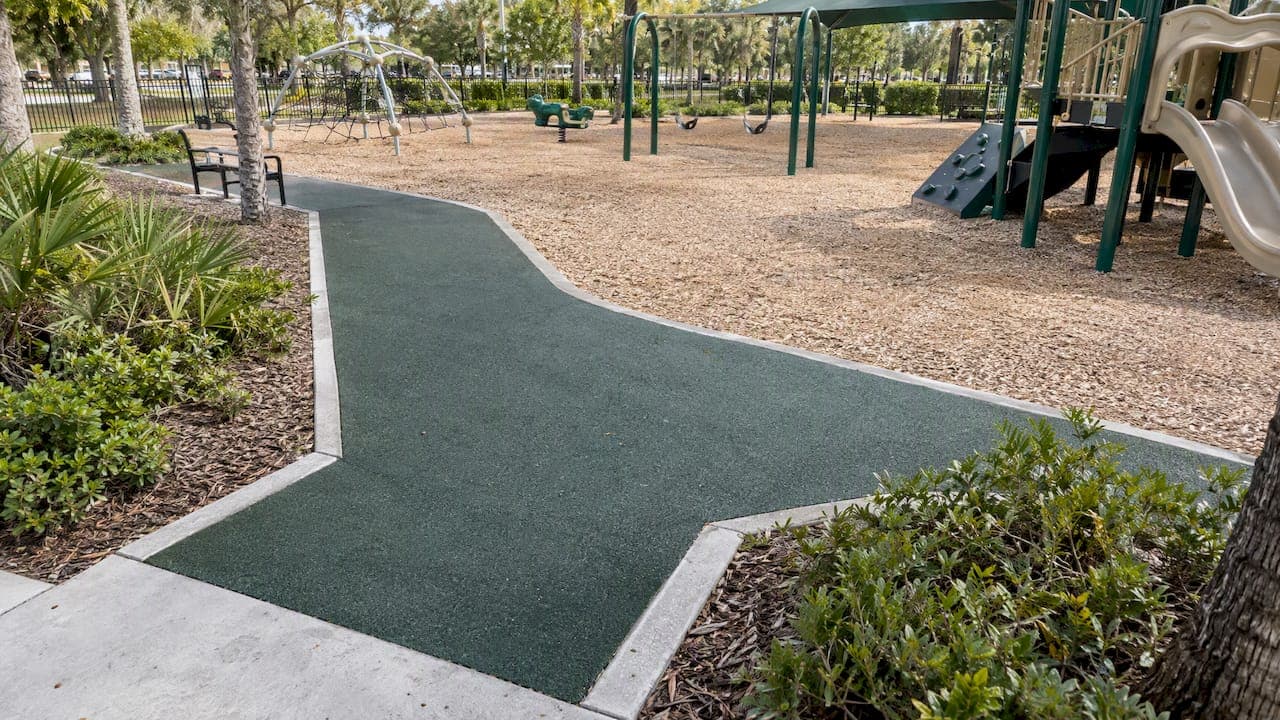
The best playground access path material is a firm, stable, slip-resistant surface that drains well and stays that way without constant labor. In practice that means poured concrete or asphalt, bonded or poured-in-place rubber, or a carefully maintained engineered wood fiber. Loose fill such as pea gravel, sand or shredded mulch is the option most likely to fail an accessibility check over time. The material is only half the decision, though. Width, slope, layout and upkeep decide whether a route actually works for a child in a wheelchair, a parent with a stroller or a grandparent with a walker.
This guide walks through the federal rules, compares the common materials, and shows how to avoid the mistakes that lead to expensive rework. It is written for HOA boards, municipal staff, school and park managers, and homeowners with a community-use or large private play area.
TL;DR
- An accessible playground route must be firm, stable and slip-resistant. Ground-level routes need at least 60 inches of clear width (44 inches in play areas under 1,000 square feet) and a running slope no steeper than 1:16.
- "Shock-absorbing" does not mean "accessible." Impact attenuation (ASTM F1292) and wheelchair access (ASTM F1951) are separate tests, so ask for documentation of both.
- Loose fill is cheapest to buy but needs frequent raking, topping off and re-leveling to stay compliant. Unitary surfaces such as poured-in-place or bonded rubber and concrete cut that labor.
- Most failures come from layout and installation, not the material itself. Draw the accessible route on the site plan and treat it as fixed.
- In wet, humid climates, drainage matters as much as the surface. Standing water makes a route harder to roll across and speeds up wear.
Table of Contents
- What the ADA actually requires of a playground route
- Accessible is not the same as safe
- Playground access path materials compared
- Why drainage decides how long a path stays accessible
- Perspective: where playground routes really go wrong
- How to choose: a practical checklist
- Maintaining the route once it is built
- Where rubber paving fits
- FAQ
- Sources
What the ADA actually requires of a playground route
The 2010 ADA Standards for Accessible Design set the baseline for play areas at public entities and places of public accommodation. The U.S. Access Board's guide to play areas puts the key numbers in one place:
| Requirement | Figure |
|---|---|
| Ground-level accessible route, clear width | 60 inches minimum |
| Play areas under 1,000 sq. ft. | 44 inches minimum clear width |
| Turning space | Required where a route exceeds 30 feet |
| Running slope | 1:16 maximum (6.25%) |
| Cross slope | 1:48 maximum (2.08%) |
| Overhead clearance | Nothing protruding into the route below 80 inches |
The same guide describes the route as one that must be stable, firm and slip-resistant, and it must connect the entry and exit points of accessible play components. The accessible route is meant to be the main pedestrian path of the site, not a leftover strip between pieces of equipment. The Access Board's chapter on play surfaces makes the same point: an accessible playground starts with an accessible site plan, and the route should be considered alongside the choice of equipment.
Two details trip people up:
- Firm and stable is measured, not eyeballed. The test method is ASTM F1951, which measures the effort a wheelchair user needs to cross the surface. A path that looks solid on installation day can fail it after a wet season.
- Compliance continues after installation. Owners are expected to maintain the surface so that it keeps meeting the standard. Loose-fill displacement, buckling slabs or a puddle that never drains can each make a once-compliant route non-compliant.
This article is general information, not legal advice. For a specific property, confirm the requirements with your accessibility consultant, architect or the authority that reviews your plans.
Accessible is not the same as safe
A playground has two surfaces to think about, and they do different jobs.
- The access path gets people to and between play components. Its job is maneuverability.
- The use zone surfacing sits under and around equipment where a child might fall. Its job is impact attenuation, tested under ASTM F1292.
The Consumer Product Safety Commission's Public Playground Safety Handbook is the reference for the safety side, and it also covers how children get onto equipment. A common pitfall is to install a hard, perfectly accessible surface that does not absorb falls where it needs to, or a soft, cushioned surface that wheelchairs cannot cross. Because the two standards are separate, the careful approach is to request lab-verified certificates for both ASTM F1292 and ASTM F1951 for any surface system, and to confirm they apply to your intended installation. Lab results can differ from what a field-installed surface delivers, especially as it ages or the base changes.
A useful rule of thumb: the path leading to the playground can often be a plain firm surface, while the surface inside the use zone must satisfy both tests. Many owners use one continuous rubber surface for both so there are no transitions to trip over.
Playground access path materials compared
Here is how the common options stack up on the things that decide long-term success.
| Material | Firm and stable | Drainage | Upkeep | Notes |
|---|---|---|---|---|
| Poured concrete | Yes | Needs slope or drains | Low, but cracks and heaving need repair | Hard, no fall protection in use zones |
| Asphalt | Yes | Needs slope or drains | Low to moderate | Heats up in sun, can crack and soften |
| Poured-in-place rubber | Yes | Depends on base and design | Low, inspect for cracks and holes | Unitary surface, can double as fall protection |
| Bonded or porous rubber paving | Yes | Can be designed to drain through | Low | Unitary, resists displacement |
| Rubber tiles | Yes when installed well | Depends on base | Low to moderate | Seams and edges need inspection |
| Engineered wood fiber | Only if depth and compaction are kept up | Good when base drains | High, regular raking and topping off | Cheaper to install |
| Pea gravel, sand, loose mulch | Generally poor for wheelchairs | Variable | Very high | Displaces and migrates |
| Stabilized decomposed granite or resin-bonded aggregate | Can be, with proper binder | Moderate | Moderate | Good for park trails, check testing |
Concrete and asphalt
Poured concrete and asphalt are the default for a reason. They are firm, they are familiar to every contractor, and they are easy to certify for slope. Their weaknesses show up over time. Concrete cracks and heaves, especially over expansive soils or tree roots, and asphalt softens in heat. Either one is a poor surface to fall on, so they work best as the approach path rather than inside a use zone. If you have an existing slab that is cracking, repairing it is a legitimate short-term step, and a guide to concrete patching can help you judge when a patch is enough and when the slab needs to be replaced. Patches that sit proud of the surface can create a trip edge, which is its own accessibility problem.
Poured-in-place, bonded and porous rubber
The CPSC identifies five general categories of playground surfacing made with recycled tire rubber: loose-fill rubber, rubber tiles, poured-in-place rubber, bonded rubber and synthetic turf, as summarized in the EPA's Federal Research Action Plan status report. The report is a research plan on tire crumb, not a product endorsement, and each product still has to prove itself against both ASTM standards.
What makes unitary rubber surfaces attractive for access paths is practical:
- They form a continuous surface, so there is no loose material to scatter and no depth to monitor.
- They stay firm for wheels and walkers, and they are comfortable underfoot.
- Porous versions let water pass through to the base, which matters for puddles.
- Color can mark the route visually, which helps users with low vision and helps staff keep equipment off the path.
The EPA's archived page on recycled tire pathways in Los Angeles County describes a county that used recycled tire rubber for pathways and playground surfaces to save landfill space. It is an example of rubber being used well beyond the playground itself.
Engineered wood fiber and other loose fill
Engineered wood fiber (EWF) can meet accessibility requirements, but only when it is installed to the right depth, compacted and then maintained. The industry's installation and maintenance guide for ADA compliance is blunt on this: maintaining the surface is critical to keeping it compliant, on a schedule that follows the manufacturer's recommendations. The CPSC handbook likewise says loose-fill materials need frequent raking to hold their depth, while unitary surfaces should be inspected for cracks and holes.

The hidden cost is labor. Loose fill is cheaper to buy, but raking, leveling and topping off, especially after heavy rain, can outweigh the savings over the life of the site. Pea gravel and sand are the weakest choices for a route that has to carry wheelchairs, because they shift under a wheel and migrate out of place.
Why drainage decides how long a path stays accessible
Puddles do more damage than people expect. Standing water softens loose fill, undermines bases and makes wheelchair propulsion harder, which pushes a surface toward failing the ASTM F1951 effort test. The CPSC handbook's routine maintenance items include checking that drainage systems are working so water does not stand, because standing water speeds up surface degradation.
When you compare materials, ask three drainage questions:
- Does water run off the surface through slope, or pass through it?
- What is under the surface? A porous top over a clogged or compacted base still pools.
- Where does the water go once it leaves the path? Discharging it onto the play area just moves the problem.
In Florida and other hot, wet climates, add heat to the list. Thermal expansion and heavy summer downpours test every joint and edge. Our own explainer on porous rubber paving specs covers how drawdown is specified for engineers.
Perspective: where playground routes really go wrong
We install rubber paving for a living, so we have a bias, and we will say it plainly. But the most expensive playground path problems we hear about have little to do with brand names.
They come from the plan. Equipment gets nudged a few feet during construction to fit a use zone, and the accessible route that was drawn so carefully now runs into a post. Someone decides the entrance can be "worked out later." The material was fine. The route was never treated as fixed. That matches what accessibility guidance keeps repeating: draw the route on the site plan first and build the equipment around it.
The second problem is maintenance. A surface that needs weekly raking will, sooner or later, miss a week. A unitary surface does not eliminate inspection, but it removes the cycle of topping off and leveling that loose fill demands. For HOAs and municipalities with small crews, that difference is real money and real liability.

The third is the assumption that "soft" means "accessible." Ask for both test results. If a supplier cannot produce them, keep looking.
When we are brought into a project, we focus on a few things: a porous, drainage-minded build, a surface that resists heat-related cracking, ADA-compliant results, and documentation that a government reviewer can work with. We do rubber paving and nothing else, which means the details of base, binder and edges are what we think about all day.
— Roger
How to choose: a practical checklist
Work through these steps in order. Skipping to the material choice first is how projects go wrong.
- Fix the route on the plan. Mark the accessible route from the parking area or sidewalk to every accessible component, with widths, turning spaces and slopes. Construction scheduling tools help keep drawings and field changes aligned, and construction project management software is one way a contractor can track revisions before they reach the field.
- Measure the site. Note existing grades, tree roots, soil type and where water goes after a storm. Clay soil, for example, holds water and moves.
- Set width and slope. Use 60 inches as the target, with 44 inches only where the play area is under 1,000 square feet. Keep running slope at or below 1:16 and cross slope at or below 1:48.
- Choose the surface by use. For heavy-traffic routes and use zones, a unitary surface is usually the lower-hassle choice. For a quiet secondary path, concrete or bonded aggregate may be enough.
- Request documentation. Ask for certificates for ASTM F1292 and ASTM F1951, plus installation instructions and a maintenance plan written for your climate.
- Plan inspections. Decide who checks the surface, how often, and where records are kept. Records support your risk management if a claim is ever made.
- Verify after installation. Confirm slopes, widths and transitions against the drawing before the contractor leaves.
Budget honestly
Compare life-cycle cost rather than purchase price. A loose-fill surface is cheaper at the start. Add the yearly labor for raking and topping off, plus the cost of replacing displaced material, and the gap narrows. Rubber and concrete cost more up front and need less handling afterward. Prices vary by site, base condition and region, so get written quotes that show the same scope of work.
Maintaining the route once it is built
Because the ADA expects continued access, treat maintenance as a standing task:
- Check for displacement and buckling after storms and at the start of each season.
- Look for cracks, holes and loose edges in unitary surfaces, and repair them quickly so a small defect does not turn into a trip hazard.
- Clear debris and keep drainage paths open.
- Mark equipment posts or borders so staff can see at a glance whether loose fill has dropped below the required depth.
- Keep written records of every inspection and repair.
For a wider look at how upkeep costs add up for community owners, see our piece on how to reduce community maintenance with rubber paving, and for the legal exposure side, how rubber paving reduces liability risk for property owners.
Where rubber paving fits
If you manage a playground in Florida, a rubber paving system is worth a serious look for the access route. We install the Rubberway® system, which uses recycled tire material and a porous design aimed at drainage, crack resistance in heat and ADA-compliant surfaces, in a wide range of colors. The product lines include Rubberway® Pervious Pavement, Rubberway Rubberrock 6000, Rubberway EVOLUTION and the Rubberway Sidewalk System. We are licensed and insured, we provide government-ready documentation, and we focus solely on rubber paving.
If you want a route assessed or a project scoped, you can see our rubber paving installation services or browse the Rubberway product lines. For more detail on how we approach this type of work, read our guides on durable playground safety surfaces for Florida sites and park path surface options.
We serve property owners who want an installed result. We do not sell materials for self-installation.
FAQ
What is the best material for a wheelchair accessible playground path?
A firm, stable, slip-resistant, well-drained surface is the best choice, and the top candidates are concrete, asphalt and unitary rubber surfaces such as poured-in-place or bonded rubber. Which one is best depends on traffic, climate and whether the path sits in a fall zone. Whatever you pick, confirm that it meets ASTM F1951 for access and, if it is in a use zone, ASTM F1292 for impact.
How wide does a playground access path have to be?
Under the 2010 ADA Standards, ground-level accessible routes in a play area must be at least 60 inches wide. Play areas under 1,000 square feet may use 44 inches, with a turning space where the route is longer than 30 feet. Running slope should not exceed 1:16 and cross slope should not exceed 1:48.
Is mulch or wood chips acceptable for an accessible route?
Engineered wood fiber can meet the standard if it is installed to the correct depth and kept compacted and level, but it demands regular raking and topping off. Ordinary loose mulch, pea gravel and sand are poor choices because they shift under wheels. If your crew cannot commit to the upkeep schedule, a unitary surface is the safer long-term option.
Does a shock-absorbing surface automatically meet ADA requirements?
No. Impact attenuation is tested under ASTM F1292, while wheelchair accessibility is tested under ASTM F1951. A surface can pass one and fail the other, so ask for certificates for both and make sure they apply to your installation.
Who is responsible for keeping the surface compliant?
The owner or operator is. Compliance is ongoing, so inspections, repairs and records of that work are part of the job. Your attorney or accessibility consultant can advise on the specific obligations for your property.
Sources
- U.S. Access Board, Chapter 10: Play Areas
- U.S. Access Board, Chapter 10: Play Surfaces
- CPSC Public Playground Safety Handbook (2025)
- EPA Federal Research Action Plan status report
- EPA archive: These Tires Were Made for Walkin'
- Installation and Maintenance Guide for ADA Compliance in Playground Surfacing