
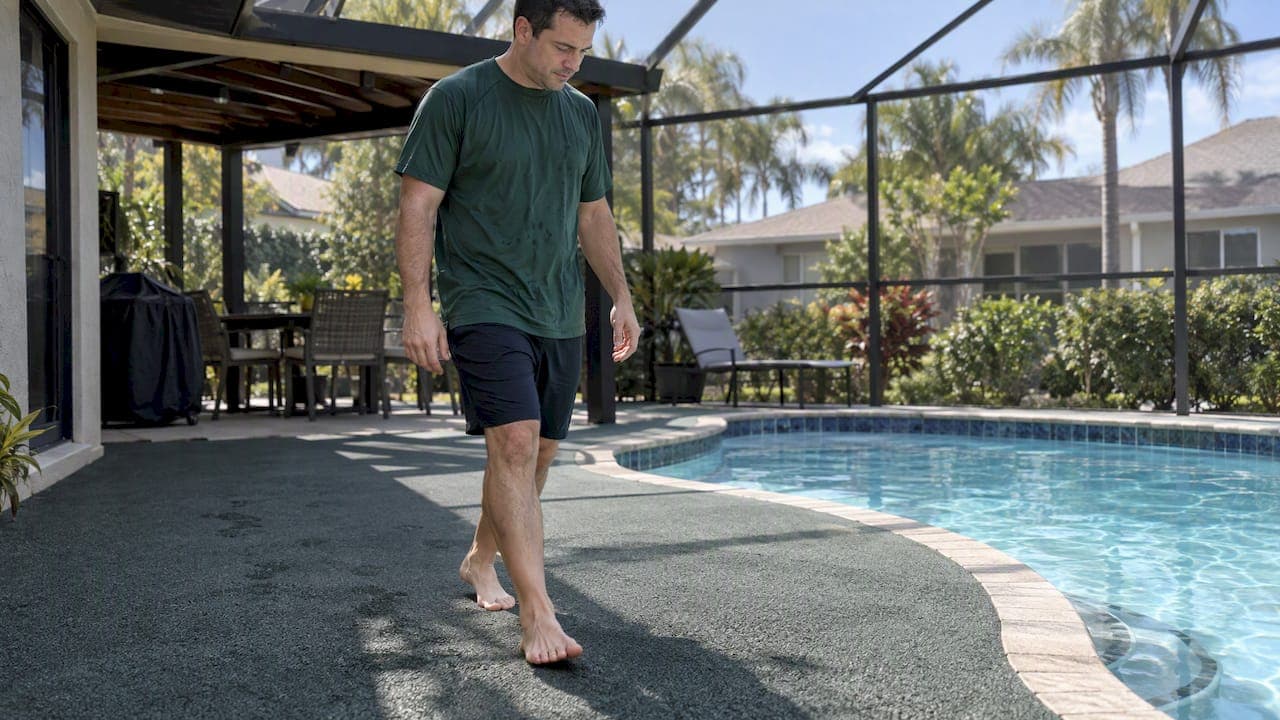
A pool deck that is comfortable barefoot does five things at once: it stays tolerable in direct sun, grips when wet, is textured without scraping skin, sheds water, and is easy to keep clean. A surface that is soft but scorching, or grippy but abrasive, fails. This guide shows how to judge each property, what to ask for in writing, and how to design the deck so wheelchair users and seniors can cross it too.
TL;DR
- Judge a deck on five properties together: wet traction, heat, texture, drainage and maintenance. Pool-deck guidance notes that sun-exposed surfaces can exceed 150°F, and that color, porosity, texture and shade all change how hot a surface feels.
- Barefoot injuries come from two opposite problems: heat ("pool feet") and rough texture ("pool toes"). Fix one without the other and you have traded one injury for another.
- "Slip-resistant" on a label is not proof. Ask for the test method, the wet condition and whether it was run on the system actually being installed.
- Accessibility is about layout as much as material: route width, slope, clear space and unobstructed transitions.
- Recycled-rubber paving is porous and flexible, but it is not one uniform material. Request product-specific documentation.
Table of Contents
- Why barefoot comfort is more than softness
- The five properties to evaluate
- Where rubber paving fits
- Wheelchair-friendly and senior-friendly decks
- A practical checklist before you sign
- Our perspective
- Talk to us about your deck
- FAQ
- Sources
Why barefoot comfort is more than softness
Most people describe a comfortable deck as "soft." Feet describe it differently: not hot, not rough, not slick. Those three complaints map to real injuries.
A dermatology case review separates two pool-related foot problems. "Pool toes" is friction damage from repeated contact with rough cement, more common in children and prone to recurring. "Pool feet" is a thermal injury from hot tile or cement around the pool. The same review notes that rubber-soled pool shoes can help prevent recurrence, and that footwear and shade are sensible temporary controls during extreme heat or on rough surfaces.
That has a design consequence. The common fix for a slippery deck is a coarse anti-slip texture. Coarse texture can scrape feet. The common fix for a hot deck is a light coating. A coating that is too smooth can be slick when wet. You are balancing, not maximizing.
There is also a safety-and-liability angle that owners of shared pools should take seriously. A 2025 Florida appellate opinion addressed whether a premises owner has a duty to warn or protect a barefoot guest from a hot cement pool deck. Reduced sensation, such as diabetic neuropathy, means some people cannot reliably feel dangerous heat. Design for them with cooler routes, shade and clear signage, rather than counting on every user to judge temperature.
The five properties to evaluate
| Property | What to ask | Red flag |
|---|---|---|
| Wet traction | Which test method, wet condition and substrate? Was it run on the installed system? | A generic "non-slip" claim with no number |
| Heat | Color options, porosity, and how much of the deck is shaded | Dark, dense surface in full sun with no shade plan |
| Texture | Is it gripping without abrading skin? | Coarse grit applied to a surface children will crawl on |
| Drainage | Where does water go: through the surface, to a drain, or to the edge? | Ponding after a summer storm |
| Maintenance | Cleaning frequency, who inspects, how repairs are made | No written plan |
Heat
Sun-exposed surfaces can exceed 150°F, and the same guidance says lighter colors generally absorb less heat, while porous materials hold air and can feel less heat-conductive. It also points out that shade over the places people sit, stand and travel often improves comfort more than upgrading the whole deck. A pergola over the lounge area and the path to the steps can do more than any material swap.

If a contractor promises a specific surface temperature, ask for the measurement conditions: air temperature, sun exposure, time of day and color. We do not publish a temperature figure for our own surfaces here, because it depends on color and exposure. Choose a lighter tone for open, full-sun areas. Our guide to which pool deck surface stays coolest goes deeper on the comparison.
Wet traction
A pool deck is walked on by dripping wet people, so wet grip is the first safety property. But a number can mislead. Research done for the Consumer Product Safety Commission on bathing surfaces distinguishes human barefoot-friction testing from tribometer testing, because a device and a bare foot do not always agree. So a credible installer should tell you the standard, the wet condition, the substrate, and whether the test was on the actual system.
Local rules vary and are narrower than people assume. One example: an Indian River County, Florida residential pool checklist sets a minimum DCOF of 0.43 for tiles inside the pool that provide footing. If a coating is used instead, the applicant must get building-official approval and submit product documentation and a certification letter before final inspection. That is a local requirement for a specific location, not a statewide rule for every deck. Check with your own building department. For wet-DCOF testing in more depth, see our post on pool deck surfaces and ANSI A326.3 wet DCOF tests.
Texture
Grip comes from texture, and texture is where "pool toes" begin. Ask to hold and walk on a full-size sample, barefoot, wet. A small swatch in an office tells you little. Walk it with the youngest and oldest person who will use the deck.

Drainage
Standing water makes any surface slick and invites algae. The Florida Department of Health's inspection guidance for public and commercial pools says deck and walkway areas must be free of sediment, debris, dirt, standing water and algae. It also says horizontal pool-deck surfaces must be slip-resistant and step edges need contrasting markings. Even a private homeowner is wise to treat that as a good target.
A porous surface helps because water can pass through it instead of sheeting across it. A 2024 peer-reviewed review describes recycled-rubber pavement as flexible and porous, with larger granules supporting faster drainage. But the surface is only one layer. The base, edges, transitions and drains decide whether water really leaves. Our guide to barefoot-safe pool deck drainage covers what to settle before anything is laid.
Maintenance
A surface that is slip-resistant on day one can become hazardous as dirt, algae and debris build up. Comfort depends on upkeep. For HOAs, municipalities and commercial operators, write cleaning frequency, inspection responsibility, drainage access and repair procedure into the specification. Facility teams comparing finishes may also find this overview of commercial tile and grout cleaning to reduce slip risk useful for planning cleaning routines. Coastal sites have a particular issue with sand and sediment, covered in our note on keeping sediment from clogging pores.
Where rubber paving fits
Rubber surfacing is often chosen for pool decks because it is cushioned, drains, and is not as abrasive as broom-finished concrete. The 2024 review mentioned above describes exterior rubber products as slip-resistant, durable and lower-maintenance than many conventional surfaces. It lists typical rubber pavement thicknesses of 38 to 51 mm in the literature, but treats these as examples, not a specification for every installed system.
The important caveat is that "rubber" is not one product. A government-commissioned review of poured-in-place rubber surfacing describes systems that use recycled tire crumb in a base layer, synthetic granules such as EPDM or TPV in a wearing layer, and polyurethane binders, installed over concrete or asphalt. Composition varies by system. So request documentation for pool chemicals, UV exposure, temperature, leaching, slip performance and maintenance, not just a brochure that says "rubber."
If you have a saltwater pool, that question is sharper. Our saltwater pool deck materials guide explains what to check.
Wheelchair-friendly and senior-friendly decks
A deck that is comfortable for a healthy adult can still be unusable for someone on wheels or with a walker. The U.S. Access Board's guidance on accessible pools frames this as a layout problem, not just a coating claim. According to its chapter on swimming pools:
- An accessible route is a continuous, unobstructed path at least 36 inches wide, with a maximum route slope of 1:12.
- Pool-lift clear deck space is at least 36 inches wide by 48 inches forward, with a slope no greater than 1:48.
- A pool with more than 300 linear feet of pool wall generally needs at least two accessible means of entry and exit.
Verify the applicable ADA Standards, building code and local authority requirements for your project. They differ for private residences, which are generally not covered by the ADA, and for public or commercial facilities, which are.
For wheelchair and walker users, the surface itself matters in three ways. It should be firm and stable, so wheels do not sink or catch. It should have no lips or abrupt level changes at transitions. And it should drain, since a puddle in a path is an obstacle. The Access Board's pool accessibility guide lays out the design logic for designers and operators.
For seniors, add these points:
- Keep the route to the pool entry shaded and lighter in color.
- Avoid coarse textures that catch a shuffling foot while still giving wet grip.
- Make step edges visibly contrasting.
- Place a cool, shaded rest spot near the entry.
The same thinking applies away from the pool. A wheelchair-friendly driveway, patio or park path needs a firm, continuous, well-drained surface with gentle slopes. Our posts on ADA slip resistance requirements and eco-friendly driveway resurfacing cover those cases.
A practical checklist before you sign
- Define who uses the deck. Children, seniors, wheelchair users, pets, guests in wet swimwear.
- Map sun and shade. Decide where shade structures go before picking a material.
- Pick a lighter color for full-sun zones. Dark tones are for shaded or partly shaded areas.
- Ask for slip-test documentation. Method, wet condition, substrate, and whether it applies to the installed system.
- Request material documentation. Composition, UV and pool-chemical resistance, drainage details and maintenance guidance.
- Confirm the drainage path. Base, edges, transitions and drains, not only the surface.
- Check your local requirements. Permit rules differ by county, and coatings may need building-official approval.
- Put maintenance in writing. Frequency, responsibility and repair procedure.
- Walk a sample. Barefoot, wet, in the sun if possible.
If you manage a community pool, our list of contract items HOA boards must approve for pool deck resurfacing turns this checklist into contract language.
Our perspective
We install rubber paving, and only rubber paving, in Florida, so we see how decks behave through heat, storms and heavy use. Here is how we think about barefoot comfort.
First, comfort is a system, not a product. We use the Rubberway® system, which is built from recycled materials with a porous design for drainage and crack resistance. But the surface only performs as well as the base, the edges and the plan for water. We would rather talk about those with you before talking about color swatches.
Second, we do not think any honest installer should promise that a surface will never be hot. Color, exposure and shade all matter. Choose lighter tones where the sun hits all day, and plan shade where people sit and walk. If someone in your household or community cannot feel heat well, treat shade and cooler routes as part of the design, not an extra.
Third, accessibility is a layout issue. A surface can be described as ADA-compliant, and a route can still fail because of slope, width or a lip at a transition. We work through the route with you, and for public and municipal jobs we provide government-ready documentation.
Finally, read the paperwork on any surface, ours included. Ask for composition, slip-test method and maintenance guidance for the exact system. We are licensed and insured, and we expect that scrutiny.
— Roger
Talk to us about your deck
If you are planning a pool deck, patio, walkway or community area in Florida and want a porous, recycled-rubber surface in a range of colors, we can walk the site with you and specify the right Rubberway system. See our rubber paving installation services or browse the Rubberway product lines, including Pervious Pavement, Rubberrock 6000, EVOLUTION and the Sidewalk System.
FAQ
Can a pool deck be both slip-resistant and gentle on bare feet?
Yes, but it takes balance. Very coarse textures grip well and can cause friction injuries, especially in children. Ask for a wet barefoot trial of a full-size sample and for the test documentation, so you get grip without abrasion.
What is the best color for a cool pool deck?
Lighter colors generally absorb less heat, so they are the safer choice in full sun. Porosity and shade also help. Shade over seating and walking zones often improves comfort more than replacing the entire deck, according to pool-deck guidance.
What makes a pool deck wheelchair friendly?
It needs a continuous, unobstructed route at least 36 inches wide with a slope no steeper than 1:12, according to the Access Board. The surface should be firm and well drained, with smooth transitions. Private homes follow different rules than public pools, so check your local requirements.
Is all rubber paving the same?
No. Systems differ in base layers, wearing-layer granules and binders. Ask for product-specific documentation covering pool chemicals, UV exposure, temperature, drainage and slip performance before you choose.
Does a hot deck really pose a health risk?
It can. A dermatology review documents thermal injury from hot tile and cement around pools. People with reduced sensation, such as those with diabetic neuropathy, are especially at risk and should talk to their doctor about foot protection around pools.
Sources
- Best Pool Decking Options and Materials, Decks.com
- Application of Waste Tire in Construction, MDPI Sustainability
- Access Board: Swimming Pools, Wading Pools and Spas
- Access Board: Accessible Swimming Pools guide
- Florida Department of Health: Explanation of Code References
- Indian River County: Residential Swimming Pools checklist
- Pool Toes: Case Report and Review of Pool-Associated Pedal Dermatoses
- Florida Third District Court of Appeal opinion, 2025
- CPSC: Bathing Surfaces research report
- Review of chemicals in poured-in-place rubber surfacing