
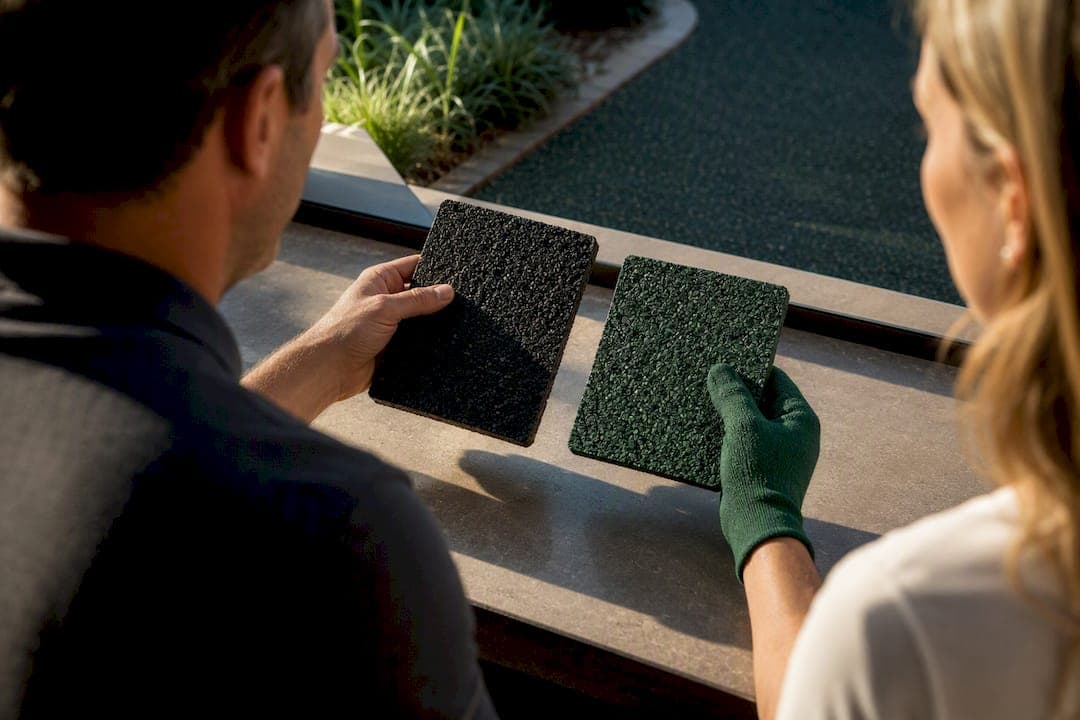
Rubber paving comes in blacks, earth tones, reds, blues, greens, and speckled fleck blends, and the right choice comes down to three things: performance under sun and heat, how the surface will be used, and how well the color suits the surrounding landscape or architecture. Chase the look you want, but let performance and function narrow the field first.
TL;DR:
- Darker colors will generally absorb more heat, making lighter high-reflectance blends the better choice for pool decks and warm outdoor spaces.
- Solid colors provide a uniform appearance suitable for branding or decorative purposes, while speckled blends better conceal dirt and wear in functional settings like playgrounds and driveways.
- Fade resistance varies by pigment chemistry and UV stabilizers, so requesting tested fade data from suppliers helps ensure color durability over time.
- Rubber granule type influences longevity of color, with pigmented EPDM showing more stability than coated recycled rubber, especially in high UV exposure areas.
- Verifying color samples on your actual substrate and lighting conditions before installation prevents surprises, as catalog images often differ from the final shade.
Table of Contents
- Common Color Palette and What the Names Actually Mean
- How Color Affects Heat, Fade, and Everyday Wear
- Choosing Colors for Playgrounds, Pool Decks, Driveways, and More
- How Pigments, Granules, and Binders Create Lasting Color
- Sampling and Verifying Color Before You Commit
- Keeping Rubber Paving Color Looking Good for Years
- What Installer Credentials Tell You About Color Quality
- Why Most Color Advice Skips the Part That Matters
- Get Color Samples and a Quote for Your Project
- Where to Look for Palettes and Performance Data
- Sources
- FAQ
Common Color Palette and What the Names Actually Mean
Most rubber paving palettes group colors into a handful of families, and once you know the categories, reading a manufacturer's swatch chart gets a lot easier. Vendor palette PDFs and physical chip cards typically organize offerings this way, and recognizing the naming conventions helps you compare products from different suppliers without getting confused by marketing language.
- Earth tones: names like terracotta, sand, adobe, and chestnut, used for driveways, patios, and walkways where a natural look matters.
- Black and charcoal: the most common functional colors, chosen for cost and for hiding stains on high-traffic surfaces.
- Reds and rust: brick red, redwood, and similar shades, popular for accent borders or pathways that need visual separation from surrounding hardscape.
- Blues and greens: often used for pool decks, splash pads, and playgrounds where a cooler, recreational feel is the goal.
- Speckled or fleck blends: two or more granule colors mixed together, sold under names like granite fleck, confetti, or mosaic blend.
The visual difference between a solid-color surface and a speckled blend is more than cosmetic. A solid color uses a single dyed or coated rubber granule throughout, giving a clean, uniform look that reads well in formal or architectural settings. A speckled blend mixes granules of different colors, producing a mottled, textured appearance that reads more like natural stone or mulch from a distance.
Solid colors tend to show up in decorative applications, borders, logos, or areas where a business wants a specific brand color underfoot. Speckled blends dominate functional applications: playgrounds, pool decks, and driveways, where hiding everyday wear matters more than a flawless uniform tone. When you request a sample, ask whether it's a solid pour or a blend, since the two behave differently as the surface ages.
How Color Affects Heat, Fade, and Everyday Wear
Color is not just aesthetic on a rubber surface. It changes how hot the ground gets, how quickly the pigment fades, and how well the surface hides dirt and scuffs over time.
Darker colors absorb more solar energy and hold heat longer, which matters most on pool decks and in warm climates where bare feet touch the surface directly. Lighter tones and high-reflectance blends stay cooler to the touch, which is why pool areas and splash pads lean toward lighter palettes rather than solid black.

The reflectance principle behind cooler pavement is well established: research on thermochromic pavement additives has shown that reflective and thermochromic materials can lower surface temperatures compared with traditional dark asphalt under test conditions. Rubber paving isn't asphalt, but the same optical principle applies: pigments and additives that reflect more solar energy keep the surface cooler underfoot, a point worth understanding when comparing color options for outdoor spaces that stay cool.
Fade rate depends on pigment chemistry and UV stabilization, not just color depth. A few things worth checking before you commit to a color:
- Ask suppliers for fade data or accelerated UV-testing results rather than taking colorfastness claims on faith.
- Expect speckled blends to mask localized wear and staining better than a single, uniform tone.
- Know that smooth, solid-color surfaces tend to show discoloration and scuffing sooner because there's nowhere for the eye to look except the flat color field.
- Understand that slip resistance comes mainly from surface texture and binder finish, not pigment, though certain topcoats can change the tactile feel underfoot.
Choosing Colors for Playgrounds, Pool Decks, Driveways, and More
The right color depends heavily on where the surface will live and who will use it. Professionals working through a color decision generally follow a sequence like this:
- Playgrounds: prioritize high-visibility, wear-masking speckled blends with UV-stable pigments, since these surfaces face constant sun exposure and heavy foot traffic from kids' shoes and equipment.
- Pool decks: lean toward lighter tones or high-reflectance blends to reduce surface heat underfoot, and confirm the slip rating before finalizing any color, since a beautiful surface that's slick when wet defeats the purpose.
- Patios and driveways: earth tones and mixed flecks do the best job of hiding dirt, leaf litter, and tire marks between cleanings, which matters more for daily livability than a showroom-perfect solid color.
- Commercial walkways and paths: build in contrast for wayfinding and to support ADA compliance, and choose colors proven to hold up under heavy, continuous foot traffic rather than colors chosen purely for branding.
- Municipal and HOA common areas: balance durability with a consistent look across multiple installations, since these projects often get compared side by side over years of service.
A pool deck is the clearest example of where color choice has a direct safety implication rather than a purely aesthetic one. Heat guidance for hot-climate paving materials generally points toward lighter or reflective blends specifically because bare feet and pool decks don't mix well with dark, heat-absorbing surfaces.
How Pigments, Granules, and Binders Create Lasting Color
Color in rubber paving starts with the granule itself, and the type of granule used has a real effect on how long that color lasts. Colored EPDM (ethylene propylene diene monomer) granules are manufactured with pigment baked into the rubber during production, which tends to give more consistent, stable color over time. Recycled tire rubber, by contrast, is typically coated with a colored layer after the fact, and that coating can wear or fade differently than a pigment integrated at the manufacturing stage.
Pigment type and UV stabilizers determine how quickly a color fades under sun exposure. Some formulations include reflectance-boosting additives, similar in principle to titanium dioxide scatterers used in other reflective coatings, which help bounce solar energy away from the surface rather than absorbing it. UV resistance guidance is worth reviewing before you settle on a color, since not every pigment or binder system handles years of sun the same way.
- EPDM granules generally hold color more consistently than coated recycled rubber, though both can perform well when properly formulated.
- Binder chemistry and topcoats help lock pigment in place and resist staining from oil, leaves, and foot traffic.
- Custom color blends, especially small runs, may carry minimum order requirements or added cost compared with standard palette colors.
Pro Tip: Ask any supplier directly whether your color choice uses EPDM granules, coated recycled rubber, or a blend of both, since that single detail predicts a lot about long-term fade behavior.
Sampling and Verifying Color Before You Commit
Color on a screen or a printed swatch rarely matches color on the ground, so verifying it in person before a full installation saves a lot of regret.
- Request a physical swatch chip and, whenever possible, a small sample pour on the actual substrate you'll be using, viewed in the same lighting your finished surface will get.
- Treat vendor photos as a starting point, not the final word: confirm the color with an on-site sample, since curing time and substrate color underneath can shift the final tone.
- Ask for documented fade or UV-test data along with a written warranty and maintenance plan, so you know what recourse you have if the color doesn't hold up.
- Clarify any incremental cost tied to custom colors or small-batch runs before you finalize a design, since these add-ons can affect the total project price.
Substrate and curing effects surprise a lot of first-time buyers. A color that looks perfect on a chip can shift slightly once poured over concrete or compacted base, which is one more reason a sample pour on your own substrate beats judging color from a catalog alone.
Keeping Rubber Paving Color Looking Good for Years
Color care on rubber paving is mostly about protecting the pigment and binder from the things that degrade them fastest: harsh chemicals, excessive heat, and abrasive cleaning.
- Use mild, pH-neutral cleaners and moderate pressure-washer settings; aggressive pressure or bleach-based products can strip pigment and dull binder faster than normal wear.
- Reserve full resurfacing for widespread fading or structural wear, and treat isolated stains or scuffs with spot cleaning or minor patching first.
- Expect speckled blends to hide blemishes longer than solid colors, since a single scuff or stain stands out far more clearly against a uniform tone.
- Watch for premature color loss tied to prolonged chemical exposure, ponding water, or years of unmitigated direct sun, all of which shorten a color's useful life faster than normal foot traffic alone.
Routine cleaning two or three times a year, paired with prompt attention to spills, keeps most colors looking close to original for years. When fading does show up, it usually starts at the surface layer rather than throughout the granule, which is part of why recoating or targeted patching can restore appearance without a full tear-out.
What Installer Credentials Tell You About Color Quality
Color performance depends as much on the installer's process as on the pigment itself. EcoTec Rubber Paving specializes exclusively in rubber paving installation using the Rubberway® system, built with recycled materials and designed for porous drainage, crack resistance, and ADA-compliant surfaces, an approach that requires close attention to the same color-stability variables covered above. Being licensed and insured, and providing government-ready documentation, are baseline signals worth requiring from any installer, not just a preferred vendor.
Before hiring anyone for a rubber paving project, run through a short checklist:
- Confirm the installer is licensed and insured in your area.
- Ask for ADA-compliance documentation if the project needs it.
- Request proof of the actual color sample, not just a catalog image.
- Get warranty terms in writing, including what's covered if color fades early.
- Ask for references from completed projects similar to yours.
For readers who want more technical depth on specific product families, EcoTec's Rubberway® product pages outline the different systems and their customization options.
Why Most Color Advice Skips the Part That Matters
Most color guides treat rubber paving like paint: pick a shade you like and move on. That advice undersells how much color choice affects the surface's actual performance. A gorgeous charcoal driveway that turns uncomfortably hot by early afternoon, or a pool deck color that fades unevenly within a couple of seasons, isn't a color failure so much as a planning failure.
The conventional wisdom treats aesthetics as the primary decision and performance as an afterthought. Flip that order. Start with how the space gets used and how much sun it takes, then narrow the palette to colors and granule types that can actually hold up there, and only then pick the shade that looks best among the options left standing. Speckled blends get dismissed as the "practical" choice, as if practicality and good looks were opposites, but a well-chosen fleck blend often ages better and looks more natural over time than a flat solid color ever does.
Ask for fade data before you ask for a mood board. It's the one step almost everyone skips, and it's the one that actually predicts what your surface will look like in five years.
— Roger
Get Color Samples and a Quote for Your Project
Once you know which color family fits your space, the next step is seeing it on the ground, not just on a chart. Rubber paving installers commonly work with Rubberway® systems that include various product lines designed for different needs: pervious pavement for drainage-critical sites, heavier-duty applications, and sidewalk systems for municipal and pedestrian projects. These systems offer color customization options suited to residential driveways, pool decks, patios, commercial walkways, and municipal or HOA spaces.
- Browse the Rubberway® product lines to see which system fits your project and request a specific color sample.
- Reach out through the EcoTec Rubber Paving site to request a quote or schedule a sample pour on your own substrate before committing to a full installation.
Getting a physical sample poured in your actual space, in your actual light, remains the most reliable way to confirm a color before the crews show up for the real installation.
Where to Look for Palettes and Performance Data
For readers who want to go deeper, a few resources are worth bookmarking. Manufacturer palette pages and PDF color charts remain the standard reference for available names and blends, so check with any supplier directly for their current chart. The thermochromic pavement study covers the heat-and-color science in more technical detail. EcoTec's own technical posts on heat resistance and UV durability expand on points raised throughout this guide. Readers weighing shade structures to reduce perceived heat around a dark surface may also find outdoor shading options useful, and those comparing exterior color strategies more broadly can review this guide to fade-resistant color selection.
FAQ
What colors are typically available for rubber paving?
Rubber paving typically comes in blacks, earth tones like terracotta and sand, reds, blues, greens, and speckled fleck blends that combine multiple granule colors. Availability varies by manufacturer, so checking a current palette chart or requesting a physical swatch is the most reliable way to see exact options.
Do darker rubber paving colors get hotter than lighter ones?
Yes, darker colors absorb more solar energy and hold heat longer than lighter or high-reflectance blends. This matters most on pool decks and in warm climates, where lighter tones are generally recommended to keep the surface more comfortable underfoot.
How long does rubber paving color last before it fades?
Fade rate depends on pigment type, UV stabilizers, and whether the granules are colored EPDM or coated recycled rubber, so lifespans vary by product. Asking a supplier for fade data or accelerated UV-testing results is the best way to get a realistic expectation for a specific color and product.
Should I choose a solid color or a speckled blend for a driveway?
Speckled or fleck blends generally hide dirt, tire marks, and everyday wear better than a single solid color, making them a practical choice for driveways and other high-traffic surfaces. Solid colors still work well for accents, borders, or decorative areas where a uniform look matters more than concealing wear.
Can I get a custom rubber paving color made?
Many suppliers offer custom color blends, though small or custom runs may carry minimum order requirements or added cost compared with standard palette colors. It's worth confirming pricing and lead time for custom colors directly with your installer, since this varies by project and provider.