

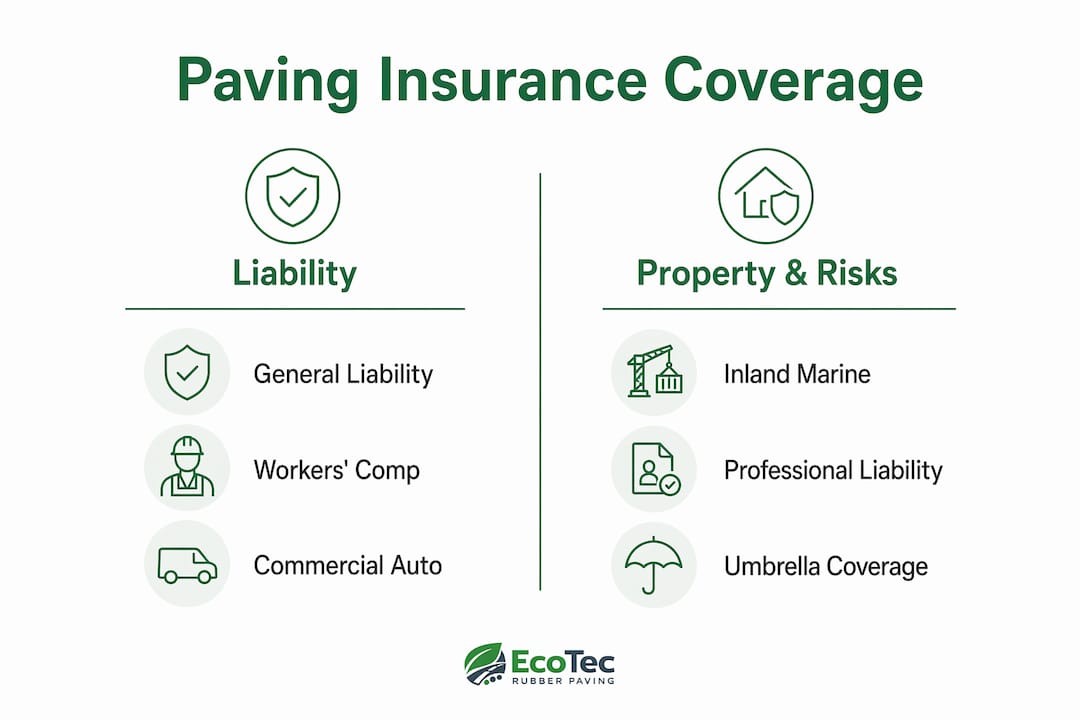
Paving vendor insurance typically covers commercial general liability (CGL), workers' compensation, commercial auto, inland marine (tools and equipment), contractors pollution liability (CPL), and umbrella/excess coverage. For contractors providing design or drainage specs, professional liability (E&O) rounds out the stack. Bonds — bid, performance, and payment — are separate instruments but almost always required alongside insurance on public work.
Quick TL;DR checklist before you bid:
- Confirm your state's workers' comp trigger and verify you have active coverage
- Check that your CGL policy includes completed operations and that the duration matches contract requirements
- Verify additional-insured endorsements name the owner or prime contractor (not just listed as certificate holder)
- Confirm CPL is in place if your work is near waterways, storm drains, or involves fuel/sealcoat chemicals
- Pull your equipment list and verify inland marine limits cover replacement cost
Common contract limit baselines:
- Commercial general liability: $1M per occurrence / $2M aggregate (standard commercial baseline)
- Municipal and industrial bids often require high umbrella/excess coverage limits
- Workers' comp: statutory limits per state, with employer's liability set per regulatory guidelines
Table of Contents
- What does paving vendor insurance cover at a glance?
- How does commercial general liability protect paving contractors?
- Why is workers' compensation critical for paving crews?
- What commercial auto coverage do paving operations need?
- When does a BOP fall short for paving businesses?
- How does inland marine protect your paving equipment?
- When do paving contractors need professional liability (E&O)?
- When should you add umbrella or excess liability coverage?
- What bonds do paving contractors need for public bids?
- What do standard paving policies typically exclude?
- Why insurers treat paving as a high-risk trade
- How much does paving contractor insurance cost?
- How to get a quote: what insurers will ask for
- Key Takeaways
- The insurance stack most contractors get wrong
- Ecotecrubber's Rubberway® system: a different approach to paving risk
- Useful sources and next reads
What does paving vendor insurance cover at a glance?
Each policy in a paving contractor's portfolio covers a distinct exposure. Use this table when reviewing a certificate of insurance or building your own coverage checklist.
| Policy | What It Covers for Paving Work |
|---|---|
| Commercial General Liability (CGL) | Third-party bodily injury, property damage, personal/advertising injury, completed operations |
| Workers' Compensation | Employee medical care, lost wages, disability from on-the-job injuries; mandatory in most states |
| Commercial Auto | Third-party liability and physical damage for dump trucks, equipment haulers, hired/non-owned autos |
| Inland Marine / Contractors' Equipment | Theft, transit damage, and on-site loss for mobile pavers, rollers, and compactors |
| Contractors Pollution Liability (CPL) | Asphalt runoff, fuel spills, sealcoat chemical releases — gaps CGL leaves open |
| Professional Liability / E&O | Financial losses from negligent design, drainage specs, or mix recommendations |
| Umbrella / Excess Liability | Additional limits above CGL, auto, and workers' comp when primary limits are exhausted |
| Bid / Performance / Payment Bonds | Surety instruments guaranteeing contract completion and payment to subs/suppliers |
When reviewing a COI, confirm each required policy appears with the correct limits, effective dates, and endorsements — not just a policy number.
How does commercial general liability protect paving contractors?
CGL is the foundation of paving insurance coverage. It covers third-party bodily injury, property damage, personal and advertising injury, and completed operations — subject to policy limits and exclusions.
For paving work specifically, the triggers that matter most are:
- Bystander injury from hot mix: A pedestrian contacts fresh asphalt running at 300–350°F. CGL responds to the bodily injury claim.
- Equipment-caused property damage: A paving machine clips a parked vehicle or damages a curb. CGL covers the third-party property damage.
- Completed operations claims: A parking lot fails structurally six months after the job closes. Completed operations coverage within CGL responds to claims that arise after the project is finished. Clients commonly require this coverage to remain in force for two years or until a contractually specified duration.
The standard commercial baseline is $1M per occurrence and $2M aggregate. Municipal and industrial contracts routinely require higher limits, which is where umbrella coverage enters the picture.
Pro Tip: Before signing any contract, verify the completed operations duration on your policy and confirm that additional-insured endorsements actually name the owner or prime contractor via a policy endorsement — being listed only as a certificate holder does not transfer coverage.

Why is workers' compensation critical for paving crews?
Workers' compensation covers employee medical care, lost wages, and disability from on-the-job injuries. In most states, it is mandatory the moment you have employees on payroll.
Paving crews face injury exposures that are genuinely severe: hot-asphalt burns, rollover incidents with heavy rollers, crush injuries from equipment, heat illness during summer road work, and respiratory issues from asphalt fumes. These are not theoretical risks.
Workers' compensation is not optional for most paving operations. State triggers vary — some states require coverage for even a single part-time employee — and operating without it can void your contractor's license, expose you to personal liability for employee injuries, and disqualify you from public bids. Check your state's specific threshold before your first hire.
Workers' comp premiums for paving are rated per $100 of payroll using NCCI class codes, and paving typically attracts higher rates than many other trades because of its injury profile. Your experience modification rate (EMR) directly affects what you pay — a clean safety record lowers it; a history of claims raises it.
What commercial auto coverage do paving operations need?
Commercial auto covers third-party liability and physical damage to vehicles used for business: dump trucks, tandem trucks, equipment haulers, and trailers. Personal auto policies exclude business use, so any vehicle moving materials or equipment to a job site needs a commercial policy.
Key coverage considerations for paving fleets:
- Combined single limit vs. split limits: Heavy-equipment transport and loaded-haul exposures justify higher combined single limits — a dump truck accident with a loaded trailer can generate claims that split-limit policies handle poorly.
- Hired and non-owned auto (HNOA): Covers rented trucks and employee-owned vehicles used on company business. If a crew member drives their personal truck to pick up materials and causes an accident, HNOA fills the gap your commercial auto policy leaves.
- Physical damage for haulers: Check whether your commercial auto policy covers physical damage to the vehicle itself, not just liability to third parties.
- Hot-mix transport: Verify whether cargo coverage or commercial auto physical damage addresses losses during hot-mix transport — some policies treat the load separately from the vehicle.
When does a BOP fall short for paving businesses?
A Business Owner's Policy bundles general liability and commercial property into one affordable package, making it the most cost-effective entry point for small paving operations. The catch: BOP property sections cover fixed premises and some on-site materials, but they frequently exclude mobile equipment and in-transit losses.
That exclusion matters enormously for paving. A paver, roller, or compactor sitting at a job site overnight is not at your fixed premises. If it is stolen or damaged, a BOP property policy typically will not respond. Inland marine coverage fills that gap.
Pro Tip: When applying for a BOP or standalone property policy, provide your insurer with a complete equipment list including serial numbers, current values, storage locations, and any theft-prevention measures (GPS tracking, locked compounds). Documented security practices can lower your inland marine premium.
How does inland marine protect your paving equipment?
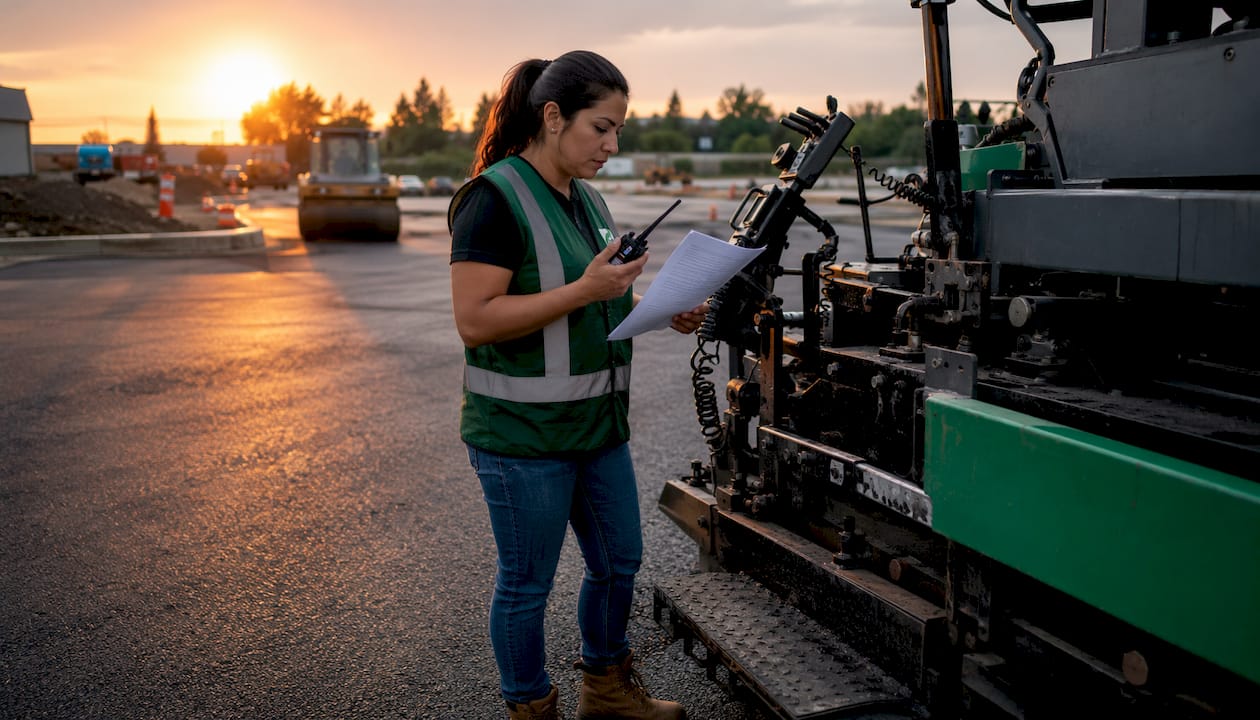
Inland marine — often called a contractors' equipment floater — covers theft, transit damage, and on-site loss for mobile paving equipment that CGL and BOP property policies do not protect. It is the policy that pays when your paver disappears from an overnight job site or your roller is damaged during transport.
You have two structural options: scheduled coverage or blanket coverage.
Scheduled coverage assigns an agreed value to each piece of equipment individually. It gives you certainty — if a $150,000 paver is stolen, you recover the scheduled amount. The tradeoff is administrative: every new machine must be added to the schedule. Blanket coverage insures your total equipment inventory up to a single limit, which is simpler to manage but can underpay if a single high-value machine represents a large share of the total.
Equipment replacement costs give you a sense of what limits to set: asphalt pavers, tandem rollers, and dump trucks vary widely in replacement cost. If your blanket limit is $300,000 and your paver alone is worth $200,000, a total loss of that machine could leave you underinsured.
Ask your broker about rental reimbursement endorsements. If a critical machine is out of service after a covered loss, rental reimbursement covers the cost of a replacement unit while yours is repaired or replaced.
When do paving contractors need professional liability (E&O)?
Professional liability covers financial losses caused by negligent design, specifications, or professional advice. It does not cover property damage from physical operations — that is CGL's territory. The distinction matters because the two policies respond to fundamentally different triggers.
A paving contractor who only lays asphalt per a client's spec rarely needs E&O. But if you are advising on grading plans, specifying mix designs, or providing drainage recommendations, you are delivering a professional service. If that advice leads to chronic pavement failure or a drainage problem that floods an adjacent property, the resulting claim is likely a financial loss from bad advice — not a bodily injury or property damage from a physical act. CGL will not respond. Professional liability will.
The practical test: if a client is paying you to think, not just to pave, E&O belongs in your policy stack.
When should you add umbrella or excess liability coverage?
Umbrella and excess liability increase your limits above what your underlying CGL, commercial auto, and workers' comp policies provide. When a single incident exhausts a primary policy, the umbrella responds.
Municipal and industrial contracts often require $5,000,000 or more in umbrella/excess coverage. Verify the contract's specific requirements before bidding — being uninsurable for a job after winning it is a costly mistake.
| Primary Policy Limits | Umbrella Increment | Typical Use Case |
|---|---|---|
| $1M per occurrence / $2M aggregate | $1M umbrella | Small commercial work, private clients |
| $1M per occurrence / $2M aggregate | $2M umbrella | Mid-size commercial, some municipal bids |
| $1M per occurrence / $2M aggregate | $5M umbrella | Large municipal, DOT, or industrial contracts |
Before finalizing your umbrella, confirm it sits over the exact underlying policies your contract requires. Some umbrella policies have gaps in the underlying schedule that leave you exposed on auto or workers' comp claims.
What bonds do paving contractors need for public bids?
Bonds and insurance are not the same thing. Insurance protects you from losses. Bonds protect the project owner from your failure to perform.
The three bonds you will encounter on public and large private work:
- Bid bond: Guarantees you will honor your bid price if awarded the contract. Typically 5–10% of the bid amount.
- Performance bond: Guarantees you will complete the work per contract terms. Required on most public projects.
- Payment bond: Guarantees you will pay subcontractors and suppliers. Protects the project owner from lien claims.
Surety companies underwrite bonds based on your financial statements, credit, and track record — not just your insurance history. Bonding capacity is something to build over time, not scramble for the week before a bid.
COI checklist for contract prequalification:
- Certificate holder named correctly (the project owner or prime contractor)
- Additional-insured endorsement attached to the policy — not just noted on the COI
- Waiver of subrogation where the contract requires it
- Policy numbers, effective dates, and expiration dates visible
- Correct limits for each required policy
- Completed operations coverage confirmed with duration
- CPL listed if the contract requires it
- Umbrella/excess shown with underlying policies listed
For lien waiver templates and contract forms that work alongside your COI package, construction form resources can save time during bid closeout.
What do standard paving policies typically exclude?
Many of the losses paving contractors assume they are covered for are actually excluded from standard policies. Knowing the gaps before a claim is filed is the difference between a recoverable loss and a business-ending one.
Pollution exclusion: Most CGL policies contain a total pollution exclusion. Asphalt runoff into a storm drain, a fuel spill on a job site, or sealcoat chemical releases are all potential pollution events. Standard CGL policies leave contractors exposed to environmental cleanup costs and third-party claims from these incidents. CPL fills that gap specifically.
Defective workmanship: CGL does not cover the cost of repairing your own faulty work. If a pavement section fails because of poor compaction or incorrect mix, the repair cost is yours. CGL may respond if the defective work damages a third party's property, but the rework itself is excluded.
Wear and tear: No policy covers gradual deterioration. Pavement that fails over time from normal use is a warranty issue, not an insurance claim.
Contractual indemnities: If you sign a contract agreeing to indemnify another party beyond what your policy covers, the excess indemnity obligation falls on you personally.
Pro Tip: If your work involves any proximity to waterways, storm drains, or environmentally sensitive areas, CPL is not optional — it is the only policy that covers asphalt runoff and fuel spill cleanup costs that your CGL will specifically exclude.
Why insurers treat paving as a high-risk trade
Paving is classified as high-risk because hot-mix asphalt runs at high temperatures, combined with heavy mobile equipment and frequent roadside work in live traffic. Insurers price that risk accordingly.
The recommended policy stack for most paving operations:
- BOP or standalone CGL for premises and third-party liability
- Inland marine for mobile equipment
- Commercial auto for the fleet
- Workers' comp per state mandate
- CPL for environmental exposures
- Umbrella/excess for large or municipal contracts
- E&O where design or specification services are provided
For municipal paving liability risks, verify completed operations coverage duration and confirm additional-insured endorsements before submitting a bid package. A missing endorsement discovered after contract award can disqualify you from the job.
How much does paving contractor insurance cost?
Premiums vary widely. The factors that most strongly drive your rate:
- Payroll: Workers' comp and CGL are both rated on payroll. More crew, higher premium.
- Revenue: General liability often uses revenue as a rating base for larger operations.
- Equipment value: Inland marine premiums scale with the replacement cost of scheduled equipment.
- EMR (experience modification rate): A clean safety record lowers your workers' comp rate; a history of claims raises it.
- Claims history: Prior losses signal future risk to underwriters.
- Contract types: Municipal and DOT work triggers higher limit requirements and often higher base rates.
- Location: State workers' comp rates and local litigation environments affect pricing.
To lower premiums: implement a documented safety program, maintain clean EMR, bundle policies where possible (BOP instead of separate GL and property), and negotiate sublimits on lower-risk exposures. A broker who knows paving NCCI class codes will get you more accurate quotes than a generalist who has to look up the trade.
How to get a quote: what insurers will ask for
Getting accurate, comparable quotes requires submitting the same information to every broker. Here is what to prepare:
- Business revenue for the prior year and projected for the current year
- Total payroll broken down by job function (operators, laborers, supervisors)
- NCCI class codes for your workers' comp application (paving has specific codes)
- Equipment list with serial numbers, year, make, model, and current replacement value
- Current policies and five-year loss runs (claims history)
- Sample contracts showing required endorsements, limits, and bond requirements
- Subcontractor usage — insurers want to know if you use subs and whether they carry their own coverage
Key questions to ask every broker:
- Does the CGL policy contain a total pollution exclusion, or is CPL included?
- What is the completed operations coverage duration?
- How is the additional-insured endorsement worded — blanket or scheduled?
- Does the policy include a waiver of subrogation?
- Is inland marine included, or is it a separate policy?
- What is the umbrella's underlying schedule, and does it match my primary policies?
Understanding lien waivers and payment bonds before contract signing also helps you ask the right questions about how your insurance interacts with subcontractor payment protections.
Key Takeaways
Paving vendor insurance requires a layered policy stack — CGL, workers' comp, commercial auto, inland marine, and CPL at minimum — with umbrella coverage added for any municipal or industrial bid.
| Point | Details |
|---|---|
| Core policy stack | CGL, workers' comp, commercial auto, inland marine, and CPL form the baseline for most paving operations. |
| Municipal limits | Large municipal and industrial contracts often require $5M or more in umbrella/excess coverage — verify before bidding. |
| Pollution gap | Standard CGL excludes asphalt runoff and fuel spills; CPL is the only policy that covers those environmental exposures. |
| Equipment scheduling | Asphalt pavers typically cost $80,000 to $200,000 new, tandem rollers $40,000 to $100,000, and dump trucks $60,000 to $150,000; inland marine limits must reflect actual replacement cost, not depreciated value. |
| Ecotecrubber's approach | EcoTec Rubber Paving's Rubberway® installations use recycled rubber that reduces lifecycle maintenance and can affect completed-operations and warranty profiles compared with asphalt. |
The insurance stack most contractors get wrong
Most paving contractors I talk with have CGL and workers' comp. That is the floor, not the ceiling. The policies that actually save businesses are the ones nobody thinks about until a claim hits.
CPL is the clearest example. A fuel spill or asphalt runoff event near a storm drain can trigger environmental cleanup costs that run well into six figures. Standard CGL excludes it entirely. Yet CPL is still treated as optional by many contractors doing roadside work next to drainage infrastructure every day.
The completed operations gap is the other one. A pavement failure discovered eight months after project closeout looks like a warranty issue until the client's attorney frames it as a negligence claim. If your completed operations coverage expired at project completion rather than running for the contractually required two years, you are defending that claim out of pocket.
The contractors who come out of large claims intact are the ones who built the full stack before they needed it, not after. Verify the endorsements, confirm the durations, and get the CPL in place before the next municipal bid goes out.
Ecotecrubber's Rubberway® system: a different approach to paving risk
Most of the insurance complexity covered in this article traces back to one source: the materials and methods traditional paving uses. Hot-mix asphalt at 300–350°F, heavy rollers, fuel-intensive equipment, and surfaces that crack, pool water, and degrade over time all drive the risk profile that makes paving one of the harder trades to insure affordably.
EcoTec Rubber Paving takes a different route. Their Rubberway® installations use recycled rubber to create permeable, ADA-compliant surfaces that resist cracking and drain efficiently. For Florida municipalities, property owners, and commercial sites, that means a paving surface with a lower maintenance burden and a different completed-operations and warranty profile than asphalt or concrete.
If you are evaluating paving options for a property or public project and want to understand how material choice affects long-term liability and maintenance costs, request a site assessment from EcoTec directly at ecotecrubber.com.
Useful sources and next reads
- Coverage Criteria: Paving Contractor Insurance Requirements — detailed breakdown of policy types and high-risk classification for paving trades
- Insureon: Paving Contractor Insurance — BOP guidance and NCCI code context for small paving operations
- NIP Group: Road Contractors Insurance Programs — municipal and industrial limit requirements and specialty program options
- Asphalt Coatings Company: Paving Contractor Insurance Guide — CPL and pollution exclusion explanation with paving-specific examples
- Ajax Paving: Sub-Vendor Insurance Requirements (PDF) — real-world COI and endorsement requirements from a major paving contractor
- ContractorNerd: Paving Contractor Insurance Overview — workers' comp class codes and EMR context
- EcoTec: Public Paving Procurement Checklist — insurance and bond requirements for public sector paving projects
- EcoTec: Types of Paving Vendor Certifications — how certifications affect prequalification and insurance requirements
- EcoTec: The Role of Licensed Contractors in Paving Projects — licensing, bonding, and why insurers require both
This article is general information for U.S. paving contractors and buyers, not legal or insurance advice. Confirm current coverage requirements and limits with a licensed insurance broker or your state's regulatory authority for your specific situation.