
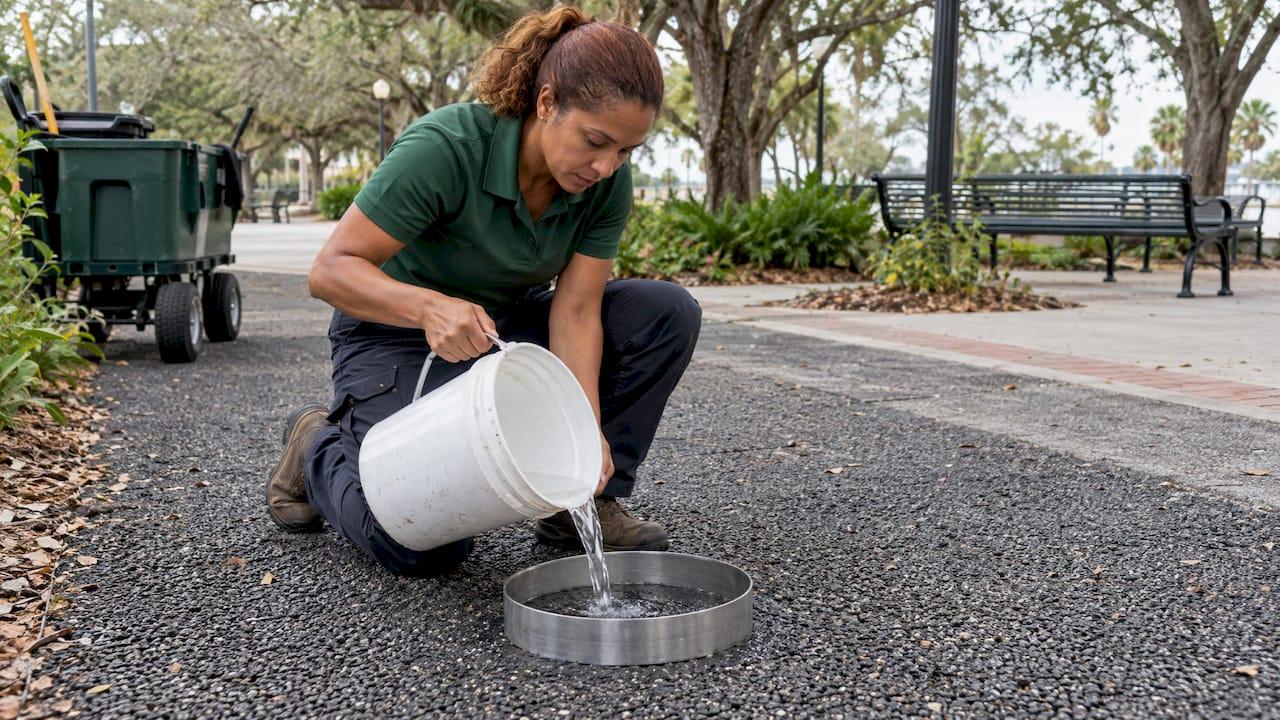
A city keeps porous pavement working with a simple routine: vacuum it at least twice a year, inspect it after storms and each spring, fix drainage problems early, and log everything. Porous surfaces drain only while their pores stay open, so maintenance is the thing that protects the investment. This guide gives public works crews, park departments and board members the schedule, the warning thresholds and the records to use, with each figure tied to its source. It also covers how a path built with the right material and installation makes that routine easier to run.
TL;DR
- Vacuum porous pavement and the paved areas that drain onto it twice a year, in spring and fall, or more often where sediment loads are heavy.
- Check for ponding after storms. Water standing longer than 48 hours is a flag for crews, and 72 hours triggers a deeper inspection in New York State guidance.
- Never seal-coat porous surfaces, and keep sand, dirt, mulch and snow piles off them.
- Restore clogged surfaces by removing the clogged top layer, then re-test infiltration at several points.
- Keep a dated maintenance log so every future decision rests on a record, not memory.
Table of Contents
- Why porous pavement needs a maintenance plan
- Build the inspection schedule
- Cleaning: how often and with what equipment
- Protect the surface year-round
- Diagnosing a clogged path
- Restoring drainage once it has dropped
- Records that protect the city
- A realistic annual calendar for a park department
- Perspective
- Rubber paving for municipal paths in Florida
- FAQ
- Sources
Why porous pavement needs a maintenance plan
Permeable pavement lets rain pass through the surface into a reservoir of open-graded stone below, where it soaks into the ground. The Federal Highway Administration describes that base as typically holding about 30 percent void space. Porous asphalt carries 15 to 30 percent air voids, against 6 to 8 percent in a conventional mix, per the same publication. Those voids are the whole point, and they are also the weak spot.
A Southern California Coastal Water Research Project review calls long-term maintenance the biggest challenge after construction. Without it, sediment and debris collect in the pores, surface infiltration falls, and the pavement starts behaving like an impermeable one. On a municipal park path, that means puddles on a walkway, ice in winter, runoff cutting across turf and complaints at the front counter.
The payoff for staying ahead is long service life. The Minnesota Stormwater Manual says permeable pavements can operate effectively for up to 30 years when maintained.
Two features of porous paving shape every program:
- Clogging comes from the surface and from the surroundings. Sources include tire wear, fuel leaks, winter salt and sand, nearby trees and biofilm on void walls, according to a 2024 peer-reviewed review. Managing what drains onto the path matters as much as cleaning the path.
- Every site behaves differently. The CMHA maintenance guide notes that sediment load, particle size, slope, nearby vegetation and joint design all change how fast infiltration declines, so cleaning frequency should follow the site's own record.
Build the inspection schedule
Most city programs layer three kinds of checks: quick visual walks, post-storm observations and a yearly structural look. Published guidance gives specific numbers to build on.
| Frequency | What to check | Source guidance |
|---|---|---|
| After storms, or monthly | Water not stored longer than 48 hours; erosion at edges | Sedgwick County stormwater inspection guidance |
| Early spring, every year | Winter damage, especially after heavy snow; sand or dirt left on the surface | NYSDEC maintenance guidance |
| Annually | Structural integrity, deterioration, compaction, spalling | Sedgwick County |
| Twice a year, or more | Vacuum the surface and the impervious areas draining onto it; clean inlets | Minnesota Stormwater Manual |
The Minnesota manual lists surface clogging, vegetation growing in the surface and water ponding or running off as the most frequently cited concerns. Train crews to look for exactly those three.
What a quick walk-through looks for
- Ponding. Puddles that outlast the storm. The CMHA guide says standing water on interlocking pavers for more than 15 minutes during or after rain suggests a spot approaching clogging, and ponding over more than 20 percent of the surface calls for cleaning. Those figures are written for interlocking concrete pavers, so treat them as an early-warning reference for other surfaces.
- Water sheeting across the top. Washington State University guidance says a significant amount of water flowing across the pavement instead of soaking in suggests the surface is clogged. See the WSU guidance.
- Weeds in joints or pores. Weeds point to accumulated sediment. The CMHA guide adds that herbicide leaves dead vegetation and roots behind, so hand removal is better for long-term performance.
- Edge and surface damage. Cracking, broken units, raveling, depressions and eroded shoulders that dump soil onto the path.
- Neighboring sources. Bare soil, mulch beds, dumpsters and stockpiles upslope, all of which feed fines onto the surface.
Cleaning: how often and with what equipment
Vacuum twice a year at minimum. The Minnesota manual says routine vacuuming of the pavement and the impervious parts of its drainage area should happen twice a year, or at shorter intervals when necessary. Spring and fall are the usual choices, and one municipal maintenance table covers inspection timing in the same rhythm.
Choose suction over brushes. A NOAA and USGS study of ten sites found that for interlocking pavers, street sweepers employing suction are preferable to mechanical sweepers. It also found maintenance was not 100 percent effective at removing clogging material, so effort may need to increase over time. That is a reason to start early, before pores are packed.
Match the machine to the area. The CMHA guide recommends weekly broom sweeping or blowing of loose debris, semi-annual removal using a wet/dry vacuum on small areas or a regenerative air machine on large ones, and topping up jointing stone as needed.

Do more on high-use pervious concrete. The Pervious Concrete Pavement Maintenance and Operations Guide calls for routine maintenance as needed, at least monthly, to keep the whole area clean.
Treat the drainage area as part of the pavement. The cheapest sediment to remove is the sediment that never arrives. Sweep adjacent asphalt, stabilize bare soil, keep construction traffic off the surface and store no material on it, as the Minnesota manual advises.
Protect the surface year-round
Several habits quietly destroy permeability. The Minnesota manual and NYSDEC guidance agree on most of them:
- Do not seal-coat the surface.
- Avoid sand and cinders in winter, and do not pile plowed snow on the pavement.
- Set plow blades 0.5 inches higher than normal, per Minnesota. NYSDEC also warns against steel-bladed plows on certain permeable types.
- Keep dumpsters, mulch, grit and soil off or away from the path.
- Clean inlets and catch basins in the drainage area twice a year.
For cities in cold regions, winter pavement practices that avoid damage and clogging are covered in this guide to cold-weather pavement maintenance. In warm states such as Florida, the equivalent seasonal risks are leaf litter, pollen, storm debris and sandy runoff after heavy rain, so the spring and fall vacuum runs can be paired with post-hurricane-season checks.
Diagnosing a clogged path
Do not wait for a complaint. The SCCWRP review says surface ponding, or water running downslope instead of infiltrating in a bucket test, can indicate clogging. A simple field routine:
- Walk the path during or just after steady rain and note where water collects or runs.
- Mark those locations on a map and photograph them.
- Run infiltration tests at the marked spots and at control spots that look healthy. The pervious concrete guide describes ASTM C1701, which calls for three tests per 25,000 square feet, with original test locations marked or noted so future tests happen in the same places.
- Compare results against the baseline measured when the path was new.
For pervious concrete, the same guide treats an average infiltration decrease of 25 percent from the initial value, or a rate below 100 inches per hour, as the point where deep cleaning is needed. The SCCWRP report sets restorative maintenance when more than 80 percent of measured infiltration rates fall below the threshold.
When to escalate to an engineer
NYSDEC guidance names the triggers for its most detailed (Level 3) inspection:
- Water standing more than 72 hours after a storm that unclogging underdrains does not fix.
- More than 25 percent of the surface covered with sand, dirt or grit to the point that paver joints are filled.
- More than 25 percent of the surface needing repair or replacement, or underlying material that has caved in.
- A repaired problem that recurs within five years.
These are New York State thresholds. Check which standards your own state or county stormwater program applies.
Restoring drainage once it has dropped
Restorative maintenance removes the clogged layer near the surface, typically up to 1 inch deep, per the SCCWRP review. Techniques include milling, vacuum street sweepers and equipment that combines vacuuming with pressure washing.

The NOAA and USGS study tested eight techniques at ten sites in the United States and Sweden. Milling to 2.5 cm nearly restored infiltration on a 21-year-old porous asphalt pavement to like-new condition. On the other hand, removing the top 2 cm did not significantly help concrete grid pavers and interlocking pavers where fines had been included in the joint and bedding stone during construction. The lesson for any city buying new paths: what goes into the surface and base at installation sets the ceiling for what maintenance can later achieve. Specify clean materials, and make sure the installer's documentation shows what was placed.
After any restorative work, re-test. The SCCWRP report advises post-maintenance infiltration testing in many locations, at least three tests for a site under a quarter acre and more for larger facilities.
Records that protect the city
A program that cannot be shown on paper is hard to defend to auditors, grant officers or residents. The Minnesota manual says a site-specific operations and maintenance plan should set out expectations, activities, schedules, an anticipated budget, an inspection checklist and a sample maintenance report. It adds that an enforceable maintenance agreement between the owner and the local review authority may be needed.
The pervious concrete guide lists what each log entry should hold:
- Date of service
- Who performed it, person or company
- Type of maintenance
- Amount (in pounds) and type of sediment or debris removed
- General observations and pavement condition
- Name and signature of the inspector
- ASTM C1701 results and test locations, when testing was done
A single spreadsheet or work-order record per path segment is enough. The value shows up in year five, when you can see whether cleaning intervals are working or need to shorten.
A realistic annual calendar for a park department
| Season | Task |
|---|---|
| Early spring | Post-winter walk, remove sand and debris, vacuum, inspect inlets, log results |
| After major storms | Look for ponding, erosion, washed-in soil, fallen limbs |
| Summer | Pull weeds by hand, check bare soil and mulch near edges |
| Fall | Second vacuum run after leaf drop, clear inlets, log results |
| Every year | Structural check, infiltration spot tests at marked locations |
For larger municipal systems, the same calendar can feed a capital plan. Our guide on municipal capital improvement paving shows how planners fold upkeep into budgets, and the piece on how stormwater ordinances shape paving choices explains the regulatory side.
Perspective
Municipal teams tell us the same thing about drainage: it is easy to specify and hard to keep. A path that drains on opening day is only half the job, because the other half is a crew that knows what to look for and a record that proves it.
That is why we focus only on rubber paving. Our Rubberway® system uses recycled tire material in a porous design built for drainage, crack resistance and ADA-compliant surfaces, and we provide government-ready documentation so a city file starts complete. Owners who want to understand upkeep for rubber surfaces can start with our note on vacuuming twice a year to prevent clogs.
Our advice to a park director or board member is to decide on the maintenance routine before choosing the surface, then pick an installer who is licensed, insured and willing to document the build. A clean installation and a twice-yearly vacuum routine give a path its best chance at decades of dependable drainage.
Roger
Rubber paving for municipal paths in Florida
If your city is planning new park trails, sidewalks or community walkways in Florida, EcoTec Rubber Paving installs the Rubberway® system: recycled tire material, a porous design for drainage, crack resistance for heat and weather, ADA-compliant surfaces and a wide range of colors. We are licensed and insured, work exclusively in rubber paving and provide government-ready documentation for public projects. The lines include Rubberway Pervious Pavement, Rubberrock 6000, EVOLUTION and the Sidewalk System.
To discuss a path, a pool deck, an HOA common area or a municipal park, contact EcoTec Rubber Paving. For engineers, our write-ups on porous sidewalk drainage and drawdown and porous rubber paving specs go into the design detail.
FAQ
How often should a city clean porous pavement?
At minimum twice a year, typically spring and fall, according to the Minnesota Stormwater Manual, and sooner if inspections show sediment building up. Busy or heavily shaded paths, and those near bare soil, usually need more. Let your maintenance log set the real interval.
How can I tell if a porous park path is clogged?
Look for water ponding after rain or flowing across the surface instead of soaking in. A bucket test at several spots confirms it. Compare the results with the infiltration rate recorded when the path was built.
Can porous pavement be repaired once it clogs?
Often, yes. Restorative methods remove the clogged top layer, typically up to 1 inch, using vacuum equipment, pressure washing combined with vacuuming, or milling on porous asphalt. Re-test infiltration afterward at several points to confirm the result.
What should a city never do on porous pavement?
Do not seal-coat it, spread sand or cinders for winter traction, pile snow or store dirt, mulch and grit on it, or run construction traffic over it. Set plow blades slightly higher than usual. Weeds should be pulled by hand rather than killed with herbicide, which leaves roots and dead growth in the pores.
What records should we keep?
Log the date, who did the work, what was done, how much and what type of debris was removed, the pavement condition, the inspector's signature and any infiltration test results with locations. A written O&M plan and checklist should be in place before the path opens.
Sources
- Tech Brief: Use of Permeable Pavements, FHWA
- Permeable Pavement Maintenance: A Review of Literature, SCCWRP
- Operation and maintenance of permeable pavement, Minnesota Stormwater Manual
- Permeable Pavement Review (Sousa et al., 2024), PMC
- Maintenance Guide for Permeable Interlocking Concrete Pavements, CMHA
- Modular porous paver inspection guidance, Sedgwick County
- Maintenance Guidance for Stormwater Management Practices, NYSDEC
- Maintenance measures for preservation and recovery of permeable pavement, NOAA/USGS
- Pervious Concrete Pavement Maintenance and Operations Guide
- Infiltrating stormwater, Washington State University Rural Stormwater Solutions