
For most homeowners, a properly engineered permeable driveway (pavers, pervious concrete, porous asphalt, or an engineered rubber pervious system) that includes a deep stone reservoir and an overflow path is the most reliable way to stop driveway flooding. Success depends on three things: a correctly sized subbase, soil testing or an underdrain where soils are tight, and routine vacuum maintenance. Skip DIY when soils drain poorly, groundwater sits high, or a large paved area drains onto the driveway.
TL;DR:
- Properly sized subbase and routine vacuum maintenance are critical for a permeable driveway to function effectively and prevent clogging.
- Interlocking concrete pavers and rubber systems are suitable for DIY installation in small, flat areas, while pervious concrete and porous asphalt typically require professional setup.
- A drainage system must include a stone reservoir, a filter layer, and optional underdrains, especially on sites with high groundwater or shallow bedrock.
- Maintenance involves biannual vacuum sweeping and annual water drainage tests; neglecting this can lead to quiet clogging and eventual failure.
- Infiltration rates and upkeep practices determine whether permeable surfaces can handle heavy rain and freeze-thaw cycles without early deterioration.
Table of Contents
- Which materials actually reduce driveway flooding?
- What construction details make a permeable driveway work?
- Comparing drainage performance, upkeep, and climate fit
- How do you maintain and verify that it's still draining?
- When should you hire a professional instead of DIY?
- What does a real engineered rubber pervious driveway look like?
- An installer's quick take: what homeowners usually misunderstand
- Get a flood resistant driveway installed the right way
- FAQ
- Sources
Which materials actually reduce driveway flooding?
Permeable interlocking concrete pavers (PICP) use open joints filled with small stone over a stone reservoir, letting rain pass straight through instead of sheeting toward the garage. They handle regular vehicle loads well and come in enough colors and patterns to match most home exteriors.

Pervious concrete and porous asphalt skip the joints and let water move through the material itself, which gives high infiltration but a rougher surface texture that some owners find less refined, and both need care in freeze-thaw climates.
Turf and grid systems reduce paved surface area by growing grass or gravel in a plastic or concrete lattice, often set up as two-track designs for secondary driveways or overflow parking.
Engineered rubber pervious systems, such as the Rubberway® line, use recycled tire rubber in a porous matrix that drains at the surface while resisting the cracking that plagues asphalt in hot, wet climates.
- PICP: DIY-feasible for small, flat areas with firm soil and patience for leveling.
- Pervious concrete and porous asphalt: pro installation only, since mix design and compaction are unforgiving.
- Turf/grid systems: good DIY candidate for secondary driveways or low-traffic zones.
- Rubber pervious systems: professional installation, suited to driveways needing both drainage and ADA-compliant texture.
What construction details make a permeable driveway work?
The surface material gets the attention, but the stone reservoir beneath it does the real work of storing and infiltrating stormwater. A functioning system is built in distinct layers, and skipping one is the most common cause of early failure.
- A choker or bedding layer of small stone, typically 1 to 2 inches deep, that locks the surface material in place.
- A filter course that separates the surface layer from the storage zone below and keeps fines from migrating downward.
- A subbase reservoir, usually 6 to 12 inches deep depending on the application, built from open-graded stone that stores water until it infiltrates into native soil.
- An optional underdrain, tied to a pop-up yard drain or storm inlet, for sites where native soil cannot absorb water fast enough on its own.
A basic soil infiltration test tells you which design you need before you dig. Where groundwater sits high or bedrock is shallow, infiltration designs cannot be used and a piped underdrain becomes mandatory rather than optional. A county technical manual on permeable pavers also calls for waterproof liners near foundations and extra stone at the downslope end wherever surface overflow is the chosen release path, since unmanaged overflow near a house can cause more damage than the flooding it was meant to solve.
Pro Tip: Ask any contractor bid for the site's measured infiltration rate in writing before approving a design, not just a verbal estimate.
Comparing drainage performance, upkeep, and climate fit
Material choice comes down to how fast water needs to leave the surface, how much upkeep you're willing to do, and how your winters behave.
- PICP drains quickly at the joints but needs the stone reservoir sized to match local soil; sediment in the joints is the main threat.
- Pervious concrete and porous asphalt infiltrate across the whole surface, which handles heavier rain events, but both are more sensitive to being resurfaced or patched with standard non-porous materials.
- Rubber pervious systems resist the cracking that causes standing puddles in hot climates and tolerate flexing better than rigid pavement.
- Turf and grid systems need less engineered storage underneath, since the vegetation and open cells absorb water locally.
EPA field research at a monitored site found that infiltration and water quality performance vary by pavement type and by how well each is maintained, meaning the right choice depends as much on upkeep habits as on the material itself. De-icer use matters too: pervious concrete and PICP both tolerate standard de-icers reasonably well, but heavy rock salt use over many winters can accelerate wear faster than on dense pavement. For a broader rundown of eco-friendly driveway materials, installation complexity and DIY feasibility track closely with how forgiving each material is during compaction and curing.
How do you maintain and verify that it's still draining?
Permeable surfaces fail quietly, usually from clogging rather than cracking, so a short maintenance routine matters more than the material you chose.
- Vacuum sweep the surface two to four times a year, more often near trees or landscaping that sheds debris into the joints.
- Never pressure-wash a permeable surface; the force drives fine sediment deeper into the pores instead of removing it.
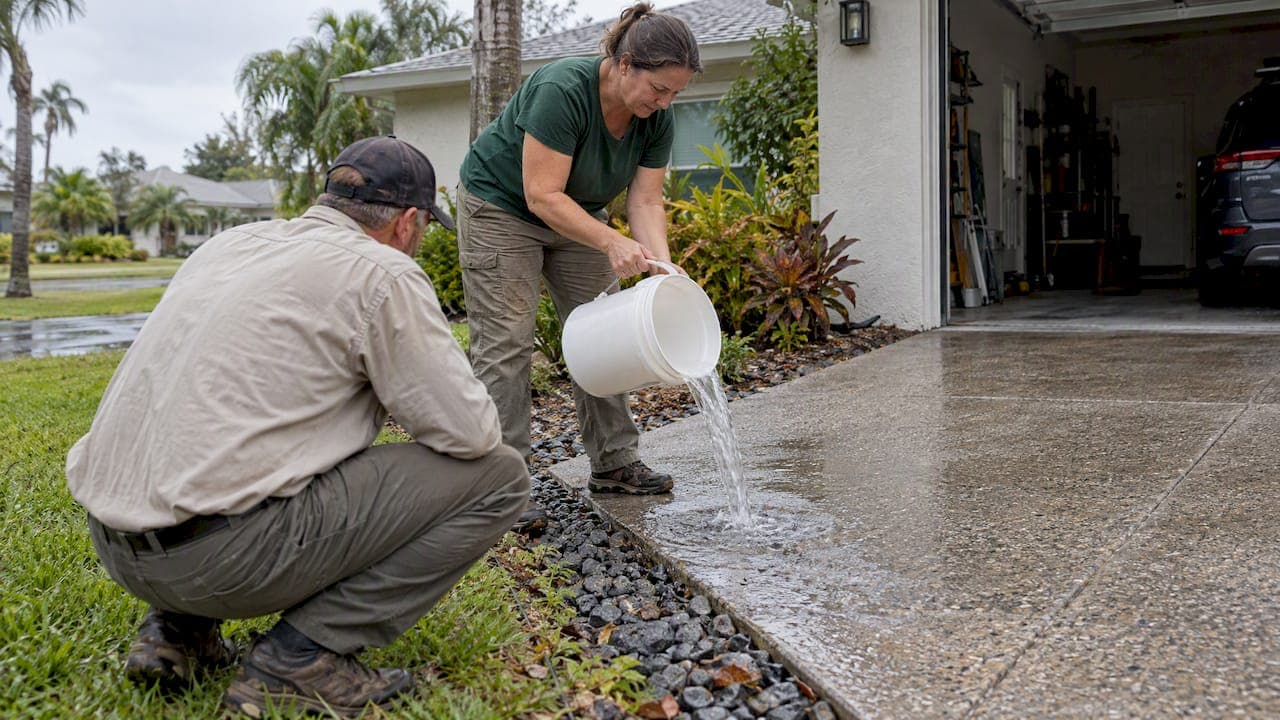
- Run an annual bucket test by pouring five gallons of water onto a test patch; drain-down under one to two hours generally indicates healthy infiltration for a residential system. A much longer time signals a problem.
- Check any pop-up drains or observation wells for blockage after major storms.
Pro Tip: Keep a simple log of your bucket-test times each year; a slowly lengthening drain time is the earliest warning sign of clogging, long before ponding appears. Most residential systems need little more than this for five to ten years before a deeper professional cleaning is worth scheduling. For quick fixes between inspections, see this guide to fixing driveway puddles.
When should you hire a professional instead of DIY?
Some site conditions move a project out of DIY territory no matter how capable you are with a shovel and a compactor; for expert help, see Concrete Patio Drainage for Homeowners: Diagnose First, Avoid Tear Out.
- Soils with low measured infiltration rates, which require engineered underdrains rather than guesswork.
- High groundwater tables or shallow bedrock that rule out infiltration-based designs entirely.
- Slopes beyond roughly 2 to 5%, where water moves faster than a simple reservoir can absorb it.
- Driveways receiving runoff from a large roof, patio, or neighboring impervious surface.
- Projects within a few feet of a foundation or basement wall, where a waterproof liner and careful grading are non-negotiable.
Permits, local stormwater ordinances, and HOA rules can also apply; local stormwater ordinances sometimes require documentation before work begins, and HOA boards may have their own approval process, covered in this guide to HOA stormwater rules. Before signing a contract, ask for soil test results, a measured drain-down time, design drawings, a written warranty, and references from completed projects.
What does a real engineered rubber pervious driveway look like?
The Rubberway® Pervious Pavement system is one concrete example of an engineered rubber driveway surface built from recycled tire materials, designed for drainage, crack resistance, and ADA-compliant texture. It was developed specifically for climates where heat and heavy rain both stress a driveway surface in the same season.
- Recycled rubber content reduces waste while giving the surface flexibility that resists the cracking common in rigid pavement.
- A porous design lets water pass through the surface rather than pooling at the low point of the driveway.
- ADA-compliant texture makes it suitable for walkways and accessible paths in addition to vehicle driveways.
For homeowners comparing sustainable materials more broadly, this overview of eco-friendly driveway options and this outdoor drainage guide cover maintenance habits that extend to most permeable surfaces, rubber included.
An installer's quick take: what homeowners usually misunderstand
Most driveway flooding problems trace back to a subbase that was never sized for the site's soil and rainfall, not to the surface material on top. The most common mistake is picking a look first and an engineer second: get the drainage math right before choosing the finish, and plan the overflow path as carefully as the infiltration path.
— Roger
Get a flood resistant driveway installed the right way
We install engineered rubber pervious driveways built around the same subbase and overflow principles covered above, using our Rubberway® product line to give homeowners a durable, recycled-material surface designed for heavy rain and intense heat in the same season. We're fully licensed and insured, and our installations come with government-ready documentation for municipal and HOA approvals.
A consultation starts with a site walk to check slope, soil, and drainage patterns, followed by a design that matches your driveway's actual runoff load rather than a one-size layout. If you're ready to stop guesswork from running your next rainstorm, get started with EcoTec Rubber Paving and request a quote for your project.
FAQ
How much does an AquaFence cost?
AquaFence barriers are a temporary flood-protection product separate from permeable driveway systems, and pricing for flood barrier products is not something we track or publish. For driveway flood prevention specifically, a permeable surface with a properly sized subbase is the more permanent solution covered throughout this guide.
How can I prevent my driveway from flooding?
The most reliable fix is replacing or overlaying a solid driveway with a permeable system, pavers, pervious concrete, porous asphalt, or an engineered rubber surface, built over a stone reservoir sized to your soil's measured infiltration rate. Regular vacuum sweeping and an annual bucket test keep that system working for years rather than clogging within one wet season.
What type of flooring is most resistant to floods?
For driveways specifically, permeable pavers, pervious concrete, porous asphalt, and engineered rubber pervious systems all resist flooding by letting water pass through rather than pool. Municipal guidance notes that success depends more on correct subbase depth and siting than on which of these materials you pick.
How much do flood gates cost?
Flood gates and barriers are separate products from permeable driveways, and pricing varies widely by size and style, so it's not something we publish figures on. If your real goal is keeping a driveway from flooding year after year, a permeable pavement system addresses the underlying runoff rather than blocking water at the door.
Sources
- NPDES: Stormwater Best Management Practice — Permeable Pavements (EPA)
- Portland
- Permeable Pavement at EPA (research site summary)