
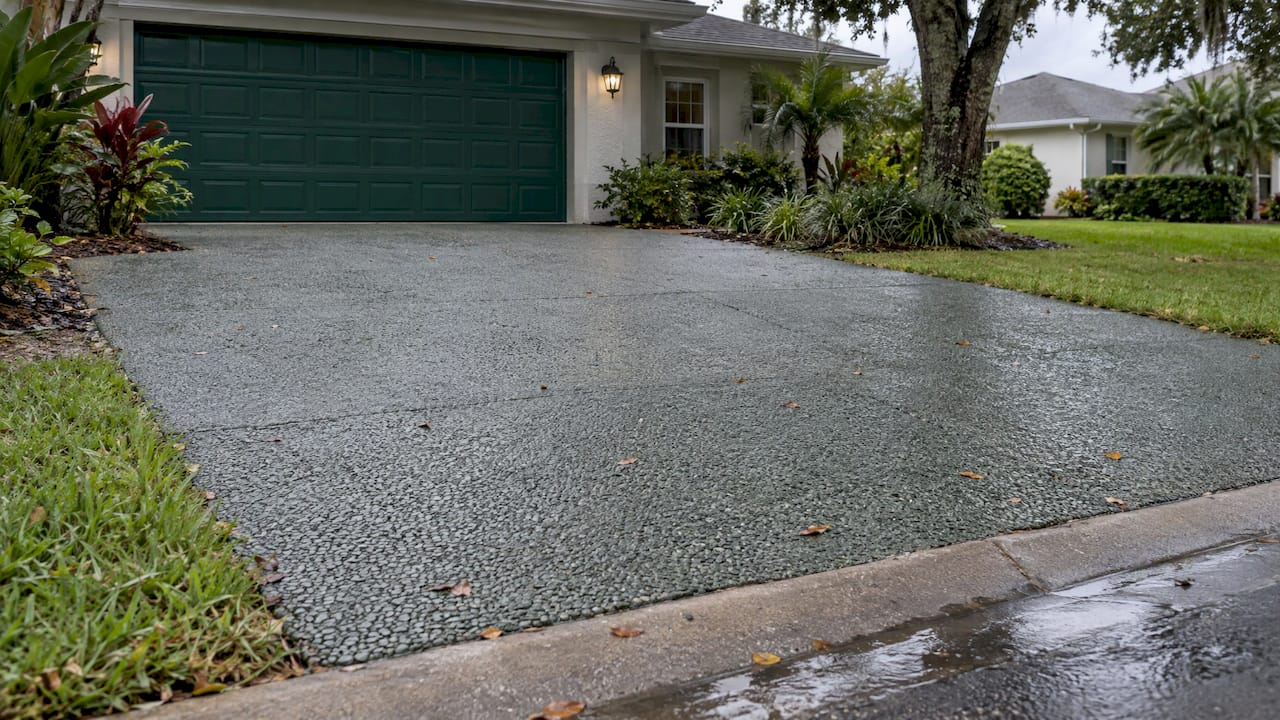
No driveway material makes a property flood-proof, but a porous surface over a properly sized stone base can take a normal storm into the ground instead of sending it across your yard, your street or your garage door. Florida property owners often get this wrong: they pick the surface first and the base second, when the base does most of the work. For Florida homes, HOA common areas and municipal paths, we install the Rubberway® porous rubber paving system made from recycled tire material, built to drain through the surface and resist heat-driven cracking.
This guide explains which materials handle stormwater, how they compare, what the site has to offer before any of them will work, and what it costs.
TL;DR
- Permeable surfaces (pervious concrete, porous asphalt, interlocking pavers, plastic grids and porous rubber) let rain pass through into a stone layer and the soil below. The EPA lists these as ways to cut runoff.
- The stone reservoir under the surface, not the surface itself, determines how much water the driveway can hold.
- These systems are designed for a normal 1 to 3 inch storm over 24 hours. In heavier rain you need an overflow or underdrain.
- Soil drainage, groundwater depth and slope decide whether a site works. Check them before you pick a material.
- Installed costs in the U.S. run from roughly $4 to $40 per square foot depending on material, according to one national budget guide.
Table of Contents
- What "flood resistant" can and cannot mean for a driveway
- The main flood resistant driveway materials
- The surface matters less than what sits under it
- Site conditions that decide whether a driveway will drain
- Traffic, lifespan and upkeep
- Costs: what to budget
- Accessible paths that connect to the driveway
- How to choose
- Perspective
- Ready to plan a driveway that drains
- FAQ
- Sources
What "flood resistant" can and cannot mean for a driveway
A driveway can do two different jobs, and owners often mix them up.
The first is managing rain that falls on it. Standard asphalt and concrete shed that water sideways, into a storm drain, a neighbor's lot or a low corner by the garage. A porous surface does the opposite: water goes down through it.
The second is surviving or resisting a true flood, where a creek, canal or storm surge rises over the property. No paving material stops that. FEMA's guidance on flood damage-resistant materials notes that its ratings do not cover long exposure of two to three weeks to floodwater and the contaminants it carries. Barriers, grading and elevation handle that problem.
What paving can do is remove the everyday causes of standing water: sheet runoff, puddles at the apron, and ponding on a surface that cannot drain. That is where the material choice matters.
One more point on the legal side. Driveways should not block or divert stormwater flow, and a driveway across a roadside ditch needs a dip or a properly sized culvert, according to Maricopa County's flood guide. Local rules differ, so confirm yours with your city or county before you design.
The main flood resistant driveway materials
The EPA names pervious asphalt, pervious concrete, interlocking pavers and plastic grid pavers as surfaces that let rain and snowmelt seep through to soil and gravel layers. They can also filter pollutants and reduce the need for some conventional drainage features. Porous rubber paving works on the same principle.
| Material | How it handles water | Typical installed cost (national, 2024 guide) |
|---|---|---|
| Permeable pavers | Water enters the joints between units and drops to the stone base | $10 to $40 per sq ft |
| Pervious asphalt and pervious concrete | Open-pore mix lets water pass straight through | $6 to $15 per sq ft |
| Concrete grid pavers | Open cells filled with gravel or grass | $4 to $12 per sq ft |
| Plastic grass pavers | Cells hold turf or gravel over a base | $5 to $10 per sq ft |
| Porous rubber paving (Rubberway®) | Porous recycled-tire surface drains into a stone reservoir | Quoted per project |
The cost ranges come from Bob Vila's permeable paver budget guide, which cites HomeAdvisor data from April 2024. They are national averages and Florida labor, base stone and site conditions will move them. We do not publish a price for our work, because each project is quoted on its own site.
Permeable pavers
Interlocking pavers are laid over sand, gravel and rock base layers, with joints filled with washed coarse sand or pea gravel. They look good and handle residential traffic, but the joints need periodic cleaning to keep water moving.
Pervious concrete and porous asphalt
Both leave out the fine particles that normally seal a surface. A Wisconsin transportation synthesis report found porous asphalt retained 25 to 100 percent of stormwater volume, permeable pavers 34 to 100 percent, and pervious concrete 99 to 100 percent, with a reported pervious concrete lifespan of 20 to 40 years. The wide ranges tell you that results depend on design and site, not on the label of the surface.

Grids and reinforced turf
Turf blocks, made of concrete or plastic grids, slow and sink runoff and spread loads over a wider area. They suit low-use areas and overflow parking. Virginia Cooperative Extension notes that pervious concrete, porous asphalt and interlocking pavers need more maintenance than grids.
Porous rubber paving
Our Rubberway® system uses recycled tire material in a porous design built for drainage, crack resistance in Florida heat and ADA-compliant surfaces. It comes in a wide range of colors. The product lines are Rubberway® Pervious Pavement, Rubberrock 6000, EVOLUTION and the Rubberway Sidewalk System, which cover residential driveways, pool decks, patios, commercial walkways, parks, trails and sidewalks. For a closer look at how water moves through the surface and the stone below it, see our guide to porous driveway drainage.
The surface matters less than what sits under it
This is the point most comparison pages miss. The EPA's stormwater best management practice document explains that the type of permeable surface has minimal impact on retention, detention and pollutant treatment. The storage and support structure underneath does the work. The EPA's advice is to choose the surface on user needs, cost, material availability, constructability and maintenance.
In practice, the stone reservoir is a bed of clean, angular stone that holds water while it soaks into the soil. Bob Vila reports base layers of crushed angular gravel installed 6 to 18 inches deep. The City of Rockville's design guide specifies a typical 15-inch excavation depth for residential permeable paver driveways. The NC State stormwater manual describes a 4 to 12 inch gravel support layer under permeable pavement.

Those numbers differ because the right depth depends on your soil, your storm size and your traffic. Sizing the base to the storm you want to handle is the core of the design. We walk through that sizing, and a simple infiltration check, in our homeowner guide to a flood resistant driveway.
Site conditions that decide whether a driveway will drain
Before you choose a material, read the site. The University of Maryland Extension's fact sheet on permeable hardscapes gives the clearest checklist for homeowners:
- Soil drainage: test the infiltration rate, and if it is below 0.5 inches per hour, choose another site or design.
- Distance from wells and septic: keep permeable surfaces at least 30 feet from wellheads or septic systems. Snohomish County, Washington sets a larger buffer of at least 100 feet from drinking water wells, so check your local rule.
- Groundwater: the same county guide calls for a surface 2 to 5 feet above the seasonally high water table. Virginia Cooperative Extension gives a minimum of 2 feet between the water table and the bottom layer.
- Slope and layout: steep slopes and driveways that slope toward the house call for site-specific professional design.
- Surroundings: avoid loose soil, mulch beds, heavy tree canopy and nearby foundations, and keep the area away from active construction, since fine sediment clogs the pores.
Florida owners should pay particular attention to groundwater depth. Many parts of the state have shallow water tables, especially in wet season. Measure it, or have it measured, before you commit to a design. Our article on outdoor paving drainage solutions covers the checks in more detail.
What a porous driveway does in a heavy storm
Permeable hardscapes are designed to infiltrate a normal 1 to 3 inch storm over 24 hours. In heavier rain, water can sheet-flow off the surface unless the design includes an underdrain or an overflow. Plan that overflow path on day one, and point it away from the house and the neighbor's lot.
The same logic applies to the water coming off your roof. Roof runoff often ends up on the driveway, so it helps to understand roof runoff and rainwater when you decide where downspouts should discharge.
Traffic, lifespan and upkeep
Permeable pavement suits residential loads well. The NC State manual says it is best used in low-traffic situations like patios, parking pads and driveways. For a household with cars, a delivery truck now and then and a garbage truck at the curb, that is exactly the range you need. For high-volume or extreme-load areas, the EPA's guidance points to site and design conditions that need engineering attention, so tell your installer about heavy vehicles at the start.
On lifespan, UMD Extension says permeable hardscapes can last as long as or longer than traditional asphalt, with little or no freeze-thaw trouble and no resealing. Virginia Cooperative Extension puts it at 20 to 30 years or more if maintained.
That last phrase matters. The same Virginia fact sheet is clear that a permeable surface depends on its upkeep: regular vacuuming and debris control keep it draining. Rockville's guide recommends vacuuming twice a year with a heavy-duty wet/dry vacuum. Our own routine for owners is the same rhythm, described in vacuuming twice a year to prevent clogs. Keep leaves, mulch and soil from washing onto the surface, and the pores stay open.
Costs: what to budget
The national figures above give you a frame. Bob Vila's guide, citing HomeAdvisor, puts permeable paver installations at $5,000 to $12,000, with a national average of $7,500, and driveway labor at $5 to $11 per square foot. Crushed rock for the base runs $40 to $86 per cubic yard.
Three things push a Florida project up or down:
- Excavation and base depth. A deeper reservoir costs more in stone and hauling but buys more storm capacity.
- Overflow or underdrain. Required in wetter sites and adds pipe and outlet work.
- Size and shape. Curves, borders and color patterns add labor.
Because site conditions drive so much of the cost, a quote based on your soil, your slope and your goals is worth more than any per-foot average.
Accessible paths that connect to the driveway
If the driveway leads to a walkway, pool deck or community path, accessibility counts. The EPA notes that most pavers comply with the Americans with Disabilities Act, but advises designers to limit units with large aggregate-filled openings on paths used by disabled people, cyclists, pedestrians in high heels and the elderly. A continuous, smooth porous surface fits those paths well. Our Rubberway® surfaces are ADA-compliant, and for HOA boards and municipalities we provide government-ready documentation. See our guide to porous parking lots and walkways for design and cost detail. HOA boards weighing local drainage rules can start with our board guide to permeable paving and stormwater rules.
How to choose
Put your priorities in this order:
- Confirm the site: infiltration rate, groundwater depth, slope, distance from wells and septic.
- Decide the storm you want the driveway to handle, and size the stone reservoir for it.
- Plan the overflow path for storms beyond that.
- Pick the surface for traffic, appearance, accessibility and upkeep.
- Set a cleaning schedule before the first rain.
For Florida, a surface that resists heat cracking and comes in many colors, such as porous rubber, fits that last step well.
Perspective
Every flooded driveway we are asked about has the same story: the surface looked fine, but the water had nowhere to go. That is why we start with the stone reservoir and the site, not the color chart.
We install only rubber paving. That focus means every project is shaped around drainage, crack resistance in Florida heat, and ADA-compliant surfaces, whether it is a home driveway, a pool deck, an HOA path or a municipal trail.
Recycled tire material keeps waste out of landfills and gives owners a surface that stays comfortable and attractive. If you want a driveway that drains the way the engineering says it should, plan the base first and let the surface follow.
Roger
Ready to plan a driveway that drains
EcoTec Rubber Paving is licensed and insured and works only with rubber paving. We install the Rubberway® system for homeowners, businesses, HOAs and municipalities across Florida, with custom colors and government-ready documentation. Explore the Rubberway® product lines or tell us about your site through our rubber paving installation page.
FAQ
What is the best driveway material to prevent flooding?
A permeable surface over a properly sized stone reservoir. The EPA's guidance says the surface type matters less than the storage layer below it, so choose on traffic, upkeep, appearance and accessibility, then size the base to your soil and storm. Porous rubber paving fits that approach for Florida properties.
How do I keep water from pooling on my driveway?
Use a surface that drains through, not across, and make sure the base can hold the water while it soaks in. Add an overflow path for storms larger than 1 to 3 inches, and keep the surface clear of leaves and soil. Grade the edges so water never runs toward the house.
Will a permeable driveway work in any soil?
Not in every soil without design changes. University of Maryland Extension advises testing infiltration and choosing another site or design if drainage is below 0.5 inches per hour. High groundwater, steep slopes and driveways that slope toward the house need site-specific design.
How often does a permeable driveway need cleaning?
Twice a year is a common recommendation, using a heavy-duty wet/dry vacuum, according to the City of Rockville's design guide. Clean more often after heavy leaf fall or nearby landscaping work. Regular cleaning keeps the pores open and the driveway draining.
Sources
- Soak Up the Rain: Permeable Pavement, US EPA
- NPDES: Stormwater Best Management Practice, Permeable Pavements, US EPA
- Permeable Paving Options, Snohomish County
- Transportation Synthesis Report: Comparison of Permeable Pavements
- Permeable Hardscapes, University of Maryland Extension
- Stormwater Management for Homeowners, Virginia Cooperative Extension
- Permeable Pavement Design Guide, City of Rockville
- 10.0 Permeable Pavement, NC Department of Agriculture
- Permeable Paver Installation Costs: A Budget Guide, Bob Vila
- NFIP Technical Bulletin 2: Flood Damage-Resistant Materials, FEMA
- Reduce Your Flood Risk, Maricopa County
- Roof Treatment and Rainwater