
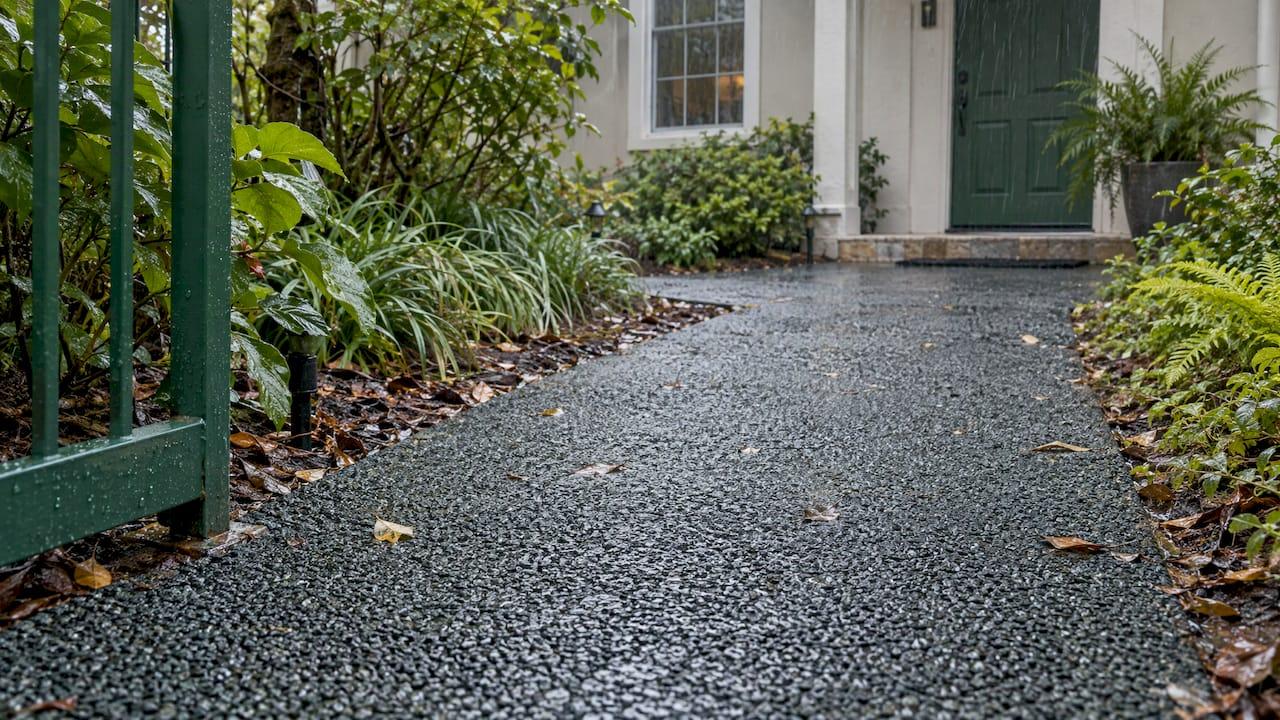
Porous rubber paving drains very fast. Field studies of pervious rubber pavement report infiltration rates from about 2 inches per hour in a Florida DOT study, which counted worn and sediment-affected test spots, to more than 1,200 inches per hour in a Canadian field test. Those numbers describe the surface, though, and your site only drains as well as the layers and soil under it. This guide explains how the rate is measured, what the studies found, and how slope, subbase and maintenance decide whether water leaves your project or sits on it.
TL;DR
- Rubber paving made from bound recycled tire granules has open pores, so water passes through the surface instead of running across it.
- A Florida DOT study kept infiltration above 2.0 inches per hour in 74.7% of 83 test runs. A Canadian field test averaged 30,836 mm/h (about 1,214 in/h).
- The surface rate is not the system rate. The subbase, the soil underneath, the water table and the outlets set how much water the whole build can actually take.
- Sediment is the main enemy of drainage. Routine vacuuming keeps the pores open.
- A fast drainage rate does not by itself make a path ADA-compliant. Slope, cross-slope and surface rules are separate checks.
Table of Contents
- What "drainage rate" actually means
- How the rate is measured
- What the numbers say in practice
- Why the surface rate is only half the story
- What clogs rubber paving, and how to prevent it
- Does a high drainage rate make a path ADA-compliant?
- Cost context: permeable paving versus conventional
- How to use drainage numbers when you compare bids
- Perspective
- Get a drainage plan for your site
- FAQ
- Sources
What "drainage rate" actually means
When a spec sheet or study quotes a drainage rate for paving, it usually means the surface infiltration rate: how fast water passes through the top layer when it is poured or ponded on it. It is expressed as a depth of water per hour (inches per hour, or millimeters per hour) or, in some product literature, as gallons per square foot per hour. These are the same idea in different units.
It helps to separate three different numbers:
- Surface infiltration rate. How quickly the wearing course accepts water. This is what most tests measure.
- Storage capacity. How much water the stone or aggregate layer below can hold while it waits to soak into the ground.
- Drawdown time. How long the stored water takes to leave through the soil beneath. Engineers often design around a window of one to three days. We cover that in our guide to porous rubber paving specs for engineers.
A surface can accept thousands of inches of water per hour on paper and still flood if the layers below cannot move the water on. Keep all three numbers in mind when someone quotes you one.
How the rate is measured
Two field methods show up in the research on porous rubber pavement.
The Florida Department of Transportation tested recycled-tire pervious pavement with the ERIK device, a field infiltration tester, and it also references its own permeability test method for this material. The report, Pervious Pavements: Installation, Operations and Strength, found infiltration above 2.0 inches per hour in 74.7% of 83 ERIK runs. Rates did not fall below 2 in/hr unless excessive sediment was spread on the surface, washed in and compacted into the pores.
A 2020 Canadian study by Kabir, Oyeyi and Tighe, Performance evaluation of Porous Rubber Pavement, used the NCAT Asphalt Field Permeameter following ASTM C1701/C1701M-17a. It measured an average of 30,836 mm/h. That is roughly 1,214 inches per hour, and it far exceeded the highest rainfall rate observed in Canada, 298.8 mm/h (about 11.8 inches per hour).
The two results look very different, and they should. They tested different pavements, with different devices, ages, sites and levels of sediment. The Florida figure is a conservative floor that included real-world test points. The Canadian figure is an average of field readings. Neither is a guarantee for your driveway.

What the numbers say in practice
The useful comparison is not one rate against another. It is the pavement's rate against the heaviest rain your site will see.
Even the Florida DOT's low end of 2 inches per hour is a high bar for a hard surface. The Canadian averages exceed the maximum rainfall rate observed there by a wide margin. When the surface can take in water faster than it falls, rain goes through the pavement instead of sheeting across it. That is why porous rubber surfaces tend to stay free of puddles on pool decks, walkways and driveways.
The Florida report also noted something homeowners notice first. During rainfall events when ponding showed up on many other pervious pavements with smaller pores, no ponding was observed on the rubber surface. Larger, connected pores are part of why.
Why the surface rate is only half the story
A porous top layer is one part of a drainage system. Below it, three things decide whether water actually leaves.
The subbase and storage layer
Water that passes through the surface lands in an open-graded stone base. The depth of that reservoir layer determines how much rain it can hold while it soaks away. The Canadian study makes this point: no hydrological design was considered during construction to confirm the storage layer was thick enough to hold rainwater for a given period and release it slowly to the subgrade. As a result, the researchers could not evaluate the system's full stormwater performance, even though the surface rate was excellent.

The lesson for owners is simple. Ask how the base was sized, not just how fast the top drains. Our post on stormwater management paving solutions for engineers walks through that sizing logic.
The soil and water table
Permeable paving relies on the ground below to take the water. Virginia Cooperative Extension's stormwater fact sheet for homeowners says permeable pavement, whether made from plastic, rubber or asphalt, is not a good fit on steep slopes, in high-speed traffic areas, where surrounding soils do not infiltrate quickly, or where the water table is high. It advises more than 2 feet between the bottom layer and the seasonal high water table.
That last point matters in Florida, where a high water table is common in many areas. A site assessment should check soil and groundwater before anyone settles on a section. Where soils are slow, a well-designed build adds outlets such as an underdrain or an overflow connection so excess water has somewhere to go.
Slope and outlets
Porous does not mean flat and forgotten. A gentle, consistent grade keeps any water that does reach the surface moving, and it keeps the base from loading at one low corner. The right slope depends on the use, the base design and the rules that apply to your project, so it should come from the design drawings and local requirements rather than a rule of thumb. If the site has a low spot with no way out, even a very porous surface will stay wet there.
What clogs rubber paving, and how to prevent it
Every pervious surface loses some rate over time, because fine particles lodge in the pores. A Wisconsin DOT synthesis, Comparison of Permeable Pavements, notes that porous asphalt starts with infiltration in the hundreds of inches per hour, then declines as pores gradually clog. It also puts maintenance at $400 to $500 per year (2005 figures) for vacuum sweeping a half-acre parking lot three to four times a year.
The Florida study adds a practical detail about the kind of sediment. Vacuum sweeper trucks removed surface sediment well, but they were not effective on sediment that had penetrated deep. That points to prevention as the best strategy:
- Keep soil, mulch and sand from washing onto the surface. Stabilize bare beds next to the paving and edge planting areas.
- Blow or sweep leaves and debris before a storm, especially under trees.
- Vacuum on a regular schedule so fines do not work deeper into the pores. We outline an easy routine in cleaning rubber paving to prevent clogs.
- Direct downspouts and irrigation overspray away from loose soil that can carry silt onto the surface.
- Keep construction dust and landscaping projects away from the surface until the work is finished, or cover the pavement while they happen.
The same Florida report found rates held up unless excessive sediment was deliberately spread, washed in and compacted. In other words, ordinary use did not choke the pavement. Heavy contamination did.
Does a high drainage rate make a path ADA-compliant?
No. Drainage and accessibility are different questions. A porous surface can help an accessible route by keeping standing water off it, which reduces slip hazards and ice in cold climates. But compliance depends on the route's running slope, cross slope, width, joints and surface firmness and stability. A fast infiltration rate says nothing about any of those. Municipal and HOA projects should confirm those requirements against the current ADA standards and the plan reviewer's expectations, and should keep the test data and drawings together as part of the submittal. Our porous sidewalk drainage guide covers how drainage and sidewalk design fit together, and our stormwater ordinance article explains how local rules affect what you can build.
Cost context: permeable paving versus conventional
Owners often ask whether the drainage benefit is worth the price. The Wisconsin DOT synthesis lists 2005 material costs of $0.50 to $1 per square foot for porous asphalt, $2 to $7 for pervious concrete and $5 to $10 for concrete pavers. It reports that permeable options generally cost 10 to 20% more than nonpermeable materials, but that the premium may be offset when the paving removes the need for detention basins and other stormwater infrastructure. Those are historical material figures, not today's installed prices, and they do not describe our work. We quote each project after reviewing the site, since size, base, color and access all change the scope. For a broader look at types and cost, see what permeable paving is, its benefits, types and cost.
How to use drainage numbers when you compare bids
When a contractor or product sheet quotes a rate, ask these questions:
- What test produced the number, and on what surface? A lab sample, a new installation and a five-year-old field reading are not interchangeable.
- In what units? Convert before you compare. Dividing millimeters per hour by 25.4 gives inches per hour.
- How was the base sized? Look for a design tied to the rainfall your local rules require, the soil type and the water table.
- Where does overflow go? There should be a named outlet for storms bigger than the base can hold.
- What is the cleaning plan? A rate that is not maintained will not last.
- Does the documentation suit your reviewer? Municipalities and HOA boards usually need specs, drawings and test references in a form they can file.
Perspective
Most drainage problems we are called about are not surface problems. The paving was porous enough, but the water had nowhere to go because of a compacted subgrade, a low corner or a planting bed washing silt across the surface.
That is why we focus only on rubber paving and treat drainage as a system. The Rubberway® system uses recycled tire material in a porous design built to let water pass through, and we plan the layers beneath it with the same care as the surface. Florida's heat, heavy rain and high water tables are the conditions we design around.
If you are choosing between surfaces, pick the one that lets you stand on a dry pool deck or walkway minutes after a storm, resists heat cracking, and comes with documentation your board or city can approve. For many Florida properties, a properly built porous rubber surface does that.
Roger
Get a drainage plan for your site
If standing water, cracked paving or a stormwater requirement is driving your project, we can review it with you. EcoTec Rubber Paving is licensed and insured, works only with rubber paving, and installs the Rubberway® system in a wide range of colors for driveways, pool decks, walkways, trails and community areas across Florida. We provide government-ready documentation for municipal and HOA work. See our Rubberway product lines or start with professional rubber paving installation.
Projects that need engineering input can start with our guides on outdoor paving drainage solutions for homeowners and sustainable paving installation best practices.
FAQ
Is rubber paving permeable?
Yes, when it is built as a porous system. Recycled rubber granules are bound so that connected voids remain, and water passes through them into the base below. A Florida DOT study of a recycled-tire pervious pavement found no ponding during storms when many other pervious pavements ponded.
How fast does porous rubber paving drain?
It depends on the product, age, site and test method. The Florida DOT held above 2.0 inches per hour in 74.7% of 83 test runs, and a Canadian field study averaged 30,836 mm/h, about 1,214 inches per hour. Both exceed the heaviest rainfall rates the studies compared them with.
Can rubber paving still flood?
It can if the layers below cannot take the water. A high water table, slow soils, an undersized stone base or no overflow outlet can all cause water to back up even when the surface is fast. Heavy sediment can also clog the pores. A site review and routine vacuuming prevent most of this.
How often should I clean porous rubber paving?
Regular vacuuming keeps fine particles from working into the pores, and our cleaning guide suggests a twice-a-year routine for owners. Sites under trees or next to bare soil may need more frequent attention, and removing debris before storms helps.
Does a high drainage rate make a walkway ADA-compliant?
No. Drainage helps keep a route dry, but compliance depends on slope, cross slope, width and surface stability. Confirm those against the current ADA standards and your local reviewer's requirements.
Sources
- Pervious Pavements: Installation, Operations and Strength (Florida DOT)
- Performance evaluation of Porous Rubber Pavement in the Canadian climate
- Stormwater Management for Homeowners Fact Sheet 3 (Virginia Cooperative Extension)
- Transportation Synthesis Report: Comparison of Permeable Pavements (Wisconsin DOT)