
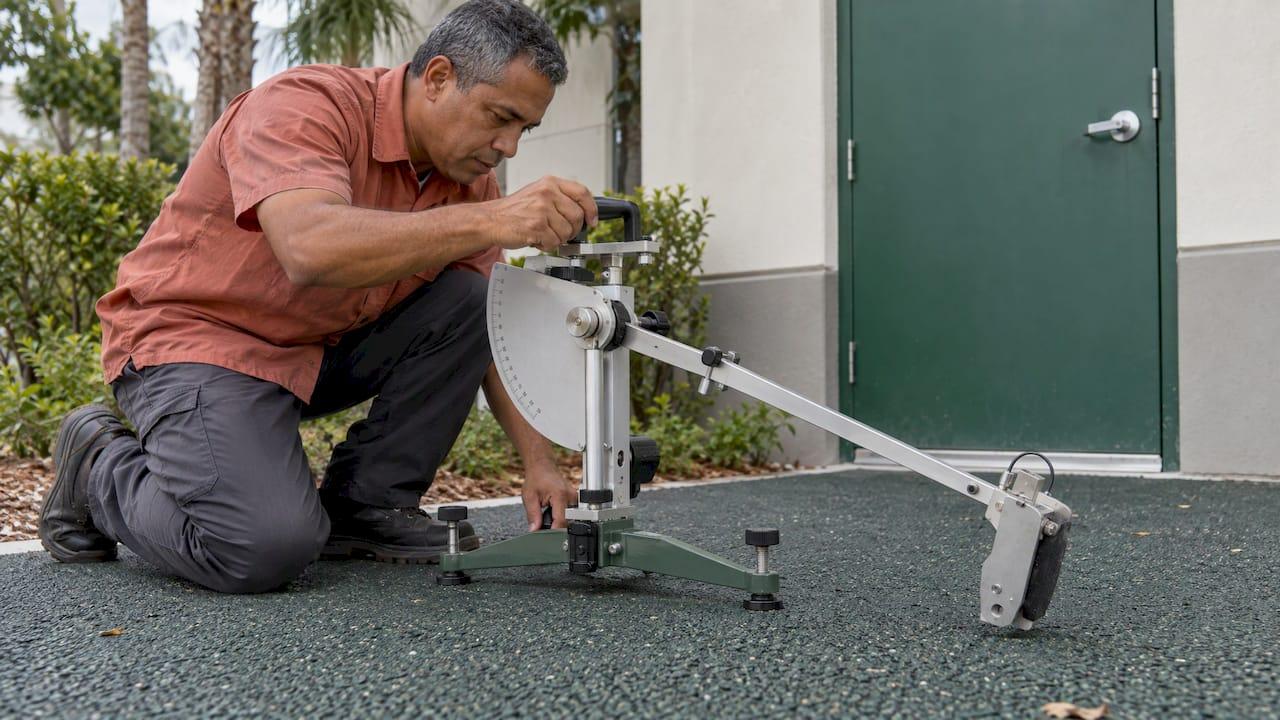
There is no single slip rating that every rubber paving surface must carry. Slip resistance is reported as a test value, most often a wet DCOF (dynamic coefficient of friction) from ANSI A326.3 or a pendulum value from ASTM E303. The ADA asks for accessible surfaces that are stable, firm and slip-resistant, but it does not set a federal number. In practice, a good rubber paving specification pairs a documented test result with drainage, texture and a maintenance plan for the actual site.
This guide explains what each number measures, what the thresholds mean, and how to write a specification that holds up with an HOA board, a city inspector or a facilities manager.
TL;DR
- A slip rating is a comparison value from a lab or field test. It is not a guarantee that no one will ever slip.
- ANSI A326.3 reports wet DCOF. For level interior areas walked on when wet it sets 0.42, and for exterior wet areas a value of 0.55 is generally accepted when the manufacturer declares nothing else.
- ASTM E303 uses a British Pendulum Tester and reports BPN or PTV values. These cannot be converted into DCOF numbers.
- The ADA requires slip-resistant accessible routes but names no universal coefficient, so specifiers judge each site by its conditions.
- Drainage, surface texture and cleaning matter as much as the test number. Porous rubber paving is designed to address standing water, the main outdoor slip factor.
Table of Contents
- What a slip rating for rubber paving actually measures
- The two test methods you will see on spec sheets
- Does the ADA require a specific slip rating?
- How rubber paving behaves when wet
- The system matters more than the number
- Choosing a rubber paving surface by use
- What to put in your specification
- Rubber compared with concrete and stone
- Our perspective
- Get a rubber paving plan for your site
- FAQ
- Sources
What a slip rating for rubber paving actually measures
Slip resistance describes how much frictional force a surface provides to keep a pedestrian's shoe heel, or a mobility device such as a crutch tip, from sliding. One state accessibility code defines it in exactly those terms: the frictional force needed to keep a heel or crutch tip from slipping under expected environmental conditions.
Two parts of that definition matter for outdoor paving.
- It is relative to a shoe or device. A test uses a standard slider material, not your actual footwear.
- It depends on conditions. Water, sand, leaves, algae, sunscreen and pool chemicals all change friction. A number measured clean and wet in a controlled setting says nothing about a surface covered in sediment.
That is why professionals talk about a rating as a way to compare materials, not as a promise.
The two test methods you will see on spec sheets
ANSI A326.3: wet and dry DCOF

ANSI A326.3 is the American National Standard test method for measuring the dynamic coefficient of friction of hard surface flooring materials. According to the standard itself, the test uses a tribometer, a standardized SBR rubber test foot and, for wet testing, a dilute sodium lauryl sulfate water solution.
The thresholds people quote come from that document:
- A wet DCOF of at least 0.42 for level interior spaces expected to be walked on when wet.
- A dry DCOF of at least 0.42 for surfaces intended to stay dry.
- For exterior, wet products, the value is manufacturer-declared. Without a superseding declaration, a wet DCOF of at least 0.55 is generally accepted, with other factors also considered.
The same standard is blunt about limits. It says the measurement is an evaluation under known conditions and can offer a useful comparison between surfaces, but it does not predict whether a person will or will not slip. It lists the variables that do: shoe sole material and wear, contaminants, walking speed and stride length, the person's physical and mental condition, whether the surface is flat or inclined, and how drainage works when liquid is present.
ASTM E303: the pendulum test
The second method you may see is ASTM E303-22, which uses the British Pendulum Tester. A rubber slider swings across the surface and the test measures the energy lost. Results for flat surfaces are reported as British Pendulum Number (BPN), often called pendulum test value (PTV) in practice. ASTM notes that these results do not necessarily agree or correlate with results from other slipperiness-measuring equipment.
Why you cannot convert between them
A DCOF of 0.55 and a PTV of 36 are different measurements from different instruments. Treat any chart that converts one into the other with caution. When you compare two rubber paving products, compare results from the same method, on the same condition (wet or dry), on a sample that matches what will actually be installed.
| Feature | ANSI A326.3 (DCOF) | ASTM E303 (pendulum) |
|---|---|---|
| Instrument | Tribometer | British Pendulum Tester |
| Slider | Standardized SBR test foot | Rubber slider edge |
| Result | Wet or dry DCOF | BPN / PTV |
| Commonly cited threshold | 0.42 interior wet, 0.55 exterior wet (generally accepted) | Varies by project and jurisdiction |
| Converts to the other? | No | No |
Does the ADA require a specific slip rating?
No. The ADA calls for accessible routes that are stable, firm and slip-resistant, but it does not mandate one universal coefficient. The U.S. Access Board explains the reason in its guide to floor and ground surfaces: no single consensus method for rating slip resistance exists, so federal standards give no values and leave specifiers to judge safety for the intended conditions.
For a city park director, an HOA board or a property manager, that has a practical meaning. Nobody can hand you a single "ADA slip rating" to check off. What you can do is require:
- A named test method and the result, wet and dry.
- A surface that is firm and stable, which a bonded, resilient rubber surface is designed to be.
- A drainage design that keeps water from standing on the route.
- A written maintenance routine.
If you want the compliance side in more depth, our guides on ADA slip resistance requirements and how rubber paving meets ADA standards cover documentation and inspection.
How rubber paving behaves when wet
Wet performance is where outdoor surfaces differ most. Two things drive it: the texture of the surface and whether water has anywhere to go.
Texture. Rubber paving is built from granulated recycled rubber bound into a resilient layer, and the finished surface has a grain that a smooth trowelled slab does not. Texture is part of what a wet test captures, which is why the wet number is the one to ask about for pool decks, entries and walkways under tree cover.
Drainage. The A326.3 standard lists drainage among the factors that decide slip risk when liquids are present. A flat surface with a film of water behaves very differently from one that sheds it. This is the reason we build around porous design. Our Rubberway system is designed to let rainwater pass through the surface, so puddles are less likely to form on the route. If you are an engineer or planner, our porous rubber paving specifications go into drawdown and design detail.
Contaminants. A wet test is run clean. In Florida, the conditions that change friction are the ones you can see: pollen, fine sediment, leaf litter, algae in shaded corners and humidity that keeps surfaces damp. We cover how surfaces respond in rubber paving in humid climates.

The system matters more than the number
Test certificates sit in a binder. Slip risk happens on the ground. A specifier's guide to the standard stresses that a threshold such as 0.42 or 0.55 is not a universal guarantee of safety, and that traffic volume, expected contaminants and the owner's ability to maintain the surface all have to be weighed for each project.
For outdoor paving, that translates to a short checklist.
Drainage and slope
Water should leave the surface, not sit on it. Porous construction, correct falls and an open base all help. The same logic applies to other permeable surfaces: this explanation of permeable paver drainage and maintenance shows how keeping sediment under control preserves the way a surface drains over time.
Surface texture and finish
Ask which texture or finish the tested sample had, and confirm it is the one being installed. Color choice does not change the principle, but you should confirm that the test sample matches the color and finish on your order.
Maintenance
Routine sweeping, rinsing and removal of organic growth keep friction near its tested level. The ANSI standard also notes that surfaces with higher DCOF can bring cleanliness and maintenance issues, and that a very high DCOF can create a difficult walking condition for elderly and disabled people who slide their feet. The target is a sensible, documented value for the use, not the highest number available.
Heat
Sun exposure affects comfort and, in some cases, behavior. If your site is in full Florida sun, such as a pool deck, think about color. Lighter colors from our range can be a practical choice for barefoot areas.
Choosing a rubber paving surface by use
Different areas call for different priorities.
| Area | Main slip concern | What to specify |
|---|---|---|
| Pool deck or patio | Constant wetness, bare feet | Wet test result, drainage plan, color for heat |
| Residential driveway | Rain, tire residue, algae in shade | Porous system, cleaning routine |
| Commercial walkway | High traffic, inspection exposure | Documented test method, ADA slope and edge details |
| Municipal park path or trail | Leaves, sediment, mixed users | Porous design, maintenance schedule, accessible route details |
| HOA common areas | Tree cover, irrigation overspray | Drainage, irrigation direction, cleaning frequency |
For planners comparing materials by type, our guide to slip-resistant community walkway types walks through the options. For retrofits on existing properties, see commercial walkway retrofit.
What to put in your specification
Use this as a starting list for a bid package or a board request.
- Test method named. ANSI A326.3 wet DCOF, ASTM E303 pendulum, or both, with the report.
- Condition stated. Wet and dry results reported separately, since dry slip resistance does not tell you how a surface performs when wet.
- Sample matches the product. Same system, texture and color as the installation.
- Drainage described. How water leaves the surface and the base.
- Accessible route details. Firm, stable surface, with changes in level and slopes meeting the current ADA standards for your project type.
- Maintenance plan. Who cleans, how often and how.
- Project documentation. Submittals the inspector or city engineer expects.
Our guide to ADA-compliant walkways and the 2026 commercial ADA paving guide cover inspection prep, and the outdoor wheelchair ramp surface article addresses steeper transitions.
Rubber compared with concrete and stone
People often ask whether rubber is more slippery or less slippery than concrete or pavers. A fair answer is that a surface type alone does not decide it. Broom-finished concrete, sealed stone and smooth pavers can each test high or low, and wet conditions can change the ranking. Rubber has a cushioned, resilient character that many owners value for comfort underfoot, and it does not crack from heat and root movement the way rigid slabs can, which also helps keep the walking surface even. When we help owners compare, the useful question is: what does each option's wet test result say for the finish being offered, and how does it drain? Our specifier's checklist for flexible sidewalk material sets out the comparison criteria.
Our perspective
We install rubber paving and nothing else, so slip resistance is a conversation we have on every project. Owners often arrive asking for one number. We understand why: a number is easy to put in a contract.
Our view is that the number is the start of the answer. The standards say so themselves. DCOF is a comparison tool, and the real outcome depends on water, footwear, upkeep and how the surface is laid.
That is why the Rubberway system is designed around drainage and a textured, resilient surface in Florida's rain, humidity and sun. A porous build is designed to keep water moving through the surface instead of sitting on top of it, and that addresses the largest outdoor slip factor at its source.
For municipalities, HOAs and commercial owners, we put together government-ready documentation so your board or inspector sees a clear specification, not a sales brochure. For homeowners, we help you choose color and layout for your pool deck, patio or driveway, with sun exposure in mind.
Ask us what is right for your site, and we will walk through the surface, the drainage and the upkeep together.
Roger
Get a rubber paving plan for your site
EcoTec Rubber Paving is licensed and insured, and rubber paving is all we do. We install the Rubberway line across Florida for homeowners, businesses, municipalities and HOAs: Rubberway Pervious Pavement, Rubberrock 6000, EVOLUTION and the Sidewalk System, in a wide range of colors, for driveways, pool decks, patios, walkways, parks, trails and community areas.
Tell us about the area, the traffic and the water conditions, and we will recommend a system and prepare the documentation your project needs. Start at our rubber paving installation page.
FAQ
What is a good slip rating for outdoor rubber paving?
For exterior wet areas, ANSI A326.3 treats a wet DCOF of 0.55 or higher as generally accepted when the manufacturer has not declared another value. Other factors, such as traffic, contaminants and upkeep, are also considered. Treat it as a reference point for comparing products, not a guarantee.
Does the ADA require a specific slip-resistance number for paths?
No. Federal ADA standards require slip-resistant accessible routes but do not set a universal coefficient, because no single consensus test method exists. The Access Board leaves it to specifiers to judge safety for the intended conditions.
Can I convert a pendulum result into a DCOF value?
No. The pendulum (ASTM E303) and the tribometer (ANSI A326.3) are different instruments with different sliders, and their results do not necessarily correlate. Compare like with like: same method, same wet or dry condition.
Does porous rubber paving help with wet traction?
It is designed to. Standing water is one of the main factors in outdoor slip risk, and a porous surface is built to let rain pass through instead of pooling. Pair it with regular cleaning to keep sediment and algae from building up.
Sources
- American National Standard Test Method for Measuring Dynamic Coefficient of Friction (ANSI A326.3)
- ASTM E303-22, Standard Test Method for Measuring Surface Frictional Properties Using the British Pendulum Tester
- U.S. Access Board, Chapter 3: Floor and Ground Surfaces
- ADAAG Manual, Ground and Floor Surfaces 4.5
- Georgia Accessibility Code, Chapter 120-3-20
- Permeable paver drainage and maintenance