
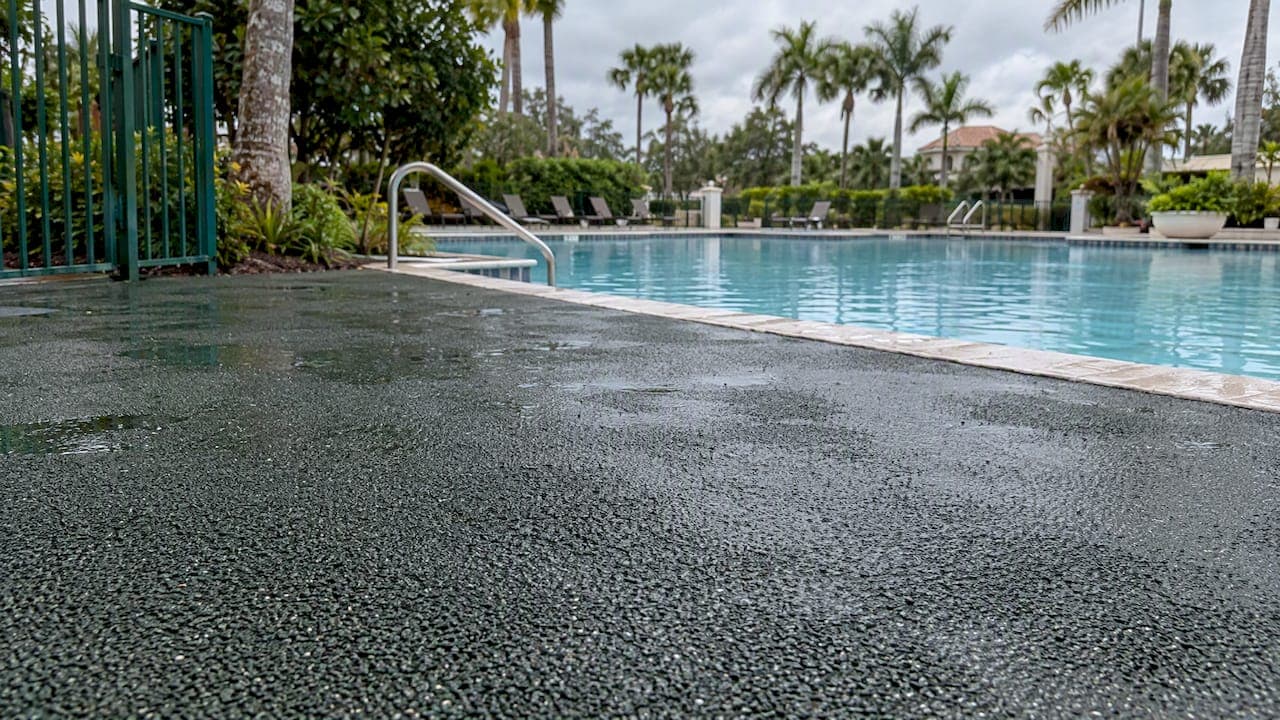
Rubber paving can work well in humid, rainy climates, but only when the surface is porous, the base is designed for local groundwater, and someone keeps the surface clean. Florida testing found a porous rubber pavement that stayed free of ponding in rain. The same research shows that clogging, a high water table and surface growth decide whether any permeable surface keeps working. This guide covers what to check on drainage, mildew, heat, noise and accessibility before you sign a contract.
TL;DR
- Porous rubber paving drains through the surface. A University of Florida study found no ponding on it during rainfall, even where smaller-pore permeable surfaces ponded.
- Site conditions matter more than the material name. Excess sediment or a high groundwater table is where these systems underperform.
- Humidity brings algae, mildew and slipperiness. Specify resistance to growth and slip resistance, then plan routine cleaning.
- Noise data comes mostly from rubber-modified asphalt on roads. Treat it as a direction, not a promise for a patio or trail.
- For public or shared spaces, the installed system must meet ADA rules on stability, firmness, slip resistance, openings and changes in level.
Table of Contents
- Why humid climates are hard on paving
- How rubber paving handles heavy rain and standing water
- Mildew, algae and slipperiness
- Clogging: the real long-term issue
- Heat, cracking and sun
- Does rubber paving reduce noise?
- Comparing rubber with other humid-climate options
- Meeting ADA requirements
- What to ask before hiring a rubber paving installer
- Our perspective
- Get a site-specific recommendation
- FAQ
- Sources
Why humid climates are hard on paving
Humid regions like Florida combine three stresses: frequent heavy rain, long periods of damp, and strong sun. Each one attacks a different weakness. Rain exposes poor drainage. Constant dampness feeds algae, mildew and moss. Sun and heat cause expansion, cracking and fading in rigid or dark surfaces.
Solid surfaces handle the first stress by shedding water, which just moves the problem somewhere else. Puddles collect at low spots, runoff carries debris, and slabs sit wet. Permeable surfaces take the opposite approach: water passes through the surface into a stone base and soaks into the ground or is released slowly.
The University of Florida's IFAS Extension lists the common permeable surfaces as pervious concrete, porous asphalt and interlocking concrete pavers, with water infiltrating into an aggregate base or subbase. Porous rubber paving belongs to the same family. It binds recycled rubber granules with a polymer so the surface stays open to water while remaining flexible.
How rubber paving handles heavy rain and standing water
The best-documented evidence comes from Florida itself. A 2011 University of Central Florida Stormwater Management Academy report, published through the Florida Department of Transportation, found that the FlexiPave rubber system performs as intended unless it faces excessive sediment loads or a high groundwater table. The same research reported no ponding on the rubber surface during rainfall events, even when neighboring permeable pavements with smaller pores ponded.
Two lessons follow.
Pore structure matters. Larger, well-connected voids let water pass faster and are harder to seal over. When you compare bids, ask how the surface is built, not just what it is made of.
The ground under the pavement matters as much as the pavement. UF/IFAS advises that in Florida the seasonal high-water table should sit at least 2 feet below the bottom of the system so water can actually infiltrate. In coastal or low-lying areas, that single number can decide whether a permeable design suits your lot. Where the water table is high, a good installer will say so and adjust the design rather than install anyway.
IFAS also says these systems should be designed to drain completely within 24 to 72 hours. If you are an engineer or board member who needs the specifics, our guides on porous rubber paving specs and drawdown and porous sidewalk drainage design go into base depth and drawdown.

Where permeable surfaces are the wrong tool
UF/IFAS notes that permeable pavements suit light-duty traffic with infrequent heavy loads and should be avoided where frequent turning can cause shifting, cracking or spalling. That points rubber paving toward walkways, trails, pool decks, patios, residential driveways and park paths, and away from heavy truck turning areas. A straightforward contractor will tell you when your site belongs in the second group.
Mildew, algae and slipperiness
This is the part many glossy product pages skip. Warm, damp, shaded surfaces grow things. Rubber is not immune.
Guidance for resilient surfaces published in Parks & Recreation Business recommends specifying resistance to algae, mold, mildew, biofilm, moss and fungi, while also requiring good traction and slip resistance. It also recommends preventing ponding and standing water, and regularly washing and sanitizing surfaces to remove or prevent growth. Read that as a list of risks to control, not conditions any rubber surface avoids automatically.

Wet and contaminated rubber can also lose grip. One academic study found that dynamic friction between vulcanized rubber and a tile surface fell as the contaminant's glycerol content and the sliding speed rose. It was a lab test on tile, not a paving trial, but the principle is practical: a slick film of biological growth or residue reduces traction, so cleaning is a safety task and not only a cosmetic one.
A practical humid-climate care routine
- Keep it draining. Watch for spots where water lingers after rain. Standing water is the first sign of a clogged or poorly graded area.
- Control debris. Blow or sweep leaves, mulch and soil off the surface. Redirect landscape runoff and sprinklers so they do not wash soil onto the pavement.
- Wash on a schedule. In shaded or irrigated areas, wash more often. Use a cleaner suited to the surface and follow the installer's guidance rather than guessing with strong chemicals.
- Inspect shaded and pool-adjacent zones first. They stay damp longest and show growth first.
Clogging: the real long-term issue
Every permeable surface depends on open pores. A 2021 systematic review of permeable pavements stresses that regular maintenance is essential to prevent clogging and restore permeability, and that clogging can erase the environmental benefits.
The UCF researchers add an important caveat: vacuum sweeping removed surface sediment but was ineffective at removing sediment that had penetrated deeply. The takeaway is prevention. Keep fines from reaching the surface in the first place by stabilizing bare soil, routing landscape runoff elsewhere and sweeping often. Waiting until water stops draining is the expensive way to learn this.
For HOA boards, this is why maintenance planning belongs in the purchase decision. We cover the ongoing side in reducing community maintenance with rubber paving.
Heat, cracking and sun
Humid climates are usually hot ones. Rubber paving is flexible, so it does not depend on rigid joints to survive expansion and contraction the way slabs do. That flexibility is one reason it is used where roots, heat and moisture crack concrete.
The broader research on rubber in paving points the same way, though most of it concerns rubber-modified asphalt rather than poured porous rubber. The U.S. Tire Manufacturers Association's 2021 summary says rubber-modified asphalt extends pavement life by resisting rutting and cracking, with performance similar to costly polymer-modified binders. A 2003 EPA-archived Tellus Institute report says rubber asphalt has increased tensile strength and ductility and high resistance to reflective cracking. Treat these as evidence that rubber helps pavement cope with stress, not as lifespan guarantees for every product.
Surface temperature is a separate question from cracking. Dark surfaces in full Florida sun get warm to the touch, and color choice and shade affect comfort for bare feet around a pool deck. If barefoot comfort matters, ask for a lighter color and check it in sun before committing. Our guide to heat-resistant paving materials covers the trade-offs.
Does rubber paving reduce noise?
The honest answer is: sometimes, and the strongest evidence is for roads. The U.S. Tire Manufacturers Association's 2021 report says rubber-modified asphalt can reduce traffic noise by 1 to 10 decibels, depending on mix type, traffic level, vehicle speeds and other variables. It also says long-term observations show the noise reduction fading at a substantially lower rate than with other surfacing alternatives.
There is a catch in wet, dusty places. A 2023 Florida Department of Transportation quiet pavements synthesis notes that porous pavements can clog with dirt and dust, which reduces their noise benefit over time, particularly at lower traffic volumes or slower speeds.
For a walkway, patio or trail, tire noise is not the issue. What you will notice is the softer, quieter footfall of a resilient surface compared with hard stone or concrete. We would not quote decibel figures for those uses, because the published numbers do not measure them. If sound matters to you, keep the surface clean and ask for a sample to walk on.
Comparing rubber with other humid-climate options
| Surface type | Drains through surface | Flexibility | Humid-climate watch-outs |
|---|---|---|---|
| Porous rubber paving | Yes | High | Surface growth, sediment, color and heat in full sun |
| Pervious concrete | Yes | Low | Clogging, cracking, limited to light-duty use |
| Porous asphalt | Yes | Moderate | Clogging, heat softening, light-duty use |
| Interlocking permavers | Yes, through joints | Moderate | Joint fill needs refilling, weeds and moss in joints |
| Conventional concrete or asphalt | No | Low to moderate | Runoff, ponding, cracking |
The permeable options and their light-duty limits come from UF/IFAS. The remaining columns are general characteristics, so confirm details against a specific product's data. For a wider primer, see what permeable paving is, its types and cost.
Meeting ADA requirements
If the surface serves the public, an HOA clubhouse path, a municipal park or a business entrance, accessibility is part of the spec. The U.S. Access Board states that accessible ground surfaces must be stable, firm and slip resistant. Openings must not let a ½-inch sphere pass, elongated openings must run perpendicular to the dominant direction of travel, and changes in level must stay within ADA limits.
For playgrounds, the Access Board says compliance means meeting the technical provisions for running slope, cross slope, openings, changes in level and vertical clearance. In practice, rubber surfacing is judged as an installed system, not by material name. Ask your installer how the finished surface, base and slopes will be checked, and request that documentation up front.
What to ask before hiring a rubber paving installer
- What is the seasonal high water table at my site, and how does the design account for it?
- How will sediment and landscape runoff be kept off the surface?
- Which growth-resistance and slip-resistance properties does the product carry, and how is the surface cleaned?
- Is the use light-duty? Will vehicles turn on it?
- What documentation will I get for ADA compliance and stormwater review?
- Is the company licensed and insured, and does it do this work every day?
Our guide to how weather affects rubber paving installation also helps you plan around Florida's rainy season.
Our perspective
We install rubber paving in Florida and nothing else, so we see the same pattern project after project. The material is rarely what goes wrong. Problems come from skipping the site check, such as a high water table, bare soil upslope or irrigation that sprays across the surface. When those are handled, a porous Rubberway® surface does what the Florida research describes: it lets rain through and stays flexible in the heat.
We would rather tell you a site is wrong for permeable paving than install it and leave you with puddles. We also tell customers plainly that no surface is maintenance-free in Florida's humidity. Plan for sweeping, washing and keeping soil away, and the pavement will reward you. Our focus on recycled materials, drainage, crack resistance, ADA-compliant surfaces and government-ready documentation is aimed at the people who must justify a decision to a board or council. For more on local benefits, see rubber paving benefits in Florida.
— Roger
Get a site-specific recommendation
We are licensed and insured and install the Rubberway® system for driveways, pool decks, patios, walkways, parks, trails, sidewalks and community areas. Our product line includes Rubberway Pervious Pavement, Rubberrock 6000, EVOLUTION and the Sidewalk System, available in a wide range of colors. See our rubber paving products or talk to us about your project.
For stormwater projects, our paving solutions for engineers and sustainable installation best practices are good next reads.
FAQ
Does rubber paving hold up in constant rain and humidity?
It can, when it is porous and installed over a suitable base. A University of Florida study found no ponding on a rubber pavement during rainfall. Performance falls when excess sediment reaches the surface or the groundwater table is too high.
Can rubber paving get moldy or slippery?
Yes, like most outdoor surfaces in damp, shaded spots. Specifications should call for resistance to algae, mildew and moss plus good slip resistance. Routine washing and keeping standing water off the surface keep growth in check.
Does rubber paving reduce noise?
Rubber-modified asphalt on roads can cut traffic noise by 1 to 10 decibels, depending on conditions. That figure does not apply directly to patios or walkways. Dirt buildup can also reduce the benefit of porous surfaces over time.
How long does porous paving take to drain after rain?
UF/IFAS says permeable pavement systems in Florida should be designed to drain completely within 24 to 72 hours. Slower drainage usually signals clogging or a poor base. A high seasonal water table can also be the cause.
Is rubber paving ADA compliant?
It can be, but compliance belongs to the installed system. The surface must be stable, firm and slip resistant, with openings and level changes within ADA limits. Ask your installer for documentation on the finished project.
Sources
- Pervious Pavements: Installation, Operations and Strength (UCF/FDOT, 2011)
- Permeable Pavement Systems: Technical Considerations (UF/IFAS)
- Resilient Surfaces (Parks & Recreation Business)
- Effects of surface roughness and contaminants on friction (ScienceDirect)
- A Systematic Review of Permeable Pavements (MDPI, 2021)
- State of Knowledge Report on Rubber Modified Asphalt (U.S. Tire Manufacturers Association, 2021)
- Recycled Rubber Products in Landscaping Applications (Tellus Institute, EPA archive, 2003)
- Quiet Pavements Synthesis (FDOT, 2023)
- Chapter 3: Floor and Ground Surfaces (U.S. Access Board)
- Chapter 10: Play Surfaces (U.S. Access Board)