
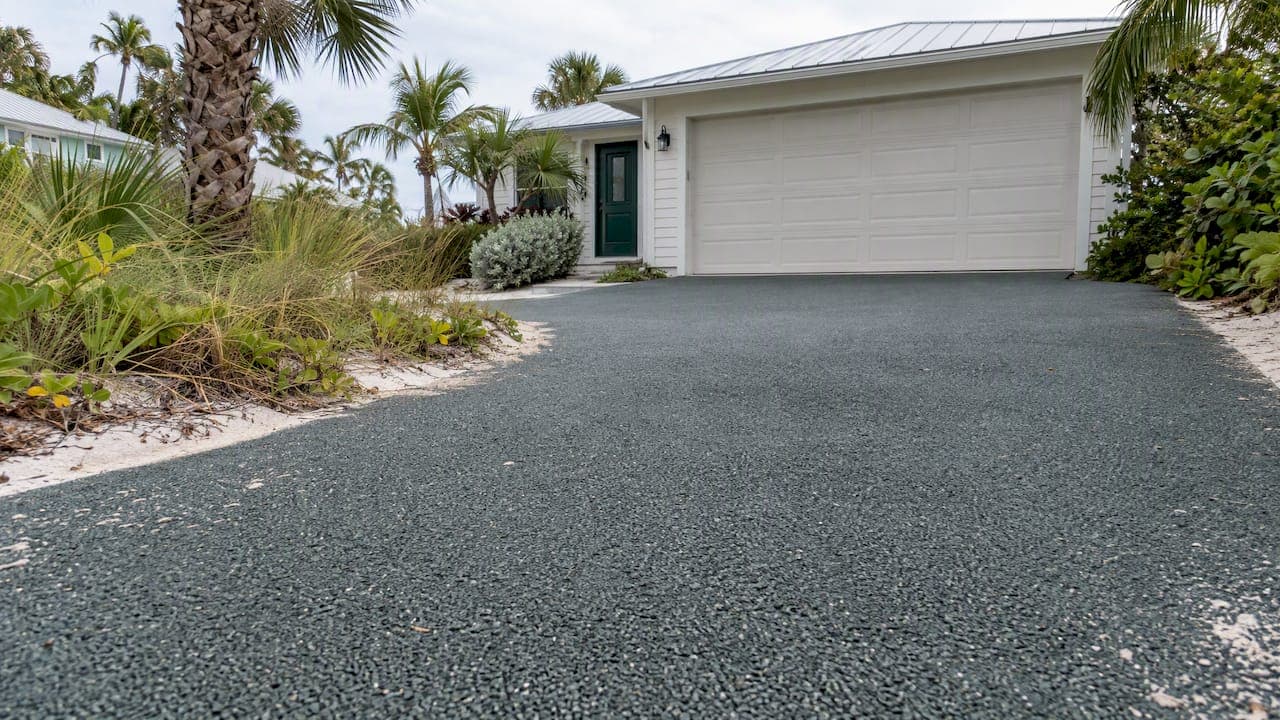
A rubber driveway can suit a coastal home well, because it is porous, it does not rust or corrode, and it flexes with heat instead of cracking. It is not right for every lot. The result depends on your soil, your water table, the system installed and the crew that installs it. This guide covers what salt, sand, storms and sun do to a driveway, where rubber paving helps, where it does not, and what to ask before you sign a contract.
TL;DR
- Rubber paving made from recycled tires is porous, so rain drains through it instead of pooling. That matters on flat, sandy coastal lots.
- It contains no steel and no cement, so salt air has less to attack than it does on reinforced concrete.
- Lifespan estimates vary by source and by installation quality. Ask any installer for written warranty terms and maintenance requirements.
- Drainage only works if the base and the surface stay clear. Sand and sediment are the main enemy near the shore.
- Check local stormwater, HOA and flood-zone rules before you choose a surface.
Table of Contents
- What a coastal driveway has to survive
- How rubber paving works
- Heat: what the research shows
- Rubber vs. other coastal driveway options
- How long does a rubber driveway last?
- Does a rubber driveway cost less than concrete?
- The sediment problem on porous surfaces
- Where a rubber driveway may not be the right call
- What we think
- Accessibility and documentation
- A checklist before you hire
- Working with us
- FAQ
- Sources
What a coastal driveway has to survive
A driveway a mile inland and one two blocks from the water face different conditions, even in the same county.
Salt and moisture. Salt spray settles on every exposed surface. Plain concrete is vulnerable over time when salts reach embedded steel, and any surface that traps moisture keeps that salt in contact longer. Materials that shed or drain water, and contain no corroding metal, avoid part of the problem.
Standing water. Many coastal lots are flat, with a high water table and sandy soil. A solid surface sends rain sideways, toward your garage, your neighbor or the street. After a heavy storm, puddles can sit for hours or days.
Heat. In Florida and along the Gulf and Atlantic coasts, a dark surface in full sun gets punishingly hot. Heat cycling also drives expansion and contraction, which is how rigid slabs crack.
Sand and sediment. Wind and tides carry fine sand onto driveways. On a porous surface, that sand can work into the pores and slow drainage unless you maintain it. We say more about this below, because it is the issue most guides skip.
Storms. Hurricane rain, surge and debris test every surface. No driveway material is storm-proof. The practical question is how fast water leaves the surface, and whether the surface can be repaired locally afterward.

We cover the broader comparison of materials in our guide to the best coastal driveway materials for salt, sand and storms.
How rubber paving works
Rubber paving is made from recycled tire rubber bound together and installed as one continuous surface, usually over a prepared base. Depending on the system, the surface is either porous, so water passes through it, or dense, with other drainage planned around it.
For a coastal home, three properties matter most:
- Permeability. Water moves down through the surface to the base and soil below, rather than running across the top.
- Flexibility. The material gives slightly, so it tolerates temperature swings and minor ground movement better than a rigid slab.
- No steel, no cement. There is nothing inside the surface to rust, and nothing to spall when salt gets in.
The form matters too. A poured, monolithic surface has no joints. An interlocking paver has many. Joints can shift, collect sand and let weeds in. On a driveway that takes vehicle weight daily, that is a real difference.
Heat: what the research shows
Surface temperature is a comfort issue on a driveway, especially if you have kids, pets or a pool nearby. A 2022 study of pervious pavement containing recycled rubber found that porous rubber-containing pavement can keep cooling through evaporation for as long as two days after rain, while dense asphalt holds heat because of its dark surface and high thermal inertia.
That study compared rubber-containing pervious pavement with asphalt, not with every driveway material, and it was an experimental investigation, not a promise about your driveway. Color, shade and the base also change what you feel underfoot. Still, a porous surface that holds some moisture is a sensible match for sun-heavy climates.
Rubber vs. other coastal driveway options
We describe the alternatives by type, because each has a place.
| Surface type | Salt and moisture | Drainage | Cracking | Main caution |
|---|---|---|---|---|
| Poured concrete | Reinforcement can corrode when salts penetrate | Sheds water to the sides | Prone to cracking with heat and settling | Needs sealing and control joints |
| Asphalt | Tolerates salt, softens in heat | Sheds water unless porous mix is used | Cracks and ruts over time | Hot to the touch, regular sealing |
| Interlocking pavers (concrete or stone) | Handle salt well | Joints allow some drainage | Individual pavers can shift | Sand in joints, settling, weeds |
| Crushed shell or gravel | Handles salt well | Very good | None, but it migrates | Ruts, loose surface, poor for accessibility |
| Poured porous rubber | No steel to corrode | Designed to drain through the surface | Flexes with temperature change | Needs a proper base and sediment control |
A general rule: choose rubber when drainage, comfort underfoot and crack resistance are your priorities. Choose something else if you need a surface that can take heavy sustained point loads, or if your site cannot drain even through a porous layer.
How long does a rubber driveway last?
This is the most common question, and sources give different answers. Angi puts the lifespan of recycled rubber paving at roughly 15 to 25 years, pointing to its resistance to thermal cracking. Our own guide to rubber paving lifespan and maintenance for homeowners takes a more conservative view, with attention to real-world upkeep.
Both ranges tell you the same thing. Longevity is not a fixed number. It depends on:
- how well the base was prepared and compacted
- how much weight the driveway carries, and whether vehicles turn tightly on it
- how much sun, salt and sediment it sees
- how you maintain it
Before you sign, ask for the warranty in writing and for the installer's maintenance requirements. A warranty that is vague or silent about coastal conditions is a warning sign.
Does a rubber driveway cost less than concrete?
Usually not up front. Rubber paving is a specialty installation, and initial cost often runs higher than a basic slab or asphalt. We do not publish a flat price, because the number depends on area, base condition, drainage needs, color and access. Anyone quoting a per-square-foot price without seeing the site is guessing.
The better comparison is lifecycle cost. A University of Texas at Tyler study of rubber and polymer modified asphalt mixtures found that rubber-modified mixtures can cost more at the start but be more cost-effective over their life, thanks to better fatigue resistance and less cracking maintenance. That research looked at asphalt mixtures containing rubber, not at poured rubber driveways, so treat it as supporting evidence for the lifecycle logic, not a price guide for your home. For a framework you can apply to your own quote, see our professional guide to lifecycle cost of paving surfaces.
When you compare quotes, count these over 15 years: sealing, crack repair, regrading or pumping of standing water, weed control, and replacement of failed sections.
The sediment problem on porous surfaces
Near the shore, windblown sand and silt are the main threat to a porous driveway. If fine particles fill the pores, water slows down and the surface starts to behave like a solid one.
Three things reduce the risk:
- Design the edges. Landscaping beds and loose sand should not drain onto the driveway. Edge restraints, curbing or a slight grade change help keep sediment out.
- Keep it clean. Sweeping and low-pressure rinsing keep pores open. Aggressive pressure washing can damage a surface, so ask the installer what they allow.
- Know your base. A porous surface sits on a stone reservoir layer. If groundwater is high, that layer may not empty fast, and the design has to account for it.
We go deeper on this in keeping sediment from clogging pores on coastal walkways. The same principles apply to a driveway.
Where a rubber driveway may not be the right call
Honest advice includes the limits.
- Very high water table or frequently flooded lots. A porous surface cannot drain into saturated ground. You may need additional drainage design.
- Heavy equipment. If you regularly park a loaded trailer or a heavy truck on one spot, discuss load ratings with the installer first.
- Poor existing base. Rubber paving cannot fix a failed base. If the ground underneath is unstable, the base has to be rebuilt.
- Strict HOA or municipal rules. Some communities specify approved materials or colors. Get approval in writing before work begins.
What we think
We install rubber paving in Florida, so we see the coastal pattern repeatedly. Homeowners pick a driveway based on how it looks on day one, then spend years fighting standing water, cracked slabs and surface heat. The problem is rarely the material alone. It is the mismatch between the surface and the site.
Our view is simple. Start with water: where does it go, and can the ground take it? Then think about heat and the people and pets who walk on the surface. Appearance comes after, and with rubber you do have a wide range of colors to work with. We specialize only in rubber paving, which means we are not trying to fit one material to every job. If your lot is better served by something else, we would rather you know that before you invest.
Also insist on an installer who is licensed and insured, who can explain the base and drainage design, and who will give you documentation. A driveway is a long-term investment, and the paperwork matters as much as the pour.
— Roger
Accessibility and documentation
If your driveway connects to a walkway used by a family member with mobility needs, the surface should be stable, firm and slip-resistant. The U.S. Access Board's guide to floor and ground surfaces explains how the ADA Standards treat surface characteristics, openings and changes in level. A private single-family driveway is generally not a place of public accommodation, but the same principles apply to paths that serve HOAs, rental properties or commercial uses.
Not every rubber surface qualifies. Loose or poorly bound material can fail the firmness test, and joints in paver systems can shift and create trip hazards. A continuous, professionally installed surface avoids those joints. For shared or public paths, ask for test documentation covering slip resistance, wet and dry. Our guides on ADA slip resistance requirements and how rubber paving meets ADA standards explain what to request.
A checklist before you hire
- Confirm the license and insurance. Ask for proof, not a verbal assurance.
- Ask what system will be used. Request the product name and data sheet.
- Request a drainage plan. Where does the water go in a heavy storm?
- Ask about the base. Depth, material and compaction should be specified.
- Get the warranty in writing. Look at what it covers and what it excludes.
- Ask about maintenance. Sweeping, rinsing and sediment control should be explained.
- Check local rules. Flood zone, stormwater, impervious-area limits and HOA approval.
- See a finished job. A site with similar conditions is worth more than a brochure.
Working with us
EcoTec Rubber Paving installs rubber paving across Florida using the Rubberway® system, including Rubberway Pervious Pavement, Rubberrock 6000, EVOLUTION and the Sidewalk System. We handle residential driveways, pool decks, patios and community areas, with custom colors and drainage built into the design. To talk through your lot, start on our professional rubber paving installation page. We install for paying projects, not for do-it-yourself kits.
If you manage a community, our posts on reducing community maintenance with rubber paving and crack-resistant paving types for Florida businesses may help with a board presentation.
FAQ
What are the disadvantages of rubber paving?
It usually costs more up front than a basic slab or asphalt, and it needs a properly built base. Porous versions need sediment control near the shore, and heavy point loads should be discussed with the installer. A poor installation is the biggest risk, which is why proof of licensing and a written warranty matter.
Is a rubber driveway cheaper than concrete?
Usually not at installation. The case for rubber rests on lifecycle cost: less cracking, less repair and better drainage. Compare quotes over 15 years, not on day one, and be skeptical of any price given without a site visit.
How long do rubber driveways last?
Estimates differ. Angi cites 15 to 25 years for recycled rubber paving, while real results depend on the base, traffic, sun exposure and upkeep. Ask for the warranty terms in writing.
Does salt air damage a rubber driveway?
Rubber has no steel to rust and no cement to spall, so salt air is less of an issue than for reinforced concrete. Sand and silt are the bigger concern for porous surfaces, because they can clog pores. Regular sweeping and good edge design keep drainage working.
Sources
- Cooling effect in pervious pavement containing recycled rubber, Scientific.Net (2022)
- Best Driveway Material for Cold Weather, Angi
- Cost-effectiveness of rubber and polymer modified asphalt mixtures, University of Texas at Tyler
- Chapter 3: Floor and Ground Surfaces, U.S. Access Board