
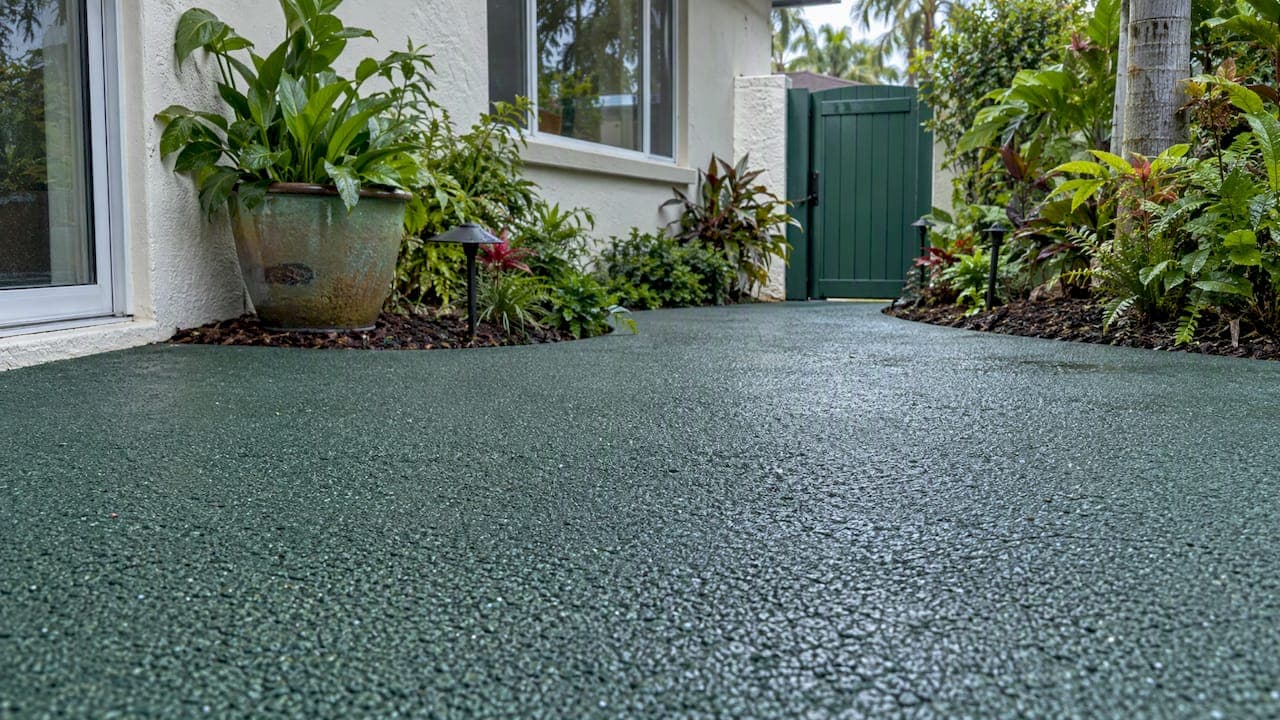
Rubber paving earns its place in Florida for four reasons: water passes through it, it resists the cracking that heat and shifting soil cause, it gives a continuous surface that supports ADA-compliant routes, and it is made largely from recycled tires. It is not right for every site, and a good installer will say so. This guide covers what the benefits mean in practice, where they hold up, and what to check before you commit.
TL;DR
- Drainage: a porous rubber surface lets rain soak through instead of pooling, which matters in a state with heavy summer downpours.
- Crack resistance: a flexible, poured-in-place surface handles heat cycles and soil movement better than rigid slabs.
- Accessibility: a continuous surface with no joints removes the lips and gaps that cause ADA violations on walkways.
- Sustainability: recycled tire rubber keeps waste out of landfills and can support stormwater goals.
- Trade-off: porous surfaces need a clean base and sediment control, so site conditions decide the result.
Table of Contents
- Why Florida is a hard place for paving
- Benefit 1: Drainage that works with Florida rain
- Benefit 2: Resistance to heat cracking and movement
- Benefit 3: A continuous surface that helps with ADA compliance
- Benefit 4: Comfort and safety underfoot
- Benefit 5: Recycled content and a smaller waste footprint
- Where rubber paving fits best
- The honest downsides
- Our perspective: choose by site, not by trend
- How to start a rubber paving project
- FAQ
- Sources
Why Florida is a hard place for paving
Florida punishes hard surfaces in three ways at once. Summer heat swings the surface temperature every day. Afternoon storms dump a lot of water in a short time. And much of the state sits on sandy, shallow-water-table soil that moves, washes out and settles.
Rigid materials like concrete and mortar-set pavers answer movement by cracking or heaving. Asphalt softens in heat and oxidizes in sun. Standing water then finds every low spot, freezes nothing here, but breeds mosquitoes, grows algae, and makes walkways slippery.
A rubber surface is built to behave differently: it is flexible, it can be porous, and it is laid as one piece. Those three traits explain nearly every benefit below. If you want a wider look at how Florida conditions drive material choice, our guide to Florida business paving challenges goes deeper.
Benefit 1: Drainage that works with Florida rain
Porous paving reduces runoff by letting water infiltrate through the surface and into the base below. A Walton County, Florida stormwater design section on pervious pavement describes pervious pavers, porous concrete and similar systems as alternatives to traditional asphalt and concrete that cut runoff by letting rainwater infiltrate. The University of Florida's IFAS Extension describes permeable pavement as green stormwater infrastructure that can reduce runoff while carrying vehicle and foot traffic.
What that means on your property:
- Fewer puddles at pool decks, patio edges and entries.
- Less ponding at the foot of driveways and along HOA walkways.
- Less load on your drainage where a site is close to its impervious-surface limit.
Our Rubberway® Pervious Pavement line is built around this idea. The surface is porous, so rain moves down through it rather than sheeting across it.
The catch: keep it from clogging
The same IFAS publication is blunt about the main operating issue: clogging from sediment and organic debris. Its researchers stress that long-term performance depends on keeping sediment-laden runoff from neighboring unmaintained landscaping off the pavement.
That is practical advice you can act on:
- Keep mulch beds and bare soil from sloping onto the paved area, or add edging and groundcover.
- Blow or sweep leaves and grit off regularly, especially after storms.
- Ask your installer how the base and edge are detailed on your site, not just how the surface looks.
If you hear a pitch that porous paving needs no care at all, be skeptical. It needs light, regular care, and in return it keeps draining.
Benefit 2: Resistance to heat cracking and movement
Cracks are the top complaint we hear about Florida driveways, pool decks and walkways. Slabs crack because they are stiff and the ground under them is not.
A poured-in-place rubber surface is bound together and flexes slightly. It is not immune to damage, since a poor base will fail any surface, but it does not rely on being rigid. Rubberway's own unitary paving system fact sheet positions the system as a cost-effective, LEED-accredited alternative to asphalt, concrete and preformed pavers.
There is also a public-sector track record for rubber in paving more broadly. The Federal Highway Administration's report on recycled tire rubber in asphalt notes that the paving industry has used it since the 1960s, and that in asphalt mixes it allows higher binder content without drain-down, which improves durability and cracking resistance. Florida got involved early: the Florida legislature directed FDOT in 1988 to study ground tire rubber in asphalt, and the results appear in a ten-year performance evaluation of asphalt-rubber mixes.
To be precise: that research concerns rubber-modified asphalt on roads, which is a different product from a poured rubber surface. We cite it because it shows how long rubber has been taken seriously as a paving material and why state agencies keep adopting it. For a business-focused breakdown of materials that resist cracking, see our guide to crack-resistant paving types for Florida businesses.
Benefit 3: A continuous surface that helps with ADA compliance
For municipalities, HOAs and commercial owners, accessibility is often the deciding factor. Under the 2010 ADA Standards, which the Department of Justice applies to public facilities, accessible routes need surfaces that are firm, stable and slip-resistant.
Joints are where many surfaces fail. In one federal settlement with the Iowa City school district, the listed violations included changes in level between adjacent rubber tiles along a route connecting play components. The lesson is not that rubber is a problem. It is that seams and edges are where compliance breaks down.
A poured-in-place surface has no tile seams. It can be laid to a consistent grade and finish, which makes it easier to hold slopes and cross-slopes within limits. We still recommend that your designer or ADA consultant confirm the specifics for each route, since slope, width and surface requirements depend on the project. Architects can find more detail in how rubber paving meets ADA standards.

Benefit 4: Comfort and safety underfoot
Pool decks and play areas are where people notice rubber most. The surface has some give, grips when wet, and tends to feel less harsh than hard stone or concrete in direct sun. Surface temperature varies with color, sun exposure and time of day, so we suggest touching a sample in the afternoon sun before choosing a color, especially for barefoot areas.
Texture and softness also help in falls, which is why rubber is common around playgrounds. If that is your use, read our piece on durable playground safety surfaces for Florida sites.
Benefit 5: Recycled content and a smaller waste footprint
Rubberway systems use recycled tire material, so a project diverts scrap tires from landfills and stockpiles. For public buyers, that can support sustainability goals. The FHWA report mentioned earlier names the environmental benefit of using rubber in pavements, alongside structural performance, as a key reason state agencies have adopted it.
A fair caution: "eco-friendly" is a claim to verify, not accept. Ask any installer for the product's documentation, what percentage is recycled content, and what certifications or credits it supports. We provide government-ready documentation for exactly this reason, so board members and procurement staff can file it with the project.
Where rubber paving fits best
| Site | Why rubber suits it | What to watch |
|---|---|---|
| Residential driveways | Flexible surface, drains, wide color range | Base prep and sediment from beds |
| Pool decks and patios | Slip resistance, softer underfoot, no joints to trap water | Color choice for sun exposure |
| Commercial walkways | Continuous surface, fewer trip edges | Heavy delivery traffic needs a proper spec |
| Municipal parks and trails | Porous, ADA-friendly, recycled content | Documentation for procurement |
| HOA common areas | Fewer trip hazards and complaints | Maintenance plan for debris |
| Sidewalks | Can flex around tree roots better than rigid slabs | Root zone and grade design |
For driveways specifically, our article on Florida driveway materials that last compares the options in more detail. For public works, see how eco-paving reduces city maintenance budgets.
The honest downsides
A useful benefits article lists the limits too.
- Site conditions decide the outcome. Poor drainage below the surface, weak soils or an unprepared base will undermine any paving. Porous systems also need clean edges.
- It is a specialist installation. Mixing, laying and finishing a poured system depends on crew skill and weather. That is why a rubber-only installer matters.
- Not for every load. Very heavy, constant truck traffic calls for a specific design and product choice, not a default.
- Upfront cost versus lifecycle cost. Rubber is not always the cheapest line item on a bid. The case for it rests on lower repair, less water damage and longer service. We do not publish fixed prices because they depend on area, base, color and access, so we quote each project.
Our perspective: choose by site, not by trend
We install rubber paving and nothing else, so we see the same patterns repeat. The projects that go well start with water: where it comes from, where it needs to go, and what will carry silt onto the surface. The projects that disappoint start with a color sample and a quote.

Our advice is simple. Walk the site after a hard rain, or ask us to look at photos from one. Decide what the surface has to do: drain, stay accessible, stay comfortable barefoot, or all three. Then pick the Rubberway product that fits. Rubberway Rubberrock 6000, EVOLUTION and the Sidewalk System each serve different jobs, and we would rather match the product to your use than oversell the most expensive one.
We are licensed and insured, we document what we install, and we tell you when another approach would serve you better on a particular spot.
— Roger
How to start a rubber paving project
- Define the area and the use. Driveway, pool deck, park trail, HOA path: each has different loads and rules.
- Check drainage and surroundings. Note slopes, planting beds and downspouts that feed the area.
- Decide on accessibility needs. For public or commercial routes, involve your designer or ADA consultant early.
- Choose a product and color. Look at samples outdoors, in daylight.
- Get documentation. Municipalities and HOA boards should request product data and proof of license and insurance.
- Plan upkeep. Keep debris and soil off the surface, and schedule periodic cleaning.
If you are ready to scope a project, our rubber paving installation team can review your site and recommend a Rubberway product. You can also compare the full range on our Rubberway products page, or read what each system offers in Rubberway system benefits: what you get and where it fits.
For owners and contractors who want more background on the material itself, our overview of rubberised paving covers the basics, and the rubber design guide for Florida properties covers layout and color planning.
FAQ
What are the disadvantages of rubber pavers?
The main ones are sensitivity to a poor base, the need for skilled installation, and clogging if sediment is allowed to build up on a porous surface. Cost can also run above basic concrete or asphalt at the start. Good site prep and regular sweeping address most of these.
What is the best material for a driveway in Florida?
There is no single answer, because it depends on soil, drainage, traffic and budget. Concrete, asphalt, pavers and rubber all work in the right conditions. Rubber is a strong option when you want drainage, crack resistance and color choice, and our driveway materials guide compares them.
How long do rubber paving surfaces last?
Life span depends on the base, the product, traffic and upkeep, so we do not promise a number without seeing the site. A well-prepared base, clean drainage and regular cleaning are what extend service life. Ask your installer what they would expect for your specific use and what upkeep that assumes.
Does rubber paving meet ADA requirements?
A continuous, firm, slip-resistant surface helps a route meet ADA surface requirements, but compliance also depends on slope, width, edges and transitions. Your designer should verify each route against the 2010 ADA Standards. We supply the documentation that goes with the installed system.
Sources
- Walton County, FL: Pervious Pavement design section
- UF/IFAS Extension: Permeable Pavement Systems, Technical Considerations
- RUBBERWAY Unitary Paving System Fact Sheet
- FHWA: The Use of Recycled Tire Rubber to Modify Asphalt Binder and Mixtures
- Ten-Year Performance Evaluation of Asphalt-Rubber Surface Mixes (TRID)
- ADA.gov: Ballot Drop Box Accessibility (2010 ADA Standards)
- ADA.gov: Settlement Agreement with Iowa City Community School District, Exhibit 1