
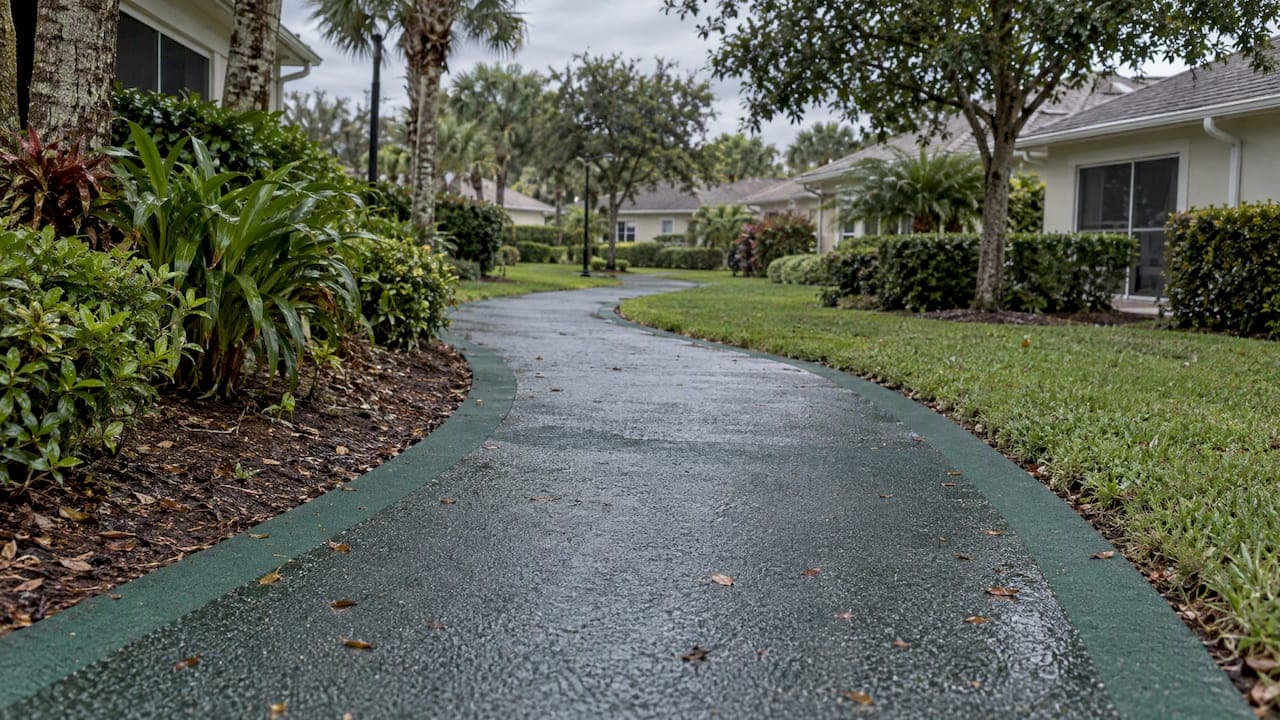
The Rubberway system is a flexible, porous paving surface built from recycled tire rubber and a binder. Its main benefits are fast drainage, resistance to cracking, a slip-resistant surface that can meet ADA requirements, a large recycled content, and a wide range of colors. It works best when the base underneath is prepared properly, and it is not the right answer for every surface. This guide explains what each benefit means in practice, what the evidence says, and where the limits are, so you can decide whether it belongs on your driveway, pool deck, trail, sidewalk or community path.
TL;DR
- Drainage: the surface is open and porous, so rain passes through it instead of pooling on top. That helps with standing water, slip risk and stormwater rules.
- Crack resistance: rubber flexes where concrete and asphalt crack. Research on rubber-modified pavements shows longer fatigue life, though that research covers asphalt mixes, not Rubberway itself.
- Accessibility: a firm, stable, slip-resistant surface is what ADA guidance asks for, and a bound rubber surface is designed to deliver it.
- Sustainability: the material is made from recycled tires, and porous surfaces can keep runoff cooler.
- Catch: the benefits depend on the sub-base and on correct installation. A good product over a poor base still fails.
Table of Contents
- What the Rubberway system is
- Benefit 1: water goes through the surface, not across it
- Benefit 2: flexibility that resists cracking
- The condition that makes the benefits real: the base
- Benefit 3: an accessible, slip-resistant surface
- Benefit 4: recycled content and a lighter footprint
- Benefit 5: a cooler surface than dark, solid paving
- Benefit 6: color, design and a finished look
- Where it works best
- Where it is not the right choice
- Our perspective
- Getting a Rubberway installation in Florida
- FAQ
- Sources
What the Rubberway system is
Rubberway is a family of rubber paving products. The manufacturer describes its Pervious Pavement as a flexible, porous system made from recycled post-consumer tire rubber, specified at roughly 1½ to 2 inches thick in a single layer, and bound with a water-repellent binder. Large rubber granules leave open channels between them, which is what lets water through.
The range we install in Florida includes four product lines, which you can see on our Rubberway products page:
- Rubberway Pervious Pavement: the porous, single-layer surface for drainage-driven projects.
- Rubberway Rubberrock 6000: a rubber paving option for traffic-bearing and demanding areas.
- Rubberway EVOLUTION: a line that gives designers more finish and color options.
- Rubberway Sidewalk System: a layered system for sidewalks and paths, including areas where tree roots lift concrete.
The right line depends on load, traffic, drainage needs and finish. A pool deck and a municipal trail do not call for the same specification, and we say so at the estimate stage rather than after the contract is signed.
Benefit 1: water goes through the surface, not across it
Standing water is the complaint we hear most in Florida. Heavy afternoon storms, flat lots and sandy-but-compacted soil mean a solid surface can sit wet for hours. A porous surface changes the physics: rain enters at the point where it lands.
What that gives you:
- Fewer puddles and slick spots on driveways, pool surrounds and walkways.
- Less runoff to manage. For commercial sites, HOAs and municipalities, handling stormwater on the spot can reduce the size of the drainage infrastructure a project needs. Local stormwater rules vary by county and water management district, so your engineer should confirm what credit a porous surface earns on your site.
- Water reaching tree roots. A porous surface lets moisture through to the soil below, which is part of why rubber is used around mature trees.
The manufacturer quotes drainage capacity of up to 2,000 gallons per square foot for its pervious pavement. Treat that as a manufacturer figure for the surface itself under test conditions. The real-world rate on your property depends on the sub-base and the soil beneath it, and surfaces clog over time if sediment is allowed to build up. If you are an engineer or board member comparing specifications, our notes on porous rubber paving drawdown specs and stormwater management paving go deeper on design.
Benefit 2: flexibility that resists cracking
Concrete is rigid. When soil shifts, tree roots push, or heat expands the slab, it cracks. Rubber bends and returns.
There is useful research behind the principle, with an important caveat. A study in Scientific Reports on rubberized asphalt mixtures under dynamic loading found that adding recycled crumb rubber improves fatigue performance, because the elastic rubber particles help delay crack formation. That study tested asphalt mixtures, not a bound rubber surface like Rubberway, so it supports the general idea that rubber resists cracking, not a specific lifespan for our installations. We do not promise a number of years, and neither should anyone selling you paving without knowing your site.
Where flexibility pays off most:
- Sidewalks near trees. Roots lift rigid slabs and create trip hazards and liability. A flexible surface moves with them. Our guide on when flexible sidewalk material beats concrete sets out a checklist for specifiers.
- Driveways and patios on shifting ground. Florida soils and heat cycles stress rigid slabs.
- Pool decks. Cracks in a deck are both ugly and a hazard to bare feet.
Flexibility does not mean the surface is indestructible. Heavy point loads, sharp equipment and poor edge detailing can damage any paving, and the next section explains why the base matters.
The condition that makes the benefits real: the base
Rubber is flexible, so it relies on what is under it. A soft or uneven base leads to surface deformation over time, and it can cancel out the crack-resistance advantage. Rubber surfaces are typically laid over a properly prepared permeable road base, concrete or asphalt, depending on the product and the use.
This is the part of a project that is easy to underprice and hard to fix later. When you collect bids, ask each contractor:
- What base are you specifying, and how deep?
- How will you compact and grade it?
- How does the water leave the base, and where does it go?
- What is the edge detail, and how will the surface be kept from lifting at the edges?
- What is covered if the surface settles?
A contractor who cannot answer these precisely is selling a surface, not a system. Our sustainable paving installation best practices guide covers preparation in more detail.
Benefit 3: an accessible, slip-resistant surface
For municipalities, HOAs and businesses, accessibility is not optional. The U.S. Access Board's guidance on floor and ground surfaces says accessible surfaces must be firm, stable and slip resistant, and it notes that loose materials such as gravel will not meet those requirements unless properly treated to give enough integrity and resilience.
A bound rubber surface is built to answer that: the granules are held together, so there is no loose fill to shift under a wheelchair, walker or stroller, and the texture grips when wet. Because rain drains through, the surface also dries quickly, which matters for slip resistance.
Two honest points:
- Compliance is a property of the whole route, not only the material. Slopes, cross-slopes, joints, transitions and widths all count. Our article on how rubber paving meets ADA standards walks through what to check.
- Golf courses and recreation sites have their own accessible route rules. The Access Board's golf course guide explains that accessible routes are continuous, unobstructed paths connecting accessible elements, which is useful if you manage cart paths or clubhouse connections.
We provide government-ready documentation for public projects, so your board or engineer has what a procurement file requires.
Benefit 4: recycled content and a lighter footprint
The rubber in these systems comes from used tires, which are a long-standing waste problem. Putting that material into a long-lasting surface keeps it in use rather than in a stockpile or landfill.

The usual worry is what leaches out. The U.S. EPA archive hosts a literature review of water quality effects of tire-derived aggregate and rubber-modified asphalt pavement. It notes that laboratory results may not replicate field conditions, so the careful reading is that the evidence on pavements is generally reassuring but not a blanket guarantee. If you have a specific concern, such as a surface next to a sensitive water body, ask for the product's technical data and raise it with your engineer.
Sustainability here is also about what you avoid: less impervious area, less runoff, and fewer demolition cycles if the surface lasts.
Benefit 5: a cooler surface than dark, solid paving
Florida summers make surface temperature a real comfort and safety question, particularly around pools and playgrounds. Dark, dense pavement absorbs and stores heat. Research on pervious pavement containing recycled rubber examined evaporative cooling, and reported that pervious pavements can lower the temperature of stormwater runoff by roughly 3 to 7°F (2 to 4°C), with cooling effects lasting up to two days in experimental conditions.
Read that carefully. It is laboratory evidence about evaporative cooling and runoff temperature, not a promise that a rubber deck will feel cool at 3 p.m. in August. Color matters as well: a lighter shade absorbs less solar energy than a dark one. If barefoot comfort is the priority, tell us, and we will discuss color options with you before you commit.
Benefit 6: color, design and a finished look
Most paving choices force a trade between performance and looks. Rubber surfaces come in a wide color range, and the colored wearing layer can be blended for borders, patterns or neutral tones that match a roof, a pool or a community's branding. For HOAs, that means a path can look intentional rather than like a repair patch. For homeowners, it means a driveway or patio that does not look like a commercial installation.
If you are sketching a patio and comparing materials, a planning tool helps you see the numbers before you ask for bids; this paver patio design and cost guide is a useful way to understand how patio quotes are built and what questions to ask.
Where it works best
| Use | Why rubber fits | What to confirm |
|---|---|---|
| Residential driveways | Flexible, drains, no slab cracking | Base depth, vehicle loads, edge detail |
| Pool decks and patios | Slip-resistant, comfortable underfoot | Color and heat, chemical exposure |
| Commercial walkways | Durable, accessible, fast drying | Traffic type, ADA slopes |
| Municipal parks and trails | Accessible, porous, tree-friendly | Procurement documents, drainage design |
| Sidewalks | Moves with roots and soil | Root zone, transitions to existing concrete |
| HOA common areas | Appearance plus liability reduction | Board approval, color matching |
For heavier use, our article on high-traffic paving solutions explains how to match the product to the load.
Where it is not the right choice
A fair assessment includes the limits.
- Very heavy, concentrated loads. Industrial yards with heavy equipment need an engineered solution that may not be rubber.
- Poor site drainage below the surface. A porous top over a base that cannot drain just moves the puddle underneath.
- Sites with heavy sediment or debris. Porous surfaces need occasional cleaning so the voids stay open.
- Projects bought on price alone. The base work is where cheap bids cut corners.
If your project is one of these, we will tell you. That is cheaper for both of us than a failed job.
Our perspective
We install rubber paving and nothing else, and that focus shapes how we advise. Florida is hard on surfaces: intense sun, heavy rain, tree roots, and soil that moves. The pattern we see is that property owners rarely ask for rubber first. They ask for a fix for water pooling at a pool deck, a sidewalk that has lifted, or a path that fails an accessibility review. Rubber answers those problems when the base and drainage are designed with it.

So we start with the problem, not the product. We look at where water goes, what the load is, who walks or drives there, and whether the surface must meet ADA requirements. Then we choose among the Rubberway lines. We are licensed and insured, and for public work we assemble the documentation that boards and municipalities need.
Our advice for anyone comparing options: ask every bidder about the base, the drainage path and the edge details before you ask about color. Color is the easy part.
— Roger
Getting a Rubberway installation in Florida
If you manage a property in Florida and want to see whether Rubberway fits, we can help you scope it. We install the full range of systems for homeowners, businesses, municipalities and HOAs. Start with our professional rubber paving installation page, or look at the Rubberway product lines to match a system to your project. We do not publish prices, because cost depends on area, base condition and the system chosen, so the next step is a site review and a written estimate.
For a wider introduction to the topic, see what permeable paving is and what it costs and what owners and contractors should know about rubberised paving.
FAQ
What is the main benefit of the Rubberway system?
For most Florida properties it is drainage combined with flexibility. Rain passes through the porous surface, so there is less standing water, and the rubber flexes instead of cracking like a rigid slab. The accessibility and recycled content are strong additional reasons.
Is a Rubberway surface ADA compliant?
The surface is designed to be firm, stable and slip resistant, which are the qualities the Access Board's surface guidance asks for. Compliance also depends on slope, width, joints and transitions along the full route, so the design needs to be checked for the specific site.
Does rubber paving get too hot in Florida?
Any surface warms in direct sun, and darker colors absorb more heat. Research on porous pavements with recycled rubber shows evaporative cooling benefits, but it does not guarantee a cool deck. For pool areas, ask about lighter colors.
Is recycled tire rubber safe for the environment?
The EPA archive literature review on rubber-modified pavements and tire-derived aggregate generally points to low water quality risk, while noting that lab results may not match field conditions. For a sensitive site, ask for the technical data and involve your engineer.
Can it go over my existing driveway or concrete?
Sometimes. Rubber can be installed over a sound, properly prepared base such as existing concrete or asphalt, but a badly cracked or unstable base needs repair first. We assess the base during the site review.
Sources
- Rubberway Pervious Pavement, manufacturer product page
- Mechanical performance under dynamic loading of rubberized asphalt mixtures, Scientific Reports
- Floor and Ground Surfaces, U.S. Access Board
- Chapter 10: Golf Courses, U.S. Access Board
- Literature Review of the Water Quality Effects of Tire Derived Aggregate and Rubber Modified Asphalt Pavement, U.S. EPA archive
- Experimental Investigation on Evaporation Rate for Enhancing Evaporative Cooling of Pervious Pavement Containing Recycled Rubber, Scientific.Net