
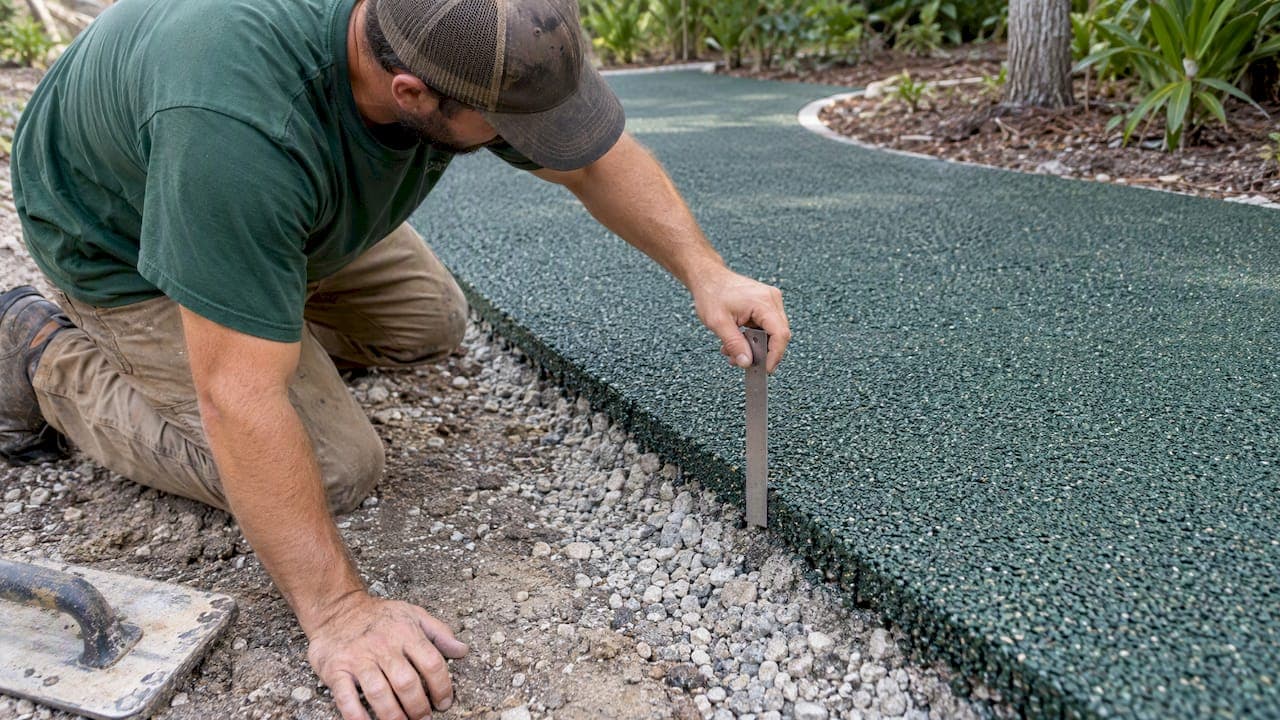
There is no single correct thickness for rubber paving. It depends on the product, the traffic and the base underneath. The poured-in-place porous system we install, Rubberway® Pervious Pavement, is specified at 1 1/2 to 2 inches, and that single-layer range covers most walkways, patios and pool decks. Driveways, trails and uneven substrates raise different questions, and most of them are about what sits under the rubber rather than the rubber itself.
This guide separates three things people often mix up: loose-lay rubber pavers sold by the pack, poured-in-place rubber paving, and rubber-modified asphalt. Each has its own idea of "thickness."
TL;DR
- Poured porous rubber paving from Rubberway is specified at 1 1/2 to 2 inches in a single layer. The base below it carries the load.
- Interlocking rubber pavers sold in packs are a different product, often around 5/8 to 2 inches thick, and they are laid loose rather than bonded.
- For ADA routes, the limits that matter are slope and edge height, not how thick the rubber is: 5% running slope, about 2% cross slope, and no more than 1/4 inch of vertical change.
- Extra thickness does not fix a weak base or standing water. Prep and drainage decide how long the surface lasts.
Table of Contents
- Three products that share a name
- How thick is poured rubber paving?
- Why a thicker layer is not automatically better
- Thickness and ADA: the limits that apply
- Driveways: where the base matters most
- Thin, thick and varying: substrates that are not flat
- Thickness, lifespan and cost
- Our perspective: ask about the base before the surface
- Choosing a system for your project
- FAQ
- Sources
Three products that share a name
Search results for this topic mix very different things, so it helps to sort them first.
Loose-lay rubber pavers. These are interlocking tiles or squares you buy by the pack. Retail listings show 3/4 inch pavers for patios and gardens and thicker 2 inch deck pavers for rooftops. We do not sell or install these, and they are built for light foot traffic, cushioning and drainage on rooftops, not for a bonded, continuous surface.
Poured-in-place rubber paving. Recycled rubber granules are mixed with a binder and troweled or machine-laid on site into one continuous surface. This is what our crews install. Thickness is set by the system and the use.
Rubber-modified asphalt. Crumb rubber is blended into conventional asphalt. Here thickness is an engineering question, measured in lifts of one inch or more. Caltrans, for example, compares overlay strategies placed at the same 1-inch minimum thickness under its maintenance preservation program. That is a highway agency's framework, not a guide for a Florida driveway.
The rest of this article is about the second category.

How thick is poured rubber paving?
For Rubberway® Pervious Pavement, the manufacturer specifies a 1 1/2 to 2 inch thickness using a water-repellent binder and recycled rubber from post-consumer tires. It is a single-layer system, so there is no stacking of thin coats to reach the target.
That range is a design figure. Where in the range a project lands depends on how the surface will be used:
| Use | What drives thickness | What to ask your installer |
|---|---|---|
| Walkways and sidewalks | Foot traffic, wheelchairs, strollers, edge transitions | Finished edge height and bevel at every joint |
| Pool decks and patios | Comfort underfoot, drainage, heat | Color, texture and how water leaves the surface |
| Residential driveways | Vehicle weight, turning stress, base strength | Base type and compacted depth, not just surface thickness |
| Parks, trails and tree surrounds | Roots, soil movement, light maintenance vehicles | How the surface handles uneven ground and root growth |
| HOA and commercial paths | Volume of use, ADA documentation | Slope calculations and slip-resistance data |
We publish no standard thickness chart for every job, and we would not trust one that did. A site visit settles it.
Why a thicker layer is not automatically better
It is natural to assume more rubber means a longer life. In practice, thickness only helps when the layers below it do their job.
A poured rubber surface is flexible. It rides on a base, which spreads loads into the soil. If the base is soft, wet or poorly compacted, the surface follows it down. Adding half an inch of rubber on top does not stop a depression from forming. It simply covers a problem for a season or two. We go deeper on this in our piece on the role of surface prep in rubber paving success.
A few other trade-offs:
- Cost. More material means more cost, and installation time rises with it. Poor value if the extra thickness addresses nothing.
- Drainage. Porous systems work because water passes through the open grid and into the base or soil. A base that cannot take the water makes the surface thickness irrelevant. See our notes on 24 to 72 hour drawdown for porous rubber paving.
- Edges. A thick surface laid against a door threshold, curb or existing slab creates a lip. Lips are an ADA problem, which brings us to the next section.
Thickness and ADA: the limits that apply
A question we hear from HOA boards and municipal staff is whether rubber paving needs to be a certain thickness to be ADA compliant. It does not. The 2010 ADA Standards regulate the route, not the material depth.
Per ADATA's summary of the standards:
- Running slope on an accessible route must not exceed 1:20 (5%).
- Cross slope must not exceed 1:48 (about 2%).
- Vertical changes in level cannot exceed 1/4 inch, or 1/2 inch if beveled at 1:2.
- Surfaces must be firm, stable and slip resistant.
The Access Board's Chapter 4 adds that the clear width of a walking surface must be at least 36 inches, with limited exceptions.
This is where thickness becomes practical. If a new 2 inch surface is laid over an existing walk, the edge where it meets the old surface can exceed the 1/4 inch limit unless it is beveled or the old material is milled down first. The same goes for thresholds, curb ramps and drain covers. The rubber's thickness has to be planned together with the grade, not chosen in isolation.
For deeper reading, see our guides on how rubber paving meets ADA standards, ADA slip resistance requirements and ADA compliance paving for commercial properties. If your project is public or commercial, confirm requirements with your architect or the local building official, since state and local rules can add to the federal baseline.
Driveways: where the base matters most
Cars are heavier than feet, and turning wheels twist the surface. For a driveway, the useful questions are:
- What is under it now? Sound, well-drained concrete or asphalt can sometimes serve as a base. Cracked, heaving or soft surfaces cannot.
- Where does water go? Florida's heavy summer rain and high water table make drainage a design issue. Standing water under any surface weakens it.
- What will drive on it? Passenger cars, a boat trailer and a delivery truck are very different loads. Tell your installer the heaviest vehicle that will use it.
- How will edges be finished? Edges at garage thresholds and the street apron need a clean transition.
Be wary of any answer that gives a single number without asking those four questions. Pack-of-pavers advice, such as 60 mm versus 80 mm for concrete pavers, does not translate to poured rubber. A different material is working under different rules.
Thin, thick and varying: substrates that are not flat
A poured surface can follow an existing grade, and the depth can vary section to section on a substrate that is out of level. That can be useful on older sites. But a surface thickened to fill a dip behaves differently from one built on a properly graded base. If a low area is deep enough to need much more rubber than the system's specified range, the right move is usually to fix the base, not pile on rubber.
If you manage a community with root-lifted sidewalks, trip hazards are the real concern. Our article on reducing community maintenance with rubber paving covers how flexible surfaces handle root pressure and why HOAs look at them.
Thickness, lifespan and cost
Homeowners ask how long a given thickness lasts. Honestly, thickness is one of several variables, together with base quality, drainage, sun exposure, traffic and maintenance. We cover realistic expectations in rubber paving lifespan and maintenance.
On cost, the evidence from rubber-modified pavements is that they can cost more up front. Caltrans reported an average initial cost increase of about 24% for rubberized pavement over conventional asphalt in 2023. Life-cycle research suggests the premium can be offset: an ASTM-published analysis of asphalt rubber mixtures looks at how reduced cracking can extend service life. Those figures cover rubber-modified asphalt on public roads, not our poured systems, so use them as a general signal and not a quote.
We do not publish prices for our work, because thickness, base condition, area and access change every job. A written estimate after a site review is the only number worth using. For a comparison with asphalt, see why rubber paving outperforms asphalt overlays.
Our perspective: ask about the base before the surface
When a property owner calls and opens with "how thick is it?", we understand why. It is the one number on a brochure that feels measurable. But in our experience the questions that predict a good result come earlier.
We only install rubber paving, and that narrow focus shapes how we see projects. Florida puts specific stress on a surface: intense sun, heavy rain bursts, and soil that stays wet. A porous rubber system suits that climate because water passes through it instead of sheeting across the top. That only works when the base beneath is designed to receive the water.

So our advice is this. Choose the product for the use, accept the manufacturer's specified thickness for it, then put your attention and budget into grading, base preparation, edge transitions and documentation. If a bid is vague about those and loud about thickness, ask more questions. If a contractor offers to add inches of rubber to cover a drainage problem, walk away from that proposal.
For municipal and HOA projects, ask for the paperwork up front: slope data, slip-resistance information and product documentation. We build projects with government-ready documentation in mind, so those requests are routine for us.
— Roger
Choosing a system for your project
We install four Rubberway lines, each suited to a different job: Rubberway® Pervious Pavement, Rubberway Rubberrock 6000, Rubberway EVOLUTION and the Rubberway Sidewalk System. Which one fits depends on traffic, drainage and what you are replacing. If you are planning a driveway, pool deck, park path or community walkway in Florida, tell us about the site and we will recommend the system and thickness for it. You can also look through our product lines first. We are licensed and insured, and we handle only rubber paving.
Before any call, gather these:
- Approximate area and a few photos
- The current surface and any cracks, heaving or standing water
- Heaviest vehicle expected, if any
- Whether the route must meet ADA requirements
- Colors you are considering
For an overview of how we work, read our sustainable paving installation best practices and what owners and contractors should know about rubberised paving.
FAQ
What thickness is rubber paving usually installed at?
For poured porous rubber, Rubberway® Pervious Pavement is specified at 1 1/2 to 2 inches in a single layer. Loose rubber pavers sold in packs come in different thicknesses, often from about 5/8 inch up to 2 inches. The two are different products with different uses.
Does ADA require a minimum thickness for rubber paving?
No. The 2010 ADA Standards set limits on slope, width, level changes and surface quality, not on material depth. The thickness needs to be planned so that edges and joints stay within the 1/4 inch level-change limit, or 1/2 inch when beveled.
Is thicker rubber paving better for driveways?
Not by itself. A driveway lasts or fails based on the base, drainage and loads, and extra rubber on a weak base will not prevent settling. Describe your heaviest vehicle and site conditions to your installer, and ask how the base will be built.
Is rubber paving more expensive than asphalt?
Often yes at the start. Caltrans data from 2023 showed an average initial cost increase of roughly 24% for rubberized pavement on roads, with potential savings from reduced cracking over time. Your own project price depends on area, base condition and system, so request a written estimate.
Sources
- Rubberway Pervious Rubber Pavement
- Accessibility of Sidewalk Dining, Retail, and Community Spaces, ADATA
- Chapter 4: Accessible Routes, U.S. Access Board
- Caltrans crumb rubber report, 2023
- Mechanistic and Economic Impacts of Using Asphalt Rubber Mixtures at Various Vehicle Speeds, ASTM