
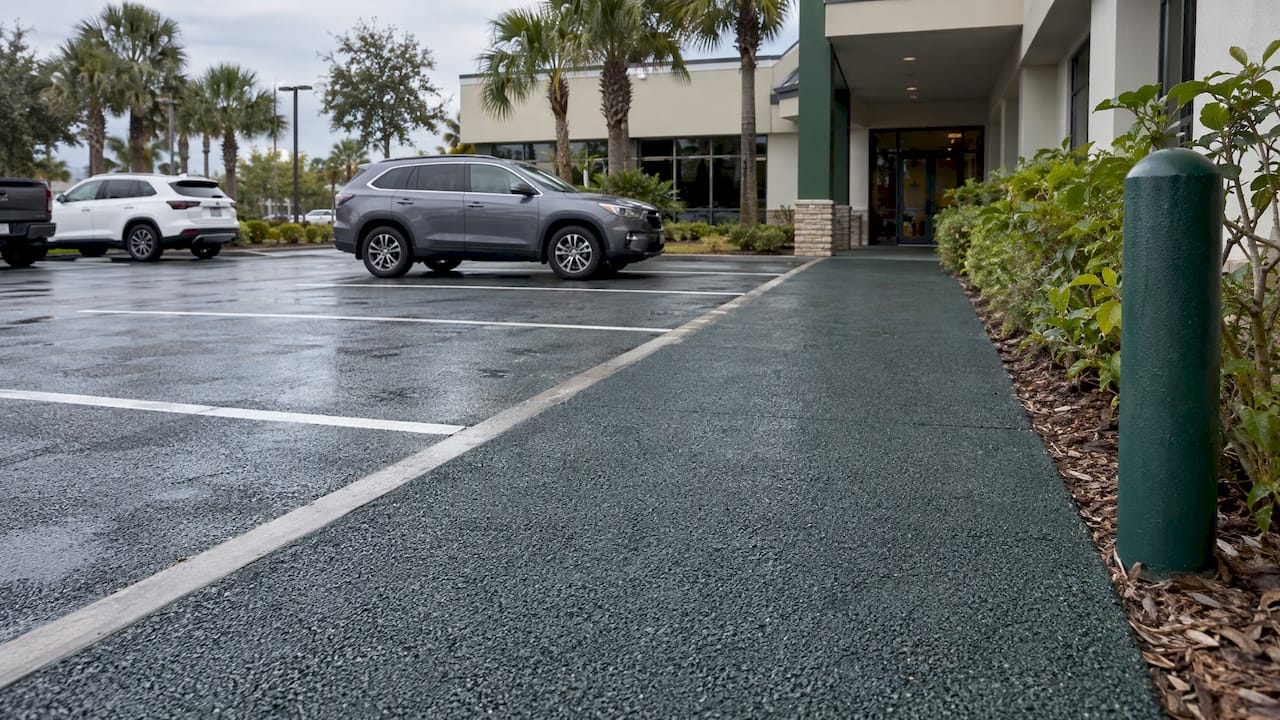
A porous parking lot or walkway is a hard surface that lets rain pass through it into a stone base and then into the ground, instead of sheeting off toward a storm drain. The EPA describes permeable pavement as a green infrastructure alternative that can replace traditional impervious surfaces in parking lots and pedestrian walkways. It works best on low-speed, light-duty areas with soil that drains, and in Florida that describes a lot of properties. Below you will find the materials, the site conditions, the ADA rules, the upkeep and the cost factors.
TL;DR
- Porous paving drains water through the surface and a stone reservoir below, so it can replace conventional pavement in parking stalls, walkways, sidewalks and driveways.
- It fits pedestrian areas and light, low-speed traffic best. Slopes under 5%, permeable soil and a safe distance above groundwater are the main checks.
- Accessible routes need a stable, firm, slip-resistant surface. Parking stalls and access aisles have set widths and a maximum 1:48 slope.
- Regular vacuuming or pressure washing keeps pores open. Plan upkeep before you build.
- Published installed costs range widely, from about $2 per square foot for surfacing alone to $20 and up for a full driveway system, so get a site-specific quote.
Table of Contents
- How a porous surface handles rain
- Materials used for porous parking lots and walkways
- Benefits you can expect from a porous surface
- Where porous paving fits: traffic, slope and soil
- ADA rules for porous walkways and accessible parking
- Parking pads and small-scale options
- Keeping a porous surface draining
- What porous paving costs
- Our Rubberway® systems for walkways and parking areas
- A quick pre-project checklist
- FAQ
- Sources
How a porous surface handles rain
Conventional asphalt and concrete shed water. Porous systems accept it. Stormwater drains through the open surface, is held for a while in the voids of a stone layer, and then seeps slowly into the soil below. The FHWA describes this sequence for porous asphalt over a stone reservoir: runoff passes through the open-graded surface, sits temporarily in the stone voids, then drains into the uncompacted subgrade to restore groundwater supplies.
Portland's permeable pavement guidance puts it simply: a hard surface with enough gaps for rain to run through, collecting in a gravel base before it gradually soaks in. The city lists driveways, parking lots and patios as suitable uses.
For a property owner this means three practical things:
- Less standing water on the surface after a storm.
- Less runoff leaving your site, which can matter for stormwater permits.
- A surface that has to be kept clean, because the pores are the whole point.
Materials used for porous parking lots and walkways
The EPA's fact sheet names three main families. Their thickness and makeup differ, which affects where each belongs.
| Material | What it is | Typical thickness |
|---|---|---|
| Porous asphalt | Open-graded coarse aggregate bonded with bituminous asphalt | 2 to 4 inches |
| Pervious concrete | Cement, open-graded coarse aggregate and water | 4 to 8 inches |
| Permeable interlocking concrete pavers (PICP) | Precast modular units | 3⅛ inches for vehicle areas, 2⅜ inches for pedestrian areas |
These figures come from the EPA's permeable pavement summary. Poured-in-place rubber systems built from recycled tire material are another route to a porous, firm surface, and they are what we install. More on that below.
Surface feel and safety underfoot
Porous asphalt and pervious concrete have slightly rougher surfaces than their traditional counterparts, which the EPA says gives more traction to vehicles and pedestrians. The City of Burlington, Vermont adds that the open surface helps snow and ice melt and drain quickly, reducing re-freezing. In Florida the more relevant point is wet-weather footing: water that drains through the surface is water that is not sitting on the walkway.
Benefits you can expect from a porous surface
The FHWA's tech brief lists a set of documented benefits of porous asphalt:
- Groundwater recharge and stormwater cooling
- Reduced contamination and sediment loading
- Better visibility and less hydroplaning in wet weather
- Noise absorption
- Credits toward green-construction ratings
- Faster snow and ice melt, with a 75% or greater reduction in deicing salts reported by the University of New Hampshire Stormwater Center
The same brief notes that studies have measured high removal rates of suspended solids, metals, oil and grease, and moderate removal of phosphorus.
OSU Extension adds a point that matters for budgets: porous pavement can substitute for conventional pavement without a separate detention basin or rain garden. On a tight commercial or HOA lot, that can free up land that would otherwise go to stormwater features. Your local ordinance still decides what is required, so check it early. Our guide to how stormwater ordinances shape paving choices walks through that step.
Where porous paving fits: traffic, slope and soil
Porous surfaces are specified, not just poured. The agencies that publish design guidance agree on a short list of conditions.
Traffic type
UF/IFAS, the University of Florida's extension service, says permeable materials suit light-duty traffic with infrequent heavy vehicles: residential feeder streets, low-intensity commercial parking lots, pedestrian and bicycle paths, and on-street parking stalls. The FHWA likewise recommends porous asphalt for parking areas and low-volume roadways, with extra uses for walkways, sidewalks, driveways and bike lanes.
That makes walkways, golf cart paths, pool surrounds, employee parking and overflow stalls natural candidates. Loading docks and bus lanes are a different design problem.
UF/IFAS also advises avoiding areas with frequent sharp turning, where permeable materials can shift, crack or spall. In a parking lot, that means putting the porous surface in the stalls and low-speed aisles, and laying out turning zones with care.
Slope
MassDEP's guidance suggests gentle slopes under 5%, and Caltrans treats anything steeper as not feasible for pervious pavement. Most Florida sites are flat, which is an advantage here. Flat ground helps water spread across the reservoir instead of rushing to one corner.
Soil and groundwater
MassDEP's guidance calls for underlying soil permeability of at least 0.17 inches per hour and at least 2 feet between the bottom of the storage layer and seasonal high groundwater. The FHWA's PICP brief gives the same 2-foot separation and also advises checking underground utilities, bedrock and surrounding land use before specifying.
This is where Florida needs local attention. Some regions have a high water table and sandy soils that drain well, others have clay or shallow groundwater. UF/IFAS says a well-designed system should drain completely within 24 to 72 hours. A geotechnical test before design shows whether the native soil and water table suit a full infiltration system or call for an underdrain. Our post on porous sidewalk drainage design and drawdown times covers that in more depth.

Run-on and sediment
The SCCWRP maintenance review calls the ratio of surrounding area draining onto the pavement critically important to clogging, noting Wisconsin allows 5:1. In practice, keep mulch beds, bare soil and sandy shoulders from washing onto the surface. Coastal sites need extra care, which we cover in coastal walkway surfacing and sediment control.
ADA rules for porous walkways and accessible parking
Porous does not mean less accessible. It means the surface must still meet the standard.
The Access Board states that accessible ground surfaces must be stable, firm and slip resistant. The standards set no minimum slip-resistance coefficient, but the surface must prevent or minimize slipperiness under likely conditions. Concrete and asphalt are named as sufficiently firm and stable.
For accessible parking, the 2010 ADA Standards set these basics:
| Element | Requirement |
|---|---|
| Car space width | 96 inches minimum |
| Van space width | 132 inches minimum |
| Access aisle width | 60 inches minimum |
| Surface | Stable, firm, slip resistant |
| Slope in spaces and aisles | Not steeper than 1:48 |
Two design implications follow. First, pick a porous surface that stays firm underfoot for wheelchairs, walkers and strollers, not a loose-fill product. Second, keep stalls and aisles close to level, because the 1:48 limit is tighter than the 5% drainage limit.
If you must document compliance for a board or a municipality, our article on ADA slip resistance requirements and testable specs explains what to ask for. For commercial properties, commercial walkway retrofit rules cover the wider picture.
Parking pads and small-scale options
Not every project is a full lot. For a single parking pad, a garage apron or a workshop, some owners look at parking pad flooring tiles, which are open-grid modular products designed to drain. For stalls, accessible routes and larger areas that need a continuous, firm, ADA-ready surface, a professionally installed porous system is the better fit.
Keeping a porous surface draining
Maintenance is what separates a surface that drains for decades from one that clogs in a few years. The FHWA's 2023 brief says maintenance is a key factor in long-term durability and effectiveness. The good news is that the routine is simple.
- Vacuum or pressure wash on a schedule. The Minnesota Stormwater Manual says all three main types need periodic vacuuming. Caltrans recommends regenerative air vacuum equipment annually and says not to apply seal coats.
- Measure, do not guess. Caltrans points to ASTM C1701 for testing infiltration rate, and says a tested rate of 10 inches per hour signals a near-clogged condition. The SCCWRP review recommends a minimum surface infiltration rate of 100 in/hr for pavements receiving run-on and 10 in/hr for direct rainfall sites.
- Know what restoration can do. The same review found that pressure washing plus vacuuming raised average infiltration by 1,703% for PICP, 169% for pervious concrete and 40% for porous asphalt. Refill paver joint stone afterward.
- Skip sand in winter. MnDOT notes sand cannot be used for winter maintenance on permeable pavements. Florida rarely needs it, but landscape sand and soil tracked onto the surface are the same threat.
A practical routine for a Florida property: sweep or blow debris off after storms and leaf drop, keep irrigation spray and mulch off the surface, and schedule a professional cleaning when water starts to linger. If you manage an HOA or municipal asset, write the cleaning interval into the maintenance budget at the start.
On lifespan, the Minnesota manual gives pervious concrete 20 to 30 years when properly maintained.
What porous paving costs
Published figures vary a lot because they measure different things.
- The Minnesota Stormwater Manual lists surfacing at $2 per square foot for porous asphalt and $3 to $4 for pervious concrete and PICP. That is a 2012 figure for a minimum 30,000-square-foot installation at Minnesota wages, and it excludes the base reservoir, drainage, engineering and inspection.
- The City of Burlington, Vermont says installed costs for porous asphalt and concrete driveways start at $20 per square foot, including the subbase but not demolition of the existing driveway.
The gap shows what drives price: project size, the depth of stone base, soil conditions, demolition, drainage components, engineering and contractor availability. FHWA lists higher initial cost among the trade-offs, offset by the stormwater features you may no longer need to build. Our guide to permeable paving benefits, types and cost goes through the budgeting side. We do not publish a fixed price, because every site's base, drainage and size differ. A site visit is how we quote.
Our perspective on porous paving in Florida
Most of what we hear from HOA boards, park departments and property managers starts with the same problem: water that will not leave. Puddles on walkways, soft edges, heat cracking, and complaints from residents. Porous paving answers that at the surface, where people actually feel it.
We install one thing: rubber paving built on the Rubberway® system, made with recycled tire material. We focus on it because Florida punishes pavement. Heat, heavy storms and standing water are hard on rigid surfaces, and our systems are designed for drainage, crack resistance and ADA-compliant surfaces from the start.
Our advice is to treat the drainage layer as the real product. Test the soil, confirm the water table, keep the slopes gentle and plan upkeep before the first day of work. When those pieces line up, a porous walkway or low-speed lot is a durable, good-looking asset. Municipal and HOA clients also get the documentation boards and engineers ask for.
Roger
Our Rubberway® systems for walkways and parking areas
If you are planning a porous walkway, pool deck, trail, sidewalk or community path in Florida, EcoTec Rubber Paving is licensed and insured and works only on rubber paving. Our line includes Rubberway® Pervious Pavement, Rubberway Rubberrock 6000, Rubberway EVOLUTION and the Rubberway Sidewalk System, in a wide range of colors. You can see the range on our Rubberway product page, or start a project through our rubber paving installation service.
For park and campus work, these guides help you compare surface types: park path surface options, community walkway types and school campus walkway materials. Engineers can also read our stormwater management paving overview.
A quick pre-project checklist
- Define the use. Pedestrian, light vehicle, or occasional heavy vehicle? Heavy repeated loads call for a different design.
- Test the soil. Get infiltration rates and the seasonal high water table.
- Check slope and layout. Keep the surface gentle for drainage and under 1:48 in accessible stalls and aisles.
- Control sediment. Redirect mulch, soil and sand runoff away from the surface.
- Confirm local rules. Stormwater ordinance, ADA documentation and any permitting.
- Write the maintenance plan. Vacuum or wash schedule, who does it and who pays.
FAQ
Can a porous surface be used for a parking lot?
Yes, for the right parking lot. UF/IFAS says permeable materials suit low-intensity commercial parking lots and on-street stalls with infrequent heavy vehicles. Plan the drive aisles, turning areas and delivery routes with the traffic in mind.
Are porous walkways ADA compliant?
They can be. The ADA requires accessible ground surfaces to be stable, firm and slip resistant, and accessible parking stalls and aisles to have slopes no steeper than 1:48. Choose a firm surface and ask your installer for documentation of its properties.
How long does water take to drain through a porous system?
UF/IFAS says a permeable pavement system should drain completely within 24 to 72 hours. Surface infiltration is much faster than that, and the stone reservoir below releases water more slowly into the soil.
How often does porous paving need cleaning?
Caltrans recommends vacuuming the surface annually with regenerative air equipment. Sites with more debris or sediment run-on may need more frequent cleaning, so measure the infiltration rate to decide.
Sources
- EPA: Permeable Pavements stormwater best management practice
- FHWA: Porous Asphalt Pavements with Stone Reservoirs
- Portland.gov: Permeable Pavement
- OSU Extension: Porous Pavement fact sheet
- UF/IFAS: Permeable Pavement Systems, Technical Considerations
- Caltrans: Pervious Pavement Design Guidance
- FHWA: Permeable Interlocking Concrete Pavement
- SCCWRP: Permeable Pavement Maintenance literature review
- FHWA: Use of Permeable Pavements
- Minnesota Stormwater Manual: Types of permeable pavement
- Access Board: Floor and Ground Surfaces
- 2010 ADA Standards for Accessible Design
- Parking pad flooring tiles guide