
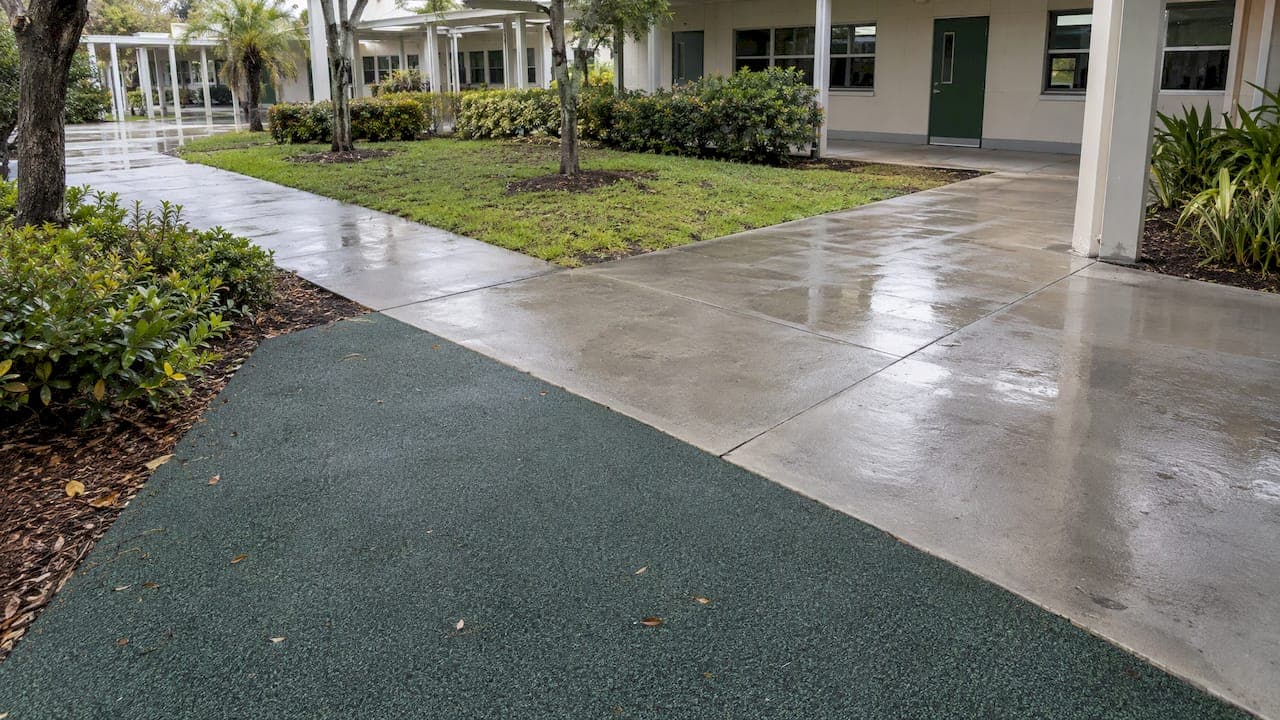
The best school campus walkway material is a firm, stable, slip-resistant surface that drains well and stays smooth under heavy foot traffic. Concrete, asphalt, pavers and poured-in-place porous rubber all can meet that bar. The right one depends on how much water your site sheds, how much movement the ground has, and who will maintain it. The same logic applies to a retail entrance walkway or any commercial entryway: the surface people cross every day should be accessible, grippy when wet and easy to keep up.
TL;DR
- Accessible routes need surfaces that are stable, firm and slip resistant. Hardened materials such as concrete and asphalt meet that test, while loose gravel usually does not without binders, compaction or grid forms.
- Entrances and school routes are wet, high-traffic places. Check slip resistance in wet conditions and keep the cross slope at or below 2%.
- Porous surfaces handle stormwater on site and can lower long-term cost, which matters under Florida rainfall and local stormwater rules.
- Pavers and decorative finishes look good but can make a bumpy route. Use them at edges and keep the walking line smooth.
- Before you sign off, get an independent ADA review of the design and measure the finished slope at several points.
Table of Contents
- What schools and commercial entrances actually need from a walkway
- The accessibility baseline: stable, firm, slip resistant
- How the common materials compare
- Match the material to the place
- Stormwater, climate and Florida conditions
- A selection checklist for owners and facility managers
- Our perspective: why we only do rubber
- Rubber walkways installed by a Florida specialist
- FAQ
- Sources
What schools and commercial entrances actually need from a walkway
A campus path is not a garden path. Hundreds of students cross it in a few minutes, in wet shoes, with backpacks, carts and wheelchairs. ASTM's practice for selecting walkway surfaces tells designers to weigh traffic patterns, climate, contaminants and water exposure, and it names educational institutions among the settings with heavy pedestrian traffic. The same standard stresses evaluating friction in specific conditions, such as wet entryways or areas with grease and soil. The purpose of the practice is to help architects and facility managers reduce slip-and-fall risk at the design stage, when changing a material costs a pencil line, not a jackhammer.
So start with five questions:
- Who walks it? Students, staff, parents, delivery carts, customers with strollers, people using mobility devices.
- What gets onto it? Rain, irrigation overspray, leaves, grease from a cafeteria or a food retailer's entrance, sand tracked in.
- Where does the water go? Standing water is a slip hazard and a cracking and mildew problem.
- What does the ground do? Roots, settling soil and temperature swings move pavement.
- Who maintains it, and how often? A surface that needs resealing every few years needs a budget line and a person.
The accessibility baseline: stable, firm, slip resistant
For public schools, private schools and most commercial properties, accessibility is not optional. The U.S. Access Board's guidance says accessible ground surfaces must be stable, firm and slip resistant. Stable means the surface resists movement. Firm means it resists deformation under applied force, such as a wheelchair wheel or a cane tip.
The same guide notes that hardened materials like concrete, asphalt, tile and wood meet those requirements, while most loose materials such as gravel fail unless they are treated with binders, compaction or grid forms. Even then, loose-fill solutions and some slip-resistant finishes need repeated maintenance or reapplication, so the long-term upkeep is part of the decision.
Two slope numbers belong in every spec. Accessible routes generally allow a running slope up to 5%, and the cross slope of an accessible route may not exceed 2%. That 2% limit is where many otherwise good walkways fail, because pavement that sheds water sideways is also tilting wheelchairs sideways. For the full requirements, read our guide to ADA slip resistance requirements and testable specs.
Texture: grippy, but not bumpy
Slip resistance should not come at the cost of comfort. The FHWA notes that broom finishes are commonly used on concrete sidewalks to give pedestrians enough grip. At the other extreme, Access Board guidance warns that decorative pavers, beveled edges and similar treatments can create a painfully bumpy surface and are best kept at the edges of a route. That is a useful rule for a campus quad or a boutique storefront: put the decoration at the margins, and keep the line people actually walk smooth.
Detectable warnings at street crossings
Where a school path meets a drive lane or a retail entrance meets a parking aisle at a flush curb, detectable warning surfaces give people who are blind or have low vision a continuous detectable edge between the path and the roadway. Plan for them in the drawings, not as an afterthought.

How the common materials compare
Here is a practical comparison of the materials most often considered for campus and entrance walkways. Pavement behavior depends on installation quality, so treat this as a starting point for a conversation with your designer.
| Material | Accessibility | Water handling | Upkeep | Best fit |
|---|---|---|---|---|
| Broom-finished concrete | Meets stable, firm, slip-resistant tests when finished and sloped correctly | Sheds water to the sides unless it is pervious | Joints, sealing and crack repair over time | Main campus spines, standard sidewalks |
| Asphalt | Hardened surface that meets the baseline | Sheds water unless it is porous | Sealing, patching | Long routes, service paths |
| Concrete pavers | Fine when joints are tight and edges are not beveled | Joints can let some water through, depending on design | Joint sand, cleaning, resetting settled units | Plazas, entry courts, decorative zones |
| Stamped concrete | Good if textured for traction | Sheds water | Resealing every 2 to 3 years | Visible entries and courtyards |
| Gravel or stabilized aggregate | Fails unless treated with binders, compaction or grid forms | Drains freely | Repeated topping up and re-compaction | Secondary garden paths, not accessible routes |
| Porous poured-in-place rubber | Firm, resilient surface designed to be ADA compliant | Porous design drains through the surface | Keep pores clear of debris | Campus paths, trails, entries, pool and play-adjacent areas |
Concrete and asphalt: the default, for good reason
Pedestrian accessible routes are typically planar, smooth and built of uniform materials. A state transportation department's accessibility manual lists concrete, bituminous concrete, brick pavers and concrete pavers among them. Concrete is familiar to every contractor and inspector, which keeps bidding simple. The trade-off to plan for is water: a solid slab sends rain to its edges, so the storm drains, swales and detention behind it matter as much as the slab.
Pavers: flexible in cold ground, demanding in detail
In freeze-thaw climates, frost-rated pavers can flex with ground movement without cracking, which is why they are often preferred over monolithic concrete there. The same source finds that over ten years, pavers can become cost-competitive with stamped concrete, because stamped concrete needs resealing every 2 to 3 years. Pavers are also repairable one unit at a time, which suits premium entrances.
Their care needs are real, though: joints need sand, surfaces collect algae in shade, and settled units must be reset. Property managers who own paver entries often rely on professional paver cleaning and restoration to keep joints filled and surfaces clean, especially where seasonal ground movement shifts the base. In Florida, where freeze-thaw is not the issue, heat, heavy rain and root pressure are what you plan around.

Gravel: a garden material
Search results for walkway materials are full of gravel and natural stone ideas, and those are lovely for gardens. For a school route or a commercial entry, loose aggregate does not meet the stable-and-firm test on its own. Treat it as a landscape accent beside the accessible route, never as the route.
Porous rubber: where drainage, cracking and comfort meet
Porous rubber paving is a poured-in-place surface made from recycled tire material. We install it in Florida using the Rubberway® system. The design lets water pass through the surface, resists cracking from heat and weather, and gives a firm but forgiving walking surface in a wide range of colors. Because the pavement itself is pervious, it reduces the standing water that makes entrances slippery and that stormwater inspectors flag.
The evidence for pervious surfaces in general is solid. Rutgers' green building manual explains that pervious hardscape lets water permeate the surface, manage stormwater on site and reduce runoff. It also notes that although porous materials may cost more up front, their longer lifespan and built-in stormwater management can reduce long-term costs. That reasoning is the same one we use with school districts and property owners: compare lifecycle cost, not just the first invoice.
Match the material to the place
School campus walkways
A campus usually mixes several path types. Main spines between buildings carry the most traffic and need the highest durability. Courtyard and bus-loop edges need excellent wet traction. Paths under mature oaks fight root lift. Paths near playgrounds and fields benefit from a comfortable surface.
A sensible approach is to define the accessible route first, then choose the surface by zone. Where drainage is a problem or the district must meet stormwater requirements, a porous option deserves a place in the bid. For planners, our guide to slip-resistant community walkway types walks through the choices, and the piece on park path surface options covers a similar use case.
Retail entrance walkways
The entrance is where rain, tracked-in sand and floor transitions come together, and it is where customers are most likely to slip. ASTM's guidance on wet entryways applies directly: test and select the surface for the wet case, not the showroom case. A retail entrance should also be easy to wash and quick to dry. Porous surfaces help with the second part, because water does not sit on them.
If your entrance is being upgraded to fix accessibility problems, read the commercial walkway retrofit guide, which covers ADA rules and fall protection.
Commercial entryways and shared areas
Office parks, medical buildings, HOA clubhouses and municipal buildings all share a pattern: frequent foot traffic, visitors with varied abilities and a documentation trail. Specify the surface with the paperwork in mind. We provide government-ready documentation, which helps public owners and boards move through approvals.
Stormwater, climate and Florida conditions
Florida pavement lives with intense summer rain, heat, high water tables and, near the coast, sand and salt. Standing water on a walkway means slip risk, mosquito habitat and accelerated wear. Local ordinances increasingly push projects to manage runoff on site, and the way those rules shape surface choice is covered in our article on how stormwater ordinances shape paving choices. Engineers will want the stormwater management paving solutions and porous sidewalk drainage design pieces. HOA boards dealing with community stormwater rules can start with the permeable paving board guide.
For sites near the water, sediment is the main maintenance concern for any porous surface, and coastal walkway surfacing explains how to keep pores clear. If a project is pursuing green building credit, the LEED-friendly paving material overview is the place to begin.
A selection checklist for owners and facility managers
- Map the accessible route from the parking, drop-off and bus areas to every entrance.
- Set the slope targets: running slope no more than 5% on the route, cross slope no more than 2%.
- Define the wet condition. Ask the supplier how the surface performs when wet, and request test documentation. ASTM F3132 is the practice designers use for this selection.
- Decide on drainage first. Pick between sending water to inlets or letting the surface pass it through.
- Put decoration at the edges. Keep the main walking line smooth and uniform.
- Get an independent ADA review of the design before bidding.
- Measure before final payment. Use a digital level to check cross slope at multiple points and have any section above 2% corrected before you release the last payment.
- Write down the maintenance plan: who sweeps, who cleans, how often, and what to do after storms.
Roger
Our perspective: why we only do rubber
Most walkway problems we are called to look at are not material failures in the abstract. They are water problems. Water that sits at an entrance, water that undermines an edge, water that freezes in a cold climate or bakes in a hot one and pushes a slab until it cracks. Florida adds heat and heavy rain to that list.
That is why we focus exclusively on rubber paving and the Rubberway® system. A porous, recycled-tire surface lets water drain through the walkway instead of sitting on it. It is designed to resist heat-induced cracking, it has a firm, resilient feel underfoot, and it comes in custom colors, so a school or a storefront does not have to look like a parking lot.
For school districts and municipalities, we pair installation with the documentation reviewers expect. For homeowners, HOAs and business owners, we treat the walkway as a drainage and safety decision first and a design decision second. If your campus or entrance has a puddle problem, a cracking problem or an accessibility upgrade ahead of it, we think porous rubber deserves a serious look.
Roger
Rubber walkways installed by a Florida specialist
EcoTec Rubber Paving is licensed and insured and works only on rubber paving. We install the Rubberway® system for campus paths, commercial walkways, municipal parks, trails, sidewalks, pool decks and HOA common areas across Florida. Our product line includes Rubberway® Pervious Pavement, Rubberway Rubberrock 6000, Rubberway EVOLUTION and the Rubberway Sidewalk System.
If you are scoping a school walkway or an entrance, see our rubber paving installation services or browse the Rubberway product line. Send us your site details and drainage concerns, and we will talk through whether porous rubber fits.
FAQ
What is the best material for a school campus walkway?
The best material is one that is stable, firm and slip resistant, and that drains well. Concrete and asphalt are the usual hardened choices. Porous rubber is a strong option where standing water, cracking or stormwater rules are concerns. Loose gravel does not meet accessibility requirements on its own.
What walkway surface works best for a retail entrance?
Choose a surface that holds its grip when wet and clears water quickly. Concrete with a broom finish, a textured hardened surface or a porous surface can all work. Test for the wet case, since ASTM guidance singles out wet entryways, and keep decorative elements at the edges.
What slope does an accessible walkway need?
An accessible route generally allows a running slope of up to 5% and a cross slope of no more than 2%. Measure the cross slope at multiple points with a digital level before final payment, and correct sections that exceed it.
Can gravel be used for an ADA walkway?
Most loose materials, gravel included, do not meet stability and firmness requirements unless treated with binders, compaction or grid forms. Even treated surfaces need repeated maintenance, so most owners use hardened surfaces for the accessible route.
Are porous walkways better for the environment?
Pervious hardscape allows water to soak through, manages stormwater on site and reduces runoff. Rubberway® systems also use recycled tire materials, which reduces waste.
Sources
- ASTM F3132-20 standard practice for selection of walkway surfaces
- ASTM F3132-20 walkway surface selection summary
- U.S. Access Board: Floor and Ground Surfaces
- ADA.gov: Curb ramps accessibility survey instructions
- FHWA: Sidewalk Design Guidelines
- U.S. Access Board: Model Sidewalks
- NYC Street Design Manual: Sidewalks
- DelDOT: Facilities in the Public Right of Way
- Rutgers NJ Green Building Manual: Pervious Hardscape Materials
- Paving and Hardscape Cost guide