
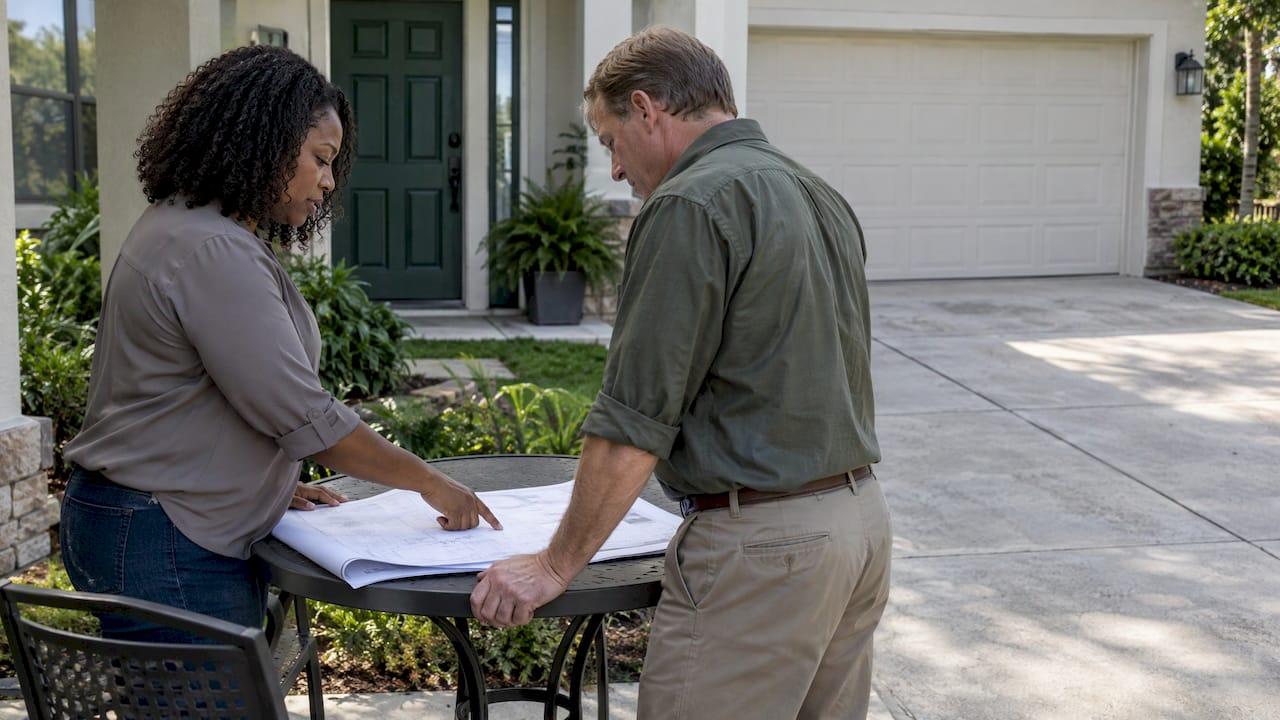
If you live in a Florida HOA, you should assume that widening, replacing, resurfacing or changing the material or color of a driveway needs written approval from the architectural review committee (ARC) before work starts. The city or county may also want a permit. The way to get a yes is a complete application, a written decision and a contractor who can supply the paperwork your community asks for. We install Rubberway® porous rubber paving across Florida, so this guide also covers what changes when the surface is permeable.
TL;DR
- Most HOAs require architectural approval for driveway changes, including widening, new materials and color. Check your declaration and design guidelines first.
- A complete application usually includes a survey, plans, material and color details, and often the contractor's license and insurance. Review times are set by your community's documents, and 45 days is common.
- Only a written approval protects you. A verbal "go ahead" binds neither you nor the association.
- HOA approval and a city or county permit are separate. Since July 1, 2026, Florida law bars an HOA from requiring a building permit before it reviews your request.
- If you are denied, the denial must be written and specific, and that tells you what to fix.
Table of Contents
- When you need HOA approval for a driveway
- What to put in the application
- Get the decision in writing
- HOA approval and city permits are different
- Permeable driveways: what the codes say
- A step-by-step path to approval
- If the HOA denies or conditions your request
- Our perspective
- Rubberway paving for your application
- FAQ
- Sources
When you need HOA approval for a driveway
The safe rule is simple: if the driveway will look different from above or from the street, ask first. That covers widening, replacing, changing the material, changing the color, and even sealing or painting. Most Florida associations treat all of these as architectural changes.
The authority comes from your declaration of covenants and the design guidelines the board has adopted. Under Florida law, review authority must be stated or reasonably inferred in the declaration or authorized published guidelines, and decisions must follow written standards that are applied reasonably and evenly. So before you spend money on a design, read two documents: the recorded declaration and the current architectural guidelines. Your management company or board can supply both.
Guidelines differ a lot from one community to the next. Here are two published examples:
- Estuary Riverview's community standards, dated 2025, allow concrete or interlocking stone or brick pavers that complement the home's color scheme. They prohibit asphalt, loose gravel and stabilized rock or sand base driveways. They also cap adjacent walking-area extensions at 4 feet total, 2 feet per side, and never beyond the outside lines of the garage.
- Babcock Ranch's driveway guidelines say a driveway can only extend to the exterior walls of the garage, require a paver sample that matches existing pavers, and do not allow changes to driveway aprons. Residents of a sub-association must get that body's approval before applying to the master HOA.
Three things follow from these examples. Width limits are common. Material lists are common. Your community may have a second layer of approval above or below the one you expect.
If your material is not on the list
Many guidelines name the materials they expect, usually concrete and pavers, and say little about anything else. A material that is not named is not automatically refused. It is a request the committee has to evaluate against the standards it has adopted, so it helps to give the committee more to work with: a physical sample, the color, the thickness, the drainage performance and the installer's credentials. A porous rubber surface is a good example. It can be specified in a wide range of colors to complement the home, and we can supply documentation for the specific Rubberway system proposed. Ask the board whether the guidelines address the material, and if they do not, submit the request with a sample and the specification sheet.
What to put in the application
Applications that arrive complete get decided. Applications that arrive missing a survey get rejected, and the clock may not start. Estuary River View's standards, for example, require a completed alteration application with the original stamped lot survey and plans that show the nature, kind, shape, height, materials and color. They give the committee up to 45 days from receipt of a properly completed application, after which the request is deemed disapproved. That outcome is specific to that community's rules. Do not assume your HOA uses the same one.
Silver Palms' architectural modification form shows a typical attachment list: a property survey, plans or specifications, a drainage and surface-water plan, samples or pictures, and the contractor's license and insurance. It says the form takes about 45 days to process and that the answer is delivered in writing.
A solid driveway package usually has these parts:
- Survey. The stamped lot survey, marked up to show the existing driveway and the proposed one.
- Site plan with dimensions. Length, width, where it meets the garage and the street, and the apron if it is touched.
- Material and color. The product name, a physical sample or photos, and the exact color. Match to existing pavers if the community asks for it.
- Drainage. Where water goes after the change. Associations increasingly ask for a surface-water plan, and a porous surface is easiest to explain when the plan shows how it drains.
- Landscape and irrigation changes. Babcock Ranch asks owners to disclose these. Removing a tree or moving a sprinkler head can trigger a second review.
- Contractor credentials. License and insurance certificates. Ours are current, since we are licensed and insured.
- Timeline. Start and finish dates, and where equipment will stage.
Put every attachment the form lists in the same submission. Keep a dated copy of everything you send and a record of how you delivered it.
Get the decision in writing
This is where homeowners most often lose money. Only written approvals and denials have legal force, and a verbal approval binds neither the association nor the owner. A good written ARC decision includes the dates, the decision, the reasons tied to specific standards, any conditions and the appeal procedure.
Committees typically answer in one of four ways. The Estuary standards list approved, approved with conditions, disapproved, and rejected for an incomplete application. If you get conditions, read them like contract terms. A condition such as "match the existing paver color" or "keep within the garage width" is something your installer must build to, so send the letter to your contractor before the work is scheduled.
Do not start work on an email that says "looks fine." Ask for the letter.
HOA approval and city permits are different
HOA approval is a private, contractual process under your covenants. A permit is a government process. You may need both, and one does not replace the other.
Local rules vary, and the research shows how much:
- Orange County requires a permit any time you pour concrete or place pavers for a driveway, walkway or pad. Pavers need a zoning permit only, and at least a final inspection must pass to confirm compliance with the Florida Building Code.
- Boynton Beach asks for written HOA approval with the city's driveway permit application if the home is in an HOA. Additions of 800 square feet or more of impervious surface need professional drainage calculations by an engineer, and corner-lot driveways must sit at least 30 feet from the intersection.
- Tampa's 2026 residential driveway guide covers material changes such as concrete to paver. It asks for a site plan with property lines, existing and proposed elevations, driveway and right-of-way dimensions, and trees within 20 feet of the work, with a signed and sealed survey.
- Lake County's driveway apron permit, effective February 2026, costs $50 and applies to work in the county road right-of-way. Pavers may only go within property lines, never in the right-of-way, and the permit expires one year after approval.
- Doral requires a building permit to replace or extend a residential driveway, with an HOA approval letter if applicable.
If the driveway connects to a state road, the state has a say as well. Connections to the State Highway System fall under the FDOT access management rules in Chapter 14-96 of the Florida Administrative Code, so contact your FDOT district before building or changing a driveway on one.
Finally, call 811 at least two full business days before anyone digs. Your installer should do this, but confirm it.
The July 2026 change in sequencing
Florida changed the order of operations this year. Effective July 1, 2026, HB 803 (Chapter 2026-63) bars an association from requiring a building permit as a prerequisite for ARC review. The committee can still condition its approval on your later obtaining a required permit. A mandatory permit-number field on an application form is a prohibited prerequisite, according to a law firm's summary of the changes. It does not oblige the HOA to approve unpermitted work.
In practice that means you can apply to the HOA first and permit second, as long as you accept that approval may come with a condition. Some cities, such as Boynton Beach and Doral, ask for the HOA letter as part of their own application, so in those places the HOA decision naturally comes first.
Permeable driveways: what the codes say
Permeable surfaces sit at the intersection of two rule sets: the HOA's appearance standards and the local government's drainage and stormwater rules.
On the government side, some codes push toward permeable surfaces. Doral requires additional parking spaces to use permeable paving, including open-cell pavers, gravel grids, porous concrete, permeable pavers or permeable asphalt, plus a native hedge at least 36 inches high along the outer border (Doral's driveway regulations).
Other codes focus on what happens to the water. Martin County's driveway checklist asks for lot coverage calculations and a site plan showing drainage. That includes a culvert of at least 15 inches, a maximum 10% grade change on local streets, a minimum 0.2-foot fall 7 feet from the pavement edge where no swale exists, and stormwater best management practices. Owner-builders must also file a disclosure statement under Florida Statutes 489.503(6).

A surface that lets water pass through it gives you a straightforward story to tell on both fronts. It helps with standing water, which is a common outdoor problem in Florida, and it helps a drainage plan show how rain is handled on the lot. If your plan needs grading or drainage calculations, commercial site grading basics explain the terms the plan reviewers use. For how local stormwater ordinances shape material choices, see our guide to stormwater ordinances and paving. For sizing the base under a driveway, see our flood-resistant driveway guide.
A step-by-step path to approval
- Find out who maintains the road. Private, county, city or state roads send you to different offices.
- Pull your survey. It locates the property line and any right-of-way, and the HOA will want it anyway.
- Read the declaration and guidelines. Note the allowed materials, width limits, color rules, review period and who must approve first.
- Choose your installer and collect their paperwork. Licensing, insurance and product documentation go in the application. Our HOA paving vendor checklist lists what boards usually look for.
- Submit the complete package to the ARC. Keep proof of delivery and the date.
- Wait for the written decision. Florida sets no statutory deadline for HOA architectural decisions according to HOA Weekly's summary, so any 30-, 45- or 60-day deadline comes from your own declaration or guidelines.
- Apply for the city or county permit if one applies, and ask about culvert size and any right-of-way apron permit.
- Schedule inspections and keep the final approval letter and inspection record with your property file.
Boards and managers who want a compliance overview can read our Florida HOA outdoor compliance tips. For how the material itself holds up under Florida heat and rain, see our guide to driveway materials that last.
If the HOA denies or conditions your request
A denial is not the end. Since July 1, 2024, a denial must be in writing and state both the rule or covenant relied on and the specific aspect of the proposal that does not conform. A vague refusal that cites only "community standards" gives you grounds to ask for a proper written explanation.
The usual path, from a law firm's guidance on denied ARC requests:
- Read the written response and your governing documents side by side.
- Identify exactly what was unacceptable.
- Adjust the plans to comply, and appeal to the board under your community's process.
- Where the rule is vague or your lot is unusual, ask for a variance.
Take your time on the revisions. Even small fixes can collide with other architectural rules, so check the documents again before you resubmit. If the dispute becomes a covenant-enforcement matter, or you think the committee acted unreasonably, talk to a Florida attorney who handles community association law before you spend more on plans. That is the professional who can tell you what your declaration allows.
Our perspective
Most driveway approvals we see on the page come down to paperwork that a committee can say yes to: dimensions it can measure, a sample it can hold, a drainage story it can follow and an installer it can verify.
That is why we work only on rubber paving. Rubberway® surfaces are built from recycled tire material, are porous so water drains through, resist cracking from Florida heat and come in a wide range of colors. Those are the points a review committee and a permit office care about: how the surface looks, where the water goes and whether it will still look right in a few years.
We are licensed and insured, and we provide government-ready documentation, so the contractor section of your application is not the part that slows you down. Get the community's rules first, get the decision in writing, and bring us in early so the plan, sample and specification match what the committee asked to see.
Roger
Rubberway paving for your application
If you are planning a driveway, pool deck, walkway or community path in Florida, we install the Rubberway® range: Pervious Pavement, Rubberrock 6000, EVOLUTION and the Sidewalk System. Each is a porous, crack-resistant, ADA-compliant surface made with recycled materials, in custom colors. HOA boards, municipalities and homeowners can send us the plan and the community's guidelines, and we will tell you what to include with the submission. See professional rubber paving installation to start.
For pool areas and shared spaces, what HOA boards must approve in a pool deck resurfacing contract is a useful companion. For accessibility requirements on community paths, see our ADA paving guide.
FAQ
Does every driveway change need HOA approval in Florida?
In most communities, yes. Widening, replacing, changing the material or color, and even sealing or painting are usually treated as architectural changes. The exact rule is in your declaration and design guidelines, so check those before you hire anyone.
How long does an HOA have to decide?
Florida sets no statutory deadline for HOA architectural decisions. The deadline is whatever your declaration or guidelines say, and 45 days is a common figure in published community forms. Some communities treat silence as a denial, so read yours.
Do I need a city permit as well as HOA approval?
Often you do, and the two are separate. Orange County requires a permit for poured concrete or pavers, and Tampa, Lake County and Doral have their own driveway rules. Check with your city or county building department.
Can the HOA require a building permit before it reviews my request?
Not anymore. Since July 1, 2026, Florida law bars an HOA from making a building permit a prerequisite for architectural review. The HOA can still make its approval conditional on your obtaining the permit later.
What if the HOA says no?
Ask for or review the written denial, which must cite the rule and the part of your proposal that does not conform. Then adjust the plan and appeal to the board, or request a variance if the rule is vague or your lot is unusual. A Florida community association attorney can advise if the dispute escalates.
Sources
- Florida Driveway Permits: Right-of-Way, Culverts, Pavers
- Estuary Riverview Community Standards (2025)
- Babcock Ranch Driveway Guidelines
- Silver Palms Application for Architectural Modification
- Architectural review committee best practices
- Orange County: Do I Need a Permit
- Boynton Beach Permitting Resources
- Tampa Residential Driveway Permit Application Guide
- Lake County Residential Driveway Apron Permit Application
- City of Doral Driveway Regulations
- Martin County Driveway Checklist
- The HOA Architectural Control Statute Has Again Been Amended
- Architectural Review Law Changes by Session
- Florida HOA Architectural Review
- ARC Request Denied: What Steps Can Homeowners Take
- What Commercial Site Grading Means for Owners