
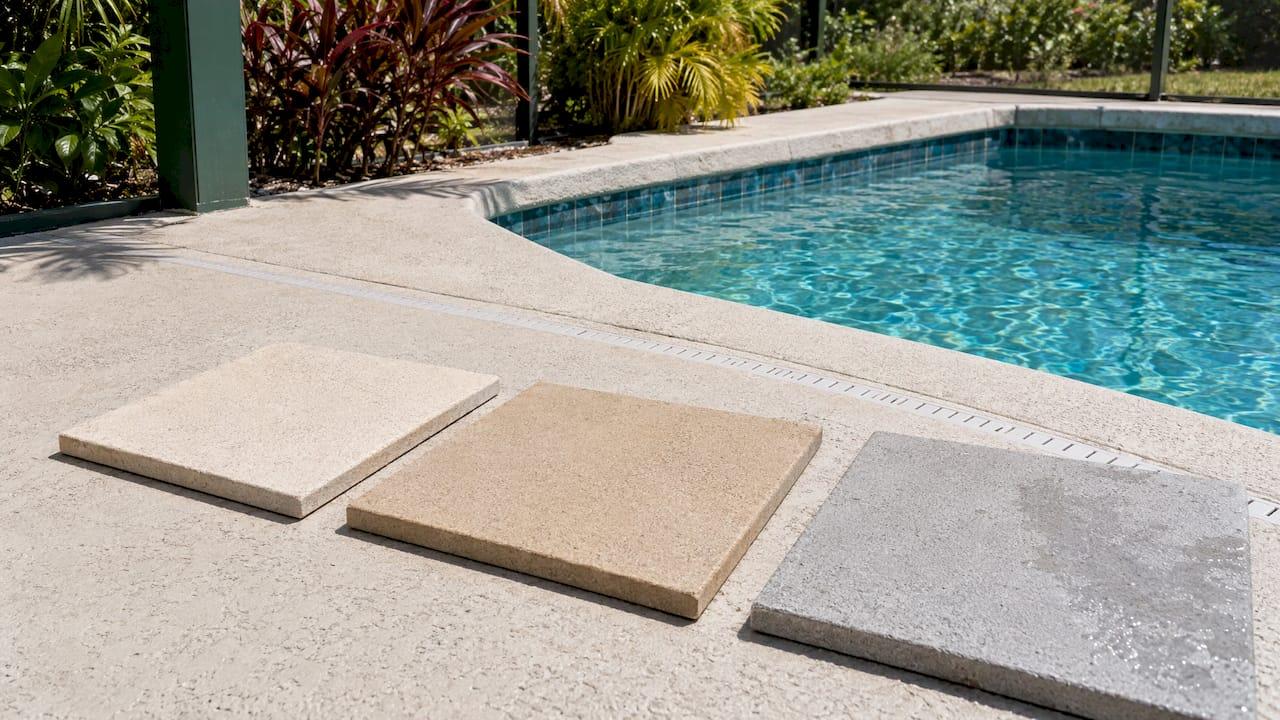
The best pool deck colors for Florida are light to mid-tone neutrals: sand, cream, pale tan, warm gray and soft terracotta. They give the most comfort under bare feet and pair with almost any pool finish and house color. The color is only half the decision. The same shade can feel very different depending on the material under it, so pick the surface first and the color second. Our Rubberway® rubber paving comes in a wide range of colors, including custom colors, and is installed on pool decks and patios across Florida.
TL;DR
- Start with off-white, cream, sand, pale tan or light gray if heat is your main worry, then judge the exact sample in full afternoon sun.
- Very light colors can add glare and show leaf stains, rust and dirt faster, so a warm mid-tone is often the better everyday choice.
- Match the deck to the house and the pool finish: the deck should sit between them in tone, not fight either one.
- Ask any manufacturer for fade data on the exact color you choose, because Florida UV is hard on pigment.
- Texture and traction matter as much as shade on a wet deck, so choose them together.
Table of Contents
- What the color does to comfort in Florida sun
- The pool deck colors that work best in Florida
- How to coordinate deck, pool, house and landscaping
- Match the color to the material
- Fading, staining and upkeep
- Do not choose color without checking traction
- Quick picks by property type
- Our perspective
- Ask us about rubber paving for your pool deck
- FAQ
- Sources
What the color does to comfort in Florida sun
Color changes how much sunlight a surface soaks up. Darker surfaces absorb more solar energy and lighter ones reflect more, which is why a charcoal deck feels punishing at 2 p.m. in July and a sand-colored one feels kinder. The Surface Blueprint guide on pool deck colors and heat (August 2026) suggests starting with off-white, cream, sand, pale tan or light gray when heat is a major concern. It then recommends checking whether the manufacturer publishes solar or temperature data for the exact color, or offers infrared-reflective pigments.
That last point is easy to miss. Two products sold as "light tan" can behave differently, because pigment chemistry and the material itself both change the result. A color chip tells you how a deck looks. It does not tell you how hot it gets.
The same logic applies elsewhere on a Florida property. If you want to see how light and dark choices play out on another large sun-facing surface, this look at dark versus light shingles in South Florida shows the same principle at work on a roof.
Test samples where the deck will actually sit
Bring samples outside and set them in full sun at the time of day your deck is normally hottest. Look at them wet and dry. Stand on them barefoot if the manufacturer will let you take a larger piece. A sample that looks perfect in a showroom can look flat under noon sun or glaring at 4 p.m. when the light comes in low across the water.
If the heat question is your top priority, our guide to which pool deck surface stays coolest underfoot and the piece on what actually matters for barefoot comfort go deeper on the material side.
The pool deck colors that work best in Florida
Florida properties tend to settle into a handful of color families. Here is how each one behaves in real use.
| Color family | Looks like | Strengths | Watch for |
|---|---|---|---|
| Cream and ivory | Soft off-white, a hint of warmth | Reads bright and clean, pairs with every pool finish | Shows tannin stains, rust and dirt more readily |
| Sand and pale tan | Beach and limestone tones | Forgiving, hides dust, suits coastal and Mediterranean homes | Can look washed out beside very pale stucco |
| Warm gray | Light to medium gray with a beige undertone | Modern look, balances blue water | Cool grays can look cold against warm landscaping |
| Terracotta and clay | Muted orange-brown | Classic Florida look, hides leaf debris | Deeper shades absorb more heat |
| Brown and bronze | Mid to dark earth tones | Rich contrast, hides stains well | Warmest underfoot, so keep them for shaded decks |
| Soft blue-gray or sage | Cool, muted tones | Fresh, ties into landscaping | Check the exact sample against your pool finish |
No single row is right for everyone. A screened lanai that shades the deck most of the day can carry a deeper tone comfortably. An open, west-facing deck is where the lightest families earn their place. If your pool sits inside a screened enclosure, see our notes on pool cage deck surface options for Florida lanais.
Light versus dark: the honest tradeoff
Light is not automatically better. Surface Blueprint notes that the lightest possible shade can bring glare, show leaf tannins, rust and dirt more readily, and call for more frequent cosmetic cleaning. Glare matters if you spend afternoons by the water in sunglasses and still squint. A warm sand or pale tan often lands in the middle: cooler than a dark brown, softer on the eyes than white, and easier to live with.
For a closer look at reflectance without the harshness, see our guide to non-glare surfaces, colors, textures and finishes. It was written for driveways, but the glare logic is the same for a pool deck.
How to coordinate deck, pool, house and landscaping
The easiest way to get a deck color wrong is to choose it alone. Start with what you cannot change, then work toward the deck.
- Fix the house color. Stucco, trim and roof set the temperature of the whole property. A warm cream house wants a warm deck. A cool gray house can take a gray or soft blue-gray deck.
- Look at the pool finish. The water color changes with the interior finish and the light. A deck in the same tonal range as the coping and the house frames the water instead of competing with it.
- Choose the deck as the bridge. It should sit between the house and the water in value: lighter than the darkest landscaping, darker than the brightest wall.
- Check the furniture and plants. White or natural furniture, green palms and bright flowers all read better against a neutral, mid-tone ground than a saturated one.
- Test in place. Set samples next to the actual coping, the door threshold and a piece of your outdoor furniture.
Homeowners document their projects widely. One South Florida home project, for example, paired limestone-look pavers with a blue pool finish and warm house paint. The takeaway is the structure rather than the exact shades: a quiet, stone-like deck, a clear blue pool and a warm house color that ties them together.
Should the deck be lighter or darker than the house?
In most Florida homes, slightly lighter than the main wall color keeps the deck from feeling heavy and helps with heat. Slightly darker works when you want the deck to anchor a pale house or hide pollen and debris. Matching exactly rarely looks good, because the textures and sunlight differ. Aim for the same family with a clear step in value.
Match the color to the material
The same color name behaves differently on different surfaces, so decide on the material first.
- Poured concrete with coatings or stains: Offers a broad palette, but coatings fade and wear unevenly, and surface cracks show through. Expect to refresh the finish over time.
- Pavers: Come in factory-made color, which is more consistent than a coating. Joints collect dirt and need care.
- Natural stone and travertine: Beautiful, but color varies from piece to piece, and what you see in the sample is a single slab.
- Tile and porcelain: Wide choice of tones, but grout lines need upkeep and wet traction needs checking.
- Rubber paving: A seamless, poured surface made with recycled tire material. Color is mixed into the surface, and a wide range is available, including custom colors.
With rubber paving, the pigment runs through the surface rather than sitting on top as a coat of paint. That is the reason fade data matters so much when you choose a color, and why we wrote a guide on asking for fade data before you pick a rubber paving color. Our article on light colored rubber paving covers shades, heat, fading and fit in more detail.
Fading, staining and upkeep
Florida sun is relentless, and every exterior color fades eventually. The question is how slowly and how evenly. Before you sign off on a shade, ask these things about the exact color:
- Is there published fade or UV data for this pigment?
- Is the color integral to the material or applied as a surface coat?
- Does it come in an infrared-reflective option, and is there solar or temperature data to match?
- How does it look wet, and how does it look after a season of leaves, sunscreen and pool chemicals?
Light surfaces show organic stains sooner, and mid-tones hide them. If cleaning is part of your plan, a regular rinse is usually enough on a sealed or seamless surface. Concrete, stone and paver decks often need cleaning and sealing, and this overview of concrete, stone and paver sealing in Miami gives a sense of what that upkeep involves.
Saltwater pools add another variable, because salt can affect finishes and surfaces differently. If you have one, read our guide to saltwater pool deck materials that last and stay cool.
Do not choose color without checking traction
A deck that looks perfect but turns slick when wet is a bad deck. Traction depends on the surface texture, not the color, but the two decisions are linked: a smooth, glossy finish in any color can feel treacherous around a pool, and a textured surface can look different from the flat sample you approved.
The standard pool and building professionals use is ANSI A326.3, a test method that measures the wet dynamic coefficient of friction (DCOF), a number for how slippery a hard surface is when wet. Ask for the wet DCOF result for the exact product and finish. Our piece on pool deck surfaces that pass ANSI A326.3 wet DCOF tests explains how to read it. If the deck serves a community pool, HOA boards and municipal staff should also check that the surrounding paths and entries meet accessibility requirements.

Quick picks by property type
Single-family home with an open, sunny deck. Choose a sand, cream or pale tan. Test it at the hottest hour of the day. Keep furniture and plantings in warmer tones to avoid a washed-out look.
Home with a screened lanai. You have more freedom. A warm mid-tone or terracotta can look rich and stay comfortable because of the shade.
HOA or community pool. Pick a durable, neutral tone that hides debris and will look consistent across seasons. Documentation on color, traction and drainage helps when the board has to justify the choice to members.
Municipal park or splash area. Combine a light-to-mid neutral with a slip-resistant texture, and plan for accessible routes around the water.
Golf club or resort pool. Pick a color that photographs well, complements the clubhouse and handles heavy foot traffic and sun without visible wear.
Our perspective
Most color decisions go wrong because the choice is made in a showroom and lived with in July. We start from the other end: where does the sun hit, how much of the day is the deck in shade, and what do you want under your feet at 3 p.m.?
That is why we work only with rubber paving. Rubberway® is made with recycled tire material, drains through its porous design and is made to resist cracking in Florida heat, and the color range is wide enough that most homes find a match, with custom colors available when they do not. A deck that drains well also dries faster after a storm, which keeps standing water from sitting on whatever color you chose.
Our advice is simple. Choose a light-to-mid warm neutral, look at the real sample in the real sun, and make color and texture one decision. We are licensed and insured, and we prepare documentation that boards and municipalities can use.
Roger
Ask us about rubber paving for your pool deck
If you are planning a pool deck, patio or community pool area in Florida, we install the Rubberway® system on pool decks, patios, driveways, walkways and community areas. It combines recycled tire material, a porous design for drainage, crack resistance and ADA-compliant surfaces, in a wide range of colors. Tell us about your deck, and we can talk through color and texture options for your site. You can see the full line on our Rubberway products page or learn more about our professional rubber paving installation.
FAQ
What color is best for a pool deck in Florida?
For comfort in strong sun, off-white, cream, sand, pale tan and light gray are the usual starting points. Very light shades can add glare and show stains, so many homeowners choose a warm light-to-mid tone. Whatever you choose, check the sample in full sun at the hottest time of day.
Should my pool deck be lighter or darker than my house?
A deck slightly lighter than the house walls keeps the area feeling open and helps with heat. Slightly darker can anchor a pale house and hide debris. Aim for the same color family with a visible step in tone, rather than an exact match.
Do darker pool deck colors get hotter in Florida?
Yes. Darker surfaces absorb more solar energy than lighter ones, so they usually feel warmer underfoot. Shade, material and pigment type also change the result, which is why checking published temperature or solar data for the exact color is worth the effort.
Does a pool deck color fade in the Florida sun?
All exterior colors fade over time under strong UV. How fast depends on the pigment and whether the color is mixed through the material or applied as a coating. Ask for fade data on the specific shade you are considering.
How do I choose a color that works with my pool and landscaping?
Start with the house color, look at your pool finish, then choose a deck tone that sits between them in value. Test samples next to the coping, furniture and plants before you commit.
Sources
- Pool Deck Colors and Heat: Which Colors Stay Cooler? (Surface Blueprint)
- Florida pool details project (Life On Virginia Street)
- Dark vs Light Shingles: What Changes in South Florida
- Concrete, Stone & Paver Sealing Miami