
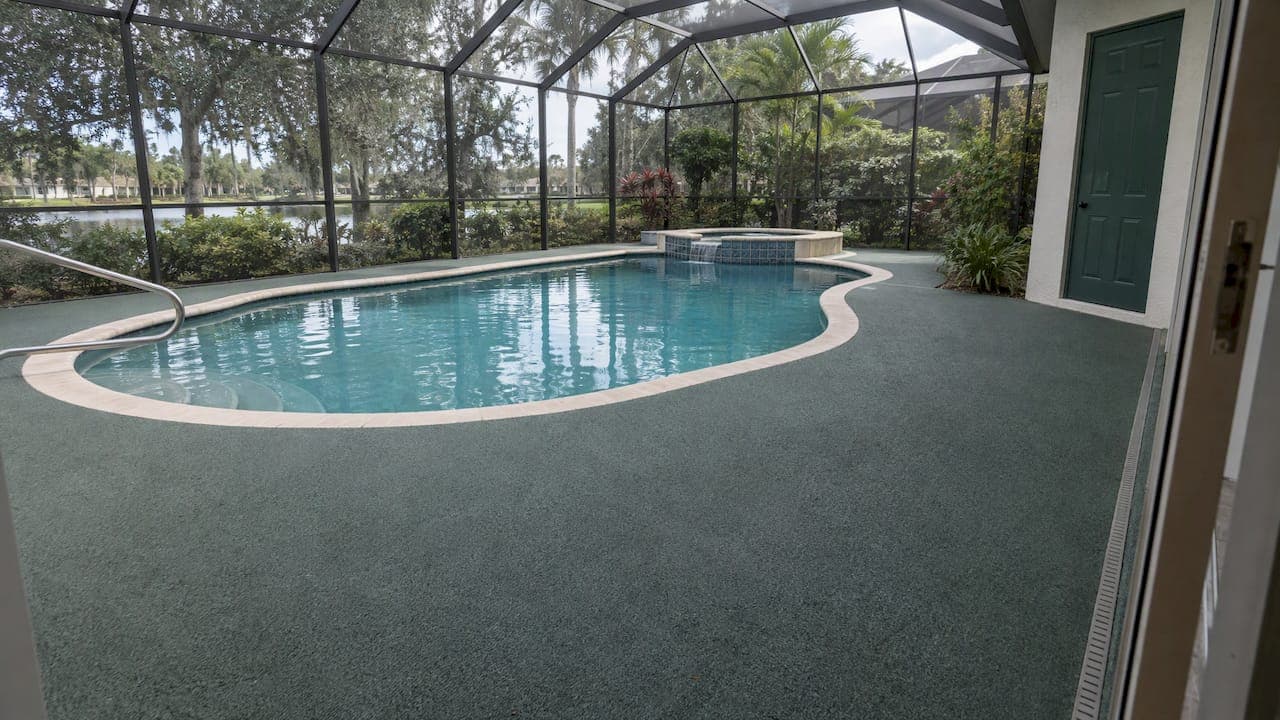
The best pool cage deck surface is one that stays grippy when wet, doesn't scorch bare feet, drains water quickly and doesn't crack. It also has to suit your slab. In a Florida lanai, the main choices are bare or sealed concrete, a cool-deck coating, pavers or porcelain tile, and poured-in-place porous rubber. Which one is right depends on the condition of your slab and how much heat, rain and foot traffic the space sees.
The screen cage is only the roof and walls of the space. The deck under it takes the daily punishment. Here is how to compare the surfaces, check your existing floor and decide between resurfacing and starting over.
TL;DR
- The cage is the enclosure. The deck surface is a separate decision, and it drives safety, comfort and upkeep.
- Cool-deck coatings go over a sound slab and don't bridge cracks. A failing slab needs repair or replacement first.
- Judge any surface on wet traction, surface temperature, drainage, crack behavior and maintenance, not on looks alone.
- Porous, flexible rubber paving handles standing water and movement in the slab better than rigid finishes. We install it in Florida.
- HOAs, municipalities and golf courses should also check accessibility and contract terms before approving a surface.
Table of Contents
- What the deck under a pool cage actually is
- How the main deck surfaces compare
- Wet slip resistance: what to ask for
- Drainage under a cage
- Resurfacing or replacing: how to decide
- Check your existing deck before you resurface
- What matters most in Florida and in high-use spaces
- Our perspective
- Talk to a rubber paving specialist
- FAQ
- Sources
What the deck under a pool cage actually is
People use "pool cage," "screen enclosure" and "lanai" loosely. The cage is the aluminum frame and screen over the pool. The lanai is the covered patio space, sometimes inside the same enclosure. The deck, the walking surface around the water, is poured or laid separately and has to last through years of sun, storms, chlorine or salt, and wet feet.
The screen blocks insects and cuts some direct sun, but it doesn't keep rain, humidity or splash-out off the floor. Wind-driven rain still reaches the slab, and pool water still carries onto it. In most Florida homes the deck is a concrete slab. What changes from house to house is what sits on top of it: a broom finish, paint, a spray-on coating, a stamped pattern, pavers, tile or a rubber surface.
Two things set the cage apart from an open patio. Airflow is lower, so a wet surface dries more slowly. And the screen sets the footprint, which leaves limited room for machinery. Both matter when you choose a surface and a way of installing it.
How the main deck surfaces compare
The table below summarizes the common options. Where a figure appears, it comes from a professional pool-deck materials guide; the rest is general trade knowledge you can confirm with any installer you invite to bid.
| Surface | Wet traction | Heat underfoot | Drainage | Crack behavior | Upkeep |
|---|---|---|---|---|---|
| Bare or broom-finish concrete | Fair when new, worse as it polishes | Hot in direct sun | Sheds water only where graded | Cracks and stays cracked | Sealing and cleaning |
| Cool-deck acrylic coating | Grippy texture | Cooler than bare gray concrete | Follows the slab | Doesn't bridge cracks | Recoating over time |
| Pavers | Depends on the paver | Varies with color | Joints can help or settle | Individual units shift | Joint sand, weeds, resetting |
| Porcelain tile or pavers | Depends on the finish | Varies with color | Needs a sloped base | Brittle to point impact | Low |
| Poured porous rubber paving | Textured, soft underfoot | Typically comfortable, see the heat guide | Water passes through | Flexes rather than snapping | Occasional washing |
Cool-deck coatings
A light acrylic cool-deck coating is applied over a sound slab. According to this pool-deck materials guide, it gives a grippy texture and runs 15 to 40°F cooler than bare gray concrete. That is a real comfort gain for a quick, relatively simple upgrade. The catch is the word "sound." The coating is thin and rides on whatever is beneath it.
Pavers and porcelain
The same guide describes 2 cm porcelain pavers as a durable, low-maintenance choice that resists salt and chlorine, though brittle to point impact. Dropping a heavy planter or a metal chair leg onto the edge can chip or crack a unit. Pavers can also settle unevenly on sandy Florida soil if the base isn't prepared well, which turns into a trip hazard at the pool edge.
Rubber paving
Poured-in-place rubber made from recycled tire material is a different kind of surface. It is porous, so water drains through instead of sheeting across the top. It flexes slightly, so it doesn't snap the way a rigid finish does when the ground moves. It is also softer underfoot, which many families with children or older adults notice quickly. Our guide to the coolest deck surfaces goes into surface temperature in more detail, and our comparison of paving materials covers the wider field.

Saltwater pools
If your pool uses a salt system, material choice matters even more, because salt attacks some sealers, metals and porous stone. Our write-up on saltwater pool deck materials lays out what holds up and stays cool.
Wet slip resistance: what to ask for
A deck that feels fine when dry can be treacherous when wet, and a pool deck is wet most of the day. Don't rely on a salesperson's word that a surface is "non-slip." Ask for a wet traction test result for the exact product and finish. In tile, the industry measures this as wet dynamic coefficient of friction under the ANSI A326.3 method, and we explain how to read those results in our piece on pool deck surfaces that pass wet DCOF tests.
For any surface, ask three practical questions:
- Has the product been tested wet, and can I see the report?
- Does the texture last, or does it wear smooth with foot traffic and cleaning?
- How does it behave with sunscreen, oils and algae film?
A slippery stamped concrete patio is a common complaint. If that sounds like your lanai, see what to try first on a slippery stamped concrete patio before spending on a full redo.
Drainage under a cage
Standing water is the quiet problem of many lanais. Because the screen reduces airflow, puddles linger. They feed algae, stain the surface and make the walking area slick. Drainage comes from two things: the slope of the slab, and whether the surface lets water through.
A coating or paver system relies on the slope of what is beneath. If the slab was poured flat, or has settled, a new top layer won't fix the puddles. A porous surface over a properly built base removes the water from the top instead of depending on grade alone. Our guide to barefoot-safe pool deck drainage explains what to settle before any surface goes down.
Resurfacing or replacing: how to decide
Resurfacing sounds cheaper and faster, and sometimes it is the right answer. But the research on cool-deck overlays is clear about the limits. The overlay is sprayed over a sound slab, it does not bridge cracks, and if the slab is failing structurally the coating only hides the problem for a while, as the materials guide notes.
Use this as a rule of thumb.
Resurfacing usually makes sense when:
- The slab is level and solid, with only surface wear, fading or a polished finish.
- Cracks are hairline and not growing.
- Drainage is already working and water leaves the deck.
- Your goal is mainly comfort or traction.
Replacement or a rebuilt base makes sense when:
- Cracks are wide, offset or keep reappearing after patching.
- Sections have sunk, lifted or rocked.
- Water pools in the same places after every rain.
- Tree roots, a drainage problem or soil movement are driving the damage.
If you are in the middle, get the slab looked at before you pay for any finish. A coating over movement will crack again along the same lines.
Check your existing deck before you resurface
A careful walk-through takes about an hour and saves real money. Do this on a dry day, then repeat after rain.
- Look for cracks. Mark them with chalk. Note whether one side is higher than the other, since offset cracks signal movement, not just shrinkage.
- Test for hollow spots. Tap the surface with a hard object. A hollow sound can mean the surface layer is delaminating from the slab.
- Watch the water. After rain or a hose test, see where water collects and where it drains. Photograph the puddles.
- Check the edges. Look at where the deck meets the pool coping, the cage base plates and the house. Gaps there let water get under the surface.
- Note the existing coating. Old paint, sealers or a previous topping can prevent a new layer from bonding, and some need removing.
- Check the cage footings. The aluminum frame is anchored into or beside the deck. Rust, staining or loose plates near the base tell you what water is doing there.
Bring your notes and photos to any installer. A good one will walk the same ground, and will tell you if the deck should be repaired before anything goes on top.
What matters most in Florida and in high-use spaces
Florida adds a few demands that a generic deck guide skips. Summer sun heats dark and dense surfaces. Daily storms put water on the deck faster than a flat slab can shed it. Humidity grows algae. Hurricane season sends debris and driving rain through the screen.
For a single-family lanai, rank your priorities like this: wet traction first, then heat, then drainage, then how it handles cracks, then upkeep. For shared and public spaces, add a few more:
- Accessibility. Paths to and around community pools, parks and trails need to work for wheelchairs, walkers and strollers. A firm, stable, level surface is the starting point, and the exact rules depend on the facility and the jurisdiction, so confirm them with your building official or accessibility consultant.
- Durability under traffic. Golf cart crossings, maintenance vehicles, chairs and carts wear surfaces quickly. Check that the product is rated for the load, not just for foot traffic.
- Documentation. Boards and municipalities need spec sheets, test reports and proof of license and insurance on file.
- Maintenance budget. A surface that needs yearly recoating has a different lifetime cost than one that only needs washing.
Our guide to crack-resistant paving for Florida businesses and our overview of Florida business paving challenges cover the commercial side. For play areas, see durable surfaces for playground safety. HOA boards should also read what contract items to approve for pool deck resurfacing before signing anything.
Our perspective
We install rubber paving in Florida and nothing else, so we see what happens when a rigid finish meets the state's heat, rain and shifting soil. The same complaints come up again and again: puddles that never leave, a coating that cracked along an old line, a deck too hot to cross at noon, a surface that turned slick once algae set in.
That is why we build with the Rubberway® system. It is made with recycled tire material, it is porous so water drains through it, and it is designed to resist cracking from heat and weather. It also comes in a wide range of colors, so a lanai doesn't have to look industrial. For homeowners, that means a deck that is gentler on bare feet and easier to keep clean. For boards and municipalities, it means a surface we can document, with ADA-compliant options and the paperwork a public project asks for.
Our advice is simple. Don't pick a surface from a sample alone. Look at your slab, look at where the water goes, and choose a system built for those conditions. If the base is sound, we can tell you. If it needs work first, we will say so before anything is laid.
Roger
Talk to a rubber paving specialist
If you are weighing a new surface for a lanai, a pool deck or a community pool area, our team can look at your site and recommend a Rubberway® system that fits. We are licensed and insured, and we work only on rubber paving.
See our professional rubber paving installation service, or browse the Rubberway® product line, including Pervious Pavement, Rubberrock 6000, EVOLUTION and the Sidewalk System.
FAQ
What is the best surface for a pool deck?
There is no single winner, because the best surface depends on your slab, your climate and your priorities. Look for strong wet traction, comfortable surface temperature, drainage and low upkeep. In Florida, porous rubber paving, light-colored cool-deck coatings and well-installed pavers are the usual contenders.
Can I resurface my lanai floor myself?
Some coatings are sold for homeowners to apply, but the result depends on cleaning, repairing and preparing the slab properly. Overlays don't bridge cracks, so skipping repairs shows through. For a deck that is cracked, uneven or holds water, have a professional assess it first.
What is the cage over a pool called?
It is usually called a pool cage, a screen enclosure or a screened lanai, depending on the region and the structure. The aluminum frame and screen protect the pool area from insects and debris. The deck surface underneath is chosen and installed separately from the cage.
Why does Florida have cages around pools?
Mostly for insects, debris and comfort. Bugs, leaves and palm fronds are a constant presence in a warm, humid state, and a screen keeps the pool and deck cleaner and more usable. It does not stop rain or humidity from reaching the deck, which is why the surface under it matters.
When should I replace the deck instead of resurfacing it?
Replace or rebuild when cracks are wide or offset, sections have sunk, or water pools in the same spots after every rain. A coating over a failing slab only hides the problem for a while. If the slab is sound and the wear is only on the surface, resurfacing is usually reasonable.