
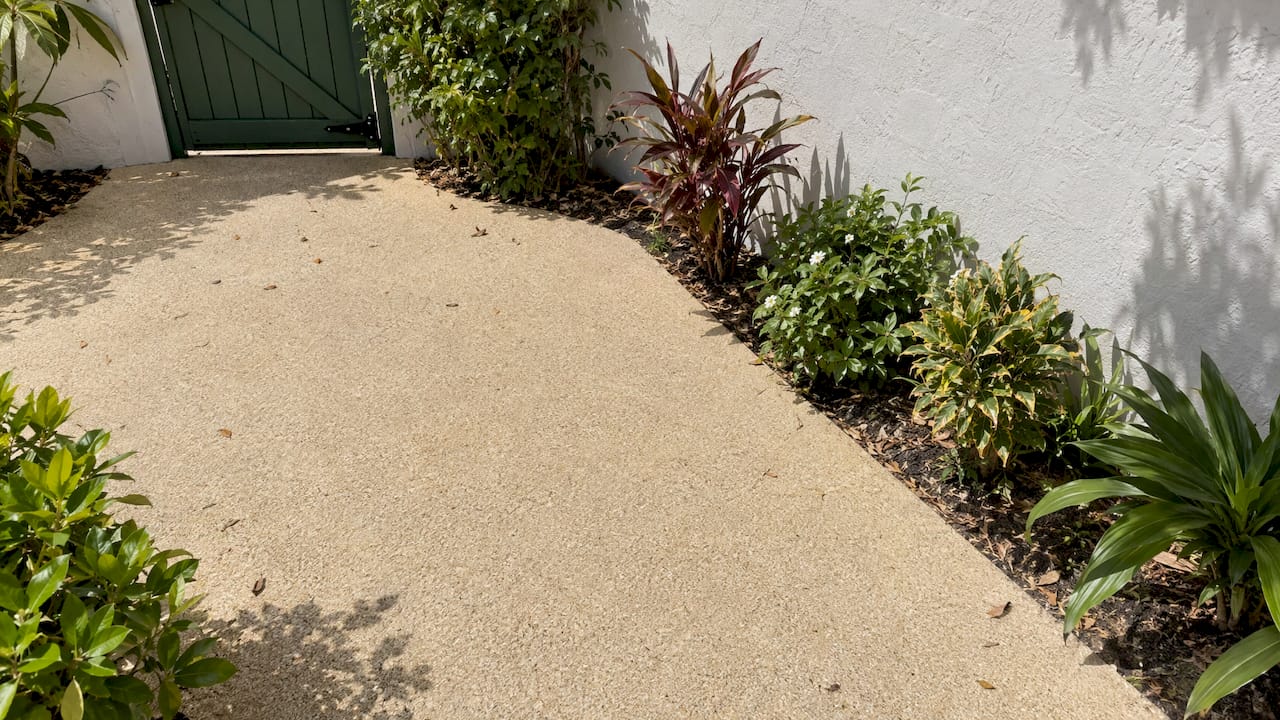
Light colored rubber paving is a good choice for sun-exposed driveways, pool decks, patios and community paths. Lighter tones absorb less solar energy, so they generally run cooler underfoot than dark ones. Pick a UV-stable color system, plan for dirt and cleaning, and match the surface to the way the space is used. This guide covers the colors on offer, how heat, fading and staining behave, what accessibility rules expect, and what drives the price.
TL;DR
- Surface temperature in sun is driven mostly by how much solar energy a surface absorbs, so lighter rubber colors run cooler than black and dark tones.
- UV-stable EPDM color granules are the usual route to long-lasting light colors. Ask any installer how the color you want is made and how it has held up.
- Light colors show dirt, tire marks and wear sooner than dark ones, so choose the shade with the traffic in mind.
- On an accessible route, the surface must be firm, stable and slip resistant, whatever the color.
- We install the Rubberway® system across Florida in a wide range of colors. Pricing is quoted per project.
Table of Contents
- Why people choose light colors for rubber paving
- What "light colored" means in rubber paving
- How light colors handle heat
- Fading, staining and color transfer
- Choosing light colored rubber paving for your space
- Accessibility on light colored rubber paths
- Installation and durability
- What affects the price
- Our perspective
- Get a light colored rubber surface for your property
- FAQ
- Sources
Why people choose light colors for rubber paving
In Florida, the first question about a rubber surface is usually how hot it gets in July. Light colors are the most direct answer. They also brighten a pool deck, make a path easier to see at dusk, and blend with stucco, coquina and travertine finishes that many Florida homes already use.
The case rests on a simple physical idea. One company guide to playground surface temperatures explains that temperature in the sun depends mostly on albedo, meaning how much solar energy a surface reflects rather than absorbs. It names dark wet-pour EPDM and dark rubber tiles as the hottest common surfaces. Lighter EPDM colors run cooler.
Independent measurement points the same way. A study of 10 playgrounds in Sydney found black and dark-coloured wet-pour rubber among the hottest flooring materials, with maximum surface temperatures above 80°C. Shade brought temperatures down significantly. The authors concluded that choosing the right material and colour-tone, along with providing shade, can remove the risk of contact burns. The study looked at playgrounds in Australia, but the physics of dark versus light surfaces applies in any sunny climate.
You will also see claims that lighter rubber pavers can be up to 30% cooler than black ones. Treat a figure like that as a rough guide. The actual difference depends on the product, the sun angle, airflow, moisture and whether the area is shaded.

What "light colored" means in rubber paving
Rubber paving gets its color in two main ways, and the difference matters for light shades.
- Recycled rubber with color on the surface. Black or dark recycled rubber, usually from tires, forms the body of many products. Color is added to the wearing layer.
- EPDM color granules. These are manufactured colored granules, often blended with or layered over a recycled base. Beige, light gray, tan and similar tones come from this route.
EPDM is the material most often used for lasting light color. One supplier describes EPDM granules as UV-stable, with long-lasting color and no fading, chalking or degradation. It adds that blending EPDM with SBR rubber improves UV resistance and durability. Another manufacturer's granule brochure lists standard light shades such as beige, eggshell, light grey and pearl, and describes the granules as UV- and weatherproof with high color resistance.
Those are material makers' own descriptions of their granules, not a guarantee for any finished surface. A finished surface also depends on the binder, the mix and the installation. That is why color is a system decision and not only a swatch decision.
Common light shades
| Shade family | Typical use | What to expect |
|---|---|---|
| Light gray | Driveways, walkways, commercial entries | Neutral, blends with concrete-like surroundings, hides some dust |
| Beige and sand | Pool decks, patios, courtyards | Warm tone that suits Florida stucco and stone |
| Tan and buff | Park paths, trails, golf cart routes | Natural look, forgiving of leaf stains and dust |
| Off-white and pearl | Accent bands, borders, decorative zones | Brightest option, shows dirt fastest |
Most projects mix tones. A light field with a darker border, or a light path through a landscaped area, gives contrast that helps people see edges and changes in level.
How light colors handle heat
Light colors help most where the sun is strongest and people are barefoot or on bare skin: pool decks, splash areas, patios and play zones. They help less where shade already covers the surface.
The same company guide recommends lighter colors in sun-exposed zones and dark colors in shaded areas. It also notes that shade sails, trees and canopies over the hottest zones cut surface temperature sharply and extend usable hours. That is sound planning advice for any property.
A few things shift the result:
- Color. Lighter reflects more, darker absorbs more.
- Shade. Even partial shade lowers peak temperature a lot.
- Material and thickness. Different surfaces hold and release heat differently.
- Porosity. A porous surface that drains well does not hold standing water, and it dries faster after the afternoon storms common in Florida.
For more on how rubber behaves in the sun, see our guides to why rubber surfaces stay cool outdoors and heat resistant paving materials for hot climates. If part of your site is under trees or buildings, our page on rubber paving in shaded areas shows how to plan for it.
Fading, staining and color transfer
The three worries buyers raise most about light surfaces are fading, dirt and transfer from other materials.
Fading
UV exposure is the main cause. UV-stable color granules and a binder suited to light colors are the main defenses. Before you commit to a shade, ask for fade information for the exact system and color you are considering. We cover that in more depth in our guide to choosing rubber paving colors.
Dirt and wear
Light colors show their surroundings. Leaf tannins, clay soil, mulch dust, tire marks and oil all appear sooner on beige than on charcoal. The ColorPlay guide makes the same trade-off: lighter EPDM runs cooler but shows dirt and wear sooner. In practice, you handle that with a few habits:
- Choose a mid-light tone such as warm gray or tan for high-traffic driveways.
- Keep landscape beds edged so soil and mulch do not wash onto the surface.
- Rinse the surface on a regular schedule and clean spills promptly.
- Use off-white sparingly, for accents rather than whole driveways.
Because a porous surface drains freely, rinsing and rain carry loose dirt away rather than leaving it to pool.
Color transfer
Color can transfer between materials. Some product guides note that light surfaces next to certain rubber products can show staining from color bleeding. Planning helps here: keep dark rubber mulch, dark sealers and fresh asphalt edges from touching light paving, and have the installer confirm which materials will border the surface.
Choosing light colored rubber paving for your space
Match the shade and system to how the space will be used.
Residential driveways. Choose a mid-light tone. It stays cooler than black, handles tire marks better than white, and drains stormwater instead of shedding it to the street.
Pool decks and patios. This is where light colors earn their keep. Bare feet and direct sun call for the lightest practical shade, plus a slip-resistant texture. Our Florida playground and safety surface guide covers the same safety thinking for play areas.
Commercial walkways and entries. Light surfaces read as clean and welcoming but must hold up to rolling carts and heavy foot traffic. A light gray with a defined border usually works well.
HOA and community areas. Choose a color that coordinates with the community palette and that maintenance crews can keep clean with routine rinsing.

Municipal parks, trails and sidewalks. Lighter tones help visibility and keep trail surfaces comfortable for walkers. Our park path surface guide compares ADA, drainage and rubber options in detail.
Questions to settle before you choose
- How much of the day is the surface in full sun?
- Who walks on it barefoot, and who rolls on it?
- Which materials, plants or vehicles will sit next to it?
- How much routine cleaning can you commit to?
- Does the area need to meet accessibility requirements?
Accessibility on light colored rubber paths
Color does not make a surface accessible or inaccessible. The surface properties do. Under the ADA Standards, floor and ground surfaces along accessible routes must be stable, firm and slip resistant, and changes in level and openings are limited. A well-installed rubber surface is designed to meet these needs, and the porous design also reduces standing water that can make a route slippery.
Light colors can help with wayfinding. Contrast between a path and its surroundings, or between a path and a curb or ramp edge, makes the route easier to read. If your project is public or must follow ADA rules, bring the design requirements to us at the start so we can document the surface for your board, engineer or inspector. Our documentation is prepared with government projects in mind.
Installation and durability
A light surface only looks good if the base underneath it is right. The steps below describe the general sequence for a rubber paving project, not a do-it-yourself recipe.
- Site review. Check slopes, drainage paths, tree roots, shade and existing surface condition.
- Base preparation. A stable, properly graded base keeps the surface from settling or cracking.
- Mixing and placing. The rubber and binder are mixed and placed to the planned thickness and finish.
- Color and detail work. Borders, patterns and transitions are laid out for contrast and safety.
- Curing. The surface needs time to cure before traffic returns to it.
Durability depends on the base, the binder, the thickness, the drainage and the climate. Florida adds heat, intense UV, heavy rain and humidity. Our article on rubber paving in humid climates explains what holds up there. Porous systems also help manage runoff, which we cover in our stormwater paving guide for engineers.
Day-to-day care
Sweep or blow off debris, rinse with a hose, and treat stains early with a mild cleaner suited to the surface. Ask your installer for the cleaning guidance that matches your system before you use pressure washers or solvents.
What affects the price
Rubber paving is quoted per project, and we do not publish a price list. The price of a light colored surface is shaped by the same factors across the industry:
- Area and shape. Larger, simpler areas cost less per square foot than small, detailed ones.
- Base condition. Excavation, grading, drainage work and removal of an old surface add to the scope.
- Thickness and system. Driveways, pool decks and trails call for different builds.
- Color and design. Custom blends, borders and patterns change material and labor.
- Access and site logistics. Tight access, phased work and multiple sites affect scheduling.
The lowest-cost surface at install is not always the lowest-cost over its life. A surface that resists cracking and drains well can reduce repaving and liability issues. Our article on how rubber paving reduces liability risk goes into that, and so does our comparison of rubber paving and asphalt overlays.
Our perspective
We install rubber paving in Florida and nothing else, so we think about light colors every day. Our view is that a light surface is one of the smartest choices you can make for a sunny site, as long as the color is treated as part of the system and not as a finish choice at the end.
We start from the site. Where the sun is hard and people are barefoot, we lean light. Where shade is steady, there is more freedom to use deeper tones. In most community and commercial projects, a mix of mid-light fields and contrasting borders gives the best balance of comfort, appearance and easy upkeep.
The Rubberway® system is built around recycled materials, a porous design for drainage, crack resistance in heat and weather, and ADA-compliant surfaces. Because it drains, light surfaces do not sit in standing water collecting grime. Because we are licensed and insured and prepare government-ready documentation, boards and municipal teams can approve a project with confidence.
Our advice: choose the color early, walk the site at midday, and tell us who will use the space. We will help you land on the right shade.
Roger
Get a light colored rubber surface for your property
If you manage a home, business, HOA or municipal site in Florida, we can walk you through color options and recommend a system for your space. Our professional rubber paving installation service covers driveways, pool decks, patios, walkways, parks, trails and sidewalks, using the Rubberway® system with custom colors.
Browse the Rubberway product lines: Pervious Pavement, Rubberrock 6000, EVOLUTION and the Sidewalk System. Tell us about your site and we will provide a project quote.
FAQ
Are light colored rubber surfaces cooler than dark ones?
Generally, yes. Surface temperature in sun depends mostly on how much solar energy is absorbed, and lighter colors absorb less. Measurements on playgrounds show black and dark rubber among the hottest surfaces. Shade lowers temperatures further.
Will light rubber paving fade in Florida sun?
UV-stable color granules and the right binder are designed to resist fading and chalking. Our own claims cover the Rubberway® system, and we are happy to discuss color choices for your site. Fade performance depends on the specific system, so ask for details on the exact color you want.
Do light colors show dirt more?
Yes, lighter shades show dirt, leaf stains and tire marks sooner than dark ones. Mid-light tones such as warm gray or tan are a practical compromise for driveways. Routine rinsing and keeping soil and mulch off the surface keep them looking clean.
Can light colored rubber paving be used on an ADA route?
Yes, when the surface is firm, stable and slip resistant and the route meets the other ADA requirements. Color alone does not decide compliance. Share your design requirements with us at the start so we can document the surface.
How much does light colored rubber paving cost?
We quote each project individually because area, base condition, thickness, color and access all change the price. Contact us with your site details for a quote.
Sources
- Outdoor playgrounds and climate change (ScienceDirect, 2022)
- How Hot Does Playground Surfacing Get? (ColorPlay)
- EPDM Colored Rubber Granules, UV stable
- EPDM granules brochure
- U.S. Access Board: Chapter 3, Floor and Ground Surfaces