
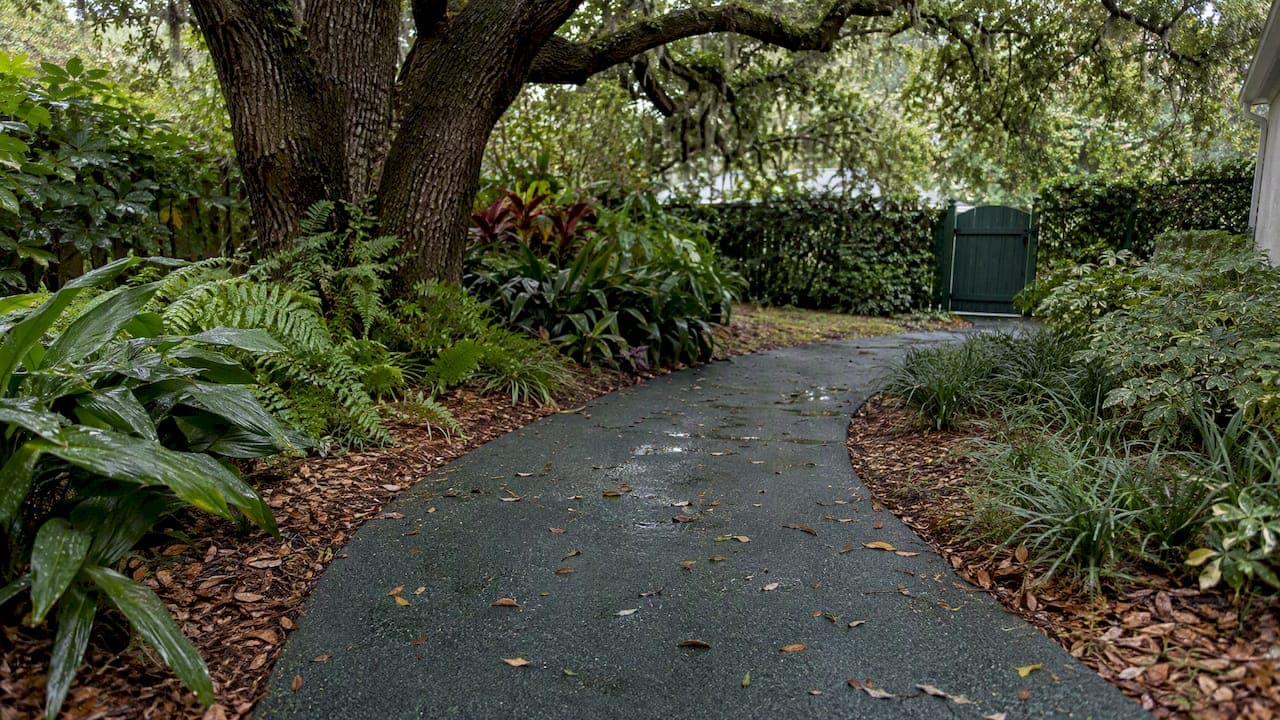
Rubber paving works well in shade. The surface does not rot, does not need sun to cure or dry out, and stays comfortable underfoot. What shade changes is the upkeep: damp, sheltered ground grows algae and moss, and leaf litter collects in the surface. Plan for drainage, a solid base and a simple cleaning routine, and a shaded rubber path, pool deck or patio can last for years. Skip those, and you get a slick, stained surface.
This guide covers what actually happens to rubber paving under trees and along north-facing walls, how slopes change the installation, and what to ask a contractor before you sign. We install rubber paving in Florida, so the examples lean toward humid, rainy, leafy conditions.
TL;DR
- Rubber paving is suitable for shaded areas. Expect more algae and moss than in full sun, and plan to clean the surface regularly.
- Leaves and debris that rot and settle into the surface can slow drainage and feed algae, so sweep often under trees.
- Slopes are workable, but the base needs drainage away from the site, solid edge restraint, and, for public routes, ADA slope limits.
- Rubber pavers can sit on compacted, level soil in light-duty settings, but a properly prepared free-draining base is what keeps them flat and dry.
- Ask your installer about base depth, drainage outlet, edging and cleaning guidance before you approve a shaded or sloped layout.
Table of Contents
- Why shade changes the job
- Moss, algae and slip resistance
- Leaves and debris: the quiet drainage problem
- Rubber paving on slopes
- Can rubber pavers go straight on dirt?
- Perspective: how we think about shade
- Disadvantages and limits to know
- A checklist before you hire
- Get a shaded or sloped site assessed
- FAQ
- Sources
Why shade changes the job
Sunlight does a lot of quiet work on outdoor surfaces. It dries them after rain, discourages biological growth and keeps temperatures high enough that damp patches disappear within hours. Remove it, and the same surface stays wet longer.
That is the main issue with shade. Rubber itself handles it fine. One supplier guide notes that SBR rubber is acceptable in sheltered outdoor areas and is a cost-effective choice for shaded surfaces, while warning that damp conditions encourage algae and moss that can reduce slip resistance, so regular cleaning is essential.
In practice, the shaded spots around a Florida home look like this:
- Under live oaks and palms. Constant leaf, seed and frond drop, plus dripping moisture.
- North sides of houses and fences. Little direct sun, slow drying after afternoon storms.
- Screened lanais and covered pool decks. Protected from rain but often humid, with poor air movement in corners.
- Community paths shaded by buildings or mature trees. The same issues, with more foot traffic and more liability.
Each of these is a good fit for a porous, slip-conscious surface. Each also needs a maintenance plan.
Moss, algae and slip resistance
The Royal Horticultural Society explains that algae and moss thrive in moist conditions, may grow faster in shady areas with poor air circulation, and can make hard surfaces slippery. That advice is written for gardens in the UK, but the biology is the same in Tampa Bay: shade plus moisture plus a little organic film equals growth. Florida's warm, humid climate gives it more months of the year to happen.
Three things reduce the problem:
- Let water leave the surface. A porous design that drains quickly gives growth less standing moisture to work with. Surfaces that hold puddles in shade are the ones that turn green first.
- Open the canopy where you can. Trimming low branches lets in light and air. It often does more than any cleaning product.
- Clean before it builds up. Brushing off early growth is easy. A thick film is not.
The RHS recommends brushing growths off and, where drainage is poor, using a pressure washer with care. On rubber paving, keep that caution in mind: use a low-pressure setting, hold the nozzle back from the surface and edges, and follow the cleaning instructions your installer gives you for the specific product. If you want background on moss on hard surfaces and eco-friendly ways to control it, this research-backed look at moss on concrete covers the principles, which carry over to shaded paved areas.
Color matters more in shade
Shaded surfaces show debris more. Needles, leaf litter and fine grit stand out against a dark or very light surface, and algae shows as dark patches on pale colors. Mid-tone blends with some speckle hide debris best. We offer a wide range of colors on the Rubberway® system, and we suggest looking at samples in the actual shaded spot, not in a showroom or in full sun.

Leaves and debris: the quiet drainage problem
For a porous surface, debris is the bigger long-term risk. The Lawn Tennis Association's court maintenance guidance says that in shaded areas, leaves must be cleared regularly so they do not rot and settle into the surface, impeding drainage and fostering algae and moss. The guidance is written for tennis courts, but the mechanism applies to any permeable surface: organic matter fills the voids, water slows down, and the rotting material becomes a growing medium.
A realistic routine for a shaded rubber surface:
| Task | Typical timing | Why |
|---|---|---|
| Sweep or blow off leaves, needles and seed pods | Weekly in heavy drop periods, otherwise as needed | Keeps debris from rotting into the surface |
| Brush off early algae or moss | As soon as green film appears | Easier to remove early, protects traction |
| Gentle wash with low pressure | Seasonally, or after a long wet spell | Clears fine grit and film from the surface |
| Check edges, outlets and drains | Twice a year | Blocked outlets cause puddles even on porous surfaces |
| Trim overhanging branches | Annually | More light and airflow, less debris |
The tennis guidance also mentions mechanical vacuuming for larger areas. For an HOA or municipal path under a tree canopy, that kind of scheduled sweeping is the practical way to keep a shaded surface performing. We cover the cost side of this in our piece on reducing community maintenance with rubber paving.
Rubber paving on slopes
People also ask whether rubber paving can go on a slope. Yes, within limits, and the limits come from three places: the base, the drainage and the edges.
Drainage first
Porous does not mean you can ignore where the water goes. One manufacturer's installation manual states that rubber tiles are water-permeable but still require drainage away from the site, through mechanical drainage or a positive sub-base slope of at least 2%. That is a playground product, so treat the figure as one reference point, not a universal rule for every system. For our Rubberway® products, the installation spec comes from the system design and the site conditions.
Water that passes through the surface has to travel through the base and exit somewhere. On a slope, that is usually an advantage, because gravity helps. The danger is the opposite: runoff from a hillside above the paving, soaking the base and pushing material downhill. Our guide to outdoor paving drainage for homeowners explains how to read the water flow on your property before choosing a layout. Engineers can find drawdown details in our post on porous rubber paving specs.
Edge restraint
Surfaces on a grade want to creep. Another manufacturer's guide strongly recommends a solid perimeter retainer such as concrete, wood or plastic curbing. On a slope, the downhill edge is the one that matters most. Ask any installer how the edge will be held and what happens where the rubber meets lawn, mulch or planting beds.
Slope limits for accessible routes
If the path is public, or you are an HOA or municipality with ADA obligations, slope is a compliance matter, not a preference. The ADA settlement documents that reference the 2010 Standards state that accessible routes must have a running slope no steeper than 1:20 (5%) and a cross slope no steeper than 1:48, with changes in level greater than 1/2 inch ramped, and that the surface must be stable, firm and slip resistant.
Three practical points follow:
- A shaded path that stays slick fails the "slip resistant" test in practice, whatever it was on day one. Maintenance is part of compliance.
- A cross slope that drains water sideways is useful, but it cannot be steeper than 1:48 on an accessible route. Drainage and accessibility have to be designed together.
- Tree roots lift surfaces. A change in level over 1/2 inch needs ramping, so check root zones before laying a route under a mature canopy.
For homeowners and managers who want to measure an existing walkway, this explainer on ADA walkway slope checks shows how to check the numbers in the field. If a path is steeper than 5%, it may need to be designed as a ramp with different requirements, so involve your engineer or accessibility consultant early.
Can rubber pavers go straight on dirt?
This is one of the most common questions, and the honest answer is: sometimes, for light use. Home Depot's how-to guide says rubber pavers can be placed on bare, level soil, but you should compact the soil first and never let water stand on or under them. That suits a garden stepping area or a temporary walkway.
Shade makes the soil shortcut riskier. Soil under trees stays damp, is full of roots and organic matter, and settles unevenly. A stricter specification shows the other end of the range: one manufacturer's manual calls for removing grass, ground cover, soil and organic fill to at least 4 inches below the tile bottom, then free-draining granular material compacted to at least 95% Proctor, with landscape fabric over the site and seams overlapped at least 6 inches. Again, that is one product's rule, not ours, but it shows what a prepared base involves and why it matters.

The pattern is clear. The more traffic, the more shade and the steeper the grade, the more prep you need. Our article on the role of surface prep in rubber paving success goes through it step by step, and our sustainable installation best practices guide covers the broader process.
If you are replacing lawn that struggles in shade, it also helps to think about the whole yard. This piece on lawn alternatives without grass is a good starting point for deciding which areas should be hardscape and which should stay planted.
Perspective: how we think about shade
Shade is where we see homeowners and boards make the same mistake: they judge a surface by how it looks the day it is installed, in sun. The better question is how it behaves in March after three weeks of rain under a live oak.
Our view is simple. Choose a surface that drains, so water has no reason to sit. Choose a color that tolerates debris. Build the base for the wettest day of the year, not an average one. And be honest with the owner about maintenance: sweeping and an occasional wash are part of owning any outdoor surface in Florida, rubber or not.
We focus only on rubber paving, so we do not stretch it into places it does not fit. If a site has a hillside shedding water onto the path, or a root system that will keep heaving the ground, we would rather solve that first than install over it.
— Roger
Disadvantages and limits to know
People also ask about the downsides of rubber paving. Here are the ones that matter in shade and on grades:
- Biological growth. Shade accelerates algae and moss, which affects traction. Cleaning is not optional.
- Debris in the surface. Leaves that settle in can slow drainage and feed growth.
- Installation quality. A US Access Board-funded one-year study of 25 playgrounds found that poured-in-place rubber and rubber tile had the highest firmness and stability of the surfaces studied, yet every surface type had accessibility, safety or maintenance issues within 12 months. Some sites had noncompliant slopes or installations that departed from manufacturer recommendations. The lesson is that how it is installed and maintained matters as much as the material.
- Slope limits on accessible routes. Steep grades may need a different design.
- Light-duty shortcuts. Loose pavers over unprepared soil can shift, especially where water collects.
What about durability?
Exact lifespan depends on the product, base, traffic and upkeep, so we will not put a number on it here. For context, the US EPA notes that rubberized asphalt is a more flexible, porous alternative to conventional asphalt that can reduce standing water and lower maintenance costs, and that it has been used to extend the life of paths and resists reflective cracking better than traditional asphalt. That is rubberized asphalt, a related but different material, and it points the same way: flexibility and porosity help surfaces last outdoors. The same EPA page describes a Los Angeles County project where about 3,000 square feet of rubberized tiles were installed at a senior outdoor shelter and shuffleboard court in 2001, a real example of recycled rubber used in a shaded, public, accessible setting.
A checklist before you hire
Whether the job is a backyard pool deck or a municipal trail, ask these questions about any shaded or sloped area:
- Where does the water go, and what is the outlet?
- How deep is the base, and what is it made of?
- How is the downhill edge restrained?
- What is the finished slope, running and cross, and does it meet ADA limits if it is a public route?
- Which trees drop what, and when? What root issues exist?
- What cleaning method and frequency do you recommend, and is it in writing?
- Which color and texture hide debris best in this exact light?
If the answers are vague, keep looking. For trail designers working on soft or root-heavy ground, our write-up on permeable trail surfaces that avoid deep excavation is also worth a look. For a broader overview, see what owners and contractors should know about rubberised paving.
Get a shaded or sloped site assessed
We are a licensed and insured team that works only on rubber paving, and we install the Rubberway® system for driveways, pool decks, patios, walkways, parks, trails and community areas in Florida. Shade and slope are the two site conditions we like to see in person, because the right base, drainage and color depend on what the site actually does in the rain. Browse the Rubberway products to see the options, or contact us about a professional rubber paving installation and tell us what the area looks like.
FAQ
Does rubber paving get slippery in the shade?
It can, when algae or moss grows on it. Damp, shaded surfaces with poor airflow are where growth is fastest, and it reduces traction. Sweeping, early brushing and a gentle seasonal wash keep the surface safe, and a fast-draining design gives growth less moisture to work with.
Can rubber paving be installed on a slope?
Yes, on moderate grades, provided the base drains and the edges are restrained so the surface cannot creep. Public accessible routes have to stay within the ADA limit of 1:20 running slope and 1:48 cross slope. Steeper grades need a different design, so have the site assessed before choosing a layout.
Can you put rubber pavers directly on dirt?
For light-duty use, rubber pavers can go on compacted, level soil as long as water never stands on or under them. In shade, with roots and damp organic soil, a prepared base with free-draining material and fabric is the safer approach. It keeps the surface flat and drains better.
What are the disadvantages of rubber paving?
The main ones are algae and moss in damp shade, debris building up in the surface, and results that depend heavily on installation quality. Slopes and accessibility rules also limit where it can go. Regular cleaning and a properly prepared base address most of these.
Sources
- Outdoor & Garden Rubber Flooring: UV Stability, Weather Resistance, Installation Guide
- Algae and Moss on Hard Surfaces: Prevention Tips (RHS)
- Maintenance of Park Courts (LTA)
- PlayFall Installation Manual 2019
- SHOCK Series Tiles Installation Manual
- ADA Settlement Agreement, Exhibit 1 (2010 Standards)
- How to Lay Rubber Pavers (The Home Depot)
- US researchers complete 1-year study of rubber playground surfaces
- Resource Conservation: These Tires Were Made for Walkin' (US EPA)