
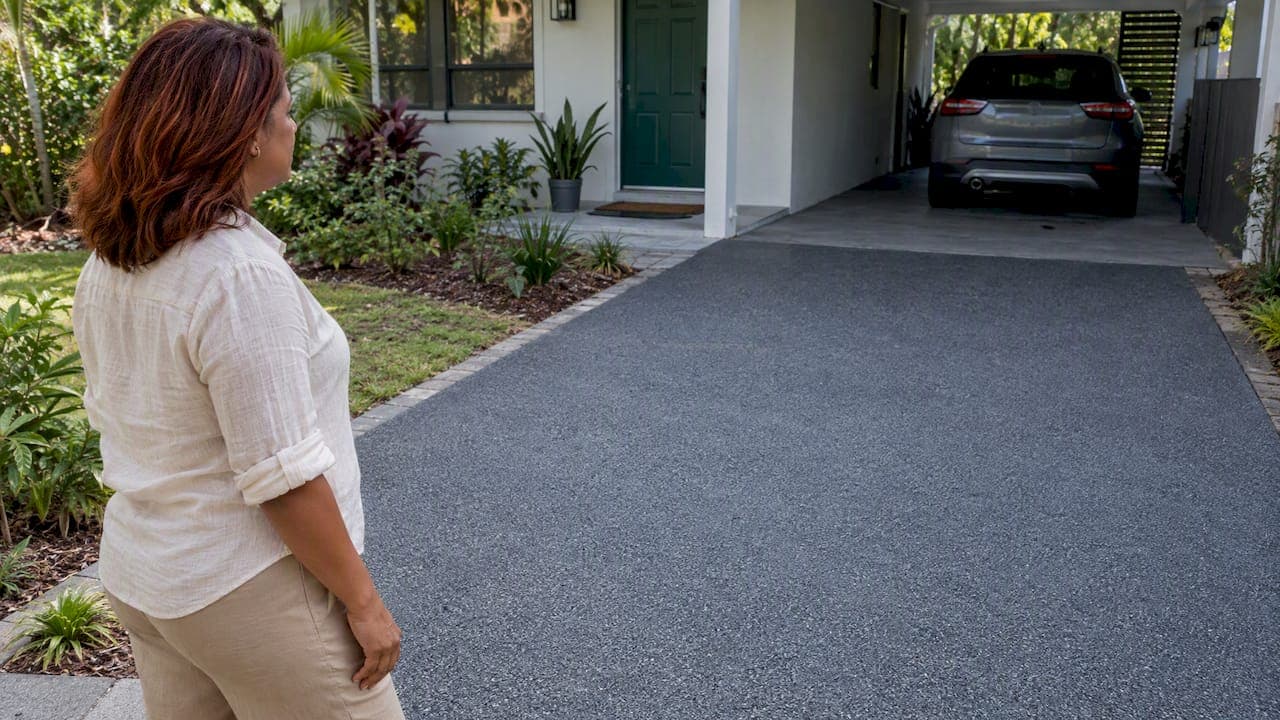
The best non-glare driveway surface is one with a textured, non-polished finish in a mid-tone color, and with drainage that keeps standing water off the top. Glare comes from sunlight bouncing off smooth, bright or wet surfaces. You reduce it by changing the surface itself, not by adding gadgets next to it. Driveway reflectors and mirrors help drivers see at night, but they do nothing about the sun in your eyes at 4 p.m. This guide covers what causes glare, which finishes and colors tame it, how to handle a pool deck, and what to check before you sign a contract.
TL;DR
- Glare is a surface problem: smooth, polished, light and wet surfaces throw the most reflected sunlight into your eyes.
- Texture, mid-tone color and good drainage work together. Fixing only one of them rarely solves it.
- Very light surfaces cut heat but can raise glare, so test samples in your own sun angle before you commit.
- For pool decks, glare control must never cost you traction. Barefoot, wet-surface grip comes first.
- Public paths and HOA walkways must be stable, firm and slip resistant under accessibility rules, so check this at the specification stage.
Table of Contents
- What actually causes glare on a driveway or pool deck
- Colors, textures and finishes that reduce glare
- How common driveway materials compare on glare
- Pool deck glare without losing traction
- Testing a surface before you commit
- Accessible paths: what HOAs and municipalities should check
- Our perspective
- Rubber paving for glare-conscious Florida properties
- A quick decision guide
- FAQ
- Sources
What actually causes glare on a driveway or pool deck
Glare is not the same as brightness. A 2026 review in the journal Buildings defines daytime outdoor glare as interference with visual function or comfort caused by high-luminance stimuli in your field of view. The same review notes that direct sun is the most intense natural source, and that specular reflections from building surfaces and pavements can create intense, localized bright spots.
"Specular" is the key word. A specular reflection is a mirror-like bounce. It happens when light hits a smooth, flat, shiny surface and leaves at the same angle it arrived. A rough surface scatters the same light in many directions, so no single bright spot reaches your eyes.
Three things drive that bounce on residential paving:
- Smoothness. Troweled concrete, sealed pavers and polished stone act like weak mirrors at low sun angles.
- Color value. Lighter surfaces send more total light back at you. Darker surfaces send less, but they hold more heat.
- Moisture. A thin film of water makes almost any surface smoother at the microscopic level. Federal highway research on glass-containing asphalt, for example, found that reflectivity can produce noticeable glare particularly when the pavement is wet. Wet glare is a real effect on paved surfaces, not a myth.
That third point matters in Florida. Afternoon thunderstorms leave puddles that turn a driveway into a sheet of reflected sky for an hour or two. A surface that drains through itself removes that problem at the source.
Nighttime visibility is a different problem
Most of the results you see when you search this topic are about reflectors, snow stakes and convex mirrors. Those address being seen or seeing around corners in the dark. Daytime glare is about reflected sunlight, and the fix is the surface. If your complaint is sun in your windshield or squinting off the patio, skip the markers and look at what you are standing and driving on.
Colors, textures and finishes that reduce glare
There is no single glare-proof material, and no official U.S. rating for it. What you can do is choose on three variables: texture, color and permeability.
Texture: rough beats smooth
Federal pavement guidance describes surface texture at two scales. Microtexture and macrotexture both matter for wet-weather friction, and the same guidance points out the tradeoff between macrotexture and tire noise. For a driveway the practical reading is simple: a surface with visible grain or granular relief breaks up reflections and also grips better when wet.
Texture is also why treatments that add aggregate stand out. The FHWA describes high-friction surface treatments as polymer resin binders that bond abrasive, polish-resistant aggregate to the pavement, with performance depending on both the microtexture of each particle and the macrotexture of the finished surface. Those are roadway products, but the principle carries over to a home: a surface made of bonded granular material has built-in relief that smooth poured slabs lack.
Texture can fade. FHWA documentation on diamond grinding of concrete reports that the gain in macrotexture and skid resistance can decrease over time, depending on how easily the aggregate polishes. Ask any installer how the texture they promise holds up after years of traffic and sun, not just on day one.

Color: aim for the middle
It is tempting to go white to keep the driveway cool. High-reflectance hardscape materials do absorb less sunlight than dark surfaces, and Rutgers' green building guidance notes they can reduce the heat-island effect. But the same reflectance that sheds heat sends light toward your eyes and your neighbor's windows. The National Glass Association's guidance on reflected solar energy says designers should consider building context, including nearby structures and sun orientation, because neighboring reflective surfaces add to heat and glare on adjacent areas.
A workable rule for most Florida homes:
- Very dark charcoal or black: low glare, highest surface heat. Hard on bare feet.
- Mid-tone tans, warm grays, terracotta and browns: the best balance of low glare and manageable heat.
- Very light creams and whites: cooler, but the most likely to produce a squint-inducing bright field, especially in a west-facing driveway.
If you want the heat side in more detail, our guide to cool driveway surface options for hot climates walks through it, and our piece on driveway materials in full sun covers UV questions to ask your installer.
Permeability: remove the water film
The EPA describes cool pavements as including reflective materials or permeable pavements that cool through evaporation when wet. The EPA also says there is no official U.S. standard definition of a "cool" pavement, so be skeptical of any product that claims a certified glare rating.
For glare specifically, a permeable surface helps because water passes through instead of pooling. No puddle means no mirror. If you are weighing this route, a plain-language primer on what permeable paving is, its types and its cost is a good place to start, and the stone reservoir beneath the surface is the part homeowners most often overlook.
How common driveway materials compare on glare
Here is a general comparison by type of material. Real results vary with color, finish and installation quality.
| Surface type | Glare tendency | Heat tendency | Wet-weather behavior |
|---|---|---|---|
| Smooth troweled or sealed concrete | Higher, especially light colors and glossy sealers | Cooler if light | Puddles can reflect sky; sealed finishes can be slick |
| Broom-finished concrete | Moderate | Cooler if light | Better grip, but still sheds water to the surface |
| Dark asphalt | Low in dry conditions, brighter when wet | Hot | Water film can reflect |
| Sealed or polished pavers | Moderate to high | Varies by color | Sealers can reduce traction |
| Gravel or crushed stone | Low | Moderate | Drains well, but loose and hard for wheelchairs, strollers and bikes |
| Bonded rubber paving | Depends on color and finish; textured, granular look | Varies by color | Porous designs let water pass through |
For a wider look at tradeoffs, see our 2026 comparison of paving surface materials.
Pool deck glare without losing traction
The pool deck is where glare and safety collide. A deck is bright because sun hits it, and then again because water hits it. Everything you do to quiet the shine must also be judged barefoot and wet.
A few principles hold up:
- Choose texture over sheen. A matte, granular finish scatters light. A glossy sealer, even a clear one, can bring the shine back and reduce grip. Ask whether any topcoat you are considering changes traction when wet.
- Pick a mid-tone. Pure white decks are the usual culprit for squinting. A warm tan or soft gray stays comfortable on the eyes and does not scorch feet the way near-black can.
- Fix the shade, too. Surface changes cannot do everything at noon. Adding overhead cover, such as an awning or pergola, cuts the light before it ever hits the deck, and this guide to shade that reduces patio glare shows how placement changes the result.
- Mind the lighting at night. Low, indirect fixtures keep light from bouncing off the water and flattening the view of the pool edge.
- Drain the water away. Standing water on a deck both glares and creates slip risk. A porous surface helps with both.
If your existing deck is a smooth stamped concrete that has turned slick, our write-up on fixing a slippery stamped concrete patio explains what to try first and when an overlay makes sense.
Permeable surfaces are not only for driveways. If you are curious how a porous patio performs in practice, this overview of permeable patio pros and cons covers the runoff side of the story.
Testing a surface before you commit
Brochures and online photos tell you almost nothing about glare, because glare depends on your sun angle, your neighbors' roofs and windows, and the time of day. Use this short routine:
- Get a large sample, not a chip. Ask for a piece at least a foot square, and set it where the finished surface will go.
- Look at it at three times of day. Morning, mid-afternoon and the low evening sun are different tests. West-facing driveways are usually the hardest.
- Wet it. Pour a bucket of water on the sample and look again. Notice whether it beads, sheets or soaks in.
- Check it barefoot. Especially for pool decks and patios, walk on it wet.
- Look from where you will be. Stand at the garage door, the mailbox and the driver's seat. Glare is about eye position.
- Ask about the surroundings. Glass doors, metal roofs and a pool can all add reflected light that no driveway color will cancel.
When a salesperson claims a surface is "glare free," ask what that means in writing. Because there is no official standard for it, a trustworthy contractor will talk about texture, color and drainage instead of a rating.
Accessible paths: what HOAs and municipalities should check
If you manage a community walkway, park path or sidewalk, glare reduction cannot compromise accessibility. Under the ABA Accessibility Standards, accessible floor and ground surfaces must be stable, firm and slip resistant. The standards do not set a minimum coefficient of friction, because no consensus method for rating slip resistance has emerged. That means you need to evaluate the actual installed surface, not rely on a single number.
For a concrete example of the geometry, ADA.gov guidance on routes to ballot drop boxes lists at least 36 inches of clear width, a running slope no greater than 1:20, a cross slope no greater than 1:48, and no level changes greater than 1/2 inch. That guidance is written for ballot drop boxes, so confirm which requirements apply to your specific project with your design professional or local accessibility official. Still, it is a useful checklist for any path: width, slopes, level changes and surface quality.
Board members evaluating bids should ask for:
- Surface and slip-resistance documentation for the exact product proposed
- Drainage details showing where water goes in heavy rain
- Proof of license and insurance
- Color and finish samples viewed on site
For engineers and board advisers, our guide on stormwater management paving solutions covers the drainage side, and our overview of outdoor paving drainage solutions is written for property owners.
Our perspective
We install rubber paving in Florida, and glare is one of the first things we hear about once the sun hits a new surface at the wrong angle. Homeowners tell us the old concrete driveway looks like a sheet of white light by late afternoon, or that the pool deck is uncomfortable to look at without sunglasses.
Our view is that glare should be designed out before the first load of material arrives. Our Rubberway® system is built from recycled tire materials in a bonded, granular form, designed to give a textured surface rather than a slick one. It is also porous in design, so rain moves through the surface instead of sitting on top of it and turning into a mirror. That combination of texture and drainage is why we think rubber paving is a strong fit for Florida's sun and storms.
Color is the other half. We offer a wide range of colors, and we encourage clients to look at samples outdoors, in their own light, rather than choosing from a catalog. A mid-tone usually gives the best balance of comfort for the eyes and comfort for the feet.
We focus only on rubber paving, and we are licensed and insured. For municipalities and HOAs, we provide government-ready documentation so boards can review a proposal with confidence.
Roger
Rubber paving for glare-conscious Florida properties
If you are planning a driveway, pool deck, patio or community walkway, we install Rubberway® systems across Florida, using recycled tire materials, a porous design for drainage, crack resistance for heat and weather, and ADA-compliant surfaces. You can see the Rubberway product lines, including Pervious Pavement, Rubberrock 6000, EVOLUTION and the Sidewalk System, and tell us about your site through our rubber paving installation page.
We work with homeowners, HOAs, businesses, municipalities and golf course owners on installed projects. We do not sell materials for do-it-yourself installation. Bring us your sun exposure, your color preferences and your drainage problems, and we will help you choose a finish that works in daylight, not just on paper.
A quick decision guide
Use this to narrow your options before you request quotes:
- West-facing driveway with strong afternoon sun: avoid very light colors and glossy finishes. Choose a mid-tone with visible texture.
- Driveway that floods in summer storms: prioritize a permeable design and a properly built stone base so puddles do not form. Our flood-resistant driveway guide explains how to size the base.
- Pool deck used barefoot: put traction first, then color. Skip glossy sealers unless the installer can show they hold grip when wet.
- HOA or municipal path: begin with the accessibility checklist, then evaluate glare and color on a site sample.
- Environmental priorities: if recycled content matters to your board or family, see our overview of green building material options for sustainable paving.
FAQ
What is the best color for a non-glare driveway?
A mid-tone, such as a warm tan, soft gray, brown or terracotta, usually balances glare and heat best. Very light colors stay cooler but reflect more light into your eyes, and near-black colors reduce glare but get very hot. Check a large sample at your driveway's sunniest time of day.
Does a rougher driveway surface really reduce glare?
Yes, in general. Smooth, mirror-like surfaces produce specular reflections, and textured surfaces scatter light in many directions. Federal pavement guidance also treats macrotexture as important for wet-weather friction, so a rougher finish tends to help with both glare and grip.
How do I reduce glare on my pool deck without making it slippery?
Choose a matte, granular finish in a mid-tone color, and avoid glossy sealers unless they are proven to keep traction when wet and barefoot. Add shade overhead where you can, and use low, indirect lighting at night. Drainage matters too, since standing water both glares and increases slip risk.
Are driveway reflectors or mirrors a fix for glare?
No. Reflectors and snow stakes help you see the driveway edge in the dark, and convex mirrors help with blind spots. Daytime glare comes from sunlight bouncing off the paving itself, so it is solved by the surface's texture, color and drainage.
Is there an official rating for glare-free paving?
Not that we know of. The EPA notes there is no official U.S. standard definition even for a cool pavement, and accessibility standards for slip resistance do not set a single friction value. Evaluate samples on your own site and ask contractors for written specifications.
Sources
- Waste Glass - User Guideline - Asphalt Concrete (FHWA)
- Challenges in Daytime Outdoor Glare Evaluation (Buildings, 2026)
- Reducing Urban Heat Islands: Compendium of Strategies, Cool Pavements (EPA)
- High Friction Surface Treatment Quick Reference (FHWA)
- Diamond grinding of concrete pavements (FHWA)
- Technical Advisory T 5040.36, Surface Texture for Asphalt and Concrete Pavements (FHWA)
- High Reflectance Hardscape Materials (Rutgers NJ Green Building Manual)
- Understanding Reflected Solar Energy of Glazing Systems in Buildings (National Glass Association)
- Chapter 3: Floor and Ground Surfaces (U.S. Access Board)
- Ballot Drop Box Accessibility (ADA.gov)
- Shade that reduces patio glare
- Permeable patio pros and cons