
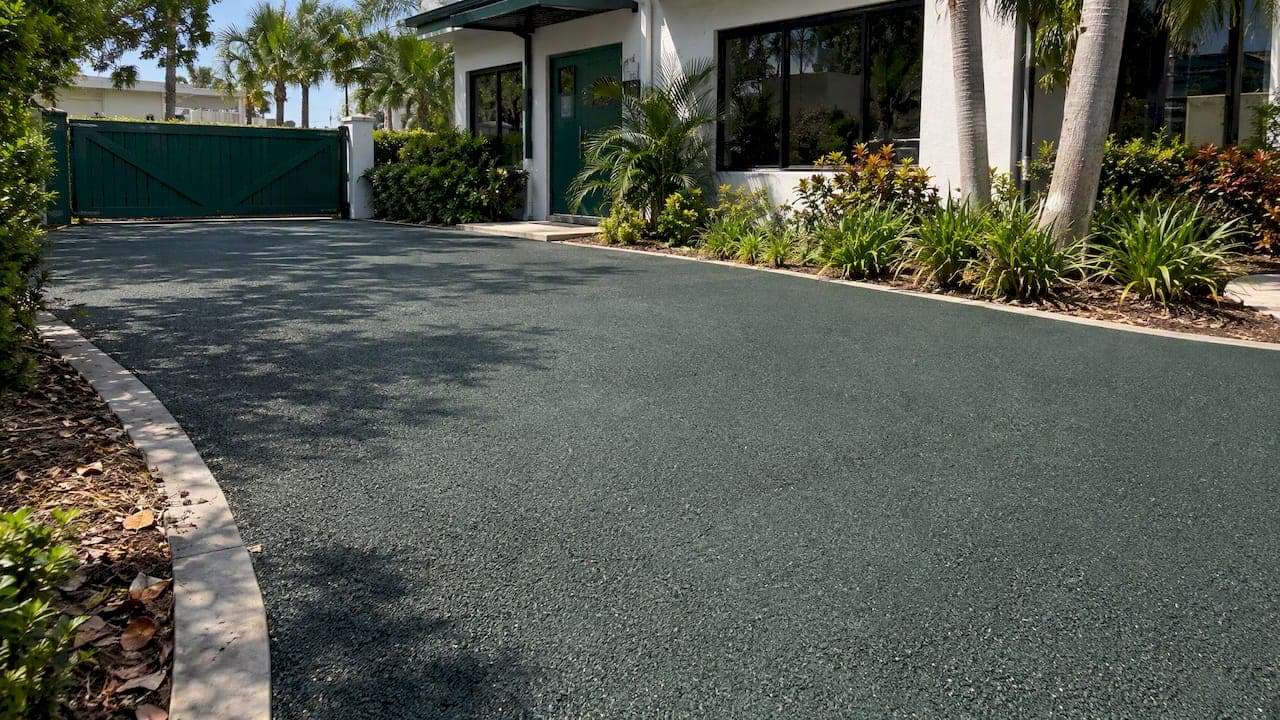
A cool driveway surface is one that stays cooler underfoot and sheds heat better than conventional dark asphalt. Three things decide that: how much sunlight the surface reflects, whether water can soak through and evaporate, and how the surface looks and holds up once it is installed. "Cool" can also mean stylish, so we cover both: the surfaces that stay comfortable in Florida-style sun, and the finishes that look good doing it.
TL;DR
- Reflectivity (albedo) is the main driver of how hot a pavement gets, so lighter colors run cooler than dark asphalt.
- Permeable surfaces let water through and can cool as that water evaporates, and they cut runoff too.
- Do not seal porous surfaces: sealant closes the voids and can make them fail.
- If the driveway connects to a public or accessible route, check slope, surface and gaps against ADA rules before you pick a finish.
- Rubber paving with a porous design is a strong fit for Florida pool decks, driveways and community paths, and we install it.
Table of Contents
- What actually makes a driveway surface cool
- Driveway surfaces compared
- Cool looks: finishes that make a driveway stand out
- Why drainage belongs in the cool driveway conversation
- Maintenance and lifespan: the part brochures skip
- If the driveway is part of an accessible route
- Our perspective on cool driveway surfaces
- How to pick the right surface: a short checklist
- Talk to us about your project
- FAQ
- Sources
What actually makes a driveway surface cool
There is no official "cool driveway" label. The U.S. EPA treats cool as a performance idea, not a single material. Cool pavements reflect more solar energy, enhance water evaporation, or are otherwise modified to remain cooler than conventional pavements. In an Arizona pilot the agency describes, conventional paving reached up to 152°F at midday, while the cool pavements tested ran 10 to 16°F cooler.
That gives you two levers to pull.
Reflectivity. The EPA's compendium on urban heat islands says solar reflectance, or albedo, is the main determinant of a pavement's maximum surface temperature. A pale surface bounces more sun back. A black one soaks it up.
Evaporation. The same compendium notes that permeable pavements can cool when wet through evaporation. After a summer thunderstorm, a surface that drinks the water will shed heat in a way a sealed slab cannot.
So when you compare surfaces, ask three questions. How light can the color go? Does water pass through? And what does it take to keep it that way for years?
Driveway surfaces compared
Here is how the common options stack up for heat, drainage and upkeep. The cost figures are indicative U.S. ranges, and your local quotes will differ.
| Surface | Heat behavior | Drainage | Upkeep | Indicative cost per sq ft |
|---|---|---|---|---|
| Asphalt | Dark, holds heat | Sheds water to the edges, may need stormwater systems | Regular sealing | $3 to $4 before stormwater systems, $7 to $15 with them |
| Plain or colored concrete | Lighter colors reflect more | Impervious | Low, per This Old House | $4 to $7, material only |
| Interlocking pavers | Cooler than asphalt, many colors | Water passes through the joints | Joints can clog | $6 to $15 |
| Gravel | Light stone stays moderate | Water runs off readily | Raking, topping up | $1 to $3, material only |
| Porous concrete | Light, plus evaporation | Water passes through | Needs vacuum sweeping | $4 to $6 |
| Porous rubber paving | Color range, water passes through | Built for infiltration | No sealing | Quoted per project |
Rutgers adds a useful point on price. Its manual says cost comparisons should include stormwater management, because asphalt may need additional systems. A cheap square foot of asphalt can become an expensive one once drainage is added.
Cool looks: finishes that make a driveway stand out
Many searchers mean "cool" as in good-looking. The ranking pages are full of ideas, and most come down to a handful of finishes.
Decorative concrete
This Old House lists pigmented or acid-stained concrete, stamping that mimics cobblestone, slate or brick, and exposed aggregate as the decorative routes. Plain concrete is smooth, level and low-maintenance. The tradeoff is that it is impervious and, in dark tones, can get hot.
Pavers
Cornell's guide says pavers come in many colors and patterns and are cooler than asphalt. They are a good choice if you want a patterned, classic look. Cost swings widely, from modest brick to premium stone.

Gravel
Gravel is the cheapest way to get a natural look, and water drains through it easily. The catch is movement: stones migrate, wheelchairs and strollers struggle on loose stone, and you will rake it. Angular crushed stone locks together better than rounded pea gravel, so if you go this way, ask your supplier about the stone for your traffic and slope.
Porous rubber paving
Rubber paving made from recycled tire material gives you a seamless, slightly soft surface in a wide range of colors. It is a different category from the options above: it is poured and troweled in place rather than laid unit by unit, and the porous versions let water pass straight down. We cover it in detail below.
Why drainage belongs in the cool driveway conversation
Heat and water are linked in Florida. Standing water after a downpour means a hot, slippery, mosquito-friendly surface. Permeable pavement helps with all three.
The EPA says permeable options include pervious asphalt, pervious concrete, interlocking pavers and plastic grid pavers, and that they let rain and snowmelt infiltrate the soil and gravel below, reducing runoff and filtering pollutants. Rutgers adds that pervious hardscapes help recharge groundwater, mitigate heat islands, and can reduce replacement and maintenance costs compared with conventional impervious surfaces.
If your driveway floods or your pool deck puddles, our guide to outdoor paving drainage solutions walks through the options. Engineers and HOA boards weighing larger sites can read about stormwater management paving solutions.
Maintenance and lifespan: the part brochures skip
Permeable surfaces are not maintenance-free, and the type matters.
- Lifespan. Virginia Cooperative Extension says properly maintained permeable pavement generally lasts 20 to 30 years or more. University of Maryland Extension gives approximately 20 to 25 years and notes these surfaces generally do not need resealing.
- Clogging. Virginia Cooperative Extension says porous asphalt, pervious concrete and interlocking pavers generally need more maintenance than grid systems because their voids can clog.
- Care routine. Maryland Extension says permeable hardscapes need trained installation and regular maintenance, including inspection after major storms and vacuum sweeping to remove clogs and sediment.
How do you seal a driveway?
It depends on the surface. Asphalt gets periodic sealing. Porous surfaces do not: Virginia Cooperative Extension warns that sealant closes the spaces in pervious concrete or porous asphalt and can cause the pavement to fail. If you plan a permeable driveway, treat "never seal" as a rule, and keep contractors from applying a sealer as an upsell.
If the driveway is part of an accessible route
Homeowners can skip this section, but municipalities, HOAs and businesses cannot. A driveway or path that forms part of an accessible route has to meet ADA requirements, and a good-looking surface that fails them is an expensive mistake.
The Access Board's accessible routes chapter lists what to check: running slope no steeper than 1:20, cross slope no steeper than 1:48, compliant floor and ground surfaces, clearances and changes in level. Its guide on ground surfaces adds that openings in accessible ground surfaces must be no wider than 1/2 inch. It also says level changes up to 1/4 inch may be vertical, changes up to 1/2 inch must be beveled no steeper than 1:2, and bigger changes need a ramp or other compliant treatment.
This is where loose gravel and wide-jointed pavers can fall short, and where a continuous, firm, porous surface helps. We explain how this works in practice in how rubber paving meets ADA standards. For your specific project, have your architect or accessibility consultant confirm slopes and details against the current standards before you sign off.

Our perspective on cool driveway surfaces
We only install rubber paving, so we are not going to tell you rubber is right for every driveway. We will tell you where it earns its place.
Florida punishes surfaces in two ways: heat and water. Asphalt softens and cracks, concrete cracks and ponds, and loose materials wash out. Our Rubberway® system uses recycled tire material, a porous design that drains, crack resistance for heat and weather swings, and a broad color palette. That palette matters for heat: since reflectivity drives surface temperature, color choice is a real design decision, not decoration. When you plan a project with us, ask about lighter tones for sun-exposed areas like pool decks and driveways.
Our rule is to be straight about the fit. Rubber paving works especially well on pool decks, patios, walkways, trails, municipal parks, sidewalks and HOA common areas, where a softer, seamless, ADA-friendly surface and good drainage count. For a driveway, the right answer depends on traffic, base conditions and how close you are to the coast; our write-up on rubber driveways for coastal homes covers that. Whatever the material, the installation is where most failures begin, which is why we put so much weight on surface preparation and on weather timing.
— Roger
How to pick the right surface: a short checklist
- Start with the heat exposure. Full sun all afternoon? Prioritize lighter colors and permeable surfaces.
- Check the water. Does the site pond, or does it sit near a drainage easement? Permeable paving can reduce runoff, and for larger sites it may ease stormwater requirements.
- Decide on upkeep. Be honest about whether you will sweep, rake or reseal. A surface you will not maintain is the wrong surface.
- Test accessibility. If the surface touches a public route, check slope, surface and gaps against the Access Board's rules.
- Look at the whole cost. Include base work, drainage, maintenance and replacement, not only the per-square-foot price.
- Ask for a sample in the sun. Look at the actual color outside at midday, not under showroom lights.
Talk to us about your project
EcoTec Rubber Paving is licensed and insured and focused exclusively on rubber paving in Florida. We install the Rubberway® lineup: Pervious Pavement, Rubberrock 6000, EVOLUTION and the Sidewalk System, and we provide government-ready documentation for municipal work. If you are a homeowner, HOA board or city planning a pool deck, walkway, trail or driveway, request a professional rubber paving installation quote and tell us about your site. We will say plainly whether rubber suits it. For community areas, our notes on reducing community maintenance are a good place to start, and our overview of rubberised paving explains the basics.
FAQ
What is the coolest driveway surface?
There is no single answer, because cool is a performance concept, not a certified material. Light-colored, reflective surfaces and permeable surfaces that cool through evaporation tend to stay cooler than conventional dark asphalt. Ask for a sample of the actual color and look at it in direct sun.
What is the latest trend in driveways?
Mixing materials and going permeable are both popular, such as pavers or grid systems combined with planting or stone. Decorative concrete finishes like stamping and exposed aggregate remain common too. In Florida, drainage and heat are pushing more owners toward porous surfaces.
What are the different types of driveway surfaces?
The main ones are asphalt, concrete, pavers, gravel, porous concrete or asphalt, and porous rubber paving. They differ in heat, drainage, upkeep and price, as the comparison table above shows. Pick based on your sun exposure, water issues and tolerance for maintenance.
Do I need to seal a permeable driveway?
No. Extension guidance says permeable surfaces generally do not need resealing, and sealant can clog the voids in pervious concrete and porous asphalt. Keep them clean with sweeping and vacuuming instead, especially after major storms.
Sources
- Using Cool Pavements to Reduce Heat Islands, US EPA
- Reducing Urban Heat Islands: Compendium of Strategies, Cool Pavements, US EPA
- Soak Up the Rain: Permeable Pavement, US EPA
- NR Pervious Hardscape Materials, NJ Green Building Manual, Rutgers
- Stormwater Management for Homeowners Fact Sheet 3, Virginia Cooperative Extension
- Permeable Hardscapes, University of Maryland Extension
- How to Choose a Driveway Surface, Cornell
- Determining Which Driveway Surface is Best for You, This Old House
- What Are the Best Driveway Materials?, U.S. News
- Chapter 4: Accessible Routes, U.S. Access Board
- Floor and Ground Surfaces, U.S. Access Board