
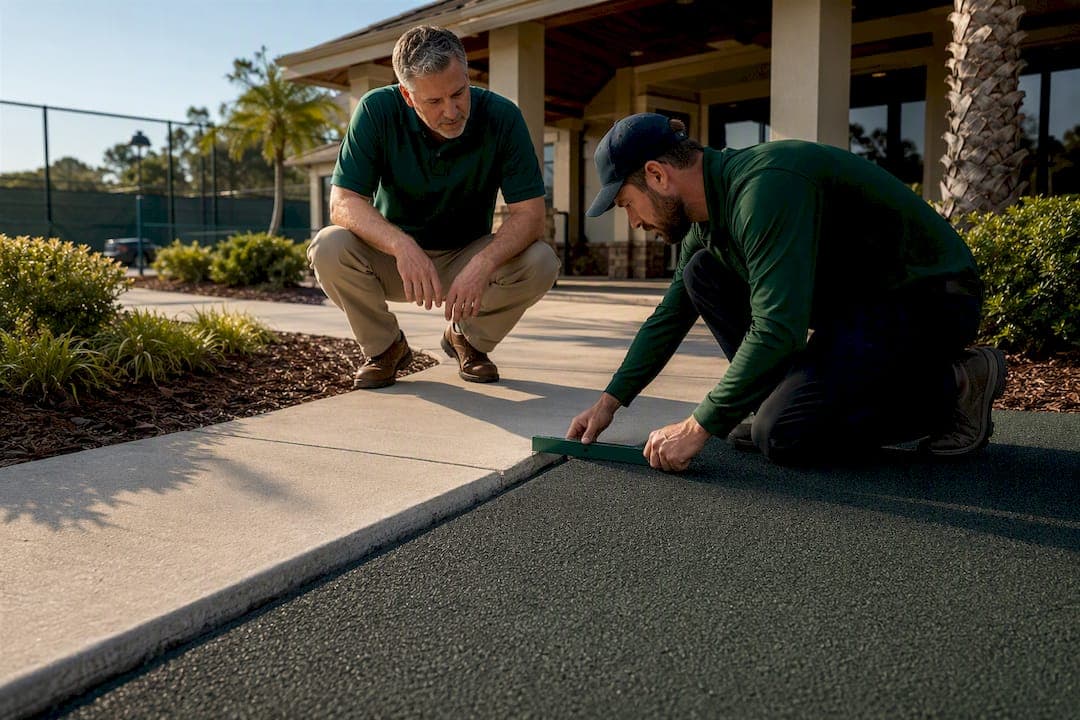
For clubhouse and court-side walkways that need durability, slip resistance, and accessible routes, a porous recycled-rubber surface in the style of Rubberway® is the recommended choice. It handles heavy foot traffic, sheds water instead of pooling it, and meets ADA firmness and slip-resistance expectations when specified correctly. The catch: none of that happens unless the drainage and base underneath are designed and installed right.
TL;DR:
- Proper drainage, base stability, and site grading are essential for porous rubber walkways to function correctly and prevent ponding or failure.
- Full installation verification, including slope and firmness testing, must occur post-placement to ensure ADA compliance and drainage performance.
- Cost and lifespan vary significantly based on site conditions, with deeper excavations, drainage systems, and transitions increasing the total project scope.
- Regular maintenance like sweeping and early repairs are critical to preserving permeability and preventing costly damages over time.
- Material choice involves trade-offs, with porous rubber offering superior flexibility, slip resistance, and environmental benefits when installed on an engineered system.
Table of Contents
- What Makes a Porous Rubber Walkway Surface Work for Clubhouses
- Site and Installation Checklist Before You Sign a Contract
- ADA Route Requirements Your Walkway Has to Hit After Installation
- Why Porous Performance Depends on the Whole System, Not Just the Top Layer
- Maintenance Routines That Keep Porous Rubber Performing
- Bid Comparison Checklist for Procurement Committees
- Why There's No Single Per-Square-Foot Price for This Job
- Comparing Walkway Materials Beyond Rubber
- Environmental Trade-offs Worth Weighing in the Material Decision
- How Weather and Seasons Affect a Rubber Walkway's Performance
- Safety Features That Matter Beyond Slip Resistance
- How Long Different Walkway Materials Actually Last
- Designing a Walkway That Fits the Clubhouse, Not Just the Budget
- What I've Learned Fixing Walkways That Were Installed Wrong the First Time
- Request a Rubberway® Walkway Assessment from EcoTec Rubber Paving
- Sources
- FAQ
What Makes a Porous Rubber Walkway Surface Work for Clubhouses
Porous recycled-rubber paving is a bound aggregate of shredded tire rubber laid over an engineered base that lets water pass through rather than sheet across the surface. Rubberway® is one system built this way, and it illustrates what the category can do when the substrate underneath is designed to match it.
The appeal for clubhouse settings comes down to a short list of practical wins:
- Permeability that reduces surface ponding near entries and courtside gates, though the actual infiltration rate depends on the subbase, not just the top layer.
- Slip resistance that holds up wet or dry, which matters on paths that see sunscreen, sweat, and sprinkler overspray.
- Shock absorption that's easier on joints than concrete, a small but real perk for aging members and staff on their feet all day.
- Crack resistance in heat and freeze-thaw cycles, since rubber flexes where concrete and asphalt split.
- Recycled tire content and a range of color and border options that let the walkway match clubhouse branding instead of looking like a municipal afterthought.
The failure modes are just as predictable: a weak base, ponding at low points, roof downspouts dumping straight onto the path, or a clumsy transition into existing concrete. Rubber doesn't fix bad grading. It just makes the mistake more visible.
Site and Installation Checklist Before You Sign a Contract
A walkway installation lives or dies on decisions made before the rubber ever gets mixed. Walk the site with your contractor and confirm each of these:
- Survey the route. Map every accessible path, note existing widths, door thresholds, and whether service carts or maintenance vehicles will cross the walkway.
- Verify the subgrade and base design. Ask for the geotechnical basis behind the stone reservoir depth, the geotextile layer, and whether underdrains are needed given local soil drainage.
- Detail the edge restraints. Unrestrained edges are one of the fastest ways a porous walkway starts to migrate or separate at the perimeter.
- Plan every transition. Door thresholds, curb ramps, and joins to existing concrete or asphalt need their own detail drawings, not a verbal promise.
- Route the downspouts. Decide now whether roof drainage ties into the porous system or gets diverted around it entirely.
- Request full documentation. Drawings, a phasing plan if the clubhouse stays open during work, a written maintenance plan, warranty terms, and a plan for installed-condition verification before final payment.
Pro Tip: Ask your contractor to walk the site with you and physically point out where water goes during a heavy rain before any digging starts. If nobody can answer that question, the design isn't finished yet.
ADA Route Requirements Your Walkway Has to Hit After Installation
ADA compliance for a clubhouse walkway isn't a design intention. It's a measurable, installed-condition outcome, and the numbers are specific. Accessible routes must have running and cross slopes that meet ADA maximum steepness requirements specified by the Access Board, and the Access Board's Chapter 4 standards require the walking surface itself to be stable, firm, and slip resistant.
Beyond slope, a handful of dimensional and material items decide whether a finished path actually passes:
- Clear width sufficient for wheelchair passage, generally with 48-inch clear areas at key points and 36-inch minimum landings where routes meet doors or ramps.
- Firmness and slip resistance documented after installation, not assumed from a manufacturer's spec sheet, since the PROWAG technical requirements treat these as performance standards the finished surface must meet.
- Edge protection at drop-offs and careful curb ramp geometry anywhere the walkway meets a parking area or street.
The 2010 ADA Standards require accessible routes to connect every area of sport activity, and when a facility is being altered rather than built new, disproportionate-cost provisions determine how far that obligation extends. Get the installed-condition sign-off in writing. A slope measurement taken after the rubber cures is worth more than any brochure claim.
Why Porous Performance Depends on the Whole System, Not Just the Top Layer
A porous rubber surface can look perfect and still fail to drain, because permeability is a property of the entire pavement system, not the wear layer alone. The FHWA's guidance on porous pavements with stone reservoirs makes clear that subbase design, underdrains, and overflow paths all have to work together, and that same logic applies directly to porous rubber walkways.
A few site conditions change the design math significantly:
- A high water table or nearby sensitive water bodies may push the design toward an underdrained system rather than one relying on full infiltration, and local stormwater authorities often require a permit review before you can rely on infiltration credits at all.
- Construction sequencing matters more than most owners expect. Heavy equipment compacting the subgrade during other site work can quietly kill the infiltration rate before the walkway is even installed.
- Maintenance is part of the drainage design, not an afterthought. Regular vacuuming or sweeping keeps the pores from clogging with sediment and organic debris, which is exactly why the FHWA groups cleaning schedules with construction guidance rather than treating them separately.
If your HOA or municipality already has stormwater rules on the books, read them before finalizing the walkway design, not after. Local ordinances shape what counts as compliant drainage, and how stormwater rules affect paving choices is worth understanding before you're locked into a design that a reviewer rejects.
Maintenance Routines That Keep Porous Rubber Performing
A porous rubber walkway isn't maintenance-free, but it's low-maintenance compared to resealing asphalt or patching cracked concrete. The routine is straightforward if you stick to it.
- Vacuum or sweep on a schedule tied to your site's debris load. The FHWA's porous pavement guidance points to vacuuming several times per year as recommended by FHWA guidance as a reasonable baseline, and a heavily landscaped clubhouse with mature trees will need the higher end of that range.
- Inspect quarterly for ponding, clogged pores, and edge separation. Catching a small edge gap early costs a fraction of a full-section repair later.
- Watch transitions and high-wear zones near entry doors and gate thresholds, where foot traffic concentrates.
- Flag any localized wear or discoloration and ask your contractor how they handle spot repairs versus section replacement.
Most early failures trace back to the same three causes: ponding nobody fixed, a substrate that was never properly compacted, or a downspout still draining straight onto the path. Get your contractor's repair procedure and warranty response time in writing before you need either one.
Pro Tip: Keep a simple maintenance log with photos taken every quarter. When you eventually need warranty service, dated photos showing routine upkeep make the claim conversation a lot shorter.
Bid Comparison Checklist for Procurement Committees
Comparing rubber walkway bids side by side is nearly impossible if each contractor quotes a single lump-sum number. Insist on line-item pricing broken out by category:
- Demolition and site prep, priced separately from everything else.
- Base and subgrade work, including any stone reservoir or geotextile.
- Drainage and underdrain installation, if the site requires it.
- Surface installation itself, including material and labor.
- Transitions, edge restraints, and cleanup.
An installer who won't separate ponding fixes, base repair, and drainage work from the surface price is asking you to buy blind. Require installed-condition verification as a contract condition: documented slope checks, photos of every edge and transition, and signed acceptance before final payment releases. Confirm insurance, licensing, warranty terms, a written maintenance plan, and references from comparable installs, ideally at another clubhouse or municipal facility rather than a residential driveway.
Sample contract language should spell out a detailed scope, a defined change-order process, and a payment holdback tied specifically to verification sign-off, not just substantial completion. Reading through how to evaluate eco-friendly paving vendor bids before you send out an RFP will save you from comparing quotes that aren't actually comparable.
Why There's No Single Per-Square-Foot Price for This Job
Anyone quoting a flat per-square-foot number for a clubhouse walkway before seeing the site is guessing. Total installed cost depends on how much base repair the site needs, whether drainage work or underdrains are required, how many transitions and curb ramps the route crosses, and how much demolition of existing concrete or asphalt has to happen first.
Two clubhouses with the same square footage of finished walkway can land in very different cost brackets. One with a well-drained, previously graded site might need minimal base correction. Another sitting on heavy clay with a high water table could require underdrains and a deeper stone reservoir before a single square foot of rubber goes down. That difference shows up in the bid, not in the marketing material.
This is exactly why a scoped site assessment matters more than a rate card. A budgeting guide for rubber driveway costs explains the same principle for residential work: installed cost tracks total scope, not surface area alone. The same logic applies at clubhouse scale, just with more variables in play, including phasing around active courts and clubhouse operating hours.
Schedule follows the same pattern. A straightforward resurfacing over an already-sound base might take days. A full base rebuild with drainage corrections and multiple transitions can stretch into weeks, particularly if the project has to work around tournament schedules or clubhouse events. Ask any bidder for a realistic timeline tied to their specific scope of work, not a generic estimate.

Comparing Walkway Materials Beyond Rubber
Concrete, asphalt, pavers, and porous rubber each solve the clubhouse walkway problem differently, and each comes with a trade-off worth naming plainly.
Poured concrete is familiar, relatively inexpensive per square foot up front, and easy for most contractors to install. It cracks under Florida's heat and freeze-thaw stress elsewhere, drains poorly unless pitched carefully, and repairs show as visible patches that rarely match the original pour.
Asphalt costs less initially and installs quickly, but it softens in extreme heat, holds standing water without a crown or drainage design, and needs periodic sealcoating that adds to lifetime cost. It's also a poor match for ADA slip-resistance expectations once it wears smooth.
Pavers offer strong aesthetics and can be pervious if installed with open joints and a proper base, but individual units shift over time, creating trip hazards at joints, and full ADA compliance requires tight tolerances that are easy to lose after a season of ground movement.
Porous recycled rubber, the Rubberway® category among them, costs more up front than basic asphalt but delivers better slip resistance, flexes instead of cracking, and drains as a designed system when the base is done right. The trade-off is that it demands more attention to subgrade and drainage during installation. Skip that step with any material and you'll pay for it in repairs regardless of what's on top. For a broader look at slip-resistant options across use cases, this guide to slip-resistant community walkway types breaks down the tradeoffs further.

Environmental Trade-offs Worth Weighing in the Material Decision
Recycled rubber walkways divert used tires from landfills, and that recycled content is a genuine environmental point in the material's favor. It's not the only factor a committee should weigh, though.
Porous surfaces reduce stormwater runoff volume compared to impervious concrete or asphalt, which matters directly for HOAs and municipalities facing stormwater management requirements or seeking credits under local ordinances. A permeable paving guide for HOA stormwater rules covers how that credit process typically works.
Manufacturing and shipping distance matter too. A rubber system sourced and fabricated closer to the installation site carries a smaller transportation footprint than material shipped across the country. Ask your contractor where the rubber comes from and how it's processed before assuming "recycled" automatically means "low-impact."
Longevity is itself a sustainability metric that's easy to overlook. A surface that lasts 15 years without a full tear-out and replacement produces less waste over its lifetime than one that needs replacing every 7 years, even if the shorter-lived material had a lower embodied-carbon footprint at installation. Weigh total lifecycle impact, not just the material's origin story.
How Weather and Seasons Affect a Rubber Walkway's Performance
Heat is the biggest seasonal stress test for any outdoor walkway surface, and it's where rubber earns its keep against rigid materials. Concrete and asphalt expand and contract with temperature swings, and repeated cycles open cracks that widen every year. Rubber's flexibility absorbs more of that movement without splitting.
Heavy rain is the second test, and it's entirely a drainage-design question rather than a surface-material one. A well-built porous system sheds a downpour within minutes; a poorly built one ponds regardless of what's on top, rubber included.
Cold climates bring freeze-thaw cycling, where water trapped in a saturated base expands and heaves the surface above it. A properly drained porous system reduces that risk because water doesn't sit in the base long enough to freeze in place. Leaf litter and pollen loads spike in fall and spring near landscaped clubhouse grounds, which is exactly when vacuuming frequency should increase rather than stay on a fixed annual schedule. Match your maintenance calendar to what's actually falling on the path that season, not a generic checklist.
Safety Features That Matter Beyond Slip Resistance
Slip resistance gets most of the attention in walkway design, but a handful of other safety details separate a well-planned clubhouse path from a liability waiting to happen.
Visibility markings at transitions, curb ramps, and changes in elevation help members with low vision or in low light identify where the walking surface changes. A contrasting border color at a curb ramp edge, for instance, does real work for almost no added cost.
Lighting along the route matters just as much, particularly for clubhouses that host evening events or early-morning court sessions. A walkway that's ADA-compliant in daylight but unlit at 7 p.m. still creates a real fall risk. Coordinate lighting placement with the walkway design phase rather than adding fixtures as an afterthought once the path is finished.
Edge definition at drop-offs, planting beds, or grade changes prevents wandering off the accessible route, especially for users with mobility devices who need a clear tactile or visual boundary. Combined with the slope and firmness requirements covered earlier, these details round out a walkway that's genuinely safe to use, not just technically compliant on paper. A guide on how rubber paving meets ADA standards digs deeper into how these details get specified in construction documents.
How Long Different Walkway Materials Actually Last
Lifespan expectations vary widely by material and, just as much, by how well the base was built underneath each one.
Poured concrete typically lasts 20 to 30 years structurally, but visible cracking and surface spelling often start well before that, especially in climates with heavy freeze-thaw cycling or expansive soils. Asphalt paths generally need resurfacing every 10 to 15 years and full replacement sooner if drainage was never corrected.
Porous rubber systems, installed over a properly engineered base, are built to handle decades of foot traffic, and their flexibility means they don't develop the same structural cracking that ends concrete's service life early. The honest caveat: a rubber surface installed over an inadequate base won't outlast asphalt over the same bad base. Material choice only pays off when the engineering underneath matches it.
Committees budgeting for a clubhouse walkway should ask every bidder for realistic lifespan expectations tied to their specific base design, not a generic industry number pulled from a brochure.
Designing a Walkway That Fits the Clubhouse, Not Just the Budget
A tennis clubhouse walkway is as much a design element as it is infrastructure. Members notice it every time they walk from the parking lot to the courts, and a path that looks like an industrial afterthought undercuts the polish of an otherwise well-kept facility.
Color and border options let porous rubber walkways echo clubhouse branding, court surfacing, or a community's existing palette instead of defaulting to plain gray. A border in a contrasting tone can double as the visibility marking mentioned earlier, solving two problems with one design decision.
Landscape integration matters too. Walkways that curve naturally around existing trees and planting beds, rather than forcing a straight line through them, tend to age better because root systems don't fight the base as aggressively. Coordinate with your landscape plan before finalizing the walkway route, not after the hardscape is already poured.
Width and flow deserve attention beyond the ADA minimums. A path wide enough for two people to pass comfortably, with clear sightlines to entries and seating areas, reads as intentional design rather than a compliance checkbox. Facilities weighing broader site planning alongside the walkway redesign may find value in an urban infrastructure planning resource that covers how pathway networks integrate with stormwater modeling at a larger scale.
What I've Learned Fixing Walkways That Were Installed Wrong the First Time
Most of the walkway problems I get called out to look at were decided before the first bag of rubber showed up. A downspout dumping onto a path that was never designed to take that volume. A base that got compacted by heavy equipment before the drainage layer went in. A transition detail nobody drew before it got poured.
The fix is almost always the same: correct the base and drainage, then reinstall the surface, and budget for that correction work from day one instead of treating it as a change order. Insist on installed-condition sign-off before final payment. If a contractor won't document slope and firmness after the work is done, ask why not. If you're planning a clubhouse walkway project and want a scoped site assessment before you commit to a design, that conversation is worth having early.
— Roger
Request a Rubberway® Walkway Assessment from EcoTec Rubber Paving
Skip the guessing games on drainage and base design. We build porous, ADA-aware walkway systems using a recycled rubber platform, with custom color and border options, installed by licensed and insured crews specializing in rubber paving.
When you request a bid, ask Ecotecrubber for a full site survey, a drainage evaluation that accounts for your specific soil and water table conditions, installed-condition verification before final payment, and a written maintenance plan tailored to your landscaping and foot traffic. Explore the Rubberway® product line to compare the Pervious Pavement, Rubberrock 6000, and EVOLUTION systems, then start the conversation on your clubhouse walkway installation with a scoped assessment instead of a rough per-square-foot guess.
Sources
- Chapter 4: Accessible Routes (Access Board)
- Porous Asphalt Pavements with Stone Reservoirs (FHWA)
- 2010 ADA Standards for Accessible Design (DOJ)
FAQ
Is Porous Rubber Paving ADA Compliant?
Porous rubber paving can meet ADA requirements when it's installed with a running slope no steeper than 1:20, a cross slope no steeper than 1:48, and documented firmness and slip resistance, per the Access Board's accessible route standards. Compliance is an installed-condition outcome, so always require verification after installation rather than relying on product specifications alone.
How Often Does a Porous Rubber Walkway Need Cleaning?
Vacuuming or sweeping two to four times a year is a reasonable baseline according to FHWA porous pavement guidance, though sites with heavy leaf litter or landscaping debris often need the higher end of that range. Skipping this maintenance is one of the fastest ways to lose the surface's drainage performance.
What Does a Rubber Clubhouse Walkway Cost?
There's no universal per-square-foot price, since total cost depends on base repair needs, drainage requirements, and how many transitions the route crosses. Ecotecrubber does not publish flat pricing; request a scoped site assessment for a quote specific to your clubhouse layout.
What's the Difference Between Rubber and Concrete for Clubhouse Walkways?
Rubber flexes with temperature swings and resists the cracking that concrete develops over freeze-thaw cycles and heat exposure, while remaining slip resistant when wet. Concrete costs less initially but tends to need patch repairs sooner and doesn't drain unless pitched and maintained carefully.
Who Installs Rubberway® Walkway Systems?
There are licensed and insured contractors who specialize exclusively in rubber paving and install Rubberway® pervious pavement systems, including the Rubberrock 6000 and EVOLUTION product lines. Visit the products page for details on each system before requesting a bid.