
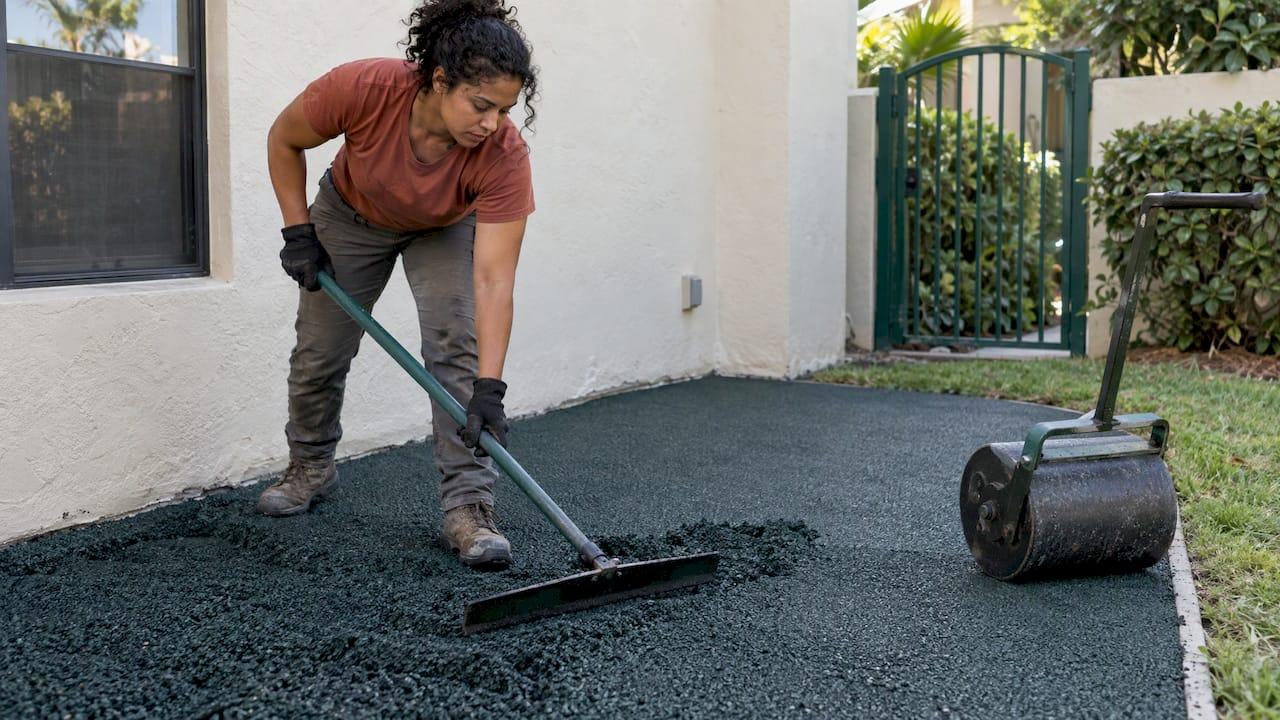
Fast-curing rubber paving is a bound rubber surface, usually recycled rubber granules held together by a polyurethane binder, that is formulated or scheduled so each layer can be applied and walked on sooner than with traditional paving. Most residential jobs finish in a few days. Foot traffic typically comes within 24 to 48 hours and vehicles later. The real speed limiter is rarely the binder. It is the condition of the base, the temperature, the moisture and the weather on the day.
This guide explains what the term means, which surfaces it can go over, what conditions a crew needs, how the layers go down, and how to tell when a surface is ready for use.
TL;DR
- Fast curing depends on the base and the weather as much as the product: new asphalt needs 14 days and new concrete 28 days of cure before surfacing, per manufacturer specifications.
- Typical minimums for polyurethane-bound systems are 50°F and rising for full-pour work, a substrate under 75% relative humidity, and no rain, wind gusts or frost in the window.
- A typical residential install runs through six steps, and a driveway usually needs a longer wait before vehicles than a patio needs before feet.
- Florida's heat and humidity make scheduling matter: early starts, dry forecasts and a moisture-tested base.
- We install the Rubberway® system across Florida and plan the schedule around your surface and site.
Table of Contents
- What fast-curing rubber paving actually means
- Which existing surfaces it can go over
- The base decides your real timeline
- Weather and temperature: the conditions a crew needs
- Preparing the surface step by step
- How long installation takes and when you can use it
- Checking that the surface is ready
- Mistakes that slow a fast-curing job
- Why we install rubber paving this way
- Get a Rubberway® surface planned for your property
- FAQ
- Sources
What fast-curing rubber paving actually means
Rubber paving combines recycled rubber (often from tires) with a binder, then spreads and compacts or pours it into a flexible, porous or semi-porous surface. "Fast curing" refers to how quickly that binder sets so the next layer, or the owner, can use the surface.
Manufacturers of polyurethane-bound rubber systems publish "fast-track" installation procedures with tight windows between layers. One fast-track specification says to apply the base layer once the primer is tack-free, no later than 24 hours after priming, then the broadcast layer within 24 hours of the base curing, followed by two coats of aliphatic top coating. That is the logic of fast curing: layers go down in sequence without long idle gaps.
The word "fast" is relative. A binder that sets quickly still sits on a base that has its own cure requirements, so the schedule is the sum of both. The binder is one half of the story. Our overview of polyurethane binder in paving covers how it behaves.
Which existing surfaces it can go over
One of the reasons homeowners and property managers choose rubber paving is that it can be laid over a sound existing surface rather than requiring demolition. Installers commonly describe bonding to existing concrete, asphalt, wood and tile in marketing, but the condition of that surface decides whether it works.
In practice, the common candidates are:
- Concrete driveways, patios and pool decks with surface wear, staining or minor cracking.
- Asphalt driveways and paths that are structurally sound but faded or rough.
- Sidewalks and park trails where a more comfortable, slip-resistant or accessible surface is wanted.
What it cannot fix is a failing base. Major settlement, deep heaving or crumbling edges need repair first, because the rubber follows what is beneath it. Our page on surface prep goes deeper on this.
The base decides your real timeline
Before any rubber goes down, the base must be ready. Manufacturer specifications are consistent on this point.
| Base | Minimum cure before surfacing | Notes |
|---|---|---|
| New asphalt | 14 days | Per manufacturer specification |
| New concrete | 28 days | No concrete curing compounds allowed |
| Concrete above 75% RH | Not ready | Shot blast and apply moisture mitigation, per the installation guide |
The same installation guide says the existing surface must be clean, sound, dry and free of oils and other contaminants, and that concrete and asphalt are primed if required. If you are resurfacing an older slab, the 14 and 28 day clocks are long past, but the moisture and cleanliness requirements still apply.
This is where jobs lose days. A slab that looks dry on top can still read high on a moisture test, particularly in Florida where ground moisture and humidity are constant. Our guide to rubber paving in humid climates explains what that means for planning.
Weather and temperature: the conditions a crew needs
Cure speed for polyurethane-bound surfaces responds to temperature, moisture and dew point. The fast-track guide lists these limits:
- Minimum 50°F and rising for full-pour applications, and 60°F and rising for full-pour gel applications.
- Maximum substrate temperature of 104°F.
- Substrate moisture below 75% RH.
- Substrate at least 4 degrees above the dew point.
- No application in inclement weather.
Another fast-track specification adds that work should not begin if rain is imminent, winds are gusting or freezing is threatened within 24 hours. A separate manufacturer specification sets a floor of 40°F base temperature for rubberized topping.
For Florida this has practical consequences. Cold is rarely the issue. Heat is: a dark slab in July sun can exceed 104°F at the surface, which is why crews start early, and afternoon thunderstorms can close a window that opened at sunrise. Summer humidity can also push a substrate close to its dew point overnight. We cover the practical side in how weather affects rubber paving installation.
Preparing the surface step by step
A typical residential rubber paving job follows six steps: inspect the surface, clean it with a power washer, repair major settlement and fill deep cracks, install edge restraints, spread and compact the mix at 1 to 2 inches, then let the binder cure before traffic. Here is what each stage involves.

1. Inspect
Walk the surface after rain and note where water stands, where cracks run and whether edges are crumbling. Oil stains matter because oils interfere with bonding. This is the stage where a crew decides whether the base is sound enough or needs repair.

2. Clean
Pressure washing removes dirt, algae and loose material. Heavily stained driveways often benefit from a degreasing step first, and a dedicated outdoor cleaner for driveways can help lift general grime before the final wash. Then the surface must dry fully. Moisture is the usual reason a start gets pushed back a day.
3. Repair
Deep cracks are filled and settled areas corrected. Rubber is flexible, but it is not a structural repair.
4. Restrain the edges
Edge restraints keep the compacted material from migrating and give a clean finished line against lawns, pavers or garage slabs.
5. Prime where required
Primer is applied to concrete or asphalt where the system calls for it, and layers then follow within their recoat windows.
6. Place the surface
The rubber and binder mix is spread and compacted to the thickness the use requires. Walkways and patios can run thinner, while driveways that carry vehicles daily get the heavier spec. See rubber paving thickness by use for how that breaks down.
How long installation takes and when you can use it
For a typical residential job, one published guide puts the binder cure at 24 to 48 hours before foot traffic, with longer for vehicles. Treat that as a planning range, not a promise for any specific product or site.
What moves the number on your job:
- Temperature. Cooler, within the product's limits, generally slows set. Warm, dry days speed it, up to the substrate maximum.
- Moisture. A wet or humid substrate delays curing and can stop a start altogether.
- Thickness. A heavier driveway build holds more binder and takes longer than a thin patio layer.
- Layer count. Systems with a base, broadcast and top coat have windows between each step.
- Use. Foot traffic comes first, then light loads, then parked or turning vehicles.
A rough sequence for planning:
- Day of install: keep everyone off, including pets and children.
- Next day or two: light foot traffic once your installer clears it.
- After the longer wait your installer specifies: vehicles, furniture and planters.
For product-specific timing, your installer's written schedule governs. Our deeper article on cure time in rubber paving explains why.
Checking that the surface is ready
Readiness is more than "it feels dry." Look at three things.
Surface feel. The top coat or binder should be tack-free, with no transfer to a clean shoe or glove and no softness under pressure.
Drainage. One specification has the contractor flood the surface with water. If birdbaths deeper than 1/8 inch remain after 30 minutes on a 70°F day, the parties agree on a correction. That test is written for athletic surfaces, but the principle applies: standing water signals a grade issue worth fixing early.
Edges and transitions. Check that edge lines are firm and that transitions to other surfaces are flush, particularly on paths that must meet accessibility requirements. Our article on how rubber paving meets ADA standards covers those details.
Mistakes that slow a fast-curing job
- Surfacing a young base. New concrete under 28 days or new asphalt under 14 breaks the manufacturer's rules.
- Skipping a moisture reading. A slab above 75% RH needs mitigation before anything else.
- Working against the dew point. A substrate within 4 degrees of dew point invites moisture at the bond line.
- Starting ahead of a storm. Rain, gusts or frost within 24 hours are reasons to postpone.
- Missing the recoat window. When layers must go down within 24 hours of each other, crew scheduling matters.
- Opening to vehicles early. Impatience on day two is how tire marks and depressions happen.
Why we install rubber paving this way
We only do rubber paving, so scheduling is the part of the job we plan hardest. A fast surface is not one rushed past its base or its weather. It is one where the base was inspected, the moisture was checked and the crew was booked for a window that suits the product.
The Rubberway® system uses recycled tire material, a porous design for drainage, crack resistance for Florida heat, and ADA-compliant surfaces, so the speed you gain is not traded for durability. For municipalities and HOAs, we also provide government-ready documentation so approvals do not slow the schedule.
Our advice to every owner is the same: decide what the surface must do, then let the installer set the cure schedule in writing. That keeps everyone off the surface at the right times and the finished result looking as intended for years.
Roger
Get a Rubberway® surface planned for your property
We are licensed and insured and focus solely on rubber paving in Florida, for driveways, pool decks, patios, walkways, parks, trails, sidewalks and community areas. Our lines include Rubberway® Pervious Pavement, Rubberway Rubberrock 6000, Rubberway EVOLUTION and the Rubberway Sidewalk System, in a wide range of colors.
If you manage a property or own a home and want a realistic schedule for your surface, see our professional rubber paving installation page or browse the Rubberway® product lines to start a project conversation. For stormwater-minded projects, our porous rubber paving specs explain the drainage side.
FAQ
Can rubber paving go over my existing concrete driveway?
Often yes, if the slab is sound, clean and dry. Deep cracks and settlement are repaired first, and the surface should test at or below 75% RH. Concrete above that needs shot blasting and moisture mitigation before surfacing.
How soon can I walk on new rubber paving?
One published residential guide gives a 24 to 48 hour binder cure before foot traffic. Your installer's written schedule for your specific system and conditions is the one to follow.
How long before I can park on it?
Vehicles generally wait longer than foot traffic, and the wait grows with thickness and daily vehicle use. Driveways get the heavier build, so the installer will give you a date for the first vehicle on your project.
Does Florida weather affect curing?
Yes. Manufacturer guidance limits substrate temperature to 104°F and moisture to below 75% RH, and rules out work in rain or gusting wind. In Florida that means early starts and flexibility around afternoon storms.
Is fast-curing rubber paving ADA compliant?
It can be when designed and installed correctly. Our Rubberway® surfaces are made to be ADA-compliant, with slip resistance and smooth transitions planned into the project.
Sources
- Fast-track installation guide, polyurethane-bound rubber surfacing (2021)
- Fast-track specification, Rev. 2 (2015)
- Rubberized topping specification, M99
- Rubber Paving for Driveways and Patios: Durability, Cost, and Care
- OxiClean Outdoor Cleaner: Refresh Your Deck, Patio and Driveway