
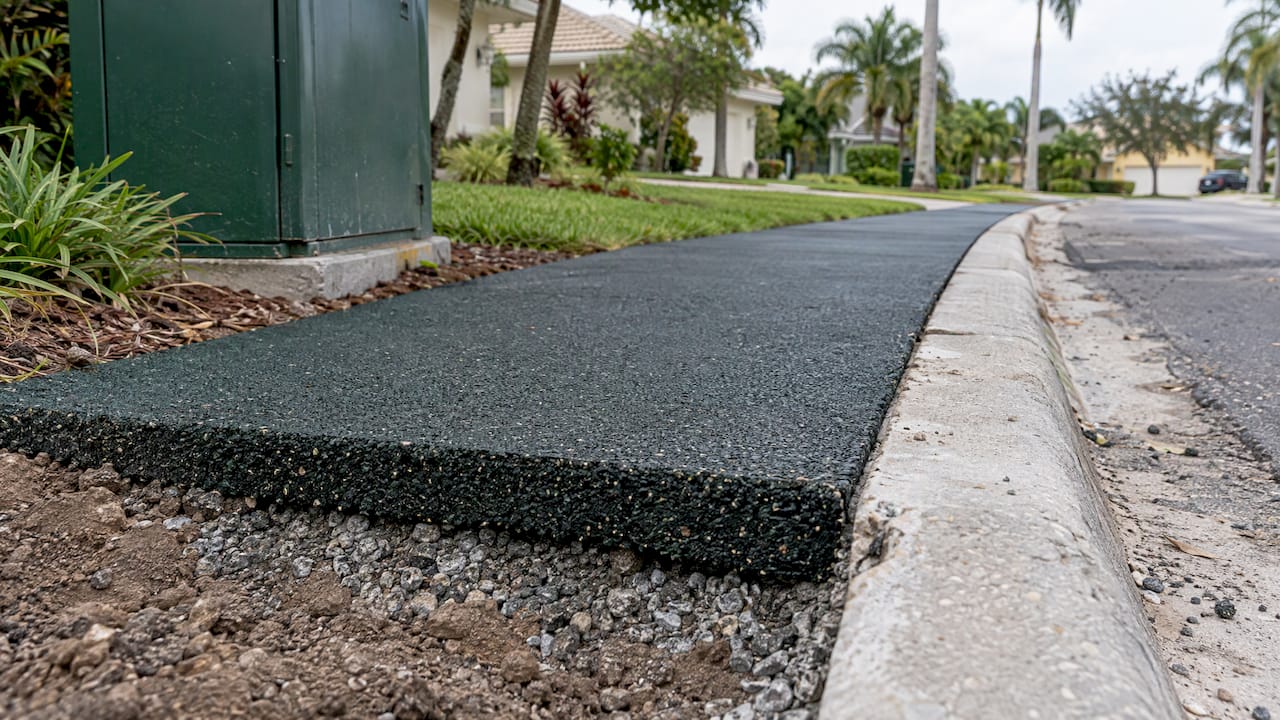
Most rubber sidewalks for foot traffic are built between 1 and 2 inches thick for pavers and tiles. Poured-in-place and pervious systems are specified by the project: by the base under them, the expected traffic and any fall-height or ADA requirements. Thickness on its own never makes a rubber path last. It works together with the stone base, drainage and installation conditions. Below you will find the ranges that show up in real specifications, what pushes a number up or down, and how to write a spec that a Florida board or city engineer can approve.
TL;DR
- Interlocking rubber pavers for patios, porches and walkways commonly come in 1 inch, 1⅜ inch and 1¾ inch thicknesses.
- Poured-in-place rubber is specified per project. One Florida park bid calls for a uniform 4.25 inches over a crushed stone sub-base.
- ADA does not set a minimum rubber thickness. It requires a stable, firm, slip-resistant surface and limits changes in level to 0.25 inch (0.5 inch if beveled).
- Base preparation, traffic type and installation temperature decide performance as much as the surface thickness does.
- Vehicle loads change the whole build, so ask for a written system spec rather than choosing a thickness by feel.
Table of Contents
- Typical rubber sidewalk thickness by product type
- How thick should a rubber sidewalk be for walking?
- What determines the thickness you need
- Does ADA set a minimum thickness for rubber?
- Can a rubber sidewalk handle vehicles?
- What goes wrong with the wrong build
- Writing a thickness spec for a public project
- Talk to us about your path
- FAQ
- Sources
Typical rubber sidewalk thickness by product type
Thickness depends on what kind of rubber surface you are buying. A paver, a tile, a rolled panel and a poured-in-place layer are different products, and comparing their numbers directly causes confusion.
| Surface type | Typical thickness | Typical use |
|---|---|---|
| Interlocking rubber pavers | 1 in, 1⅜ in, 1¾ in | Patios, porches, walkways |
| Rubber tiles | Often around 1 in or less | Playgrounds, decks, modular areas |
| Poured-in-place (PIP) | Varies by project, often 1 to 4+ in | Playgrounds, trails, parks |
| Pervious rubber and stone mix | Set by engineer's design | Sidewalks, trails, tree areas |
For patios and porches, one manufacturer recommends 1-inch, 1⅜-inch or 1¾-inch interlocking pavers, which stay together as temperatures cause expansion and contraction. That covers the pedestrian range most homeowners need.
Poured-in-place is different because you do not buy a thickness off a shelf. The crew mixes and pours it on site, so the depth is a design decision. A Walton County, Florida park project, for example, lists about 6,132 square feet of poured-in-place rubber at a uniform 4.25 inches, certified for an 8-foot fall height and laid over a crushed stone sub-base. That figure is driven by playground impact rules, not by walking comfort. A plain walkway rarely needs that much rubber.

If you want a broader product-by-product breakdown, our guide on what each use needs in rubber paving thickness goes through it use by use.
How thick should a rubber sidewalk be for walking?
For ordinary pedestrian traffic (people, strollers, wheelchairs, bikes), the surface layer on a well-built base does not have to be thick. The pavers in the 1 to 1¾ inch range above are designed for this kind of use.
Two things matter more than adding another half inch of rubber:
- A stable, compacted base. Rubber flexes. If the ground under it moves, the surface follows it.
- Consistent thickness across the path. Uneven depth creates lips and dips, which become trip points and, on public paths, accessibility problems.
Concrete sidewalk codes often quote minimum thicknesses in inches because concrete is a rigid slab that must carry its own load. Rubber does not work that way. Its strength comes from the system: surface, binder, aggregate and the base beneath. Comparing a rubber sidewalk to a code number for concrete will mislead you.
It is a bit like choosing stone. A supplier's guide on paving slab thickness rules makes the same point for rigid pavers: the right thickness depends on where the surface will be used, not on one universal number. Rubber follows that logic with its own ranges.
What determines the thickness you need
Five factors decide the number on the spec sheet.
Expected traffic
Foot traffic on a residential path is light. A municipal trail, a school route or a golf cart path sees concentrated, repeated loads. Heavier traffic points toward a thicker or more robust system, and toward a design from the installer rather than a catalog pick.
Base and sub-base
The depth and quality of the crushed stone base is a bigger lever than the rubber layer. Poured-in-place and pervious systems are normally specified over a compacted aggregate base, as in the Walton County example. Soft soil, tree roots and poor drainage all call for more preparation. We cover this in the role of surface prep in rubber paving success.
Drainage
Porous rubber paving lets water pass through to the base, so the base has to be designed to hold and release it. In Florida, where afternoon storms and a high water table are normal, that design matters. Our engineering note on porous rubber paving specs and drawdown goes into the detail.
Fall height (playgrounds and parks)
When a path runs through a play area, thickness is set by the critical fall height of the equipment, which is why a figure like 4.25 inches appears in park bids. A walkway on its own does not need it.
Overlay or new build
A thin rubber layer can sometimes finish an existing sound surface, while a full new sidewalk needs a base. Which one applies depends on the condition of what is underneath, and a site visit settles it.
Does ADA set a minimum thickness for rubber?
No. The ADA standards do not give a rubber thickness. They set performance rules for the route.
The Access Board explains that accessible floor and ground surfaces must be stable, firm and slip resistant. It also limits changes in level: up to 0.25 inch can be left as is, and up to 0.5 inch is allowed when beveled at a slope no steeper than 1:2.
What this means for thickness in practice:
- Where rubber meets concrete, a curb or a driveway apron, the finished heights must line up within those limits. Planning the rubber depth against the adjoining surface prevents an edge that fails.
- Surface texture and slip resistance are tested, not assumed. Our guide to ADA slip resistance requirements explains the documents owners should collect.
- For play areas, the IPEMA FAQ says poured-in-place surfacing is accessible when installed within ADA slope limits, and that manufacturers should provide ASTM F1951 test results from a qualified lab.
So the ADA question is about the finished path: level, firm, slip resistant and documented.
Can a rubber sidewalk handle vehicles?
Sometimes, but this is where thickness alone is the wrong question. A path that crosses a driveway, or a surface that a service truck will use, changes the base design, the surface system and the load rating. A 1-inch paver that works on a pool deck is not a driveway system.
What to do instead of guessing:
- Tell the installer exactly which vehicles will use the area: cars, golf carts, maintenance trucks, emergency access.
- Ask for the system build in writing: surface depth, base depth and material, and any reinforcement.
- On municipal and HOA projects, have the spec reviewed by your engineer of record.
Sidewalk crossings of driveways are treated separately in many local codes for concrete, so check your city's public works standards before you commit to a build-up.
What goes wrong with the wrong build
Thickness is only one part of the system, and installation conditions can undo a good spec. A longitudinal study of playground surfaces found that between 24 and 36 months some poured-in-place surfaces showed cracking and top-layer wear in high-traffic areas. At one site, the top granular layer flaked in small sections because the pour took place at 40°F and falling, not at the manufacturer's preferred 40°F and rising.
The lessons are practical:
- Pour in the right weather window. Temperature trend and moisture matter. Florida's heat and humidity create their own constraints, which we discuss in how weather affects rubber paving installation and rubber paving in humid climates.
- Respect cure time. Opening a path too early damages the surface. See cure time in rubber paving.
- Plan for wear zones. The IPEMA installation and maintenance guide says that in high-traffic spots wear mats can be embedded in the surface, and that upkeep can include roll coating, patching or re-topping.
Writing a thickness spec for a public project
Cities already write this in bids. The City of Mary Esther, Florida requested bids for poured-in-place pervious rubber pavement for trails and sidewalks, asking for ADA compliance, a warranty of at least 10 years and a lead-free, non-toxic, no-heavy-metal-leaching material. Notice what the bid focuses on: performance, warranty and materials.
A good spec for a rubber sidewalk usually covers:
- Surface type and the system name.
- Finished thickness and tolerance, with the adjoining surface heights.
- Base material, depth and compaction.
- Drainage performance for pervious systems.
- ADA and slip-resistance documentation.
- Installation temperature and cure requirements.
- Warranty terms.
HOA boards can use the same list. It keeps bids comparable and protects the community from a cheap thin layer on a weak base.
Our perspective
When owners call us about rubber sidewalks, the first question is nearly always the thickness. It is a fair question, but we think it is the second one. The first is what sits under the rubber and how water leaves it.
We install only rubber paving, and the Rubberway® system is built around that idea: recycled tire material, a porous design for drainage, and surfaces that handle Florida heat and weather without the cracking people expect from rigid paving. We choose the depth for each site from the use, the base and the drainage, not from a single catalog number.
For municipalities and HOAs, we also put the paperwork on the same footing as the product. Government-ready documentation and ADA-minded finished surfaces are part of how we work, because a path that cannot be documented is a path a board cannot approve.
If you are comparing options, ask every installer for the full build in writing. We are happy to give you ours.
Roger
Talk to us about your path
We install rubber paving across Florida for homeowners, businesses, municipalities and HOAs. Our line includes Rubberway® Pervious Pavement, Rubberway Rubberrock 6000, Rubberway EVOLUTION and the Rubberway Sidewalk System, each suited to different uses. You can see the range on our rubber paving products page.
Tell us the location, the traffic and the surface you have today, and we will recommend the build for the site. Start with our professional rubber paving installation page. We are licensed and insured.
FAQ
Is a thicker rubber sidewalk always better?
No. A thicker layer on a poor base still fails, and a correctly designed thinner paver on a compacted base performs well for walking. Match the thickness to the use, then put the effort into the base and drainage.
What thickness of rubber pavers works for a walkway or patio?
Interactive pavers for patios and porches are commonly offered at 1 inch, 1⅜ inch and 1¾ inch. For a typical residential walkway, that range covers foot traffic when installed over a proper base.
Does the ADA require a certain rubber thickness?
No. The ADA focuses on a stable, firm, slip-resistant surface and on limiting level changes to 0.25 inch, or 0.5 inch if beveled. Thickness matters only because it affects how the finished path meets the surfaces next to it.
Can I drive over a rubber sidewalk?
Only if the system was designed for it. Light foot-traffic pavers are not driveway systems. Tell your installer which vehicles will cross the path and ask for the base and surface build in writing.
How long does a poured-in-place rubber surface last?
It depends on traffic, installation conditions and upkeep. Public bids often ask for warranties of 10 years or more, as in the Mary Esther bid. Ask for the warranty terms of the specific system.
Sources
- Flooring Option: Rubber Pavers
- Helen McCall Park Pour in Place
- Chapter 3: Floor and Ground Surfaces, U.S. Access Board
- IPEMA FAQ on playground surfacing
- Poured in Place Rubber, longitudinal study of playground surfaces
- Installation and Maintenance Guide for ADA Compliance
- City of Mary Esther bid: Pervious Rubber Pavement Material
- Paving slab thickness rules