
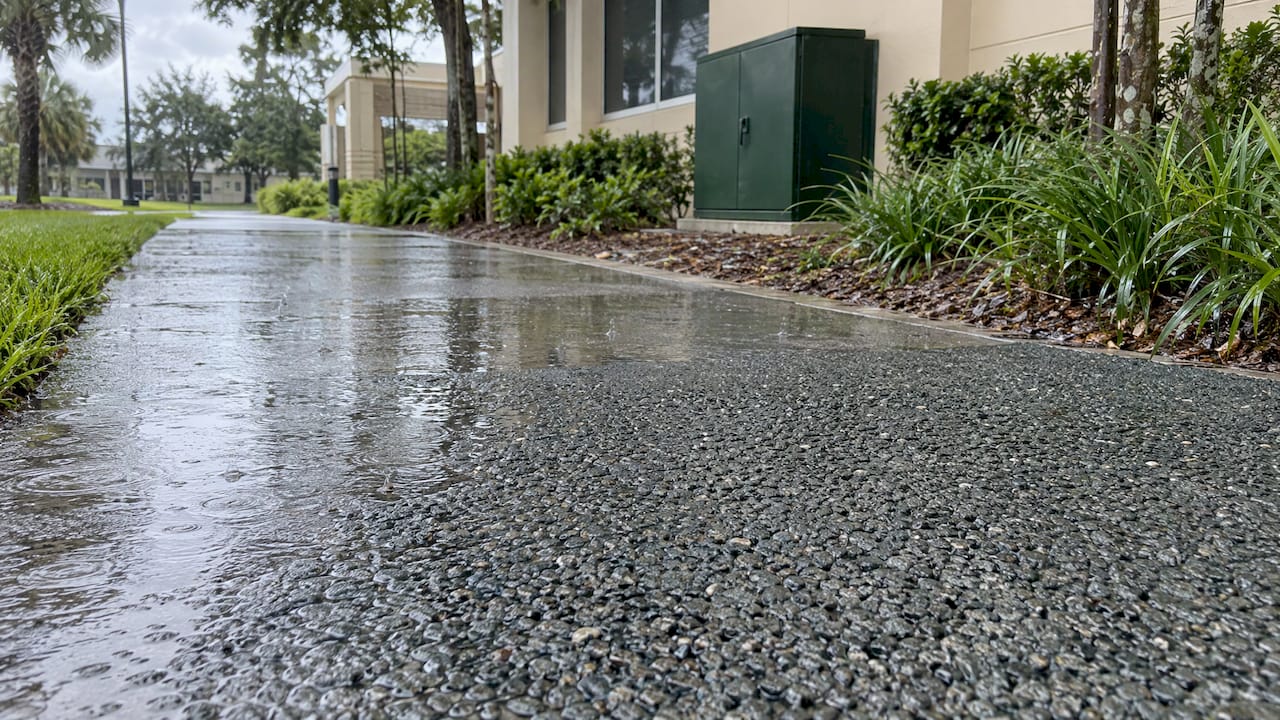
Permeable pavement can earn stormwater credit in Florida, but the credit depends on how the system is designed and who reviews it. In the state's Environmental Resource Permit (ERP) program, retention-designed permeable pavement can receive pollutant load reduction credit, while underdrained systems have not. Counties and water management districts then add their own rules. If you own a driveway, HOA common area, parking lot, trail or golf course path, the practical question is whether your surface can be counted as pervious area on your plans. We install Rubberway® porous rubber paving across Florida, and the sections below cover what you need to settle before you sign for any porous surface.
TL;DR
- A "stormwater credit" is the reviewer's decision to count a surface as pervious or as treating runoff. It is not a product label and not a permit.
- In Florida, retention-style permeable pavement can receive ERP pollutant load reduction credit. Systems that rely on underdrains to recover storage have not received that credit, per UF/IFAS.
- Credit is set by the site: soil infiltration, seasonal high-water table, slope, edge restraints and a geotechnical report all matter, and the local reviewer decides.
- Plan to hold the credit by keeping the surface open: vacuum on a schedule, keep sediment off it, and never pressure wash.
- Ask your engineer and the local stormwater office early, before the paving contract is signed.
Table of Contents
- What a stormwater credit actually is
- What Florida says about permeable pavement credit
- How the credit gets calculated
- Site conditions that make or break the credit
- The paperwork reviewers want
- Keeping the credit: maintenance is part of the design
- A practical order of operations
- Perspective
- Where Rubberway fits
- FAQ
- Sources
What a stormwater credit actually is
Three things get mixed up on this topic: a permit, a credit and a rebate.
A permit is permission to build. In Florida, the Department of Environmental Protection (DEP) and the water management districts issue ERPs for a stormwater management system. DEP's ERP page defines that system as one designed to control discharges from rainfall by collecting, conveying, storing, absorbing, inhibiting, treating, using or reusing water to prevent flooding, overdrainage, environmental degradation and water pollution. Permeable pavement is one way to "absorb" and "store" water inside that system.
A credit is how a reviewer counts your pavement in the math. It might let part of a surface count as pervious area, reduce the runoff volume you must store, or count toward a pollutant load reduction. A credit is only as good as the documentation behind it.
A rebate or points program is separate. Utilities, counties and green building programs sometimes reward pervious surfaces with money or points, each on its own terms.
None of these is automatic. The same pavement can earn credit on one parcel and none on the next.
What Florida says about permeable pavement credit
The clearest statewide statement comes from the University of Florida's extension service. Its technical publication on permeable pavement says that in Florida, systems designed as retention can receive pollutant load reduction credit under the ERP program, but systems that recover storage volume through underdrains did not receive credit for reducing stormwater volumes or pollutant loads at the time of writing. The publication dates from 2019, so confirm current practice with your engineer and reviewer.
The design lesson is simple. Credit follows water that soaks into the ground on your site. A surface that mostly collects water and pipes it away is judged differently from one that lets rain pass through to the soil below.
DEP's own planning tool for low impact development points the same direction. It notes that for most stormwater control measures, credit is not explicitly given by the South Florida Water Management District and is based on case-by-case evaluations. It also says underdrains are required where soil cannot infiltrate, but they reduce volume control and may reduce treatment potential.

The 2024 statewide rule
Florida's revised statewide stormwater rules took effect when the ratification bill (SB 7040) was signed on June 28, 2024. Permits issued after that date require a Qualified Inspector for required inspections conducted after June 28, 2025. If your project is permitted under an older conceptual approval, DEP's FAQ explains which phases are exempt from the new performance standards. For a new project, assume the current rule applies and have your engineer confirm.
The South Florida district reviews projects under its own handbook. A February 2026 industry guide summarizes that post-development discharge may not exceed pre-development rates for the design storm in the 16-county region. Other districts have their own criteria, so the district matters as much as the county.
How the credit gets calculated
There is no single Florida formula. Here are three real examples of how local reviewers handle it.
Impervious surface ratio (ISR) reduction. Walton County's low impact development manual applies reduction factors to the area of different surfaces: 0.75 for pervious pavers, 0.60 for wood decks, 0.50 for porous concrete and 0.25 for geo-grid. The factors can bring a project below the 40% ISR threshold for the stormwater management exemption. The manual also requires edge restraints and says the approach is unsuitable on slopes greater than 0.5%.

A worked example shows how this plays out. Suppose a 10,000 sq ft lot has 4,500 sq ft of impervious surface, an ISR of 45%. If 1,000 sq ft of that is a pervious paver surface counted at 0.75, the effective impervious area becomes 3,500 + 750 = 4,250 sq ft, or 42.5%. That is closer to 40% but not under it. Swapping in more pervious area, or reducing other hardscape, is what crosses the line. This is an illustration of the arithmetic, not a ruling for any county, so use the factors your own jurisdiction publishes.
Counting as pervious area. The Central Broward Water Conservation District's engineering manual allows pervious, porous or permeable pavements to be counted as pervious area for ground storage and runoff calculations only if they have sufficient porosity and permeability. It requires a geotechnical report with soil borings to a minimum depth of 5 feet below the water control elevation for each half acre of pervious pavement or fraction thereof.
Points programs. Florida Water Star awards up to 20 Gold-level points for pervious surfaces installed in place of impervious materials or irrigated areas. Points equal pervious surface area divided by total landscaped area, multiplied by the available points, and an inspector confirms the practice through your documentation.
The UF/IFAS publication also lists Florida-Friendly Landscaping thresholds of at least 50% and at least 25% of hardscape made of porous materials, along with LEED credits for heat island reduction and rainwater management. Those matter for homeowners and commercial owners chasing certifications rather than a permit.
Site conditions that make or break the credit
Reviewers look at the ground first and the surface second. These are the conditions that come up in Florida guidance.
| Condition | What the guidance says | Why it matters |
|---|---|---|
| Water table | Seasonal high-water table and confining layers at least 2 ft below the bottom of the system | Shallow groundwater leaves nowhere for water to go |
| Drawdown | The system should drain completely within 24 to 72 hours | Reviewers use this to confirm storage recovers between storms |
| Soil infiltration | Subgrade infiltration rate requirements, tested by a geotechnical engineer | Poor soils push the design toward underdrains, which affects credit |
| Edge restraint | A perimeter edge that forces ponding before overflow | Keeps water on the surface long enough to soak in |
| Slope | Walton County's manual says unsuitable above 0.5% for its pavers | Water runs off instead of infiltrating |
| Sediment | Site where it will not receive sediment-laden run-on | Fine particles clog pores |
| Spills | Not where hazardous materials may spill and contaminate soils or groundwater | Protects groundwater |
| Beach sand | Not in areas with significant sand migration such as beaches | Sand fills pore spaces |
Walton County's manual also specifies construction details for its pervious pavement: geotextile fabric between layers overlapping at least 16 inches, a minimum 8-inch subbase of well-graded stone, and a recommended 4-inch observation well to monitor infiltration time. Other jurisdictions set different details, which is why the local manual is the document to read.
The paperwork reviewers want
Whether you are a board member approving a plan or a homeowner pulling a permit, expect to assemble:
- A geotechnical report. Soil borings, infiltration rates and the seasonal high-water table. Some districts set boring depth and frequency, as Central Broward does.
- A stamped drainage design. Your engineer shows how the surface is counted, the storage depth, the drawdown time and where overflow goes.
- Product and section details. Layer thicknesses, base stone, fabric, edge restraint and the surface specification.
- A maintenance plan. Reviewers want to see who vacuums, how often and who pays.
- Inspection records. Under the current rule, a Qualified Inspector is needed for required inspections on newer permits.
Our team provides government-ready documentation with a rubber paving project, which gives your engineer and the reviewer the product information they need in one place. Your engineer still decides how the surface is counted for your site, and the reviewing agency decides whether to grant the credit.
If you are an HOA board or a municipality, our guides on how permeable paving helps with HOA stormwater rules and how stormwater ordinances shape paving choices go deeper on approvals. Engineers can read our porous rubber paving drawdown specs and the porous sidewalk drainage design guide.
Keeping the credit: maintenance is part of the design
A credit granted on paper disappears if the surface clogs. Maintenance guidance from Florida sources is consistent.
- Inspect at least quarterly. Walton County's guidance calls for visual inspection at least quarterly, replacing settled or missing aggregate where the design uses it.
- Vacuum, never pressure wash. The same guidance says to clean clogged surfaces with a vacuum or regenerative air sweeper. Pressure washing forces sediment deeper and permanently reduces infiltration.
- Keep chemicals off. No pesticide or fertilizer on the area or within a 10-foot perimeter.
- Control what lands on it. UF/IFAS recommends collecting leaves and needles regularly, stabilizing adjacent bare soil and keeping grass clippings off the surface.
- Remove fines. Hillsborough County's manual says vacuuming is required to remove fine particles that settle into the pore spaces.
For rubber surfaces, our cleaning guide covers why owners' vacuuming twice a year can prevent clogs, and cities can use our porous pavement maintenance program. If the site also has a retention pond downstream, pond and lakefront management keeps the rest of the drainage system in shape alongside the paving.
A practical order of operations
- Call the local stormwater office or district first. Ask which manual applies, whether pervious area is counted, and what documentation they want.
- Commission soil borings and a water table reading. These decide whether retention is possible.
- Have the engineer set the design. Retention versus underdrained drives the credit, per UF/IFAS.
- Choose the surface and installer with documentation in mind. The drawings must match what is built.
- Schedule inspection and maintenance before closing out. Put the vacuuming routine in the HOA budget or the facility plan.
Perspective
Owners come to us asking whether the paving "gets a credit." The better question is whether the whole system, from soil to surface, is designed so a reviewer can count it.
Florida's heat, heavy summer rain and flat sites are exactly where standing water and cracked surfaces cost owners the most. That is why we focus only on rubber paving. Our Rubberway® system uses recycled tire material and a porous design for drainage, and it is built to resist cracking in heat and weather.
We are licensed and insured, we provide government-ready documentation, and we can supply ADA-compliant surfaces in a wide range of colors. For municipalities, HOAs, golf courses and homeowners alike, that means one specialist coordinating the paving while your engineer handles the stormwater math.
Bring us in while the drainage plan is still open. It is much easier to match a surface to the design than to redesign after the fact.
Roger
Where Rubberway fits
EcoTec Rubber Paving installs the Rubberway® system for residential driveways, pool decks, patios, commercial walkways, municipal parks, trails, sidewalks and HOA areas in Florida. Our product lines include Rubberway® Pervious Pavement, Rubberway Rubberrock 6000, Rubberway EVOLUTION and the Rubberway Sidewalk System. If you are planning a project where stormwater matters, send us your site details and your engineer's requirements.
For cost, ADA and layout questions, see our guide to a porous parking lot and walkway, or our overview of what permeable paving is, its types and cost.
FAQ
Is a stormwater credit the same as a permit?
No. A permit authorizes construction of a stormwater system. A credit is how a reviewer counts a feature, such as pervious pavement, within that system's calculations. You may need a permit and still receive little or no credit for a surface.
Does every permeable pavement qualify for credit in Florida?
No. UF/IFAS reports that retention-designed systems can receive ERP pollutant load reduction credit, while underdrained systems did not at the time of its writing. Soil, water table and local rules decide the rest, so ask your reviewer before design.
How much pervious area credit will I get?
It depends on the jurisdiction. Walton County, for example, uses an ISR factor of 0.75 for pervious pavers, while Central Broward requires proof of porosity and a geotechnical report. Your engineer should use your local manual's method.
What maintenance keeps the surface working?
Inspect at least quarterly, vacuum clogged areas, keep sediment, leaves and clippings off, and never pressure wash. Put the schedule and the responsible party in writing, because reviewers and inspectors will ask for it.
Is there a rebate for permeable pavement in Florida?
Some utilities and counties offer rebates, and Florida Water Star awards points for pervious surfaces. Terms differ by program, so check the local stormwater or utility page before you buy.
Sources
- Permeable Pavement Systems: Technical Considerations (UF/IFAS AE530)
- Permeable Pavement Systems: Technical Considerations, PDF edition
- ERP Stormwater, Florida Department of Environmental Protection
- Frequently Asked ERP Stormwater Questions, Florida DEP
- LID-GI Matrix Decision Tool, Florida DEP
- Stormwater Management Guide for Florida
- Walton County LID Technical Manual: Pavers, Concrete, Geogrid
- Walton County LID Manual Section 5.8
- Central Broward Water Control District Engineer Criteria Manual
- Permeable surfaces, Florida Water Star
- Hillsborough County Green Infrastructure Manual