
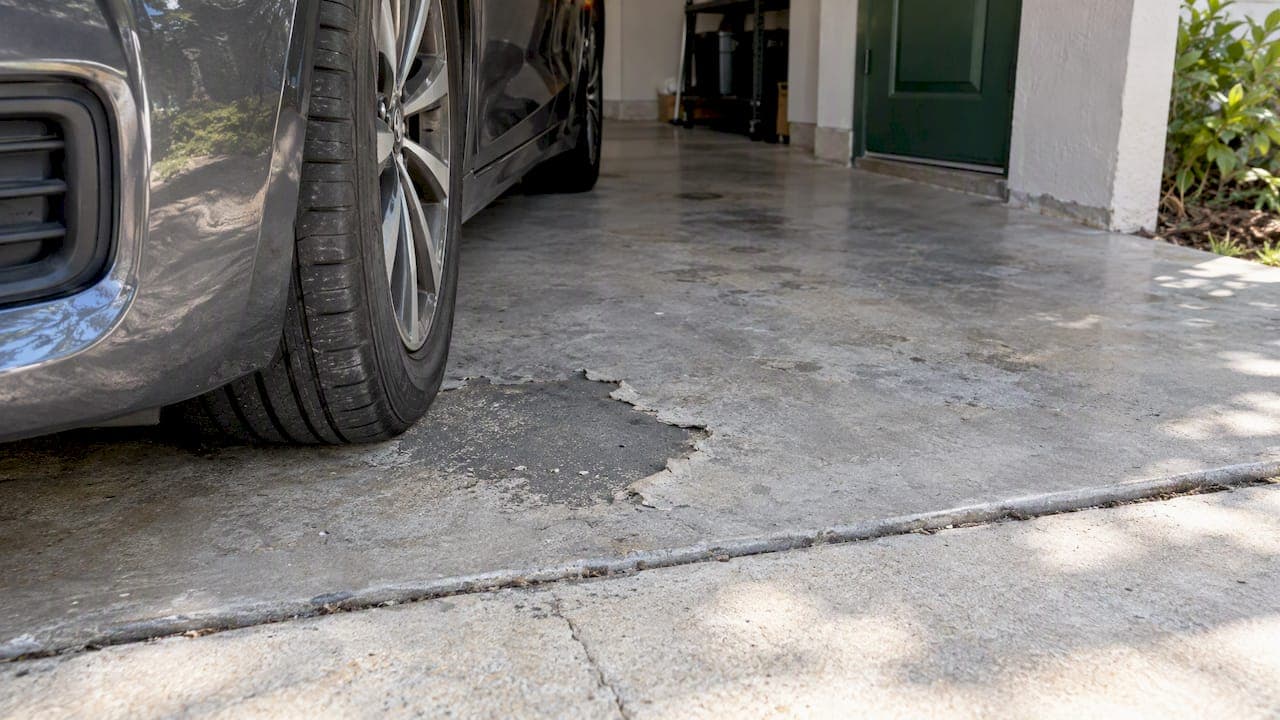
Hot tire pickup happens when a warm tire softens a driveway sealer or coating, bonds to it, and pulls it up as the tire cools. You are left with tire-shaped patches, stains or peeling film where you park. It is a coating problem, not a tire problem, and it is almost always fixable. The right fix depends on whether you are looking at a dark scuff, a stained sealer, or a coating that is actually lifting.
Below we separate those three cases, explain the chemistry in plain words, walk through cleaning, and show which surface choices avoid the issue in the first place.
TL;DR
- Hot tire pickup is a failure of the sealer or coating, not just a black mark. A scuff that wipes away is a different, simpler problem.
- The main drivers are heat, plasticizers in the tire, poor surface prep, and a film-forming sealer that is too weak or too new.
- Try degreaser and a stiff brush first. If a coating is peeling, strip the loose material, prep properly, and recoat per the manufacturer's instructions.
- Penetrating sealers form no surface film, so they have less to lift. Film coatings need careful prep and cure time.
- If you are tired of recoating, a porous rubber surface has no film to peel. We install that across Florida.
Table of Contents
- What hot tire pickup actually is
- Why tires leave marks on a driveway
- How to clean tire marks without making things worse
- How to keep it from coming back
- How the surface under your tires changes the risk
- Perspective: why we stopped worrying about the film
- If your driveway keeps failing: resurfacing options
- Work with us in Florida
- A short decision guide
- FAQ
- Sources
What hot tire pickup actually is
People use the phrase for several different things, so it helps to sort them out.
Ordinary tire marks. Rubber scrubbed off the tread and left on the surface. These are dark, sit on top, and usually clean off with a degreaser and a brush.
Sealer discoloration. Technical guidance from a concrete-products manufacturer says tire marking on concrete sealers is caused by plasticizer migration. Tires heat up while you drive, plasticizers soften and leach out, and they can move into the sealer and stain it.
True pickup. The coating softens or loses its bond, sticks to the tire and lifts, leaving thin spots or bare concrete behind. The same bulletin says that when tires remove the sealer or coating, the area may be recoated following the manufacturer's instructions.
Why does the distinction matter? Because you do not fix a stain the way you fix a failed bond. Scrubbing a peeling coating makes it worse. Recoating over a dirty surface repeats the failure.

A quick test at the curb
Look at the mark in daylight and run a gloved finger over it. If it smears or rubs off, it is surface rubber. If the sealer is tacky, cloudy, rolled up in tire-width strips, or you can see bare concrete in the patch, you have pickup.
Also check the pattern. Pickup shows up where the tires stop: the first parking spot inside the garage apron, or the place you pull in after a highway drive. Scuffs show up where you turn.
Why tires leave marks on a driveway
The causes stack. Rarely is it one thing.
Heat
A tire that has just come off a long drive can be much hotter than the air around it, and Florida pavement in July adds to that. Heat softens both the tread compound and a film-forming sealer, which is what lets the two stick together.
Plasticizers in the tire
The same technical bulletin notes that higher-quality tires carry more plasticizer, which raises the chance of marking, while harder, lower-quality tires usually mark less. Nobody should buy worse tires to protect a sealer. The point is that a good tire on a vulnerable coating is a common cause of staining.
Sharp turns on a standing wheel
Turning the steering wheel while the car is barely moving scrubs the tread sideways. A paving contractor in Texas explains that this is worse with front-wheel drive, and that low-profile tires, hot tires, fine-aggregate mixes and insufficient curing can all increase marks on new asphalt. A city in California makes a similar point about fresh surfacing: abrupt starts, stops and sharp turns can lift material and leave tracks, especially on hot days.
Driving on it too soon
New asphalt is more prone to scuffing when it is opened to traffic early, in hot weather, or when it is marked by tires heated on the highway. One paving contractor also notes that front-wheel-drive cars concentrate load on the front wheels. The lesson carries over to sealers and coatings: cure time is not optional.
Poor preparation
This is the one most owners never see. A trade publication quoting a decorative concrete supplier reports that improper preparation is usually the root cause of hot tire pickup on coatings. Cleaning, degreasing and mechanical profiling are needed so the coating can grip. A coating on an oily, glossy or damp slab is a coating waiting to peel.
How to clean tire marks without making things worse
Start gentle and escalate only when needed.
- Sweep and wet the area. Remove grit so you are not grinding it into the sealer.
- Apply a concrete degreaser or citrus cleaner. A flooring and coatings company recommends letting it sit for a few minutes, scrubbing with a stiff-bristled brush and rinsing thoroughly.
- Rinse with moderate pressure. A pressure washer works as a rinse tool, but a Dallas-area cleaning company advises reasonable pressure so you do not damage the surface. Too much pressure etches concrete and strips sealer.
- Reassess in dry daylight. Wet concrete hides residue.
If marks persist, the trade article above reports that tire residue may need mechanical abrasion because water and degreaser alone do not remove the rubberized material. That is a job for a grinder or a professional crew, not a garden brush.
When cleaning is not enough
If the sealer is peeling, stop scrubbing. The same source that suggests degreaser also says persistent marks may call for stripping and resealing or resurfacing the concrete. Remove all loose coating, let the slab dry, and prep it again before anything new goes down.
How to keep it from coming back
Prep like the coating depends on it
It does. Clean and degrease first, then profile the surface so it has texture for the new material to grip. The trade article describes a simple water check before sealing: a dime-sized bead of water should soak in within 10 to 15 seconds. If it beads up, the surface is still sealed, greasy or too dense, and needs more work.

Timing matters too. Resealing is a seasonal task with weather limits, and a guide on crack sealing and sealcoating timing is a good way to think through when a surface is ready to be treated. Climate differs from New England to Florida, so adjust for your humidity and summer heat.
Respect the cure window
Product labels differ, so follow the manufacturer's instructions for return to traffic. Park on the street, or on a different surface, until the label says the coating can take tire load. Hot weather is the worst time to rush it.
Choose the right type of sealer
For exterior concrete with a tire-marking problem, the technical bulletin says a penetrating silane or siloxane sealer may be the better choice, because it does not form a film and does not react with tire plasticizer. A flooring company makes the same point, calling a penetrating sealer a good choice because it creates no surface film and is less likely to interact with tire softening agents.
The trade-off is appearance. Penetrating sealers give a natural look, not the glossy, colored finish a film coating gives.
Change how you park and turn
These habits cost nothing:
- Roll forward or back a little while turning the wheel, rather than cranking it at a standstill.
- After a long highway drive, park on a surface that tolerates heat, or let the tires cool before pulling onto a fresh coat.
- Pull in straight and avoid pivoting on the same spot every day.
How the surface under your tires changes the risk
It helps to think in three groups.
| Surface type | How it reacts to hot tires | Watch for |
|---|---|---|
| Film-forming sealer or coating on concrete | Can soften, stain or lift, especially if prep was poor or cure was short | Peeling in tire-shaped patches, cloudiness |
| Penetrating sealer on concrete | No film to lift; less interaction with plasticizer | Natural look only; marks can still sit on top and need cleaning |
| New asphalt | Prone to scuffing and indentation in heat or when opened to traffic early | Tight turns on a standing wheel, early use |
| Rubber paving | No surface film to bond with the tread | Normal dirt and rubber transfer that cleans off |
The last row is where we work, and we will be specific about what it does and does not do below.
Perspective: why we stopped worrying about the film
Most hot tire pickup stories end the same way. Someone pays for a coating, it looks great for a season, and then the first hot summer lifts it where the car sits. They recoat, and the cycle repeats. The problem is structural: a thin film is bonded to a slab, and the slab, the prep, the weather and the tire all have to cooperate.
We install rubber paving with the Rubberway® system, which is built from recycled tire material. It is a different category. It is a thick, porous surface and not a coating on concrete, so there is no thin film to be pulled off by a tire. Heat and weather are what it was designed for in Florida: it drains instead of holding standing water, resists cracking from heat, and meets ADA requirements for accessible paths.
We are also straightforward about limits. Any surface collects some tire residue and dirt, and we would rather tell you to cure it properly and keep it clean than promise a driveway that never needs attention. If your concrete is sound and you only need a better sealer, a penetrating one may be all you need. If you are tired of the recoat cycle, or the slab is cracked and heat damaged, that is when we suggest looking at replacing the surface instead of patching it.
— Roger
If your driveway keeps failing: resurfacing options
After the second or third recoat, the math changes. You are paying for prep again and again, and the underlying slab may be cracking. Two ideas are worth knowing.
Overlay the concrete. A rubber overlay can go over a sound concrete driveway. We cover the thickness, base and Florida specifics in our guide to resurfacing a concrete driveway with a rubber overlay. Slabs with serious movement or drainage problems may need to be replaced, not covered.
Fix the heat problem at the root. If your driveway is cracking and softening in summer as well as marking, read our piece on heat damaged driveway repair before spending money on another sealer.
Sun matters too. Whatever you choose, ask about UV stability, since driveway materials in full sun fade and age at different rates depending on the binder.
Drainage and color are part of the decision
Tire marks are rarely the only complaint. Puddles by the garage door, slippery patches and fading come up in the same conversation. Our guides on fixing driveway puddles and porous driveway drainage explain how a porous build handles water, including the stone reservoir underneath that homeowners often overlook. If you manage an HOA or a municipal property, the colored driveway resurfacing specs page covers what to put in a bid.
Timing after installation
Every surface needs time before it takes full traffic. For rubber paving, see our explanation of cure time in rubber paving so you know when the car can come back on.
Work with us in Florida
EcoTec Rubber Paving is licensed and insured, and rubber paving is all we do. We install the Rubberway® system for driveways, pool decks, patios, walkways, trails and community areas, with a range of colors and drainage built in. Our full range, including Rubberway Pervious Pavement, Rubberrock 6000, EVOLUTION and the Sidewalk System, is on our products page. If you want a surface assessed and a project scoped, start at EcoTec Rubber Paving. We do not publish prices, because they depend on area, base conditions and design, so the first step is a conversation about your property.
We install on Florida properties only, and we work with homeowners, HOAs, businesses and municipalities. We do not sell materials for DIY installation.
A short decision guide
Use this to choose a next step.
- Dark marks that wipe off: clean with degreaser and a brush. No further action.
- Stained sealer, not peeling: clean, then talk to the sealer manufacturer about whether a recoat is needed.
- Peeling in tire-shaped patches: strip loose coating, check the water absorption, profile the slab, then recoat per the label, or choose a penetrating sealer.
- Repeated failures, cracking or standing water: consider resurfacing instead of another coat.
- New asphalt scuffing: limit sharp turns while parked, avoid heat-of-day traffic, and let it cure. Paving contractors report that insufficient curing increases marks.
Mistakes to avoid
- Pressure washing at high pressure to "blast" a mark off. It etches concrete and can strip the sealer around it.
- Coating over a slab you have not degreased or tested.
- Driving on a new coating the day it feels dry. Dry to the touch is not the same as fully cured.
- Treating every black mark as a failure. Sometimes it is just rubber.
FAQ
Why are my tires leaving marks on my driveway?
Usually because warm tread is scrubbing sideways against the surface, most often during tight turns at very low speed. Heat makes the rubber softer and the marks worse. If the surface itself is peeling or stained, the cause is more likely a sealer or coating reacting with the tire.
What is the difference between tire marks and hot tire pickup?
Tire marks are rubber sitting on top of the surface and generally clean off. Pickup is when the coating softens or loses its bond, sticks to the tire and lifts, leaving thin or bare spots. A black mark alone does not prove the coating has failed.
How do I remove hot tire marks from concrete?
Apply a concrete degreaser or citrus cleaner, let it sit briefly, scrub with a stiff brush and rinse well. If residue remains, it may need mechanical abrasion, and a peeling sealer calls for stripping and resealing. Test a small area first and use only moderate rinse pressure.
Which driveway sealer is least likely to pick up tire marks?
A penetrating silane or siloxane sealer is the usual recommendation for exterior concrete with tire marking problems, since it forms no surface film and does not react with tire plasticizer. Film coatings can work but depend heavily on prep and cure time.
Sources
- Tire Marking / Pickup of Concrete Sealers (technical bulletin)
- Street Repair, City of La Palma, California
- Put the Brakes on Hot Tire Pick Up, For Construction Pros
- Tire Scuffing and Indentations on New Asphalt
- Asphalt Paving and Tire Scuffing
- How To Get Tire Marks off Concrete
- How to Remove Tire Marks from Concrete: A DFW Guide