
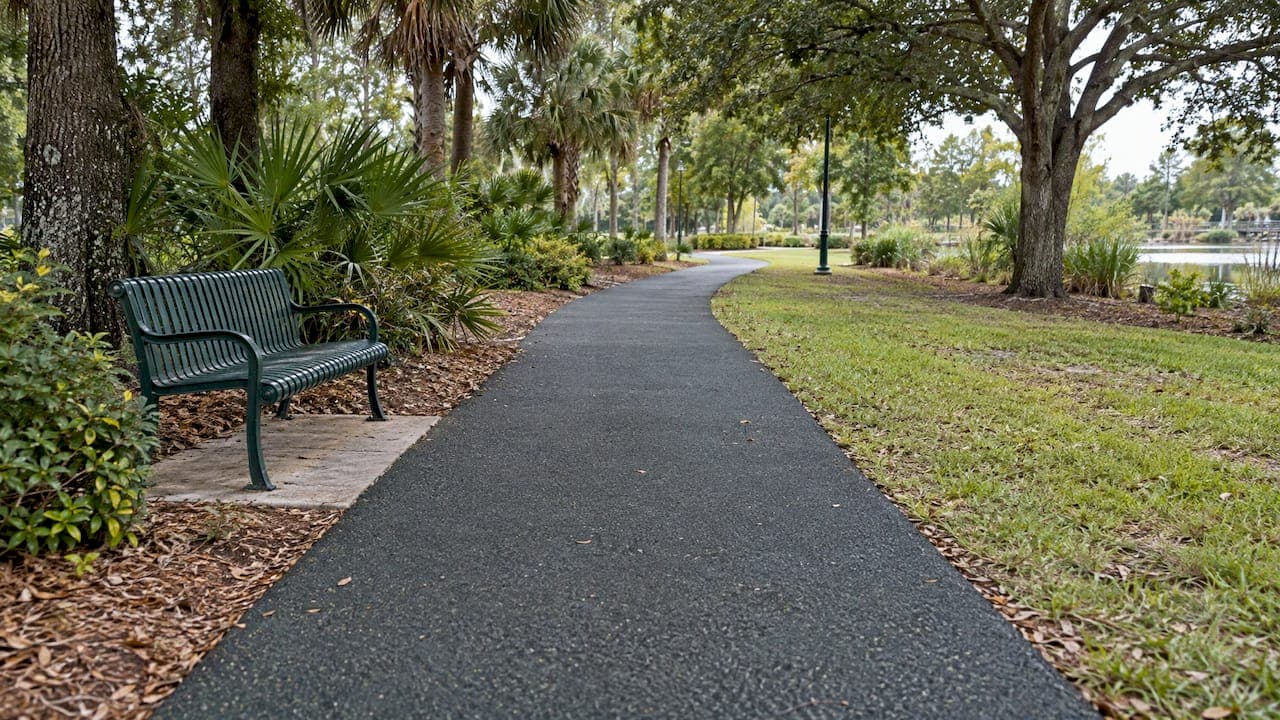
A rubber trail surface is a flexible, bound path made from recycled rubber (often from post-consumer tires), aggregate and a binder, laid over a prepared base. Done well, it gives a firm, non-slip, porous walking surface that handles rain, heat and heavy foot traffic. Federal guidance describes it as made of rubber, aggregate and binder with porous options. This guide covers what goes into one, how it compares with other trail surfaces, what ADA expects, what it costs, and how to keep it performing.
TL;DR
- A rubber trail surface combines recycled rubber, aggregate and binder. It can be poured in place and installed in a porous format that lets stormwater pass through.
- Surface choice should follow user type, accessibility, drainage, upkeep and sustainability, the same criteria transportation agencies use when they select trail surfaces.
- Published trail guidance puts rubberized surfaces at roughly $12 to $13 per square foot, against about $2 for bark mulch. Your site conditions set the final number.
- The base matters as much as the rubber: excavation, drainage grading and compaction decide how the path ages.
- In Florida, rain, heat and soft soils make drainage and color choice central decisions.
Table of Contents
- What a rubber trail surface is made of
- How rubber compares with other trail surfaces
- Drainage: why porous rubber suits wet climates
- ADA and accessibility on a rubber trail
- What a rubber trail surface costs
- How a rubber trail is installed
- Lifespan and maintenance
- Choosing color and finish for Florida heat
- Our perspective
- Let us look at your path
- FAQ
- Sources
What a rubber trail surface is made of
Most rubber trail surfaces have three ingredients: rubber granules or crumb, a binder that holds them together, and sometimes aggregate. The Federal Highway Administration's maintenance guide describes the material as rubber (often recycled), aggregate and binder. It notes the result is a non-slip surface, with porous options available.
The same guide describes two ways to place it. Small spots can be poured in small batches and hand-finished. Larger runs are poured in bigger batches and leveled and compacted with a machine.
A few variables change how a given product behaves:
- Rubber type and size. Large crumb leaves open voids between particles, which is what makes a surface pervious. Finer, tighter mixes feel smoother but drain less.
- Binder. The binder bonds the particles and shields the mix from water and sunlight. Our deeper look at the role of binder in rubber paving systems explains why this one ingredient matters so much.
- Layering. Some systems use one pervious layer. Others use a recycled rubber base with a thin colored wear layer on top.
- Thickness. Thickness depends on what sits underneath and how much load the path carries.
Our Rubberway® Pervious Pavement is built from post-consumer recycled rubber in a large crumb format, laid 1.5 to 2 inches thick with a water-repellent binder. Our dual-layer approach pairs a recycled rubber base with a thin wear layer on top for color and finish.
How rubber compares with other trail surfaces
Transportation agencies don't pick a trail surface on looks. Virginia's trail type and surface selection guidelines cover asphalt, chip seal, concrete, pavers, crushed stone and structural surfaces, plus permeable pavement and permeable pavers. They weigh each against user type, volume of use, safety, accessibility, connectivity, economics, sustainability and aesthetics. That is a sound checklist for any owner, whether you run a county park, a golf course or an HOA.
Here is how those criteria tend to play out for rubber against common alternatives.
| Criterion | Rubber (pervious or poured) | Asphalt | Concrete | Crushed stone |
|---|---|---|---|---|
| Underfoot feel | Cushioned, flexible | Hard | Hardest | Variable, loose |
| Drainage | Porous formats pass water through | Sheds water to edges | Sheds water to edges | Drains, but can wash out |
| Color options | Wide range | Black or gray | Gray, tinted, stained | Natural tones |
| Recycled content | High, in recycled-rubber systems | Varies | Varies | Low |
| Tree-root friendliness | Flexible surface can follow gentle movement | Rigid, can crack | Rigid, can crack | Easy to re-grade |
VDOT's guidance is a useful reminder here: it notes asphalt trails may need tree clearing and heavy equipment access for grading, and should sit outside the structural root plate of trees. Where a path runs through mature shade trees, which describes much of Florida, a lighter, more flexible build is often worth a look. Our article on permeable trail surfaces that avoid deep excavation goes further into that approach.
For a broader walk through the options, see our guide to park path surface options and our comparison of paving surface materials.
Drainage: why porous rubber suits wet climates
Water is what ages a trail. The FHWA guide says proper grading and drainage infrastructure are what prevent ponding, erosion, washouts, scouring and rutting on unpaved paths. A path that holds water also holds slip risk and mosquito habitat, which matters in a Florida summer.
Porous rubber addresses this by letting rain move through the surface and into the stone base below. A 2016 walking path in Wellesley, Massachusetts used a porous rubber-and-granite mix over 20,000 square feet, and its stormwater flow rate was tested at 5,800 to 6,300 gallons per hour per square foot. The same report says the material resists freezing and frost heave, and that the project used rubber recovered from roughly 5,000 to 6,000 old tires. That is one project in a cold climate, not a promise for every site, but it shows the scale of both the drainage and the recycling.

Permeable surfaces perform best when they match the ground beneath them. Rails-to-Trails Conservancy's What's Under Foot? notes that the success of permeable concrete or asphalt correlates with soil permeability and climate. In practice, that means the stone base and the drainage plan are designed for your soil. Our engineering write-ups on porous rubber paving specs and stormwater management paving cover drawdown and base design in detail.
ADA and accessibility on a rubber trail
An accessible trail surface has to be firm, stable and slip resistant. The U.S. Access Board's 2007 proposed guidelines for outdoor developed areas define firmness as the degree of surface resistance to deformation, and stability as the degree to which a surface resists change from force or contaminants and returns to its original condition. Both definitions appear in the National Trail Surfaces Study, which was funded by the Access Board and run by Indiana University's National Center on Accessibility. The study evaluated 11 surface materials over 51 months at a test site in Indiana.
What this means when you specify a rubber path:
- Ask for firmness and stability to be designed in. A properly compacted base and a correctly bound surface are what keep the path from rutting or shifting under wheelchairs, strollers and walkers.
- Plan slopes and edges before the rubber goes down. Grade, cross slope and openings in the surface are set by the base and layout, not by the rubber itself.
- Think about traction when wet. Slip resistance is a surface-finish question. If you want to understand how wet traction is measured on other hard surfaces, this explainer on wet traction testing for coatings is a helpful read on the principle.
- Document everything. Municipal and HOA boards often need submittals and specifications they can hand to reviewers.
We design our Rubberway® paths to meet or exceed ADA expectations, and we provide government-ready documentation for public projects. Architects and engineers can find more in our piece on how rubber paving meets ADA standards.
What a rubber trail surface costs
The most useful published benchmark comes from Rails-to-Trails Conservancy. What's Under Foot? says trail surface costs run from around $2 per square foot for bark mulch to $12 to $13 per square foot for a rubberized surface. It adds that construction cost includes excavation, subbase preparation, aggregate base placement and the surface itself. The same guide puts anticipated life at anywhere from a single year for bark in a moist climate to more than 25 years for concrete.
Two points help you read those numbers properly:
- The cheapest surface isn't the cheapest over time. Bark in a wet climate may need replacing within a year, which is why life-cycle cost is the right frame. Our piece on how rubber paths reduce maintenance budgets works through that math. For a related comparison of loose-fill rubber against wood, see this breakdown of rubber versus wood mulch costs.
- Site conditions move the price. Soil, access, length, width, drainage needs, color and thickness all change the quote. We don't publish a flat price because no two paths are alike. We price each project after reviewing the site.
When you collect bids, ask that each one lists the same scope: excavation, base depth, geotextile if used, surface thickness, edging and drainage. That's the only way to compare them fairly.
How a rubber trail is installed
The order of work is consistent across most rubber paths, and the prep is where quality is won or lost.
- Survey and layout. Set the alignment, width, slopes and drainage outlets, and mark trees and utilities.
- Excavation. Remove organic material and soft soil so the base sits on stable ground. The depth depends on the site and the surface chosen.
- Grading for drainage. Shape the subgrade so water has somewhere to go.
- Base construction. Place a geotextile where the soil calls for it, then a compacted crushed-stone base. Compaction is what gives the path its firmness.
- Surface placement. The rubber mix is blended and placed, then leveled and compacted by hand on small spots or by machine on longer runs, as the FHWA guide describes.
- Curing and opening. The binder needs time and dry conditions to set before traffic. Weather planning is part of any schedule, especially during Florida's rainy season.
Pre-existing concrete or asphalt can sometimes serve as the base, which is one reason rubber is used for resurfacing. Whether that makes sense depends on the condition of what is there. Our sustainable paving installation best practices cover this in more depth.
Lifespan and maintenance
Rubber surfaces last when they are maintained on a schedule. Rails-to-Trails Conservancy's guide lists rubberized track-type surfaces at 8 to 10 years in one case, with binder reapplication every 5 to 6 years, and 8 to 12 years in another, with topcoat replacement after about 10 years (What's Under Foot?). Those are examples of how resurfacing cycles are planned, and they give a municipal budget a realistic frame.
A practical care plan looks like this:
- Sweep or blow debris regularly. Leaves and sand left in a porous surface can clog voids over time.
- Rinse as needed. Low-pressure water keeps pores open.
- Inspect after major storms. Check edges, low spots and outlets.
- Plan periodic top sealing or binder refresh. It extends the surface and restores color.
- Repair small issues early. Localized patching is simpler than a full resurface.
If you're budgeting upkeep for equipment and crews, it can help to think through service-life planning in the way fleet owners do, as this overview of service life and maintenance planning shows for machinery. A path is a long-lived asset and deserves the same calendar.
Choosing color and finish for Florida heat
Surface temperature is a real design factor in a Florida summer. Color affects how much heat a surface absorbs, so choosing a lighter or blended tone can make a path more comfortable for bare feet, pets and paws. That is one reason we offer a wide range of colors, rather than a single dark finish. Color also helps with wayfinding, with separating pedestrian and bike lanes, and with fitting a path into a community's look.
For golf courses and HOAs, a natural-toned path that blends into the landscape often reads better than a stark black ribbon. For municipal parks, a bold color can mark a loop or a fitness route.
Our perspective
Florida is hard on paths. Heavy rain, standing water, intense sun and shifting soils will crack and heave rigid surfaces that look fine in a brochure.
That is why we only install rubber paving. We don't treat it as a side line to asphalt or concrete. When one crew works with one material system every day, the details get right: base preparation, binder behavior, drainage outlets and color.
We build with recycled tire rubber, and we design our porous Rubberway® surfaces so rain can move through the path rather than sit on it. Good drainage keeps a path usable after storms, protects the base, and cuts down on the repairs that eat a parks or HOA budget.
Our advice to boards and project owners is simple. Start with the use: who walks, rolls or rides here, and how many. Then set the drainage plan and accessibility requirements, and choose the surface that satisfies them. For many Florida trails, sidewalks and community paths, rubber does that job while also keeping scrap tires out of landfills.
We are licensed and insured, and we supply the documentation public projects need.
Roger
Let us look at your path
If you're planning a trail, sidewalk, park path or community walkway in Florida, we can review your site and recommend the right Rubberway® system. Our range includes Pervious Pavement, Rubberrock 6000, EVOLUTION and the Sidewalk System. You can see the Rubberway product lines and learn how our professional rubber paving installation works for homeowners, HOAs, businesses and municipalities.
Tell us the length, the use and the drainage problem you want solved, and we'll take it from there.
If you're still weighing options at the planning stage, our guide for planners on park trail surfacing options and a 10 to 20 year lens is a good companion.
FAQ
Is rubber a good surface for an ADA-accessible trail?
It can be, when the base is compacted well and the surface is installed firm, stable and slip resistant. Accessibility depends on firmness, stability, slopes and openings, so those need to be designed before the rubber is placed. We build Rubberway® paths to meet or exceed ADA expectations and provide documentation for public reviews.
How long does a rubber trail surface last?
It depends on the product, traffic and upkeep. Published trail guidance lists rubberized surfaces at roughly 8 to 12 years, with binder or topcoat refreshes planned along the way. Regular cleaning and prompt small repairs help the surface reach the upper end of that range.
How much does a rubber trail surface cost per square foot?
Rails-to-Trails Conservancy's guide cites about $12 to $13 per square foot for a rubberized trail surface, including base preparation. Actual pricing depends on your soil, access, width, thickness and color. We provide a project quote after reviewing the site.
Does a rubber trail drain water?
Porous rubber formats are designed so rain passes through the surface into a stone base below. A tested porous rubber walking path in Massachusetts recorded flow rates in the thousands of gallons per hour per square foot. Performance still depends on the base and the soil, so the drainage plan is designed for each site.
Sources
- Guide for Maintaining Active Transportation Infrastructure (FHWA, 2024)
- What's Under Foot? (Rails-to-Trails Conservancy)
- VDOT Trail Type and Surface Selection Guidelines
- National Trail Surfaces Study
- Walking Path Completed with 20,000 Square Feet of Permeable Pavement (For Construction Pros, 2016)
- Anti Slip Additives vs Flakes
- Rubber vs Wood Mulch
- Tier 4 Final Explained