
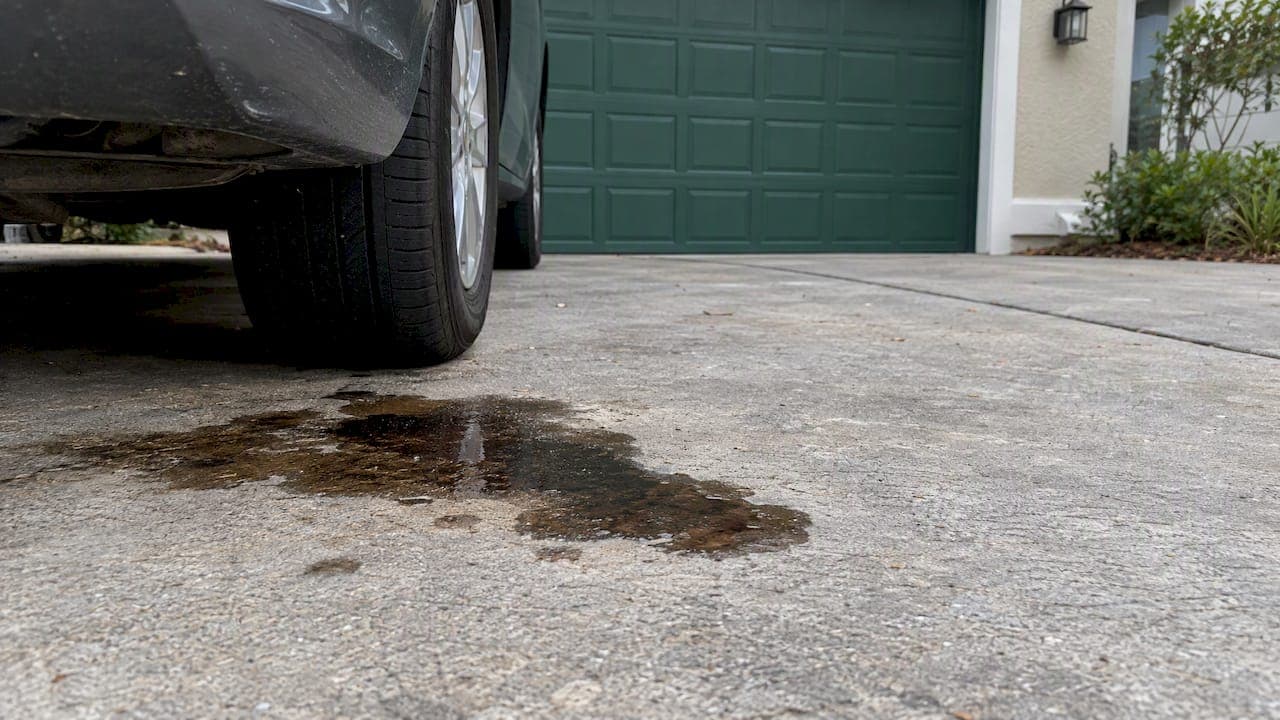
No driveway is completely oil proof. What you can do is choose a surface that resists oil, protect it with the right sealer, and clean spills within hours instead of months. Plain concrete and asphalt are both porous enough to take up motor oil. A sealer buys you time, not immunity. A few habits decide whether a drip becomes a permanent shadow.
This guide covers what makes a driveway resist oil, how sealers on concrete and asphalt perform and where they fall short, how to clean fresh and old stains, and how to do it without sending oil into the storm drain. We also explain where a porous rubber surface fits, and where it does not.
TL;DR
- Oil soaks into porous paving. Sealers, whether penetrating or topical, slow that down but wear out and need to be reapplied.
- Sealers are stain resistant, not stain proof. Professional guidance puts reapplication at roughly every 2 to 3 years in high-traffic or sun-exposed areas.
- Fresh oil comes out far better than old oil. Absorb it the same day with clay litter, then scrub and rinse.
- Never wash oil toward a storm drain. Dry cleanup first, containment second, water last.
- A rubber paved surface is a different category from sealed concrete. Ask any installer, us included, exactly how it handles oil on your project before you sign.
Table of Contents
- Why oil ends up in the driveway surface
- What makes a driveway resist oil
- How long does a sealer keep working
- A prevention routine that works
- How to clean a fresh oil spill
- How to treat an old, set-in stain
- Clean without polluting the storm drain
- Perspective: what we tell property owners about oil and paving
- When replacing the surface makes more sense than sealing it
- Planning a Florida driveway with us
- FAQ
- Sources
Why oil ends up in the driveway surface
Oil is a thin liquid that spreads sideways and sinks down into pores. Concrete is full of tiny capillaries. Asphalt is bound with a petroleum-based binder, which is why oil and fuel can soften it. Heat from a parked engine thins the oil and helps it travel. The longer it sits, the deeper it goes, and the harder it is to lift.
That is why every ranking guide on this topic says the same thing in different words: speed matters more than product. A stain you treat today is a cleanup job. A stain you treat next spring is a restoration job, and sometimes a lost cause.
If you are choosing a surface rather than cleaning one, the question is not "which material never stains." It is "which material stains least, cleans easiest and keeps its protection longest in my climate."
What makes a driveway resist oil
Three things matter: how much liquid the surface absorbs, what sits on top of it, and how often that layer is renewed.
Sealed concrete
Concrete is the most common driveway surface, and the sealer you pick changes how it handles oil. According to the Concrete Network, acrylic-resin and reactive penetrating sealers repel water and deicing salts, siliconate is the type suited to repelling oil, and epoxy or urethane systems resist petroleum distillates and acidic chemicals. The same source notes that reactive penetrating sealers soak in and are nearly invisible, while epoxy and urethane are high-performance topical coatings that sit on the surface.
In practice that gives you a trade-off:
| Sealer type | How it works | What it does for oil | Trade-off |
|---|---|---|---|
| Acrylic resin | Thin film on the surface | Repels water and salts, modest oil protection | Wears at the tire path |
| Reactive penetrating | Soaks into the concrete | Nearly invisible, slows absorption | No surface film to see wear |
| Siliconate | Penetrating water and oil repellent | Suited to repelling oil | Needs reapplication |
| Epoxy or urethane | Thick topical coating | Resists petroleum distillates | Highest-performance and most demanding to apply |
The American Society of Concrete Contractors' sealer guide is blunt about the limits. Sealers can block oil from penetrating, but they are scratch and stain resistant rather than proof. A sealer is a sacrificial coat that wears and has to be renewed.
Sealed asphalt
Asphalt is dark, so stains show less, but oil does more damage to it. Petroleum products can soften the binder, and a soft spot is a bigger problem than a dark spot. Bob Vila says asphalt should be sealed a few months after installation and resealed every 3 to 5 years. Sealcoat is the most common protection, but it needs clean, dry asphalt to bond. Sealer applied over an oil-soaked patch tends to flake off that patch.
Pavers
Interlocking pavers can be lifted and replaced one at a time, which is a real advantage when one spot is ruined. The weak point is the joint sand, which absorbs oil and is easily washed out by aggressive cleaning. Allstate's cleaning guidance recommends testing a cleaner first, using an absorbent, avoiding forceful scrubbing or pressure washing that erodes joint sand, and replacing stained bricks if cleaning fails.
Porous rubber paving
Our own work is rubber paving, so here is the plain version. The Rubberway® systems we install use recycled tire material bound into a porous, crack resistant surface that drains well and meets ADA requirements. Those are the benefits we stand behind: drainage, flexibility in Florida heat, slip resistance and a wide range of colors.
What we do not claim is that any paving surface is immune to oil. A porous surface lets water through, and the way a spill behaves on it depends on the binder, the mix and how quickly you respond. If oil resistance is a deciding factor on your project, ask for it to be addressed in writing before you commit. Our article on the polyurethane binder in paving explains what the binder does in a rubber surface and why it matters.
How long does a sealer keep working
Sealer protection is not a one-time purchase. The ASCC guide gives a general rule of thumb of every 2 to 3 years in higher-traffic or UV-exposed areas, and 4 to 5 years in lighter-traffic or interior areas. A driveway is both: tires, sun, rain and the occasional drip.
The same guide lists the signs that a sealer needs reapplication: faded areas, blotchiness or an uneven look when the surface is wet. Check after a rain. If the wet concrete looks patchy, the film is thinning, and the next oil drip will go in faster than the last.
When choosing a product, the ASCC suggests matching the sealer to the concrete's traffic and exposure, and weighing safety, appearance, performance, durability, weather resistance and maintenance. It also says to make sure the sealer is compatible with any surface treatment already on the slab. A slick, glossy topical coat that looks great can also be slippery when wet, so ask about a slip-resistant additive on any driveway with a slope.
Sun matters here too. UV breaks down coatings and binders alike, which is why we wrote about driveway materials in full sun and what to ask about UV binders.

A prevention routine that works
Most lasting oil stains come from slow leaks, not spills. A car that drips a few drops every night will stain the same patch for years. These habits cut the risk.
- Find the leak. Slide a flattened cardboard box or a drip tray under the engine. Fix the leak or park that vehicle on a mat until it is fixed.
- Keep absorbent handy. A bag of clay cat litter in the garage is the cheapest stain protection there is.
- Do oil changes on a pan and a mat, not directly on the driveway.
- Check the sealer each year. Look at the driveway when it is wet. Fading or blotching means it is time to plan reapplication.
- Reseal on schedule, not after the first stain.
- Keep the surface clean. Dirt and leaf debris soak up oil and make the stain look larger and darker.
Regular upkeep also pays off over the long run. Our piece on long-term paving maintenance benefits covers how small routine tasks keep a surface performing.
How to clean a fresh oil spill
If the spill happened in the last few hours, you can usually get most or all of it out. Allstate's guidance for concrete or asphalt follows this order, and it matches what other cleanup guides recommend.
- Absorb. Cover the oil with clay litter, sand or another absorbent. Let it sit, and work it in with your shoe if the puddle is large.
- Sweep it up. Do not hose it. Wet litter is harder to collect and sends oily water toward the street.
- Scrub. Make a paste of baking soda and water, work it in with a stiff brush, then rinse and let the surface air-dry.
- Bag the waste. Washington's Department of Ecology advises sweeping or scooping oily absorbent after a small spill and double-bagging it or placing it in a container for disposal. Check your local household hazardous waste rules for the final drop-off.
The National Park Service, writing about historic masonry, makes the same point from a different angle: cleaning unweathered light to medium-viscosity oil from brick, sandstone and concrete is easier when you start as soon as possible. Its method is to apply a surface-washing-agent solution, leave it about 10 minutes, agitate and rinse.
How to treat an old, set-in stain
Older stains take more effort and give less certain results. Allstate's suggestions for set-in stains on concrete include a laundry-detergent paste, a grease-cutting dish soap or a microbial remover. For asphalt, use a less abrasive cleaning solution, then scrub and rinse. Strong acids are a poor idea on asphalt, since they can damage the surface and burn skin.
One caution: cleaner and degreaser products work well on fresh spills and surface stains, but Jon-Don's concrete guidance says they are not the recommended solution for embedded oil and grease. For deep stains, a poultice or a professional treatment is the realistic path.
What results to expect
Be realistic. According to Power Wash SoCal's stain guide, fresh and recent stains can be substantially or completely removed, aged stains may improve but leave residual shadowing, and deep, years-old oil can leave a permanent ghost. If a stain refuses to move after two or three rounds, stop. More scrubbing usually damages the surface faster than it removes the oil.
Before you reseal, remove as much oil as you can and let the surface dry completely. Sealer over oil does not bond.
Clean without polluting the storm drain
A driveway drain is not a sink. Rain and wash water on most residential streets run to a storm drain and then to a creek, lake or the ocean, often untreated. In Florida, where so much water moves over and through sandy soil, that matters even more.
The agencies agree on the approach:
- Dry first. The U.S. EPA advises cleaning oil and solvent spills with dry methods. It also warns that emulsifying cleaners disperse oil so it can pass through a separator.
- Use gentle detergents. For washing, the EPA recommends biodegradable, phosphate-free, water-based detergents used sparingly, washing on a driveway or yard, directing wash water to grass or gravel, and using kits to protect storm drains.
- Contain the runoff. UNC's environmental health office recommends dry cleanup with absorbents, blocking drains and containing runoff, then collecting the wash water and sending it to the sanitary sewer instead of the storm system.
That last step is mostly for professional crews, but homeowners can follow the spirit: block the drain, contain the water and do not rinse a stain down the street. Pressure washing is a common stain-removal method, and it is only responsible when the water is captured.
If stormwater rules affect your property, whether you are an HOA board or a municipal buyer, our guide on how stormwater ordinances shape paving choices is a good next read.
Perspective: what we tell property owners about oil and paving
We install rubber paving in Florida, and the oil question comes up on pool decks less than on driveways, parking areas and HOA lots. Our answer is the same each time. We do not sell a surface as stain proof, because no honest installer can. We sell a surface that handles Florida's two big problems, standing water and heat cracking, and we are straight about how the rest behaves.
Here is how we think about it. First, a surface that drains is a surface that does not hold a puddle of anything. Second, a flexible surface that resists cracking keeps spills from finding a crack to settle into, which is where a lot of stains get their start on rigid slabs. Third, any surface needs a spill plan. Clay litter in the garage beats any product on the market.

If you are a board member or a public works buyer, ask for documentation in writing. We provide government-ready documentation, and we are fully licensed and insured. If a project has a vehicle-heavy area, such as a maintenance yard, a golf cart barn or a clubhouse lot, tell us up front so we can talk through the mix, the binder and the maintenance routine for that exact use.
Our view: pick the surface for drainage, durability and the way it ages, then protect it with habits, not hope.
— Roger
When replacing the surface makes more sense than sealing it
Sealing a stained slab and cleaning it every few years is the right choice when the concrete is sound. Replacement or resurfacing starts to make sense when:
- the slab is cracked, spalled or heaving, so oil has many paths in;
- stains cover large areas and cleaning keeps failing;
- water pools on the surface and drains poorly;
- the surface is slippery when wet, which is common on sealed or stamped concrete;
- you are managing a community or public space and need ADA-compliant, documented surfaces.
Florida homeowners with sound concrete underneath have another option: a rubber overlay. We cover how that works in resurfacing a concrete driveway with a 1.5 to 2 inch rubber overlay. If you are weighing drainage as well, see our flood resistant driveway guide. For color specifications aimed at HOAs and municipal buyers, read our post on colored driveway resurfacing specs.
Planning a Florida driveway with us
If you want a durable, drainage-friendly driveway, we install the Rubberway® range, including Pervious Pavement, Rubberrock 6000, EVOLUTION and the Sidewalk System. Each has a different use, from residential driveways and pool decks to trails and municipal sidewalks. We do rubber paving and nothing else, so the crew on your job does this work every day. See the Rubberway product line or talk to us about your project. Pricing is quoted per project, so there is no published price list.
FAQ
Does concrete sealer protect against oil?
It helps, but it does not make concrete oil proof. Sealers can block oil from penetrating, yet they are stain resistant rather than stain proof, and they wear over time. Siliconate sealers are suited to repelling oil, and epoxy or urethane coatings resist petroleum distillates.
Do oil stains eventually come out of concrete?
Fresh and recent stains often come out almost entirely. Older stains may fade but leave a shadow, and very old, deep oil can leave a permanent mark. Treat spills the same day for the best result.
How do I get oil off a driveway?
Cover fresh oil with clay litter, sweep it up, then scrub with a baking-soda paste and a stiff brush, rinse and let it dry. For older stains on concrete, try a laundry-detergent paste, grease-cutting dish soap or a microbial remover. Keep wash water out of storm drains and bag the used absorbent for disposal.
How often should I reseal a driveway to keep oil out?
A general rule for concrete is every 2 to 3 years in high-traffic or sun-exposed areas, and every 4 to 5 years in lighter-use areas. For asphalt, one source recommends resealing every 3 to 5 years. Reseal sooner if the wet surface looks faded or blotchy.
Sources
- Frequently Asked Questions About Concrete Sealer, Concrete Network
- Sealer Selection and Application Guide, American Society of Concrete Contractors
- Concrete vs Asphalt: Which Makes a Better Driveway, Bob Vila
- Removing Oil from Concrete and Driveways, Allstate
- Focus on Small Spill Cleanup, Washington Department of Ecology
- Oil Spill Response for Cultural Resources Using Surface Washing Agents, National Park Service
- How to Remove Oil Stains From Concrete, Jon-Don
- Oil Stain Removal Guide, Power Wash SoCal
- Oil/Water Separators Best Environmental Practices, U.S. EPA
- Stormwater Best Management Practice: Vehicle Maintenance and Washing, U.S. EPA
- Power Washing Guidelines, UNC Environment, Health and Safety