
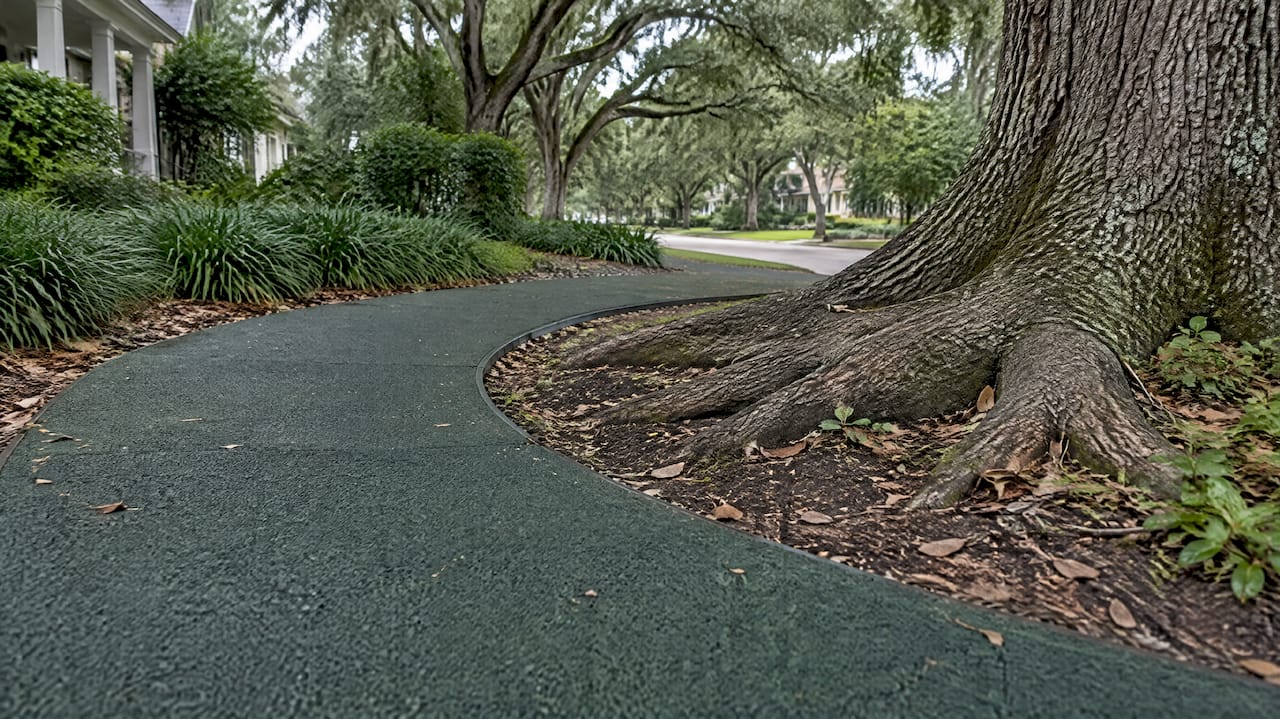
The best answer to roots lifting a walkway is a surface that moves and breathes instead of fighting the tree. That means a flexible, porous pavement laid over a properly prepared base, not a rigid slab that cracks the first time a root grows. Our Rubberway® system is built from recycled tire material, drains water through the surface, resists cracking in Florida heat and weather, and meets ADA-compliant surface requirements. Below you'll find how root damage happens, which paving types handle it, what they cost, and how to plan a path so the tree and the pavement both last.
TL;DR
- Roots lift rigid pavement because they find water, oxygen and space beneath it, then thicken every year. Flexible, porous surfaces give them less to push against and let water and air reach the soil.
- Flexible porous pavement made of rock, rubber and binder is already used in street tree pits to keep roots from ripping up the surface.
- Permeable pavement of any type is best for light traffic: pedestrians, bicycles, patios, pool decks, driveways with gentle turning. Plan for the load before choosing a product.
- Good results depend on the base: limit compaction, don't cut large roots, and don't put plastic sheeting under the surface.
- Accessible routes still have to be firm, stable and slip resistant, so confirm the surface and slopes against the standard your project follows.
Table of Contents
- Why tree roots damage pavement
- What "flexible paving" means
- How the main options compare
- What it costs
- How to plan a path around existing roots
- Where a flexible surface fits best
- Accessibility: firm, stable and slip resistant
- Keeping a porous surface working
- Our approach to roots and rubber
- Talk to us about your site
- FAQ
- Sources
Why tree roots damage pavement
Roots don't punch through concrete. They grow where conditions are good, and the soil just under a slab is often the best spot on the property: moist, loose and shielded from sun. According to Iowa State University Extension, roots use available moisture, oxygen and space, then increase in diameter as the tree grows, which is how they lift and crack sidewalks.
That explains two things many owners find out the hard way:
- Patching a rigid slab is temporary. The root keeps thickening, so the same panel lifts again.
- Cutting the root is not a free fix. Research summarized by Penn State Extension's answer service cites work from Bartlett Tree Research Laboratories showing that cutting large lateral roots within the root plate (the zone of roots that anchors the tree) can destabilize a tree (Penn State Extension answer). If root pruning is ever on the table, a qualified arborist should be on site, as Iowa State advises.
So the goal is a surface that tolerates small movement, lets water and oxygen pass to the roots, and doesn't need the tree to be damaged to survive.
What "flexible paving" means
Flexible paving is a surface that bends slightly with the ground instead of staying locked in a rigid panel. In the tree-root context it usually also means porous: water moves through the surface rather than running off it.
One well-documented version is a mix of rock, recycled rubber and a formulated binder, poured into the tree pit over compacted rock and left to cure for about 24 hours. A Seattle arborist who uses it describes it in a KING 5 report as letting roots grow without ripping up the sidewalk while the tree bed captures stormwater. A conference presentation from the paving industry describes the same family of products as 4 to 6 inches of gravel topped with 2 to 4 inches of rubber, well suited to small areas around roots and difficult tree spots.
Rubberway is in this family. It uses recycled tire materials in a porous design, and its product lines cover pervious pavement, a thicker Rubberrock 6000 surface, EVOLUTION and a dedicated sidewalk system. You can see them on our Rubberway products page. If you want the engineering reasoning behind choosing a flexible surface over concrete, our specifier's checklist for flexible sidewalk material goes deeper.
How the main options compare
Not every permeable surface answers a root problem equally. Some are rigid units with open joints. Others are bonded and flexible. This table sorts the common types by how they behave near roots.
| Surface type | Behavior near roots | Typical limits |
|---|---|---|
| Poured porous rubber and stone | Flexible, continuous surface; moves slightly instead of snapping | Designed for pedestrian, bike and light vehicle use |
| Pervious concrete | Rigid; water passes through but it can still crack when roots lift it | Needs periodic vacuuming; longevity of 20 to 30 years with maintenance per the Minnesota Stormwater Manual |
| Permeable interlocking pavers | Individual units can be reset, but joints and base can shift | Jointing stone may need replacing if clogging can't be cleaned |
| Plastic grids with gravel or grass | Suits uneven ground; low strength | Less intrinsic strength than concrete pavers and some mowing, watering or aggregate replenishing, per the Rhode Island DEM |
| Structural soil under a surface | Stone carries load while soil-filled gaps let roots in | Mostly used in street tree installations |
Structural soil is worth a sentence because it shows the same idea from below. The Trees and Structural Soils manual explains that angular stone carries the load while roots grow through the soil between the stones, and that excavated roots suggest deep rooting in structural soil helps prevent heaving of sidewalks, curbs and gutters.
What it costs
Prices vary by site, so use published ranges to set expectations, not to budget a final number. The University of Florida IFAS publication Permeable Pavement Systems: Technical Considerations lists these ranges per square foot, surface cost first and installed cost second:
- Porous asphalt: $2 to $6 surface, $6 to $13 installed
- Pervious concrete: $2 to $8 surface, $6 to $15 installed
- Permeable interlocking concrete pavers: $3 to $10 surface, $7 to $16 installed
- Concrete grid pavements: $3 to $9 surface, $5 to $14 installed
- Plastic reinforcing grids: $3 to $9 surface, $5 to $14 installed
Virginia Cooperative Extension shows how wide the spread can get, giving a permeable-pavement range of $4 to $50 per square foot and noting that material, project size, stormwater design, site preparation, labor and maintenance all move the total.
Two points matter for a root site. First, base preparation and root protection are a large share of the work, and they differ for every tree. Second, the comparison that counts isn't price per square foot against basic concrete. It's the cost of a surface you won't have to grind, patch or tear out. Our cost guide for eco-friendly sidewalks breaks down the factors in more detail. Rubberway projects don't have a published price, so we quote each one after seeing the site.

How to plan a path around existing roots
The surface is only half the answer. The way the area is prepared decides whether the tree stays healthy and the pavement stays flat.
1. Find out where the roots are before anyone digs
Arlington County's guide to tree and root protection lists practices such as protecting roots during construction, aerating roots under walkways, using air excavation before disturbing the soil, adjusting the design based on the roots exposed, and aftercare. Air excavation uses compressed air to remove soil from around roots without cutting them. For a large or valuable tree, bring in a certified arborist at this stage, not after the first root is cut.

2. Let the layout move, not the roots
If a trench hits a large root, stop and adjust. Penn State's guidance is to scoop soil by hand near trees, stop and relocate if you reach a root, and avoid shoveling through roots. A path can curve, narrow or sit slightly higher over a root zone. A flexible surface can follow gentle contours, so the design rarely has to cut the tree to hit a straight line.
3. Don't over-compact the base
Compaction squeezes out the air and water roots need. For permeable pavement, UF/IFAS recommends limiting subgrade compaction to 92 to 95 percent of modified Proctor density (a standard lab measure of soil density) and placing open-graded reservoir stone in lifts no thicker than 6 inches. Over-compacting can hurt both the tree and drainage.
4. Use breathable layers
Penn State advises porous landscape fabric under the rock layer, not plastic sheeting, because plastic blocks oxygen and water from reaching roots. Avoid any sealed membrane over the root zone.
5. Keep the surface open
Permeable surfaces work only while water can pass through them. The EPA's Stormwater to Street Trees guide says sealing or repaving with a non-permeable material clogs the surface and stops infiltration, and that proper design, construction and maintenance keep it working. Keep leaves, mulch and soil from washing across the path. Our guide to outdoor paving drainage for homeowners shows how to direct runoff so it doesn't carry sediment onto the surface.
Where a flexible surface fits best
Permeable pavement as a category is for light duty. UF/IFAS describes it as generally weaker than conventional pavement and best for light traffic such as pedestrian and bicycle paths, noting that frequent turning can cause shifting, cracking or spalling. That makes the right projects clear:
- Homeowners: walkways, patios, pool decks and driveways shaded by oaks, ficus, mangroves or other large trees.
- HOAs: community paths where a rigid sidewalk has become a trip-and-fall liability.
- Golf course owners: cart-adjacent walkways and paths under mature canopy where roots keep raising the surface.
- Municipalities: park trails, sidewalks and street tree pits.
- Businesses and contractors: entry walks and plaza areas where a heaved panel creates liability.
Florida adds heat, heavy summer rain and standing water to the root problem. A surface that drains and resists heat-related cracking suits that climate. Our guide to park path surface options compares these factors for public spaces.
Accessibility: firm, stable and slip resistant
A flexible path still has to work for wheelchairs, walkers and canes. For pedestrian routes in the public right of way, the Access Board's 2023 guidelines call for surfaces that are firm, stable and slip resistant, without large openings or abrupt level changes, and cite a cross slope of 1:48 (2.1 percent). The guidelines took effect on September 7, 2023, but they become enforceable only when the federal agencies responsible adopt them, so check which federal, state and local standard governs your project. The Access Board's ADA standards page notes that accessible routes can include walks and sidewalks, curb ramps and exterior ramps.
What this means in practice: the surface should be dense and bonded enough to be firm, and any root-related bump should be addressed in the design, not left to grow. Rubberway surfaces are ADA compliant, and we provide the documentation public agencies ask for. For testable specs, see our guide to ADA slip resistance requirements.
Keeping a porous surface working
Porous surfaces last when they are kept clear. The New Orleans Green Infrastructure Toolkit points to regular debris removal and inspection of paving, drainage areas and underdrains. For a home, this means sweeping or blowing off leaves and watching where runoff enters the path. For an HOA or city, it means a written schedule. Our porous pavement maintenance program gives a practical outline, and the porous sidewalk drainage design article covers drawdown for engineers.
The Rhode Island DEM adds a related warning for grids: don't route large volumes of runoff from nearby impervious areas onto them, and don't aerate with equipment that could damage the pavers. The principle applies to any permeable surface: manage what flows onto it.
Our approach to roots and rubber
We install one thing: rubber paving. Because we aren't selling you concrete, asphalt or pavers, the question we ask on a root site is simple: what surface will still be flat in ten years?
Florida makes that question harder. Heat, heavy rain and fast-growing trees put stress on rigid pavement from every direction. Rubberway was designed with those conditions in mind. It is porous, so water moves through it. It resists cracking, so heat and small movements don't break it into panels. It uses recycled tire material, so the project also keeps waste out of landfills.
We work as a licensed and insured contractor, and we supply government-ready documentation for municipal and HOA projects. That means the board member signing off has the paperwork, and the homeowner has a licensed crew on the job.
Our advice: pick the surface and the design together. A flexible surface, a base prepared with the tree in mind and a clear maintenance routine will do more than any patch.
Roger
Talk to us about your site
If roots are lifting a driveway, pool deck, community path or park trail in Florida, we can look at the site and recommend a Rubberway system. Our crew handles the installation as licensed and insured specialists in rubber paving. See the Rubberway product lines or start with our installation service.
For HOA boards and municipal decision-makers, our sustainable paving installation best practices guide and stormwater paving guide for engineers are useful for scoping a bid package.
FAQ
Will tree roots grow under pavement?
Yes. Roots grow under pavement wherever oxygen, water and space are available, then thicken as the tree grows and can lift or crack sidewalks. Root barriers and root-excluding bases reduce the risk. A 2008 Arboriculture & Urban Forestry study found minimal lifting with barrier, gravel and foam treatments, and that results depend on barrier depth and soil texture.
What are the downsides of permeable pavement?
Permeable surfaces need to be kept free of sediment and debris so they keep draining, and they suit light traffic best. They can cost more up front than conventional paving, though UF/IFAS notes savings may come from reducing stormwater infrastructure. Good design and a maintenance routine address these points.
Can I install pavers or a path right next to a tree?
Yes, with care. Work by hand near roots, move the layout if you hit a large one, avoid plastic sheeting and limit base compaction. For a mature or valuable tree, have a certified arborist advise before digging.
Does a flexible path still meet ADA requirements?
It can, if the surface is firm, stable and slip resistant and the slopes and level changes meet the standard that applies to your project. Rubberway surfaces are ADA compliant. Confirm the adopted federal, state and local requirements for your site.
Sources
- Permeable Pavement Systems: Technical Considerations (UF/IFAS)
- Sidewalk Repair Near Trees (Iowa State University Extension)
- Installing brick pavers near mature trees (Penn State Extension answer)
- Porous pavement saves Seattle trees (KING 5)
- Porous Flexible Pavement presentation (2023)
- Types of permeable pavement (Minnesota Stormwater Manual)
- Plastic Grid Pavers (Rhode Island DEM)
- Trees and Structural Soils manual
- Stormwater Management for Homeowners (Virginia Cooperative Extension)
- Understanding Tree and Root Protection (Arlington County)
- Stormwater to Street Trees (US EPA)
- Accessibility Guidelines for Pedestrian Facilities in the Public Right-of-Way (Federal Register)
- ADA Accessibility Standards (US Access Board)
- Green Infrastructure Toolkit (New Orleans)
- Comparison of Methods to Reduce Sidewalk Damage from Tree Roots (Arboriculture & Urban Forestry)