
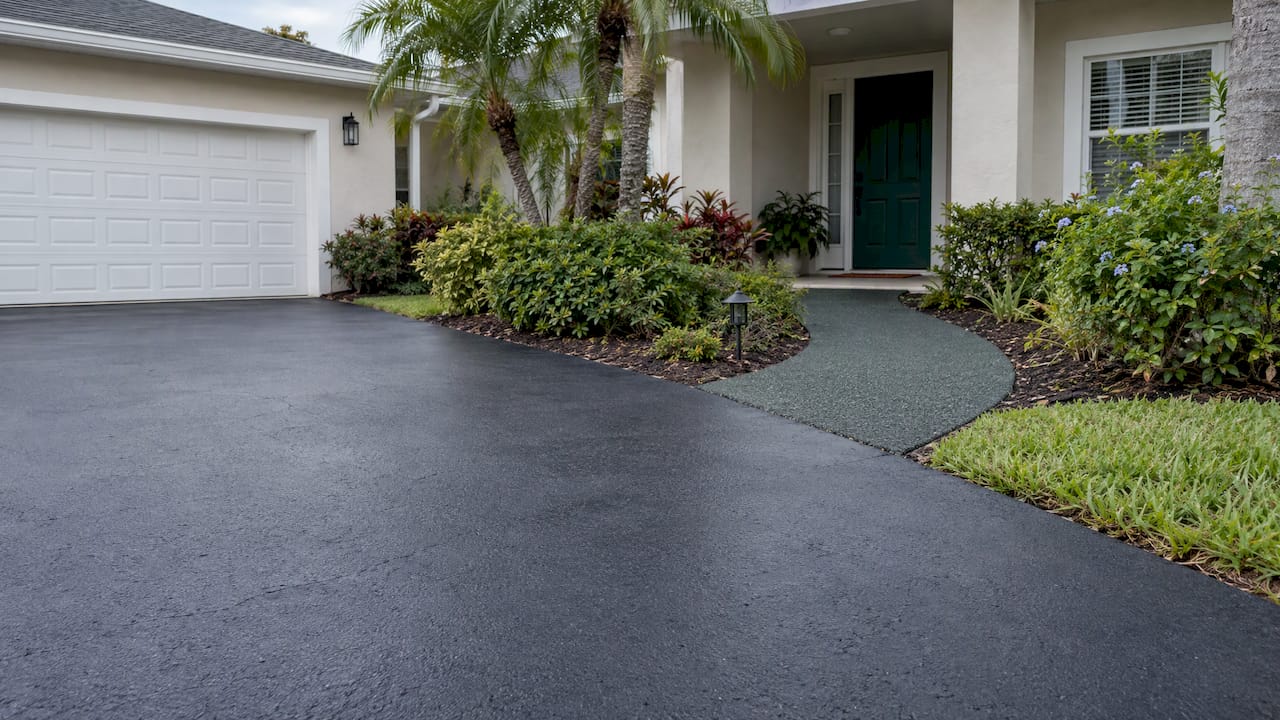
Rubber driveway sealing usually means a thin, rubberized liquid brushed or squeegeed over existing asphalt. It is a surface treatment, not a new driveway. If your driveway is cracked, ponding water or breaking at the edges, a coating will not fix it. A rubber paving surface will, because it replaces the failing layer instead of covering it. We install that surface across Florida with the Rubberway® system, which is made with recycled tire material.
This guide explains the difference in plain terms, shows how to tell which one your property needs, and walks through what a rubber paving project looks like for homeowners, HOAs, businesses and municipalities.
TL;DR
- "Rubber driveway sealing" means a rubberized coating or crack filler on existing pavement. Rubber paving is a full porous surface made from recycled rubber.
- Public transportation agencies treat seal coats as a surface or waterproofing layer, not as a new structural pavement layer.
- Cracking, potholes, soft spots and standing water point to a problem below the surface, and a coating does not repair a problem below the surface.
- Rubberway® surfaces are porous for drainage, resist heat and weather cracking, meet ADA requirements and come in a wide range of colors.
- We install rubber paving only, fully licensed and insured, for driveways, pool decks, walkways, trails and community areas in Florida.
Table of Contents
- What "rubber driveway sealing" actually means
- What a coating can and cannot do
- Signs your driveway needs more than a coating
- Why Florida makes thin coatings work harder
- Rubber paving: a surface, not a coating
- Resurfacing instead of recoating
- What a rubber paving project looks like
- Who this fits
- A note on the environmental side
- Our perspective
- Ready to replace the surface, not just cover it?
- FAQ
- Sources
What "rubber driveway sealing" actually means
The phrase covers several different things, and that is why search results for it look so mixed. Most of what you find is a rubberized sealcoat: a liquid applied over asphalt to renew its color and slow surface wear. Some of it is a crack filler. A small part of it is a new paving material in which rubber is the main ingredient.
The U.S. Environmental Protection Agency lists the ways ground tire rubber enters pavement. Ground tire rubber can modify asphalt binders, seal coats, cap-seal sprays and joint and crack sealants, or serve as aggregate in rubber-modified asphalt concrete. Same raw material, very different jobs.
The Texas Department of Transportation draws the line more sharply. It treats seal coats, hot-mix pavement and crack sealers as separate crumb-rubber applications, and describes a seal coat as a surface treatment or waterproofing layer rather than necessarily a new structural pavement layer.
That distinction is the whole story for a property owner:
| Rubberized sealcoat or crack filler | Rubber paving (Rubberway®) | |
|---|---|---|
| What it is | A thin liquid layer on existing pavement | A full paving surface made with recycled tire rubber |
| Role | Surface protection and waterproofing | The wearing surface itself |
| Drainage | Sits on top of the old surface | Porous design lets water pass through |
| Cracks underneath | Can reopen beneath the coating | Built for crack resistance in heat and weather |
| Color | Typically dark | Wide range of colors |
| Typical need | Recurring reapplication | A surface installed as a project |
What a coating can and cannot do
A rubberized sealcoat is maintenance for pavement that is still sound. It darkens faded asphalt, fills hairline surface texture and adds a thin barrier against water and sun. On a driveway with a stable base and only light wear, that is a reasonable use.
It cannot add strength. A coating is a skin. If the layers under it are moving, cracking or holding water, the skin follows whatever the pavement does, and the damage shows through again. That is true of any thin coating, rubberized or not.
That is why the first question is never "which sealer?" It is "what condition is the driveway in?"
Signs your driveway needs more than a coating
Walk the surface slowly after a heavy rain and look for these:
- Interlocking, web-like cracks. Often called alligator cracking, this pattern means the layer beneath has lost support.
- Potholes or crumbling edges. Material is already missing, and a coating bridges nothing.
- Dips and soft spots. If a depression holds a puddle hours after the storm, water is working on the base.
- Cracks that return. If you have filled the same crack more than once, the movement is coming from below.
- Roots or settling. Heaving along a tree line or slab joint will keep breaking any thin layer.
One or two of these is the signal to look at replacing the wearing surface, not recoating it. A twice-yearly walk-around, the same habit that keeps a deck maintenance schedule on track, helps you catch them early, before a small crack becomes a repair across the whole drive.
Why Florida makes thin coatings work harder
Florida pavement deals with two things at once: heavy summer rain and long, intense heat. Standing water and heat-induced cracking are the two outdoor problems we see named most often when owners ask about their driveways and pool decks, and both are the conditions a thin coating handles least well. Water that cannot drain finds the cracks. Heat then expands and stresses the surface around them.
This is the problem Rubberway® was built around. The surface is porous, so rain passes through it instead of sheeting across it, and the material is designed to flex with heat and weather rather than crack. Coastal properties add salt air and sandy soils, which we cover in our guide to rubber driveways for coastal homes.
If your concern is a driveway already damaged by sun, our article on heat damaged driveway repair goes through what happens to a surface under Florida heat and what a durable replacement looks like.

Rubber paving: a surface, not a coating
Rubberway® is a paving system. Instead of spreading a film over an old driveway, we install a new rubber surface made with recycled tire materials. The result is a porous, crack-resistant, ADA-compliant surface that reduces waste by putting recycled material to work.
We offer four Rubberway product lines, each suited to a different job:
- Rubberway® Pervious Pavement, for areas where drainage is the priority.
- Rubberway Rubberrock 6000, for projects that need a durable, high-use surface.
- Rubberway EVOLUTION, for installations where color and finish matter.
- Rubberway Sidewalk System, for sidewalks and public walkways.
You can see all four on our Rubberway rubber paving products page.
Three features answer the usual reasons people search for a sealer in the first place:
Drainage. A sealcoat sits on a surface that sheds water toward low spots. A porous Rubberway® surface lets water move through, which is how it addresses standing water.
Crack resistance. The common reason owners recoat is that cracks keep coming back. Rubberway® is designed to resist cracking from heat and weather, so you are not signing up for repeated cycles of patching and recoating.
Color. A sealcoat gives you black. Rubberway® comes in a wide range of colors, which matters for pool decks, entries and community areas as much as for curb appeal. For the technical side of colored resurfacing, our piece on colored driveway resurfacing specs for HOAs and municipal buyers is written for boards and public buyers.
Resurfacing instead of recoating
Many owners asking about rubber driveway sealing have a tired concrete or asphalt driveway and want it to look and perform like new without a full tear-out. That is a resurfacing decision. Our guide to a 1.5 to 2 inch rubber overlay on a concrete driveway in Florida explains how a rubber surface can go over an existing slab, and what condition the slab needs to be in.
The point is that the question changes. Instead of "how often must I reseal?", it becomes "what surface do I want to own for the long run?"
What a rubber paving project looks like
A paving project is coordinated work, and the preparation decides how it turns out. We are fully licensed and insured, and rubber paving is the only thing we do, so every step is handled by a team focused on that one material. Here is the sequence you can expect to discuss with us.
1. Assess the existing surface
We look at what is there: asphalt or concrete, how it is cracking, where water collects and how the area is used. This is where we decide whether a surface can be overlaid or needs more work first. Owners often skip this step when they buy a coating, and it is the step that explains most disappointments afterward.
2. Prepare the base
A new surface is only as good as what it sits on. Preparation is the part of a paving job people underestimate, and we treat it as central to the result. Our article on the role of surface prep in rubber paving success explains why.
3. Choose the product and color
We match the Rubberway® line to the use: a family driveway, a pool deck, a municipal trail or a community walkway. This is also where you pick from the color range.
4. Install and let it cure
We install the surface as one coordinated project. Rubber paving, like any paving material, needs time before it takes full use, and the timeline depends on conditions. Our guides to cure time in rubber paving and fast-curing rubber paving timelines, conditions and prep explain what affects it.
5. Documentation for public and community projects
For municipalities and HOAs, we provide government-ready documentation, so board members have the paperwork they need to approve and record a project.
Who this fits
Homeowners. Driveways, pool decks and patios, where drainage, heat and color all matter. If oil is a worry, our guide to an oil stain resistant driveway covers surfaces and upkeep.
HOAs and community boards. Shared walkways, entries and amenity areas where one surface choice affects many residents and a single decision has to hold up to a board vote.
Municipalities. Parks, trails and sidewalks that must be ADA-compliant. The Rubberway Sidewalk System and Rubberway® Pervious Pavement are built for these uses.
Businesses and golf courses. Commercial walkways and cart paths where durability and drainage keep areas open and safe.
Contractors. If you are specifying eco-friendly materials on a project, Rubberway® is made with recycled tire material and installed by our team.
A note on the environmental side
When a surface is made with recycled tire rubber, scrap material goes into a useful, long-lived product instead of waste. The EPA's own list of ground rubber applications shows how widely recycled tire rubber is used in paving. For a public project or an HOA with sustainability goals, that gives the choice a story that goes beyond looks.
Our perspective
Almost every call that starts with "rubber driveway sealing" is really a question about a driveway that keeps failing. The owner has patched it, recoated it, and watched water sit on it after every storm.
We only install rubber paving, and we built our work around Florida's two big problems: water and heat. A surface that drains through itself and is designed to resist cracking solves those problems directly, instead of covering them every couple of years.
Our advice is simple. Look at the condition of what you have. If the surface is failing, put your budget into a surface that is meant to last, with the right preparation underneath it, in a color you chose on purpose. That is what Rubberway® is for.
Roger
Ready to replace the surface, not just cover it?
If your driveway, pool deck or community walkway keeps cracking or holding water, we can look at it and recommend the right Rubberway® product. We are fully licensed and insured, we install only rubber paving, and for public and HOA projects we provide government-ready documentation. Start with our professional rubber paving installation page, or see the Rubberway product lines.
FAQ
Is rubber driveway sealer the same as rubber paving?
No. A rubberized sealer is a thin coating over existing pavement, and the Texas Department of Transportation describes seal coats as surface treatments or waterproofing layers. Rubber paving is a complete surface made with recycled tire material, which is what Rubberway® provides.
How do I know if my driveway needs replacing instead of resealing?
Look for web-like cracking, potholes, crumbling edges, dips that hold water and cracks that return after repair. Those point to a problem beneath the surface. We can assess the driveway and tell you whether an overlay or full resurfacing makes sense.
Does rubber paving handle Florida rain and heat?
Rubberway® is porous, so water drains through the surface instead of pooling, and it is designed to resist cracking from heat and weather. That is the reason we focus on Florida properties.
Can rubber paving be installed in colors other than black?
Yes. Rubberway® comes in a wide range of colors, so you can match a home, a pool deck or a community's look. We help you choose when we scope the project.
Is rubber paving ADA-compliant?
Rubberway® surfaces are designed to be ADA-compliant, which is why municipalities, HOAs and businesses use them for walkways, trails and sidewalks. We provide government-ready documentation for public projects.
Sources
- Ground Rubber Applications, Scrap Tires, US EPA
- Pavement Applications with Crumb Rubber, Texas Department of Transportation
- Deck Maintenance Schedule for Ottawa Homeowners