
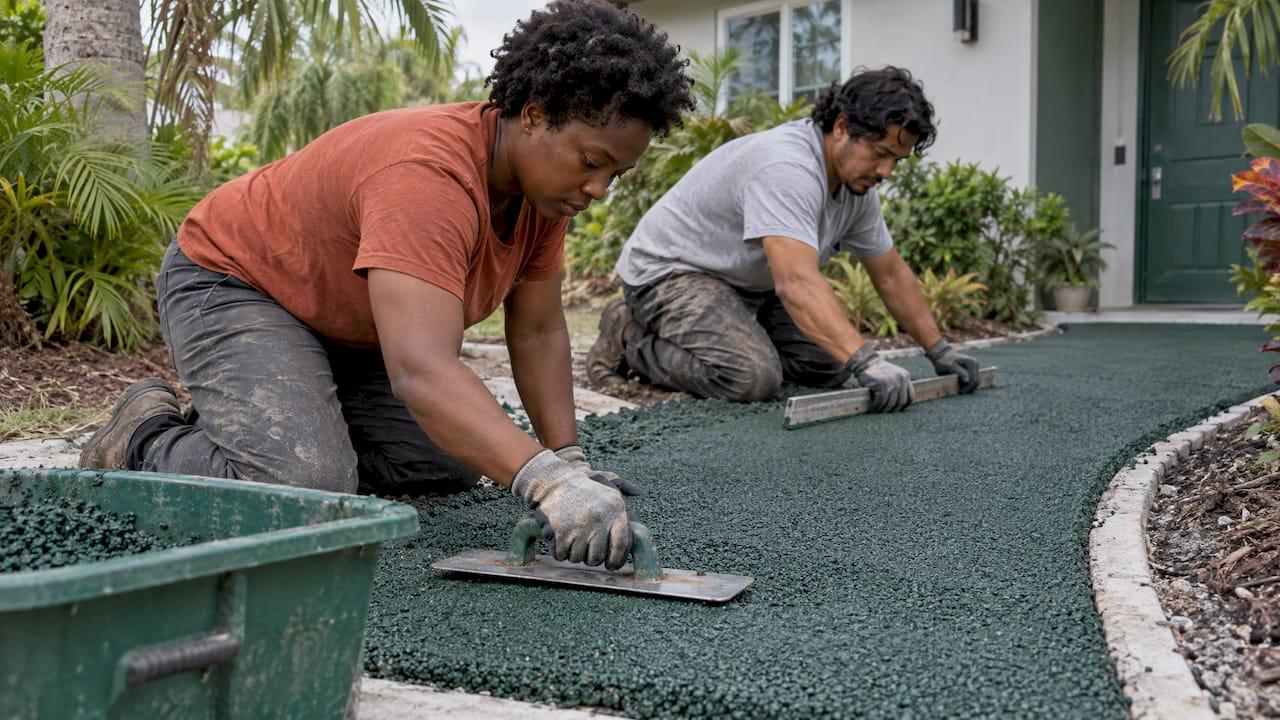
Rubber paving installation comes down to four things: the ground under the surface, how water leaves the site, the slopes the surface follows, and the cure before anyone uses it. Get those right and a rubber surface stays flat, drains and resists cracking. Get them wrong and no surface material can save the job. We install the Rubberway® system in Florida, and this guide walks homeowners, HOA boards, municipal staff, golf course owners and contractors through the process so you know what a well-run project looks like.
TL;DR
- Rubber paving is only as good as its sub-base: compaction, slope and drainage are set before any rubber goes down.
- Accessible paths have hard numbers: running slope no steeper than 1:20 (5%) and cross slope no steeper than 1:48 (about 2.1%).
- Weather, humidity and shade change timing and cure, so a Florida schedule is planned around them.
- Government and HOA projects need paperwork as well as a surface. We provide government-ready documentation, and we are licensed and insured.
- Rubberway® is a porous, recycled-tire system installed for driveways, pool decks, patios, walkways, trails and parks.
Table of Contents
- What rubber paving is, and where it fits
- The installation process, step by step
- Installing over existing concrete or asphalt
- Getting the slopes right on accessible routes
- Installing next to grass and other permeable areas
- Weather, humidity and shade in Florida
- Are rubber pavers and poured rubber right for high-traffic areas?
- What to ask for in a rubber paving quote
- Why hire a rubber paving specialist
- Our perspective
- FAQ
- Sources
What rubber paving is, and where it fits
Rubber paving is a surface made from recycled tire material bound into a continuous or modular layer. Rubberway® is our system: it uses recycled tire material, a porous design that lets water pass through, and a finish built to resist cracking under heat and weather. It comes in a wide range of colors.
The typical Florida uses are residential driveways, pool decks and patios, commercial walkways, municipal parks, trails, sidewalks and HOA common areas. Our product lines each suit a different job: Rubberway® Pervious Pavement, Rubberrock 6000, EVOLUTION and the Sidewalk System. Which one is right depends on traffic, drainage needs and whether the surface sits on an accessible route.
For a plain-language overview of the material itself, see our guide to rubberised paving for owners and contractors.
The installation process, step by step
Every professional rubber paving job follows the same order. What changes is how carefully each stage is done.

1. Site assessment and design
Before anyone digs, the site is walked and measured. The questions are simple: where does water come from and where can it go, how much traffic will the surface carry (a family car, delivery trucks, golf carts, strollers and wheelchairs), and what sits underneath today (soil, sand, old concrete, old asphalt).
This stage is where jobs are won or lost. A surface laid over a low spot will hold the same low spot. For public and HOA projects, this is also where the drawings, slopes and specifications are put on paper so the board or the city can review them. We provide government-ready documentation for exactly that purpose.
2. Preparing the ground
Preparation means removing grass, topsoil and organic material, and then building a firm, free-draining base. Organic material rots and settles, so it cannot stay under a surface you expect to last. Sand alone is not a base either; it needs a compacted stone layer above it to carry loads.

Numbers vary by product and load, which is why the specification for your site matters more than a rule of thumb. Our article on why surface prep decides rubber paving success goes deeper on what is checked and why.
The base must also be shaped to shed water. Even a porous surface needs a sub-base that slopes, because water that passes through the rubber still has to go somewhere. Without that slope, a porous surface can hold water instead of draining it.
3. Drainage design
Porous paving is a drainage tool as well as a surface. Water moves down through the rubber layer and the stone beneath it, then away from the site by slope or by a drainage outlet. That is what prevents the standing water Florida homeowners and managers complain about after summer storms.
For engineers who need detailed performance figures, our specification article on porous rubber paving drawdown times covers them. For HOA boards the practical point is simpler: a surface that drains through itself reduces puddles on pool decks, walkways and driveways.
4. Placing the rubber surface
Once the base is accepted, the rubber layer is placed and finished to the designed thickness and slope. Colors, patterns and edges are set at this stage. This is a crew job: the material has a working time, and the finish depends on keeping the layer even while it is placed. This is why rubber paving is an installed service and not a weekend project for most properties.
5. Curing and opening to traffic
The surface needs time to cure before it takes foot or vehicle traffic. Cure time depends on temperature, humidity, product and thickness. We explain the factors in cure time in rubber paving and the faster options in fast-curing rubber paving. Plan the schedule so pool decks, driveways and entrances are not needed until the crew says they are ready.
Installing over existing concrete or asphalt
Many Florida properties already have a slab or asphalt that has cracked or stained. Rubber paving can often go over a sound existing surface, which saves demolition and haul-away, but the old surface becomes the base and so it must be sound.
What gets checked:
- Condition. Heaving slabs, deep cracks and loose areas move, and whatever sits on top moves with them.
- Slope. The new surface follows the old one. If the old slab holds water, the rubber surface above it will too unless the slope is corrected.
- Cleanliness. Oil, algae, mold and dust interfere with a good bond. Florida humidity makes this a real concern.
- Moisture. Slabs can hold moisture. Timing and weather matter, as covered below.
A site visit settles whether an existing surface can stay or has to come out. That judgment is much better made by a crew that installs rubber paving all day than by a general guess.
Getting the slopes right on accessible routes
If a path is part of an accessible route, the surface has to meet numbers, not impressions. The U.S. Access Board's ADA standards for accessible routes set the running slope of walking surfaces at no steeper than 1:20 (5%) and the cross slope at no steeper than 1:48, which is about 2.1%. Running slope is the grade along the direction of travel. Cross slope is the tilt from side to side.
Those limits leave little margin. A cross slope that drains water well to one side can quickly pass 2.1% if the base is not checked. That is why the sub-base is surveyed before the surface goes on. A written construction survey plan lists what is measured and when, so grades are checked against the design and not guessed. Playground installers use the same discipline: the IPEMA installation guide says subgrade slope accuracy is critical because a poured surface follows the sub-base slope, and it calls for compaction documentation and recorded grades during the pour.
Public sidewalks and trails
For routes in the public right-of-way, the Access Board's PROWAG guidelines apply. They require pedestrian access routes at least 48 inches wide, with grades no steeper than 5% and cross slopes no steeper than 2.1% outside crosswalks, on surfaces that are stable, firm and slip resistant. Changes in level are limited to 1/4 inch vertical, with 1/4 to 1/2 inch allowed when beveled.
PROWAG was published in August 2023. For federally funded projects it becomes a requirement once the Federal Highway Administration adopts it, as a 2023 industry training presentation explains. Municipal staff should confirm with their own agency which standard governs a given project.
Transitions
The edge where rubber meets a curb, door threshold, existing concrete or a pool coping is where accessibility fails most often. The IPEMA guide directs installers to ensure transitions to adjacent surfaces have no openings greater than 1/2 inch. Plan every transition on the drawings before the crew arrives, not on the day.
If the route leads to a play area, our guide to playground access path material covers what works and what fails.
Installing next to grass and other permeable areas
Rubber paving next to a lawn or planting bed has two jobs: hold a clean edge and keep soil and roots out. Grass and soil are removed under the paved area, and the base is built to drain away from buildings. Where the rubber meets turf, the edge should sit flush so mowers, feet and wheels cross without catching.
Because Rubberway® is porous, it can also help move runoff down into the ground beside it instead of sheeting it onto a road or neighbor's yard. Where the landscape is the reason you are paving (a worn path through grass, a trail around a pond or fairway), a continuous porous surface handles the same wet conditions that wear out a turf path.
Weather, humidity and shade in Florida
Florida conditions shape the schedule more than any other single factor. Afternoon storms, high humidity and strong sun all affect when a surface can be placed and when it is ready to use. Our guides cover them one by one:
- How weather affects rubber paving installation
- Rubber paving in humid climates
- Rubber paving in shaded areas
The practical advice for owners: do not book a pool deck or driveway job for a week when you need it daily, and expect a crew to move the start date when the forecast turns. A delay for rain protects the result.
Are rubber pavers and poured rubber right for high-traffic areas?
Rubber surfaces are used on residential drives, commercial walkways, parks and trails. The question is less "is rubber strong enough" than "is this layout and base designed for this load." A driveway that takes parked cars and turning wheels needs a stronger base and a product matched to that load than a garden path does. Tell us what will use the surface (cars, delivery vans, golf carts, maintenance trucks, strollers, wheelchairs) and the product line and base are chosen to match.
Rubberway® is made to resist cracking from Florida's heat and weather. That matters on pool decks and patios, where concrete slabs often crack and heave, and on community walkways where tree roots push up the surface.
What to ask for in a rubber paving quote
Whether you are a homeowner or an HOA board comparing proposals, these items belong in writing:
- Scope and area, including every transition, edge and drain.
- Product line and the reason it suits your traffic.
- Base preparation: what is removed, what is placed and how it is compacted.
- Drainage plan: where the water goes.
- Slope targets for any accessible route.
- Color selection and finish.
- Cure time and when the surface reopens.
- License and insurance: we are fully licensed and insured.
- Documentation for boards, cities and funders. We provide government-ready documentation.
For a wider view of sustainable installation practice, see our 2026 guide to sustainable paving installation.
Why hire a rubber paving specialist
Rubber paving installation is not a side service for us. Rubber paving is all we do. That means the crew that prepares your base, sets your slopes and finishes your surface does this work every week, in the same climate your property sits in. The project is coordinated from assessment through cure, so you deal with one team and not a chain of trades.
Our offer is a professional installation of the Rubberway® system: request a rubber paving installation from EcoTec, and we will assess your site, recommend the product line from our Rubberway® range and plan the schedule around Florida weather.
For HOA boards and municipalities, the same visit produces the documentation your board or procurement office needs to review the project.
Our perspective
Most paving problems we are called to look at were decided before the surface went on. A low spot in the base becomes a puddle. A missed slope becomes a failed accessible route. A rushed cure becomes a mark on the first day of use.
That is why we treat rubber paving as a system and not a product. Rubberway® gives you recycled material, a porous surface that drains, and resistance to cracking in Florida heat. The installation is what turns those properties into a surface that works on your property.
If you manage a community, a park or a course, you also answer to residents, boards and regulators. We are licensed and insured, we provide government-ready documentation, and we focus only on rubber paving. Give us the site, the traffic and the schedule, and we will tell you what the surface should be.
Roger
FAQ
What is the best base for rubber paving?
A compacted, free-draining stone base over a firm subgrade is the standard approach, with grass, topsoil and organic material removed first. Sand alone is not enough. The base is also sloped so water leaves the site. We set the exact build-up per site and load.
Can rubber paving go over existing concrete?
Often yes, if the concrete is sound, clean and sloped correctly, since the old slab becomes the base. Heaving, deep cracks and ponding areas are looked at first. A site visit confirms whether to overlay or remove.
Is rubber paving ADA-compliant?
Rubberway® surfaces are ADA-compliant when the route is built to the required numbers: a running slope no steeper than 1:20 and a cross slope no steeper than 1:48, with flush transitions. Those slopes are set in the base, so they are planned and checked before installation.
How long before I can use a new rubber surface?
It depends on the product, thickness, temperature and humidity. In Florida, rain and humidity can lengthen the wait. We give you a reopening time for your specific job when we schedule it.
Sources
- U.S. Access Board, ADA Standards Chapter 4: Accessible Routes
- 36 CFR Part 1190, Accessibility Guidelines for Pedestrian Facilities in the Public Right-of-Way (2025 CFR)
- IPEMA Installation and Maintenance Guide for ADA Compliance
- CP Tech Center, 2023 PROWAG Final Rule presentation
- Mätplan för anläggningsprojekt