
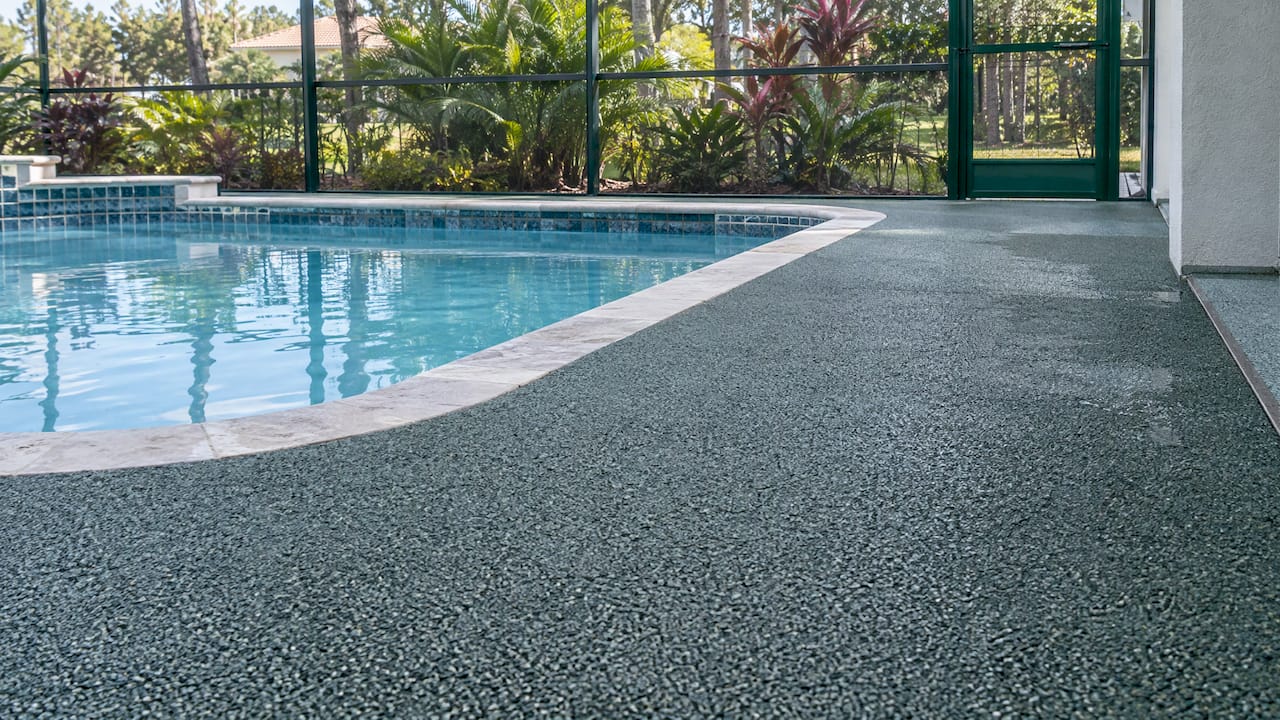
Textured rubber paving is a poured or troweled surface made from recycled tire rubber and a binder, finished with a grain that grips shoes and tires, drains water and keeps its color. The finish, the color blend and the edge detail are decisions you make before installation, and they are far harder to change afterward. At EcoTec Rubber Paving we install the Rubberway® system across Florida, and this guide covers what to specify for a driveway, pool deck, HOA walkway, municipal path or golf course trail.
TL;DR
- Texture comes from the rubber granules and the way the surface is finished. It gives traction on wet ground and, with the porous Rubberway® design, lets water pass through instead of pooling.
- Color is chosen from a wide range, and custom colors are available. Pick lighter or darker tones with sun exposure in mind and always judge a sample outdoors.
- Borders and patterns define edges, separate uses and guide the eye. Plan them with the layout, before the base is built.
- For accessible routes, the federal ADA standards call for stable, firm, slip-resistant surfaces and set slope limits of 1:20 running and 1:48 cross.
- Base preparation and binder quality decide how long the surface looks and performs the way it did on day one.
Table of Contents
- What textured rubber paving is
- How texture affects traction and drainage
- Choosing the right finish for the space
- Color matching: how to choose and what to expect outdoors
- Borders and patterned rubber paving
- ADA considerations for paths and sidewalks
- What decides how long it lasts
- Comparing cost and lifespan with other materials
- How to specify a textured rubber project
- Our perspective
- Get a quote for your project
- FAQ
- Sources
What textured rubber paving is
Rubber paving is built from granules, most often recycled from scrap tires, bonded together with a polyurethane binder. Spread and finished by hand, the mix sets into a flexible, continuous surface. The texture is part of the material itself: the granules sit at the surface and form a fine, even grain, rather than a coating applied on top.
That grain is why people choose it for places where feet are wet or hurried: pool decks, entry walks, ramps, playground approaches and park paths. It is also why it appears on residential driveways, where tires and shoes both need grip.
The material has a long record in landscaping. A U.S. EPA archive report on recycled rubber in landscaping lists trail and path paving, playground surfacing and running tracks among the uses for ground scrap-tire rubber. It also notes that ground rubber consumed about 33 million scrap tires a year at the time of the report, and that growth in landscaping uses had large potential to absorb tire stockpiles. For an HOA board or a city council, that recycled content is a practical point in a project approval.
Our Rubberway® product lines include Pervious Pavement, Rubberrock 6000, EVOLUTION and the Sidewalk System. Each is installed as a rubber surface made with recycled tire materials, and each is built for Florida heat and rain.
How texture affects traction and drainage
Texture does two jobs. The first is grip. A granular surface gives shoes and tires many small contact points, which helps in rain and around pools. The second is drainage. When the system is porous, as our Rubberway® Pervious Pavement is, water moves down through the surface into the base instead of sheeting across it. That matters in Florida, where afternoon storms are routine and standing water is the first complaint on most hard surfaces.
Because the surface stays open, puddles are less likely to form at low spots, and runoff leaves the site more slowly. For engineers and municipal staff who need to manage stormwater on a project, we explain the design side in stormwater management paving solutions for engineers. For the wider climate picture, see rubber paving in humid climates.
The rubber also flexes slightly. Rigid slabs crack when the ground moves or the heat swings, while a flexible surface is made to move with it. Crack resistance is one of the reasons Florida owners ask about rubber in the first place.
Choosing the right finish for the space
Not every area needs the same grain. A practical way to decide is to ask who walks there and in what condition.
| Space | Who uses it | What to prioritize |
|---|---|---|
| Pool deck | Barefoot swimmers, children | Grip when wet, drainage, a color that suits sun exposure |
| Residential driveway | Cars, bikes, foot traffic | Base depth, edge detail, color that hides tire marks |
| HOA walkway or common area | Residents of all ages | ADA slopes, continuous surface, low upkeep |
| Municipal path or sidewalk | General public, mobility devices | Documentation, slopes, firm and stable surface |
| Golf course trail | Golfers, carts, maintenance crews | Load-bearing base, drainage, color that blends with turf |
| Patio or garden path | Family, guests | Pattern, border, color matched to the house |
If you are comparing several of these in one property, we can quote them as one project. The point is to settle the finish per area, rather than accept a single look everywhere.
Color matching: how to choose and what to expect outdoors
Color is the decision homeowners and HOA boards spend the most time on, and the one they most often judge in the wrong light. Our Rubberway® installations are available in a wide range of colors, and we offer custom colors for projects with a specific palette.
A few rules make the choice easier:
- Start from fixed elements. Roof, siding, stucco, pavers, pool coping and masonry do not change. Match or complement those, rather than the plants, which do.
- Look at a sample outdoors. Indoor light, a screen or a printed chart will all mislead you. Set a sample on the actual spot and check it in morning sun, midday sun and shade.
- Think about sun exposure. Surfaces in full Florida sun look different from shaded ones, and lighter and darker tones behave differently in heat. We cover that trade-off in detail in light colored rubber paving: colors, heat, fading and fit.
- Plan for blends. Many rubber surfaces are made from more than one granule color. A blend can hide dirt and wear better than a single flat tone and looks more natural next to stone and landscaping.
- Match across phases. If an HOA will extend a path in two or three stages, confirm the color specification in writing so later sections match the first.
Colorfastness in Florida sun
All outdoor colored surfaces are exposed to ultraviolet light, and sunlight is the main driver of color change in colored rubber surfacing, with brighter colors typically more sensitive than earth tones. That is a reason to choose color with the site in mind, not a reason to avoid color. Earth tones, browns, tans, grays and deep greens are common choices for driveways and trails because they suit Florida landscapes, and brighter tones work well in accents and play areas.
The binder is a large part of the answer. Binder chemistry affects how the surface holds together and how it behaves in sun and moisture. We explain it in polyurethane binder in paving and, in more technical terms, in the role of binder in rubber paving systems.
If you manage a property for a board, put the color name, the blend and the area in the contract, so everyone agrees on what "matched" means.
Borders and patterned rubber paving
A border is the cheapest way to make a poured surface look designed. It separates a driveway from the lawn, frames a pool deck, marks a bike lane in a park, or signals the edge of a path for people with low vision.
Contrasting borders. A darker or lighter band along the edge defines the shape of the surface and hides irregular edges against soil or turf. On accessible routes, a clear edge helps users see where the path ends.

Inlays and stripes. Bands of color can run through the path to mark crossings, direct traffic, or tie the paving to a community's colors. Run them at right angles to the direction of travel at crossings, and keep them smooth and level with the surrounding surface.
Pattern within the surface. Two or three granule colors can be laid in zones, or in simple geometric shapes. Keep patterns bold and simple. Fine detail is hard to keep crisp in a poured surface and will not read from a few feet away.
Hardscape edges. Concrete curbs, pavers, steel edging or landscape timbers all work as the physical edge. The choice affects drainage and how cleanly the rubber ends, so decide it with the layout and not as an afterthought.
Patterns and borders are laid out before the base is built, because the base grade and edge restraints are set to match. Tell us early if you want them, and we will plan the project around them.
ADA considerations for paths and sidewalks
Municipalities and HOA boards often ask whether a textured surface can serve as an accessible route. Texture helps, but the standards ask for more than grip.
The U.S. Access Board's guide to the ADA standards states that accessible ground surfaces must be stable, firm and slip resistant, and it notes that most loose materials, gravel included, do not meet this without treatment. A continuous bonded rubber surface is a different kind of material from loose fill.
Slope matters as much as the surface. The Access Board's chapter 4 comparison summarizes the walking-surface limits: a running slope no steeper than 1:20 and a cross slope no steeper than 1:48. A textured finish cannot fix a path that is too steep, so slope is set in the grading and the base.
A practical checklist for accessible routes:
- Confirm the running slope and cross slope on the grading plan before the base goes in.
- Make sure the surface is continuous, with no lips or gaps at joints and transitions.
- Keep texture fine enough for wheels and canes. A grain that grips shoes should still roll smoothly.
- Keep drainage moving so water does not pool on the route.
- Keep project documentation together for the owner or the reviewing authority.
Our Rubberway® surfaces are ADA-compliant, and we provide government-ready documentation for public projects. Slopes and any approval a project needs are still verified against the plans and the authority having jurisdiction, and we coordinate the paving work around them.
What decides how long it lasts
The surface you see is the smaller part of the system. Three things decide how a textured surface ages.

The base. Rubber follows the shape beneath it. A soft, uneven or poorly compacted base shows through as dips and cracks. Whether we are working over dirt, stone or existing concrete, the base has to be sound, clean and dry before a granule goes down. Our guide to the role of surface prep in rubber paving success explains what that involves.
The binder and the mix. A contractor's mix ratio and binder quality determine how well the granules stay bonded. One contractor guide on poured rubber surfacing identifies poor base preparation or a bad binder mix as what shortens the life of a poured surface, which is why we treat both as non-negotiable.
Weather during installation. Moisture and temperature affect cure time. If a project has a tight schedule, see fast-curing rubber paving: timelines, conditions, prep.
For realistic expectations on service life and upkeep, we publish a plain guide: rubber paving lifespan and maintenance for homeowners. Routine care is light: regular sweeping or rinsing, and keeping petroleum-based solvents off the surface. Community managers will find a longer discussion in reducing community maintenance with rubber paving.
Comparing cost and lifespan with other materials
Most boards and homeowners compare rubber with concrete, asphalt and pavers before committing. Published per-square-foot ranges vary a lot by region, thickness, site access and finish, so a written quote for your property is the only number that counts. For a neutral overview of how material costs, lifespan and upkeep compare, see this breakdown of pavers versus concrete costs.
What the comparison often leaves out is lifecycle cost: what you spend over the years on sealing, crack repair, drainage fixes and replacement, not only the day-one price. Rubber needs no sealcoating, and its flexibility and permeability address the cracking and standing water that drive repair bills in Florida. Our lifecycle cost guide for paving surfaces shows how to run that calculation for a property.
How to specify a textured rubber project
When you ask for a quote, give us the information that determines the result:
- Location and use. Driveway, pool deck, path, trail or park. Include expected loads: cars, golf carts, maintenance vehicles.
- Area and existing surface. Dirt, compacted stone, concrete or asphalt. Photos help.
- Color and blend. Name the fixed elements it must match, and say if you need a custom color.
- Borders and patterns. Describe the edge condition and any stripes, inlays or contrast bands.
- Accessibility and drainage requirements. Note any ADA requirement, grading plan or stormwater requirement.
- Approvals. HOA architectural review, municipal procurement or permit needs, and the documentation your board requires.
With those six items, a quote can be specific about materials, finish and scope, and nothing gets decided on site by default.
Our perspective
Most surfaces people ask us about fail for the same reasons: water sits on them, the ground moves under them, or the finish was chosen from a catalog photo. Textured rubber answers all three when it is designed properly.
We only install rubber paving. That focus means we think about grain, color and edges as parts of one system, and we plan them with the base and the drainage rather than after them. A pool deck, an HOA path and a golf trail want different things, and the Rubberway® lines exist so the surface can be matched to the job.
The recycled tire content matters to us as well. Every project keeps scrap rubber in productive use, and it gives boards and municipalities something concrete to point to when they approve the work.
Roger
Get a quote for your project
If you are planning a driveway, pool deck, community path, municipal sidewalk or golf trail in Florida, EcoTec Rubber Paving is a licensed and insured contractor focused solely on rubber paving. We install the Rubberway® system with recycled tire materials, porous drainage, crack resistance, ADA-compliant surfaces, custom colors and government-ready documentation.
Tell us the space, the color and the edge detail you have in mind, and we will plan the surface around it. Start at our professional rubber paving installation page, or see the full Rubberway® product range.
FAQ
Is textured rubber paving slippery when wet?
The granular surface gives shoes and tires many contact points, and a porous system lets water drain through instead of sitting on top. That is why rubber is a common choice for pool decks and walkways. For public accessible routes, the ADA standards require firm, stable and slip-resistant surfaces, and we plan Rubberway® projects with that in mind.
Can you match rubber paving to my house color?
Yes. Rubberway® installations come in a wide range of colors, and we offer custom colors. Judge samples outdoors, on the actual site, in both sun and shade, and confirm the final color and blend in writing before work begins.
Will the color fade in Florida sun?
Sunlight is the main cause of color change in outdoor colored rubber surfaces, and brighter colors are generally more sensitive than earth tones. Choosing the right color and a quality binder helps the surface keep its look. Our guide to light-colored rubber paving covers the trade-offs for sunny sites.
Can rubber paving have borders and patterns?
Yes. Contrasting borders, stripes and zoned color blends are all common. They are planned with the layout and base, so share your ideas when you request a quote.
Is rubber paving suitable for an ADA-accessible path?
Our Rubberway® surfaces are ADA-compliant, and we supply documentation for public projects. The slope limits (1:20 running, 1:48 cross) are set in the grading, so they should be confirmed on the plans before installation.
Sources
- Recycled Rubber Products in Landscaping Applications, U.S. EPA archive
- Guide to the ADA Accessibility Standards, Chapter 3: Floor and Ground Surfaces, U.S. Access Board
- ADA and IBC comparison, Chapter 4, U.S. Access Board
- How Long Does Poured Rubber Surfacing Last? Lifespan and Durability
- Pavers vs Concrete for Homeowners